

Naukri Jobs Search Scraper
Pricing
from $0.80 / 1,000 results
Naukri Jobs Search Scraper
Efficiently scrape job listings from Naukri.com, India's #1 job site with 75+ million registered users. Extract comprehensive data including job titles, salaries, company details, skills requirements, and application deadlines. Perfect for recruitment agencies, job aggregators, salary benchmarking.
Pricing
from $0.80 / 1,000 results
Rating
0.0
(0)
Developer

Stealth mode
Maintained by CommunityActor stats
1
Bookmarked
855
Total users
6
Monthly active users
3 days ago
Last modified
Categories
Features
Share
Naukri.com Jobs Search Scraper: Extract India's Largest Job Portal Data
Understanding Naukri.com and Its Market Dominance
Naukri.com dominates India's online recruitment landscape as the country's largest job portal, operated by Info Edge. With over 75 million registered job seekers and 100,000+ active employers, it serves as the primary hiring platform for Indian IT, finance, healthcare, and manufacturing sectors.
The platform specializes in Indian market nuances: salary ranges in INR/LPA (Lakhs Per Annum), work-from-home filtering, company ratings via Ambition Box integration, and skill-based matching for India's tech-heavy job market. For recruitment agencies targeting Indian talent, market researchers analyzing IT hiring trends, or job aggregators building comprehensive databases, Naukri data provides unmatched insights into Asia's third-largest economy.
This scraper automates extraction from search result pages, transforming filtered job listings into structured datasets ready for analysis, integration, or competitive intelligence.
What This Scraper Extracts and Who Should Use It
The Naukri.com Jobs Search Scraper processes search result pages, capturing multiple job listings efficiently. Unlike detail page scrapers requiring individual URLs, this tool handles entire search pages with filters applied.
Key extracted data: Job titles, company names and IDs, logos, salaries (currency and detail), experience requirements (min/max years), skills and tags, job descriptions, application deadlines, creation dates, URLs, work modes (office/hybrid/remote), Ambition Box ratings, and saved job status.
Target users:
IT Recruitment Agencies track tech hiring trends across programming languages, frameworks, and experience levels. Job Aggregators build comprehensive Indian job databases. Market Researchers analyze salary trends, skill demand, and hiring velocity in India's tech sector. Companies benchmark compensation, monitor competitor hiring, and identify talent shortages. Career Platforms integrate Naukri data for enhanced job discovery.
Input Format
The Actor supports two scraping modes — use only one at a time:
- Scrape by URLs — scrape data directly from a list of Naukri job search result URLs. Example Configuration:
- Scrape by search filters — scrape data using a keyword and additional filters (location, work type, experience, salary, publish date, etc.) instead of providing URLs. Example Configuration:
There is also a General settings group that applies to both modes.
Example Screenshot:
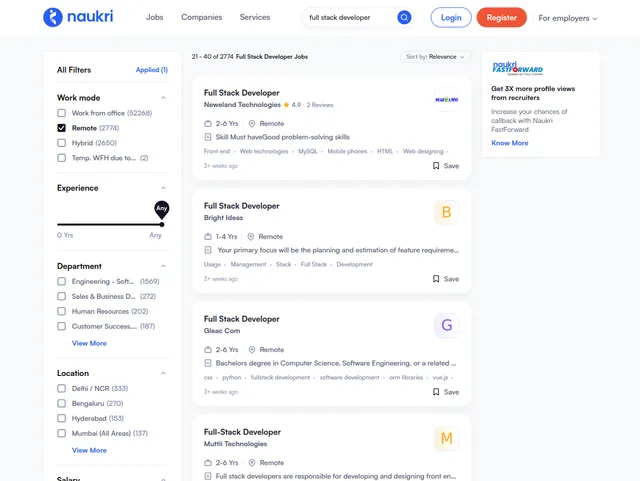
1. Scrape by URLs
Use this mode when you already have specific Naukri search result URLs. When this mode is used, all options in the "Scrape by search filters" section will be disabled.
| Field | Type | Default | Description |
|---|---|---|---|
urls | array | (required) | One or more Naukri job search result URLs to scrape. You can paste URLs one by one, or use the Bulk edit section to add a prepared list. The example shows full-stack developer jobs with the work-from-home filter (wfhType=2). Build URLs by performing a search on Naukri, then copying the resulting URL with all filters intact. |
ignore_url_failures | boolean | true | If true, the scraper continues running when a URL fails instead of stopping the entire run. Essential when scraping multiple searches / batch processing. |
URL Building Tips: Naukri encodes filters as query parameters — ?k=python (keyword), &experience=5 (years), &cityType=metropolitan (location tier), &wfhType=2 (work from home). Build multiple URLs to cover different job titles, locations, or experience bands.
2. Scrape by search filters
Use this mode when you want to search using a keyword and additional filter attributes instead of scraping by URLs. If you use this mode, leave the urls field above empty.
| Field | Type | Default | Description |
|---|---|---|---|
keyword | string | — | The keyword to search for. |
location | string | — | The location to search for (city, department, postal code). |
work_type | string ("", 0, 1, 2, 3) | — | Filter by work type: Any (empty), Work from office (0), Temp (1), Remote (2), Hybrid (3). |
experience | string | — | Filter by years of experience. Valid values: 0–30 (number of years). |
salary | string ("", 0to3, 3to6, 6to10, 10to15, 15to25, 25to50, 50to75, 75to100, 100to500) | — | Filter by minimum salary band, e.g. 0-3 Lakhs, 3-6 Lakhs, up to 100-500 Cr. Select Any (empty) for no filter. |
published_at | string ("", 1, 3, 7, 15, 30) | — | Filter by publish date: Any (empty), 1 day, 3 days, 7 days, 15 days, 30 days. |
page | integer | — | The page number to start scraping from. |
3. General settings
Applies to both scraping modes above.
| Field | Type | Default | Description |
|---|---|---|---|
proxy.useApifyProxy | boolean | false | Set false if Naukri doesn't require proxies for your use case, or true (with residential proxies) for enterprise-scale scraping. Test without proxies first — Naukri is generally accessible without them. |
max_items_per_url | integer | 20 | The maximum number of job listings to collect per URL/search. Naukri typically shows 20 results per page — increase to 50–100 for more comprehensive extraction across multiple result pages. |
Complete Output Structure and Field Definitions
The scraper returns JSON data with each job as an object containing detailed fields. Understanding field purposes enables effective analysis and application.
Job Identification
Job ID: Unique numeric identifier of the job posting on Naukri. Purpose: Database indexing, tracking specific jobs over time, avoiding duplicates, linking to detail pages.
Job URL: Direct link to the full job posting on Naukri. Purpose: Accessing complete details, applying for the job, verification of scraped data.
Title: Job title as published by the employer. Purpose: Role segmentation, keyword analysis, job market trend tracking.
Description: Full job description in HTML format, including responsibilities and requirements. Purpose: Extracting skill requirements, responsibilities, keyword and NLP analysis.
Skills and Requirements
Skills: List of skills and technologies required for the job. Purpose: Skills demand analysis, candidate matching, technology trend tracking.
Experience Text: Required experience range as displayed (e.g., 3-5 Yrs). Purpose: Display and quick filtering by seniority level.
Minimum Experience: Minimum years of experience required. Purpose: Numeric filtering and seniority-level analysis.
Maximum Experience: Maximum years of experience targeted. Purpose: Numeric filtering and seniority-level analysis.
Compensation
Salary Text: Salary as displayed on the listing (e.g., Not disclosed). Purpose: Quick display and identifying jobs that publish salary.
Salary Detail: Structured salary object with minimum and maximum salary, per-month values, currency, variable percentage, CTC breakup and a hidden-salary flag. Purpose: Compensation benchmarking and salary analysis when the employer discloses it.
Currency: Currency of the salary (e.g., INR). Purpose: Correct financial interpretation across markets.
Location and Work Mode
Location: Job location and work mode as displayed (e.g., Hybrid - Hyderabad, Chennai, Bengaluru). Purpose: Geographic demand analysis and remote/hybrid/on-site segmentation.
Attributes: List of label/value pairs summarizing key job properties (experience, salary, location). Purpose: Flexible display of job highlights, preserving the original structure of the listing.
Posting Dates
Posted Label: Relative posting time as displayed (e.g., 12 Days Ago). Purpose: Measuring listing freshness.
Created Timestamp: Job creation time as a Unix timestamp in milliseconds. Purpose: Precise date sorting, time-series analysis, conversion to readable dates.
Apply By Time: Time-of-day deadline or timestamp shown for applying. Purpose: Tracking application timing.
Company
Company ID: Unique numeric identifier of the hiring company. Purpose: Grouping jobs by employer, hiring trend tracking.
Company Name: Name of the hiring company. Purpose: Lead generation, competitor hiring analysis, employer research.
Company URL: Link to the company profile page on Naukri. Purpose: Exploring all jobs and details of the employer.
Company Logo URL: Link to the company logo image. Purpose: Branding in reports and dashboards.
Company Group ID: Identifier of the company group or parent brand. Purpose: Aggregating jobs across subsidiaries of the same organization.
Company Review: Employer rating data from AmbitionBox, including title, aggregate rating, number of reviews and review page URL. Purpose: Employer reputation analysis and candidate decision support.
Application Options
JD URL: Link to an external job description (may be null). Purpose: Accessing the original job description when hosted outside Naukri.
Show Multiple Apply: Whether the job supports applying to multiple related positions at once. Purpose: Understanding application flow options.
Raw Data
Raw Data: Complete original JSON object of the job as scraped, without modification. Purpose: Auditing, debugging, accessing fields not included in the cleaned output, and reprocessing without re-scraping.
Sample Output:
Step-by-Step Usage Guide
1. Define Target Jobs: Identify job types, skills, locations, or experience levels you need. Test searches on Naukri.com to refine filters.
2. Build Search URLs: Copy URLs from test searches. For large datasets, create multiple URLs: different technologies ("python-jobs," "java-jobs"), experience bands (0-2 years, 3-5 years), locations (Bangalore, Mumbai, Hyderabad).
3. Configure Input: Add URLs to JSON config. Set max_items_per_url to 20 for standard pages or higher for deep extraction. Enable ignore_url_failures for robustness.
4. Execute Scrape: Launch via Apify. Processing 5-10 search pages (100-200 jobs) typically completes in 2-4 minutes.
5. Export Data: Choose JSON for databases, CSV for analysis. Clean by removing duplicates using job_id or filtering by created_date for recent postings only.
6. Handle Pagination: For jobs spanning multiple pages, either include page URLs manually (...&page=2, ...&page=3) or set max_items_per_url higher to auto-paginate.
Strategic Applications for Indian Job Market Intelligence
Tech Skill Demand Tracking: Analyze tags_and_skills across thousands of jobs to identify trending technologies. Track React vs. Angular adoption, cloud platform preferences (AWS/Azure/GCP), or emerging frameworks.
Salary Benchmarking: Salary_detail data enables compensation analysis by skill, experience, location, and company size. Calculate average LPA for specific tech stacks or roles.
Remote Work Trends: Mode field tracks work-from-home vs. office vs. hybrid distribution. Analyze which industries/roles offer remote options most frequently.
Hiring Velocity Analysis: Created_date patterns reveal hiring surges (seasonal, funding-driven) and company expansion phases. Track posting frequency by employer.
Experience Level Demand: Minimum/maximum_experience fields show market demand distribution—entry-level saturation vs. senior talent shortages.
Company Hiring Monitoring: Track specific companies via company_id and company_name. Monitor competitors' job types, volumes, and growth signals.
Application Urgency Insights: Apply_by_time reveals hiring urgency. Short windows (7-14 days) indicate desperate hiring; long windows (60+ days) suggest selective processes.
Maximizing Data Value and Best Practices
Weekly Scraping Cadence: India's tech market moves fast. Weekly scrapes capture new postings and market shifts. Store historical data for trend analysis.
Segment by Technology: Create separate searches for Python, Java, JavaScript, Cloud, DevOps, Data Science. Cleaner datasets, easier analysis.
Enrich with Ambition Box: Use ambition_box_data to correlate company ratings with hiring difficulty (low-rated companies may struggle to fill roles).
Geographic Segmentation: India's metro cities (Bangalore, Pune, Hyderabad, Mumbai, NCR) have distinct markets. Scrape separately for regional insights.
Quality Checks: Flag anomalies—salaries outside normal ranges, missing experience requirements, or very old created_dates may indicate data issues.
Skill Co-occurrence Analysis: Mine tags_and_skills to find skill combinations (React + Node.js + AWS). Helps identify full-stack requirements and technology ecosystems.
Respect Rate Limits: Space out large scraping runs. Sustainable practices ensure continued access.
Conclusion
The Naukri.com Jobs Search Scraper unlocks India's largest job market dataset. From tech skill trends to salary benchmarks and remote work adoption, this tool transforms public job data into actionable intelligence for recruitment, market research, and competitive analysis in Asia's fastest-growing digital economy.


