
AI Content Detector — ChatGPT, Claude & Gemini Text Checker
Pricing
from $5.00 / 1,000 text checkeds
AI Content Detector — ChatGPT, Claude & Gemini Text Checker
Check if texts were written by AI (ChatGPT, Claude, Gemini, Llama) in bulk: pasted texts, web pages, PDF/Word files or scraper datasets. AI score, verdict, confidence and per-section scores. Runs its own model: no third-party site.
Pricing
from $5.00 / 1,000 text checkeds
Rating
0.0
(0)
Developer

tidydata
Maintained by CommunityActor stats
0
Bookmarked
2
Total users
1
Monthly active users
4 days ago
Last modified
Categories
Features
Share
🕵️ AI Content Detector — check if a text was written by ChatGPT, Claude or Gemini
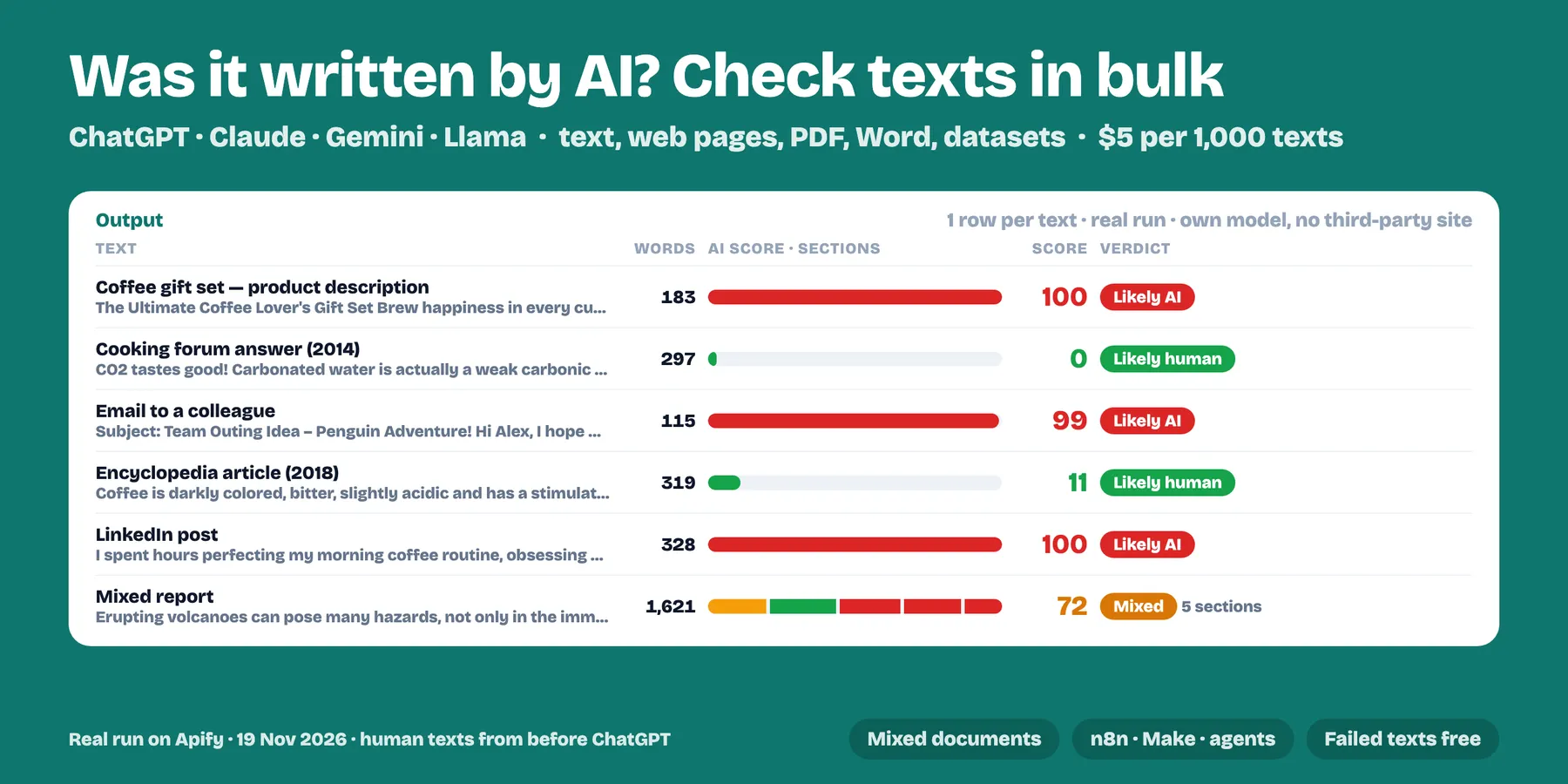
Find out if texts were written by AI, in bulk. Paste a text, give it web pages, PDF or Word files, or chain it with any scraper, and get for every text an AI score (0-100), a clear verdict, a confidence level and, for long documents, a score for every section, so you can see which parts of a mixed document look AI-written.
$5 per 1,000 texts (up to 1,000 words each) + the Apify compute of the run (see Pricing). Failed, too-short and skipped texts are free. No API key, no subscription.
- ✅ Its own detection model, running inside the Actor: no third-party detector website in the middle, no login, nothing that breaks when a website changes, and your texts are not sent to any other service
- ✅ Built on one of the top-ranked open models of the RAID benchmark for AI-text detection (DeBERTa-v3-large, MIT licence). It learns how AI writes, not one brand, so it works on text from ChatGPT / GPT, Claude, Gemini, Llama, Mistral, Qwen… (our own test below used Claude, GPT-OSS and Qwen)
- ✅ Mixed documents: long texts are scored section by section (about 350 words each) →
mixedverdict when only some parts look AI-written - ✅ Any source: pasted text, a JSON list of texts (API, n8n, Make, Zapier, AI agents), web pages (only the article, not menus, ads or comments), PDF, Word (.docx), TXT, Markdown, uploads, Google Drive / Dropbox / OneDrive links, or a text column of another Actor's dataset (reviews, articles, posts, product descriptions)
- ✅ Honest results: we publish our own accuracy test below, every row says how much to trust it (
confidence), and texts that are too short to judge are refused for free instead of guessed - ✅ Thousands of texts per run, results as JSON, CSV or Excel
What can I use it for?
- SEO and content teams: check freelance and agency articles before you publish or pay for them.
- Marketplaces and review sites: flag AI-written product reviews, listings or profiles at scale (chain it with a reviews scraper).
- Publishers and editors: screen guest posts, submissions and press releases.
- Education (as a hint, never as proof — see Limits): get a second opinion on essays and assignments.
- Recruiting: see which cover letters and answers were written with ChatGPT.
- AI pipelines and agents: route texts by "human / AI" before training, moderation or ranking.
How to use it
- Give it your texts in any of these ways (you can mix them):
- Text to check: paste one text.
- Many texts (JSON list):
["first text…", "second text…"]or[{"id": "A-1", "text": "…"}]. - Web pages or document links: one link per line (articles, blog posts, PDF, .docx, .txt, .md).
- Upload documents from your computer.
- Dataset of another Actor: pick the dataset and, if needed, the field with the text (e.g.
reviewText) and an ID field.
- Click Start. Each text becomes one row; export the results or read them from the API.
Output example
A long, partly AI-written report looks like this (only the section fields shown):
Verdicts: likely_ai (AI score ≥ 90), uncertain (50-89: could be either, or a human text edited with AI), likely_human (< 50) and mixed (at least 15 % of the text in AI-looking sections and 15 % in human-looking ones). Confidence is high, medium or low depending on the text length (150+ words is best), the language and how far the score is from the thresholds.
Accuracy (our own test, November 2026)
We tested it on 148 English texts we know the origin of: 94 human texts written before ChatGPT existed (Wikipedia articles as of 2018 and Stack Exchange answers from 2014-2015) and 54 texts we generated with Claude Haiku 5.5, GPT-OSS-120B and Qwen 3.8 (essays, blog posts, product descriptions, news, reviews, emails, LinkedIn and Reddit-style posts, and "write like a human, with imperfections" prompts).
| Result | |
|---|---|
AI texts flagged likely_ai | 49 of 54 (91 %) |
Human texts wrongly flagged likely_ai | 3 of 94 (3 %) |
Human texts in likely_human | 82 of 94 (87 %) |
The AI texts it missed were casual "personal story" posts written on purpose to sound human. Spanish (35 texts, beta): no human text scored above 50, and 10 of 18 AI texts scored 90+.
Pricing
| What | Price |
|---|---|
| One text up to 1,000 words | $0.005 |
| Longer texts | $0.005 per started 1,000 words |
| Failed, too short, unsupported language or skipped | free |
| Apify compute (paid to Apify; your plan's free credit covers it) | about $0.0015 per 300-word text (≈ $0.005 per 1,000 words) + about $0.01 per run to start |
So 1,000 short texts cost about $6.50 in total and a single text checked on its own about $0.015 — measured on Apify in November 2026. That is several times cheaper than detector APIs and other detector Actors (which charge $0.012 to $0.10 per check). Apify store discounts apply automatically (−10 % Bronze, −15 % Silver, −20 % Gold and above). Tip: send many texts in one run instead of one run per text — the start is paid once.
Your spending limit is respected: the Actor checks it before each text and stops cleanly, marking the rest as skipped (free).
Limits and good to know
- No AI detector is proof. Scores are probabilities from a statistical model: use them to decide what to look at more closely, never as the only evidence against a person (students, employees, writers).
- Short texts (under 40 words) are refused for free; under 100 words the score is only a hint (
confidence: low). - Languages: English gives the best results. Spanish, French, German, Italian, Portuguese, Dutch, Catalan and other Latin-script languages work in beta. Other languages (Chinese, Russian, Arabic…) are skipped for free unless you turn on Analyse other languages anyway.
- Edited AI text (rewritten by a person, or by a "humanizer" tool) and very formal human writing (encyclopedias, legal text) are the hardest cases: expect more
uncertainscores there. - Web pages are read without running JavaScript: pages that only show text after scripts run (some web apps) give "no readable text". Pages behind a login and social networks (Instagram, Facebook, TikTok, X, LinkedIn…) are not read.
- PDFs need a text layer: for scans, run PDF Text Extractor (OCR) first. Old
.docand.rtffiles: save as.docx. - Texts over 100,000 words are cut there (noted in the row).
FAQ
Is my text sent to OpenAI, GPTZero or another website? No. The model runs inside your Actor run on Apify; the text is not sent to any other service and is not stored by us.
Which model is it? desklib/ai-text-detector-v1.01, a DeBERTa-v3-large model fine-tuned for AI-text detection (MIT licence), ranked first on the RAID benchmark when it was published. We pin the exact version, so results do not change from run to run.
Can it tell which AI wrote the text? No: it tells AI-written from human-written, not the brand of the model.
Why "uncertain" and not a yes/no? Because between 50 and 90 the model is not sure, and pretending otherwise causes false accusations. You can still sort by aiScore.
How do I use it from n8n, Make or Zapier? Run the Actor with {"texts": ["…", "…"]} (or objects with your own id) and read the dataset; or chain it after a scraper with Dataset of another Actor.
How fast is it? About 3 seconds per 300-word text (about 10 seconds per 1,000 words) on the default 4 GB of memory, plus a few seconds to start. 1,000 short texts take about 50 minutes; more memory does not make it faster.
Related Actors
- PDF Text Extractor — PDF & Image to Text OCR — get the text out of scanned documents first
- Article Text Extractor — clean article text from any web page
- Merge, Dedupe & Transform Datasets — join the scores back to your reviews or articles
- Audio & Video Transcription — turn videos and podcasts into text, then check it here


