

Google Play Scraper: App Details, Search & Change Monitor
Pricing
from $0.70 / 1,000 full app rows
Google Play Scraper: App Details, Search & Change Monitor
Paste Google Play app IDs, keywords, developers or a seed app and get clean app rows: rating, ratings, installs, price, version, update date. Every country and language you pick in one run. Monitor mode returns only apps that changed, with the old and new values. No developer emails or addresses.
Pricing
from $0.70 / 1,000 full app rows
Rating
0.0
(0)
Developer

Waffleiron
Maintained by CommunityActor stats
0
Bookmarked
2
Total users
1
Monthly active users
2 days ago
Last modified
Categories
Features
Share
Get Google Play app details, search results, developer catalogs and similar apps, for every country you pick in one run. $1.00 per 1,000 apps with full details, $0.30 per 1,000 cards from searches and lists, less on paid plans.
Paste app IDs, keywords, developers or a seed app. A bad or removed app never fails the run.
Run it daily in monitor mode for only the apps that changed.
🔍 What does Google Play Scraper do?
You give Google Play Scraper app IDs, search keywords, developer names or apps to find similar ones for. It reads Google Play's public pages and hands back one clean row per app.
- Every country and language in one run. Search results differ by country: "budget" in the US and the UK shared only 18 of 30 apps in our test. Pick several countries and get them side by side.
- Pay for what you asked for. A search, developer or similar-apps row is a short card (name, developer, rating, price, installs, position) at a card price. Tick "Full details" only when you need the full app page.
- Full app details. The precise rating and the one Google shows, ratings count, star histogram, installs band and exact installs, price and sales, version, last update, what's new, content rating, ads and in-app purchases.
- A developer's whole catalog. By name, number or link. In our test Google LLC came back with all 89 apps, not just the first 20 (set Max results to 0 for a whole catalog).
- Similar apps from the right list. Up to 50 per app, from Google's "Similar apps" list, never the developer's own "More by" list.
- No developer emails, addresses or phone numbers, by design. You get the developer's name, Play page, website and privacy policy. Email addresses inside descriptions are replaced with [email].
- Clean fields, tested every day. Load the rows straight into a sheet or database without cleaning them. A live test and a data check run on this Actor every day, and we read every issue.
- Take it anywhere. Download CSV or Excel, or send results to Google Sheets, Make, Zapier or an AI agent. Developers also get JSON, XML and the API.
Why use Google Play Scraper?
- A bad app never fails the run. A removed app, a typo or an unknown developer comes back as one free row saying why. Everything else still arrives.
- Caps you can see. Google Play shows up to 30 apps per search (11 to 30 in our tests). Each search, developer and similar list gets a free status row saying how many Google offered and how many you got.
- Monitor mode returns only what changed. A new version, a price or sale change, a rating move of 0.05 or more, a new installs band, a renamed listing: each with the old value next to the new one.
- New apps from developers you watch. In monitor mode, an app a watched developer releases after you started watching comes back as new. Older apps that only came into view are not sold as new.
- Field names you already know. The columns match the names most Google Play tools use (
score,ratings,installs,minInstalls,version,updated), so switching needs no remapping. - Works with our reviews scraper. Paste the
appIdcolumn into Google Play Reviews Scraper as is.
📋 What data can I get from Google Play?
Rows from a run on November 16, 2026 (app IDs, and the keyword "budget" in the US and the UK):
| App | Developer | Rating | Installs | Price |
|---|---|---|---|---|
| Spotify: Music and Podcasts | Spotify AB | 4.35 | 1,000,000,000+ | free |
| Minecraft: Dream it, Build it! | Mojang | 4.30 | 100,000,000+ | $6.99 |
| CookBook - Recipe Manager | CookBook Co. | 4.74 | 100,000+ | free |
| Keyword | Country | Position | App | Rating |
|---|---|---|---|---|
| budget | US | 1 | Budget Car Rental | 4.61 |
| budget | US | 2 | Money Manager Expense & Budget | 4.63 |
| budget | UK | 1 | Wallet: Budget Expense Tracker | 4.56 |
| budget | UK | 2 | Money Manager Expense & Budget | 4.61 |
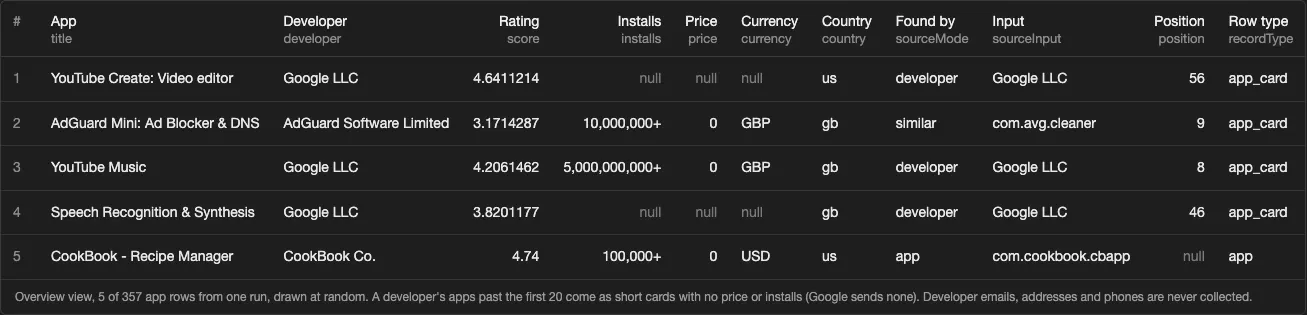
Each app row also gives you:
- The listing: name, short description, full description, category, content rating, icon (screenshots and video on request).
- Ratings: rating, ratings count, text-review count and the 1 to 5 star histogram.
- Installs: the band Google shows ("1,000,000+") and the exact number behind it.
- Price: price and currency, sale price and end date, in-app purchase range, whether it shows ads.
- Releases: version, last update, release date, what's new, minimum Android version.
- The developer: name, Play page, website and privacy policy.
- Where it came from: country, language, whether it came from your IDs, a search, a developer or a similar-apps list, and its position there.
Monitor mode: what a change row looks like
A change row from our offline test on Minecraft's real page with its version and price edited, shortened to the monitor fields (your rows carry every field and come from Google's own changes):
previousholds the value at your last recorded change (or the first run), so slow drift adds up and is reported once it crosses the line.- The deltas (
ratingsDelta,realInstallsDelta,scoreDelta) run from the last check (deltaSince), so dividing bydaysSinceLastCheckgives a true daily rate.
How complete is the data?
Not every app has every field. This is what we measured on real apps, so treat it as a guide, not a promise. We re-measure it every time we update the Actor.
| Share of rows with | Status rows (free) | App details | Developer | Search | Similar |
|---|---|---|---|---|---|
| Apps measured | 2 (1) | 12 (6) | 189 (97) | 83 (59) | 102 (53) |
| Rating | never given | 100% | 98% | 90% | 97% |
| Ratings count | never given | 100% | never given | never given | never given |
| Installs band | never given | 100% | 24% | 96% | 98% |
| Price | never given | 100% | 24% | 96% | 98% |
| Version | never given | 50% | never given | never given | never given |
| Last updated | never given | 100% | never given | never given | never given |
| What's new | never given | 100% | never given | never given | never given |
| Developer website | never given | 100% | never given | never given | never given |
Last refreshed 2026-11-21, from 388 rows on 213 apps' public Google Play pages.
Every run also checks a sample of its own rows (formats, stray spaces, malformed links, impossible values) and saves the result in the run's storage as DATA_QA.
How do we check the data?
- Against Google Play's own pages: on November 20, 2026, 5 random rows from each of app details, search, developer and similar apps were compared with each app's public Google Play page (name, rating, ratings, installs, version, update date and price for app rows; name, developer and rating for cards), and each drawn search was re-read for apps we missed: 24 checks, 0 mismatches. It repeats weekly.
- Success rate: on November 16, 2026, held-out runs in the US, Japan and Germany, on apps and searches we had never tuned on: 3 of 3 runs returned their rows, 408 in all, with 0 blocked requests.
- A stuck column is a failure. If a field such as "contains ads" ever holds one value on every app, our daily check fails, a mistake other Google Play scrapers have shipped.
Read this before you buy
- Numbers depend on the country. Rating, histogram, price and sometimes the app's name differ by country. The exact installs and update date do not. In our test Spotify's rating was 4.35 in the US and 4.25 in the UK.
- Ratings counts move between reads. On a big app two reads seconds apart can differ by a few ratings, and counts can go down when Google removes ratings. Monitor mode never reports a change on counts alone; it shows them as deltas.
- "Varies with device." Some apps have no single version on Google Play. Their
versionis empty andversionVariesis true. - Search is one page. Google Play shows up to 30 apps per search, per country and language (11 to 30 in our tests).
- A developer's apps past the first 20 come as short cards. Google sends no price, category or installs for them (69 of Google LLC's 89 apps in our test). Turn on full details to get those fields for every app.
- A developer's own name may be a person's name. For a one-person developer the public seller name Google shows is often their own name. We keep it, as Google shows it; we never collect their email, address or phone.
- Monitor mode's first run records each app and returns no rows. Each app it records is charged as an app checked. Later runs return changes.
🚀 How to scrape Google Play app data
- Open Google Play Scraper and keep the example input (Spotify and WhatsApp by ID, and the keyword "meditation").
- Click Start. It takes about 15 seconds and returns 2 app rows and 30 search cards.
- Open the Output tab, or download the results as CSV or Excel.
- Swap in your own apps, keywords, developers or seed apps and run again.
Which apps, keywords and developers work
- App IDs or Play Store links, such as
com.spotify.musicorhttps://play.google.com/store/apps/details?id=com.spotify.music. - Keywords, in any language Google Play supports.
- Developers by name (
Google LLC), by number (4772240228547998649) or by their Play page link. - Seed apps for similar apps.
- Not supported: Apple App Store links. They come back as a free row saying so.
💰 How much does it cost to scrape Google Play?
You pay for each row you receive, and in monitor mode for each app checked. There is no start fee. Apify's running costs (servers, proxies) are included.
| Event | Price per 1,000 (Free plan) |
|---|---|
| Full app row | $1.00 |
| Card row (search, developer or similar, without full details) | $0.30 |
| App checked in monitor mode, no change | $0.40 |
Paid Apify plans pay less per row: 10% off on Starter, 20% on Scale, 30% on Business. Prices shown are the Free plan's.
What a typical run costs
Costs below are at the Free plan price.
| What you run | Charged | Cost |
|---|---|---|
| The example input, once | 2 app rows + up to 30 cards | about 1 cent |
| 100 keywords in 3 countries, cards only | about 7,500 cards | about $2.25 |
| 500 apps' full details | 500 app rows | 50 cents |
| A daily monitor of 500 apps, a day with 25 changes | 25 app rows + 475 checks | about 22 cents |
- Apify's Free plan includes $5 of credit a month, enough for about 5,000 full app rows or 16,000 cards at the Free plan price.
- Cap your spend. Set a maximum cost per run in the run options, and the run stops cleanly when it gets there.
- Overlapping monitor runs skip, not wait. If another run of the same monitor is still reading one of your app IDs, searches, developers or similar lists, this run skips that one and reads the rest.
- The skipped one is not charged. It gets a free
partialrow. The run reading it returns its changes, and your next run returns anything newer. - Give each task its own
monitorName. Tasks without one share an app's or list's memory, so a change one task returns is not returned to the other. - If everything is in use, the run waits up to 5 minutes for one to free up. If none does, it fails without reading anything, and nothing is charged.
- One gap: an app reached through a list is guarded by that list only. Two runs that reach the same app at once, through different lists or one by its ID, can both return and charge the same change.
You never pay for
- Inputs that return nothing: removed apps, typos, unknown developers and requests Google blocks.
- Duplicate full rows: an app found by two of your sources is one full app row. Cards are per list: an app in two of your searches is two cards, one for each position.
- Status rows for every source and every failed input.
👥 Who uses Google Play Scraper?
ASO and marketing teams: where your app ranks, country by country
- Search your target keywords in every market you sell in, as cheap cards with their position (
position,featured). - Compare your listing's title, rating and price across countries in one table.
Competitor and market research: what rivals ship
- Watch competitors' apps in monitor mode: new versions, price changes and sales, rating moves, renamed listings.
- Map a category from a few seed apps with similar apps (
similarTo).
Investors and analysts: a portfolio of apps
- Track installs bands and exact installs over time (
realInstallsDeltaper day). - Catch a developer's new releases as they appear (
changeType: new).
App developers: your own listing in each country
- Check how your app shows in each country and language: title, rating, price and what's new.
🛠️ For developers: input and output examples
Example input: details for a list of apps
Example input: keywords in three countries, as cards
Example input: a developer's whole catalog with full details
Example input: a daily monitor of a few apps and a developer
Save it as a task and schedule it.
Output example: one app row
The CookBook row from the November 16, 2026 run (description and what's new cut after the first paragraph):
- Every row has every field, in the same order. A value Google does not publish is
null. recordTypesays what a row is:app(full row),app_card(a list row),app_statusorsource_status(free).
❓ Limits and FAQ
What does it not do?
- No developer emails, addresses or phone numbers.
- No top charts or category pages.
- No data-safety or permissions sections.
- Google Play only, not the Apple App Store.
- No rank change between runs yet.
What happens when an app or source cannot be read?
The run says why, instead of failing silently.
| Status | Meaning | Charged |
|---|---|---|
not_found | No such app or developer, or it was removed | No |
not_in_country | The app exists but is not offered in that country | No |
invalid_input | Not a Google Play app ID, developer or link | No |
empty | Google shows no apps for that search or no similar apps | No |
partial | Your spending limit or the time limit was reached, or Google's page was incomplete. In monitor mode, also an app or list skipped because another run of the same monitor was reading it | Only rows delivered |
blocked_retry_later | Google asked us to slow down; try again later | No |
route_changed | Google's page changed shape; we fix this | No |
removed | Monitor mode: an app you were watching left Google Play (said once) | No |
- The run fails only when nothing at all could be read. One bad input never fails the others.
- No country stand-ins. An app missing in one country is never filled in with another country's data.
How does monitor mode decide what changed?
| Change | When it counts |
|---|---|
release | The version changed, or the update date moved forward |
price | Price, currency, free or paid, or a sale started or ended |
rating | The rating moved 0.05 or more since it was last reported |
installs | The installs band changed (for example 1M+ to 5M+) |
listing | Title, short description, description, developer name, category, content rating, ads or in-app purchases changed (confirmed by a second read) |
- Counts never count as a change. Ratings and installs move both ways between reads; they ride along as deltas.
- A value that goes missing is not a change, and its return is not one either.
- Pick what counts with
changeOn. A different list, or a differentmonitorName, starts its own memory. - Big lists: each run checks the apps checked longest ago first, about 1,000 apps an hour; apps not reached come back as
partial"not checked: time limit" and go first next time.
How does Google Play Scraper work?
- Reads public pages. It reads the same public pages Google Play shows any logged-out visitor, without a browser or an account.
- Stays polite. One request at a time, 2 seconds apart. If Google asks us to slow down, it waits a minute and retries at most twice, then marks the input "try again later".
- Never solves a CAPTCHA. If Google shows one, the run stops.
Why not use Google's own API?
Google's Play Developer API covers only the apps you publish, through your own developer account. For anyone else's apps, searches and developers, Google Play Scraper reads the public store pages instead.
Is it legal to scrape Google Play?
-
Public data only. Google Play Scraper reads only what Google publishes for anyone to view, without logging in.
-
No developer contact details. Emails, addresses and phone numbers are never collected, and emails inside descriptions are replaced with
[email]. Street addresses written inside a description are not detected. -
Personal data can still appear, for example a one-person developer's own name as their public seller name. The GDPR protects it in the EU, and similar laws apply elsewhere.
Do not collect or process personal data without a legitimate reason, and ask a lawyer if you are unsure. This is not legal advice.
How do I get only changes on a schedule?
- Set
modetomonitorand give it a name (monitorName). - Save your input as a task.
- In Apify Console, add a schedule to the task (Schedules, for example every day at 07:00).
The first run records a baseline and returns no app rows; each app is charged as an app checked. After that, each run returns only changed apps, and a run with no changes says so in one free row.
Can I use it from Make, Zapier, Google Sheets, an AI agent or my own code?
Yes.
- No-code tools: Apify connects runs to Make, Zapier, n8n, Google Sheets, Slack, webhooks and more (https://apify.com/integrations).
- AI agents: through the Apify MCP server.
- Your own code: the API tab has ready snippets.
- A feed URL: the latest run of a task is always at
https://api.apify.com/v2/actor-tasks/<TASK_ID>/runs/last/dataset/items?format=csv(alsojson,xlsx,xml), with your API token.
🧇 More tools from us and support
- Jobs: Career Page Jobs Scraper. Every open job from company careers pages, only new ones each run.
- Jobs: Greenhouse Jobs Scraper. Every open job from Greenhouse job boards, with salaries read from the job text.
- Jobs: Lever Jobs Scraper. Every open job from Lever job boards, with remote or hybrid and salaries.
- Ads: Google Ads Transparency Scraper. Your competitors' new and stopped Google ads.
- Keywords: Keyword Search Volume. Search volume, CPC, difficulty and intent for a keyword list.
- App Reviews: Google Play Reviews Scraper. Every Google Play review for any app, with developer replies and no reviewer names.
- App Reviews: App Store Reviews Scraper. App Store reviews in any country, newest first, with developer replies and no reviewer names.
- Transcripts: YouTube Transcript Scraper. Transcripts of YouTube videos, with chapters and timestamps.
- Transcripts: TikTok Transcript Scraper. Transcripts of TikTok videos, with AI speech-to-text when there are no captions.
- All our tools: apify.com/waffle-iron.
- Found a bug, or need a field we do not cover? Open an issue on the Issues tab and include the run link.
- Did it save you time? A short review helps other buyers find it.
📖 Field reference
Input fields
| Field | Type | Default | Description |
|---|---|---|---|
appIds | array | none | Google Play app ids (e.g. com.spotify.music) or Play Store links: one full app row each. A link that is not a Google Play app comes back as a free row saying why. |
searchTerms | array | none | Keywords, searched as Google Play shows them: one page per term, which holds up to 30 apps (11 to 30 measured). Each app comes back as a card with its position. |
developers | array | none | Developer names as Google Play shows them (Google LLC), numeric developer ids or developer page links: every app the developer page lists. |
similarTo | array | none | App ids or links: the apps Google Play lists as similar (up to 50 per app, measured). |
countries | array | ["us"] | Google Play countries (two-letter codes). Every source runs once per country: rating, price, currency and even the title differ by country. |
languages | array | ["en"] | Languages for the text (description, what's new). Codes like en, ja, pt. |
maxResultsPerSource | integer | 50 | Apps per search term, developer or seed app, per country and language. 0 returns everything the page lists. The free source row says how many the page had. |
fullDetails | boolean | false | Off: search, developer and similar results are cards (title, developer, rating, price, installs) at the card price. On: each becomes a full app row (one more page read each). |
includeMedia | boolean | false | Add screenshot, header image and video links to full app rows. The icon is always in. |
mode | string | "all" | all returns every app. monitor returns only apps that changed since your last run (new version, price, rating, installs band or listing text), with the old values. Its first run records a baseline and returns no app rows. |
monitorName | string | none | A name for the monitor's memory, so two tasks watching the same apps keep apart. |
changeOn | array | ["release", "price", "rating", "installs", "listing"] | Monitor mode: which changes count: release, price, rating, installs, listing. A different list (or monitor name) starts its own memory. |
routeCheck | boolean | false | For our daily health check: also test each of Google's routes once. |
Output fields
| Field | Type | Description |
|---|---|---|
appId | string | The app's package id, e.g. com.spotify.music. |
url | string | The app's Google Play page in this country and language. |
title | string | The app's name as shown in this country. |
summary | string | The short description under the title. |
description | string | The full description as plain text (line breaks kept). Email addresses in it are replaced by [email]. |
developer | string | The developer's name as Google Play shows it. |
developerId | string | The developer's Google Play id: a name (Spotify AB) or a number. |
developerUrl | string | The developer's Google Play page. |
developerWebsite | string | The website the developer lists. |
genre | string | The app's category, e.g. Music & Audio. |
genreId | string | The category's id, e.g. MUSIC_AND_AUDIO. |
score | number | The average rating, unrounded (1 to 5). |
scoreText | string | The rating as shown, e.g. 4.3. |
ratings | integer | How many people rated the app. |
reviews | integer | How many ratings came with a written review. |
histogram | object | Ratings per star: {"1": n, ..., "5": n}. |
installs | string | The installs band as shown, e.g. 1,000,000+. |
minInstalls | integer | The installs band as a number. |
realInstalls | integer | Google's exact install count. |
price | number | The price in currency (0 for free apps). |
currency | string | The price's currency in this country, e.g. USD. |
free | boolean | True when the app costs nothing to install. |
priceText | string | The price as shown on paid apps, e.g. £6.99. |
originalPrice | number | The price before a sale, during a sale. |
saleEndDate | string | When the sale ends, ISO 8601 UTC. |
offersIAP | boolean | True when the app sells in-app items. |
iapRange | string | The in-app price range as shown. |
containsAds | boolean | True when Google says the app contains ads. |
contentRating | string | The age rating, e.g. Teen or PEGI 7. |
version | string | The current version. Null when Google shows Varies with device. |
versionVaries | boolean | True when Google shows Varies with device instead of a version. |
androidVersion | string | The minimum Android version. |
updated | string | When the app was last updated, ISO 8601 UTC. |
released | string | When the app was first released, ISO date. |
recentChanges | string | The developer's "What's new" text. |
icon | string | The app icon's link. |
screenshots | array | Screenshot links (with Include media). |
headerImage | string | The header image link (with Include media). |
video | string | The promo video link (with Include media). |
privacyPolicy | string | The app's privacy policy link. |
country | string | The Google Play country it was read in. |
language | string | The language it was read in. |
sourceMode | string | What found it: app (your app list), search, developer or similar. |
sourceInput | string | The keyword, developer, seed app or app id that found it. |
position | integer | Its place on the list (1 = first), list rows only. |
featured | boolean | Search: true for the featured card Google shows above the list. |
resultsOnPage | integer | How many apps that list showed. |
changeType | string | Monitor: changed, or new (released after you started watching this source). Null in all mode. |
changedFields | array | Monitor: the fields that changed. |
previous | object | Monitor: the changed fields' values at the last recorded change or baseline. |
ratingsDelta | integer | Monitor: ratings gained since deltaSince. |
realInstallsDelta | integer | Monitor: exact installs gained since deltaSince. |
scoreDelta | number | Monitor: rating change since deltaSince. |
deltaSince | string | Monitor: the last check the deltas run from. |
daysSinceLastCheck | number | Monitor: days between deltaSince and this check. |
status | string | Status rows: what happened (see the FAQ). |
error | string | Status rows: why, in words. |
retryable | boolean | Status rows: true when running again later may help. |
input | string | Status rows: the input as you gave it. |
offered | integer | Source status: how many apps the page listed. |
delivered | integer | Source status: how many rows this run returned. |
scrapedAt | string | When the row was produced, ISO 8601 UTC. |
recordType | string | app (full row), app_card (list row), app_status or source_status (free). |


