

Counterparty Risk Rollup — Sanctions, Courts, Registry, Hiring
Pricing
from $42.50 / 1,000 delivered counterparty evidence rollups
Counterparty Risk Rollup — Sanctions, Courts, Registry, Hiring
Combine sanctions-list names, GLEIF identity, bounded US/PL legal-record evidence and public ATS observations into one review-ready counterparty rollup. Get source links, confidence, gaps, triage priority, manual next action and billing truth—never an automated compliance, legal or credit verdict.
Pricing
from $42.50 / 1,000 delivered counterparty evidence rollups
Rating
0.0
(0)
Developer

Tim Zinin
Maintained by CommunityActor stats
0
Bookmarked
2
Total users
1
Monthly active users
a month ago
Last modified
Categories
Share
Counterparty Evidence Rollup — Sanctions, Registry, Courts, Hiring
Combine bounded sanctions-list, legal-entity, legal-record, and public hiring observations into one review-ready counterparty evidence packet with source links, explicit gaps, billing truth, and no automated verdict.
Built for: Procurement and supplier-onboarding teams, finance operators, compliance analysts, small businesses, agencies, marketplaces, and data teams that need a transparent first-pass evidence packet before qualified review.
Commercial unit: one delivered counterparty evidence rollup with at least one completed selected check. Live pricing contract: $0.05 per delivered result-found rollup plus the configured start event (starting at $0.005). The live Apify pricing panel is authoritative. A row with at least one completed selected check can be paid and explicitly partial; an all-check failure is a free advisory.
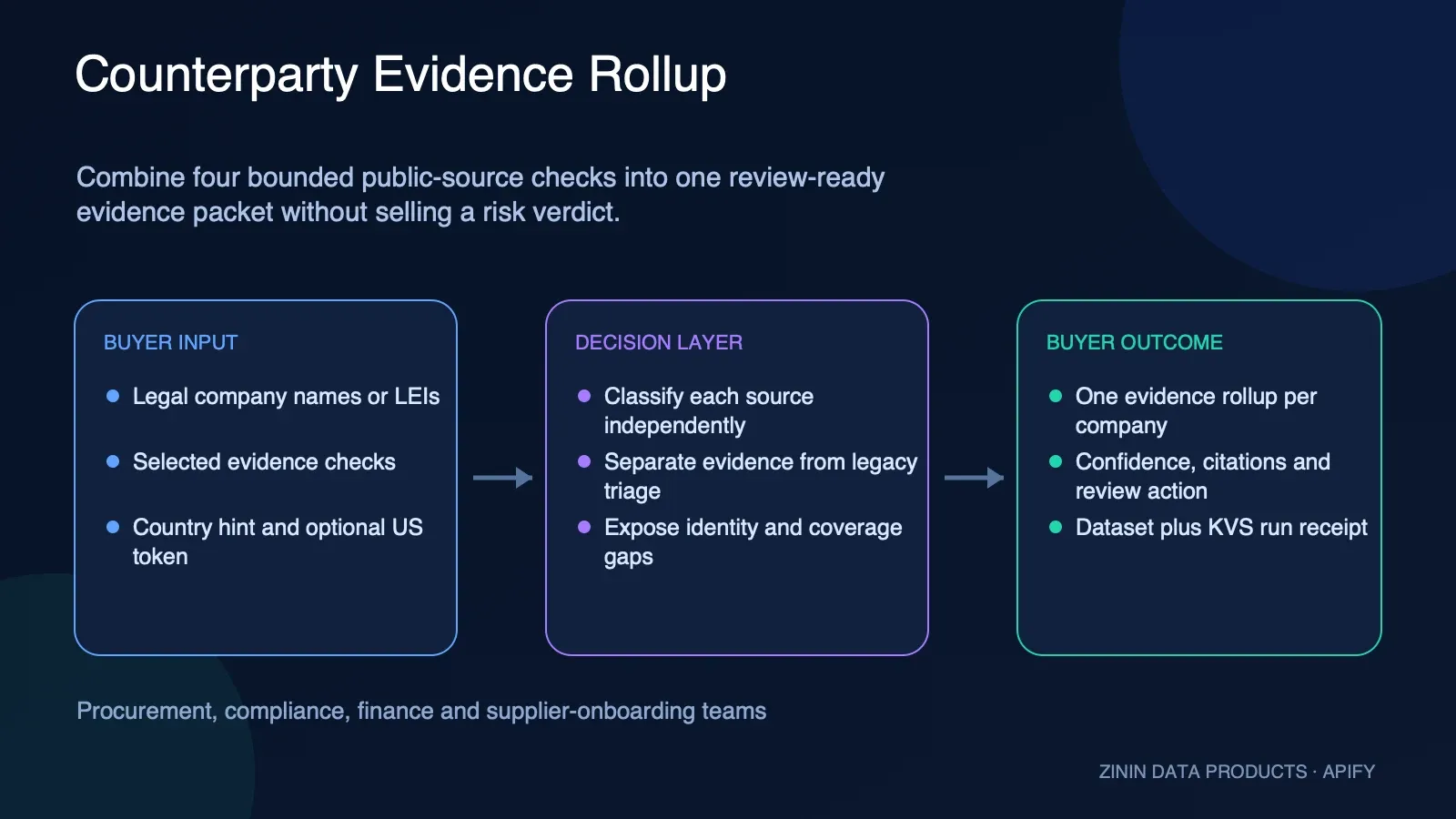
What this Actor sells
This Actor sells a structured first-pass evidence packet, not a company verdict. It puts selected public observations into one row while preserving which source completed, which failed, which name or identifier was queried, what can be opened for review, what remains unknown, and whether the row was delivered and billed. That distinction matters: a polished score built on an unresolved name, missing source, guessed job-board token, or full-text mention is less useful than a conservative packet that tells a reviewer exactly where confidence stops. Use it to shorten collection and triage before a documented procurement, supplier, marketplace, finance, or compliance review. Keep qualified sanctions analysis, legal research, KYC, ownership/control, credit assessment, onboarding and every external action outside the Actor.
Buyer-visible outcomes
- One row per unique submitted company, with every selected source leg visible.
- OFAC and EU name-match observations only after the configured list set loaded completely.
- GLEIF entity candidates, exact LEI evidence, or an explicit unresolved identity outcome.
- Bounded US CourtListener party-index evidence or Poland SAOS full-text mentions with cited links.
- A public ATS board observation whose guessed identity limitation stays attached.
- Evidence confidence kept separate from the deprecated deterministic triage score.
- Structured gaps, source failures, handling diagnostics, and a bounded human-review action.
- Dataset rows plus a KVS
OUTPUTreceipt for delivery, billing, withholding, fatal state, and replay safety. safeToAutomate=falseon every row so collection cannot silently become rejection, payment hold, or approval.
Good fit
- Creating a consistent first-pass supplier or counterparty review packet from several public sources.
- Keeping source failures, identity ambiguity, point-in-time freshness, and legal limits attached to the row.
- Separating evidence confidence from a deprecated deterministic triage heuristic.
- Feeding a controlled procurement or compliance review queue while external action remains blocked.
Not a fit
- Automated sanctions clearance, KYC, AML, credit approval, supplier rejection, payment hold, account suspension, or legal advice.
- Proving legal identity from a company name, guessed ATS token, sanctions name match, or court-text mention.
- Comprehensive litigation, ownership/control, insolvency, adverse media, beneficial ownership, credit, financial, or fraud analysis.
- Treating a zero match, missing LEI, failed source, role count, or legacy score as a business conclusion. If the business decision can deny a person or organization access, money, work, credit, services, or legal rights, this Actor is only one evidence input. Define the lawful purpose, required sources, qualified reviewer, correction path, retention period, and decision policy separately.
Evidence-to-review workflow
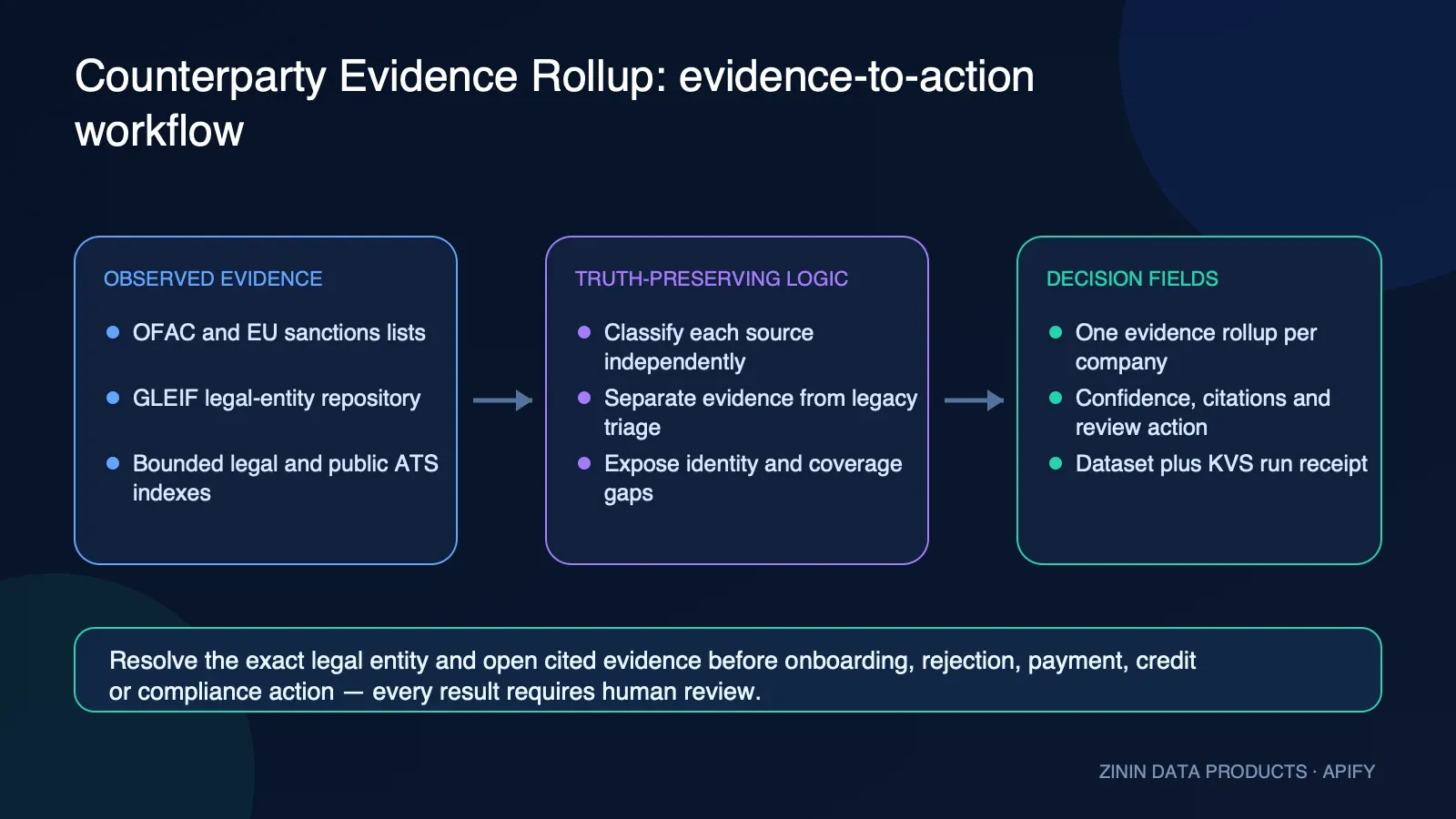
- Submit the current registered legal name or exact LEI and choose only checks relevant to the documented review purpose.
- Add an ISO country hint to narrow GLEIF and select the bounded legal-record path.
- When US legal-record evidence is selected, provide a buyer-owned CourtListener token through the encrypted secret field.
- Load the complete configured sanctions-list set once per run and fail that leg rather than selling partial coverage as clean.
- Run sanctions, registry, legal-record, and public ATS legs independently so one source failure remains visible.
- Preserve raw source observations and the legacy deterministic triage fields for compatibility, but label their limits explicitly.
- Attach confidence, source evidence, data gaps, negative signals, and one bounded human-review action.
- Deliver one paid row only when at least one selected check completed; all-check failure is a free advisory.
- Read KVS
OUTPUT, reconcile paid, free, withheld, and ambiguous states, then route evidence to a qualified human reviewer.
Four checks, four different meanings
| Check | What this Actor can observe | What it cannot establish |
|---|---|---|
| Sanctions | Name tokens above a permissive threshold in complete configured OFAC SDN/alternate-name and EU consolidated source files. | Exact identity, ownership/control, applicability, licence, exemption, clearance, legal status, or a final match decision. |
| Registry | A supplied exact LEI or a thresholded GLEIF legal-name search, including candidates and status fields. | KYC, beneficial ownership, website ownership, trading activity, solvency, good standing in every registry, or that a name candidate is the intended entity. |
| Legal records | Authenticated CourtListener PACER/RECAP party-index results for US scope, or SAOS full-text judgment mentions for PL scope. | Complete litigation, state-court coverage, sealed or current matters, party role in PL, merit, liability, loss, outcome, materiality, or legal advice. |
| Hiring | Published roles returned by one public Greenhouse, Lever, or Ashby board token guessed from the company name. | Board ownership, every vacancy, headcount, growth, budget, revenue, business health, hiring intent, or a counterparty-risk fact. |
Why one row can be partial and paid
The commercial unit is a delivered rollup with at least one completed selected check. If GLEIF and sanctions complete while a selected legal source lacks credentials, the buyer still receives useful evidence, the failed leg is explicit, partial=true, and the row can be paid. If every requested check fails, no evidence rollup exists: the Actor emits a free advisory instead. This rule prevents one transient source from erasing useful work without turning a missing source into a clean negative.
A paid partial row is not a complete due-diligence report. Consumers must inspect checksRun, checksFailed, partial, failureDiagnostics, dataGaps, and sourceEvidence before relying on any field.
Score semantics: compatibility, not prophecy
Existing integrations may depend on riskScore and riskLevel, so this release preserves them additively. Their meaning is now explicit through scoreType, scoreInterpretation, legacyRiskScore, and legacyRiskLevel. The formula is a deterministic evidence-triage rule: a sanctions name match carries a large weight; unresolved or stale registry evidence and observed legal-record counts carry smaller weights; hiring never contributes.
Those weights were not trained against verified losses, compliance outcomes, defaults, fraud, enforcement, onboarding quality, or any regulated target. They are not calibrated probabilities and should not be thresholded into automatic decisions. A high band means “review this evidence packet first under the documented heuristic,” not “this company is high risk.” A low band means neither clearance nor safety.
| Field | Correct interpretation | Incorrect interpretation |
|---|---|---|
riskScore | Deprecated deterministic evidence-triage weight preserved for compatibility. | Probability of wrongdoing, default, sanctions exposure, litigation loss, fraud, or poor credit. |
riskLevel | Deprecated band over that same fixed heuristic. | Regulatory classification, approval decision, legal conclusion, or risk appetite. |
confidenceScore | Support for the evidence path and completed coverage in this row. | Confidence that the company is good, bad, safe, solvent, sanctioned, or liable. |
actionPriority | Which packet a human should review first. | Permission to reject, block, contact, investigate, report, or suspend. |
safeToAutomate | Always false for external action. | A field that can be dropped after export. |
Input
Use Try for free on Apify Store or send the same JSON through API, Task, schedule, webhook, n8n, Make, Zapier, or an Apify MCP integration. The public example selects the keyless sanctions and registry legs and therefore contains no secret:
Input fields
| Field | Safe use |
|---|---|
companies | One to twenty company legal names or exact 20-character LEIs. Exact duplicate strings are processed once. Use current registered names and keep aliases as separately documented review inputs. |
checks | Any subset of sanctions, registry, litigation, and hiring. Select only sources relevant to the documented purpose; more checks do not automatically create a better decision. |
jurisdictionHint | ISO country hint for GLEIF and legal-record routing. PL uses SAOS. Other supported values route legal scope to authenticated US CourtListener. GB/UK returns a free licence advisory and makes no Find Case Law request. |
courtListenerApiToken | Buyer-owned token required for deployed US API access. Enter only in the encrypted secret field. The Actor sends it as the CourtListener Token header and never stores it in Dataset, KVS, logs, screenshots, or public Task JSON. |
maxConcurrency | One to eight companies in parallel. Sanctions lists load once per run; other checks are bounded per company. Keep traffic responsible and never use concurrency to bypass source limits. |
Query preparation checklist
- Obtain the legal name from a current contract, invoice, registry, tax document, or verified onboarding record.
- Prefer an exact LEI for GLEIF when the intended legal entity is already known.
- Keep parent, subsidiary, branch, trading name, previous name, and website identity separate.
- Use a country hint supported by evidence; do not infer jurisdiction from language or brand alone.
- Document why each selected source is necessary for the review purpose.
- Add CourtListener credentials only for US legal-record scope and monitor the buyer account rate limits.
- Do not submit private allegations, credentials, personal dossiers, or unnecessary personal data.
- Retain the exact submitted string and observation time with the human disposition.
Source contracts and reuse boundaries
OFAC
The runtime downloads published sanctions data from the US Treasury Office of Foreign Assets Control Sanctions List Service. OFAC describes SLS as the primary public delivery application for current sanctions-list files and provides machine-readable formats and API access. The Actor records name-match evidence only. Review the current OFAC list entry and applicable guidance before relying on a match or no-match.
European Union consolidated financial sanctions list
The European Commission manages and updates the consolidated list to reflect officially adopted legal texts. Commission-owned website content is generally reusable under CC BY 4.0 unless otherwise indicated, with attribution and change indication requirements; only the Official Journal/EUR-Lex text is authentic and legally effective. The Actor must not present the consolidated file as legal advice or an independent clearance service.
GLEIF
GLEIF states that Global LEI Repository data available through its access service is free and provided under CC0. The Actor queries a supplied LEI or bounded name search and retains the returned identity evidence. CC0 access does not make a fuzzy name association correct and does not convert an LEI into KYC, ownership, solvency, or universal registry coverage.
CourtListener and Find Case Law
CourtListener documents authenticated REST API access and default request limits. US scope therefore requires a buyer-owned secret token. The National Archives states that Find Case Law computational analysis requires a separate licence. This public Actor does not claim that licence: GB/UK produces a free non-retryable advisory and sends no request to the Find Case Law feed.
Public ATS posting APIs
Greenhouse documents that Job Board GET data is publicly available without authentication. Lever documents public published postings and states that published jobs may be scraped by third parties. Ashby documents its public Job Postings API for listed postings. The Actor requests only published board observations. Technical public access does not prove the guessed token belongs to the intended company or grant a right to build an unrelated permanent mirror; use the evidence minimally and verify the board owner.
Output stores
The default Dataset contains one company rollup or free advisory per processed unique company, plus a bounded run advisory when budget or delivery state creates a gap. The default Key-Value Store record OUTPUT contains the terminal receipt. Read both. A process exit by itself cannot prove that every requested company was delivered, paid, free, withheld, or safe to replay.
Core fields
| Field | Meaning |
|---|---|
company / entityId | Submitted name plus a stable Actor record identity; neither field proves the legal entity without source resolution. |
recordType / schemaVersion | Counterparty evidence rollup or advisory with an additive semantic contract version. |
checksRun / checksFailed | Exact selected checks that completed and structured reasons for every check that did not. |
sanctionsHit / sanctionsMatches | Permissive OFAC/EU name-match observations with list, name, program, alias type, and similarity evidence. |
registry | GLEIF resolution evidence including LEI, legal name, jurisdiction, entity and registration statuses, match basis, confidence, and candidates. |
litigation | One bounded US party-index or PL full-text observation with count, cited review links, scope, and partial state. |
hiring | Published job count from one guessed Greenhouse, Lever, or Ashby board token; board ownership is not independently proven. |
riskScore / riskLevel | Deprecated deterministic evidence-triage compatibility fields; never probability, compliance status, credit quality, or legal verdict. |
scoreType / scoreInterpretation | Machine-readable meaning and explicit boundary for the legacy triage fields. |
confidenceScore / confidenceBand | Support for the combined evidence path and completed coverage, not likelihood of wrongdoing or loss. |
sourceEvidence / freshness | Primary or public-index review pointers and point-in-time Actor observation metadata. |
change | Explicitly unavailable; the Actor does not persist a prior compatible counterparty baseline. |
dataGaps / negativeSignals | Identity, coverage, interpretation, source, and failure limits that must survive export. |
recommendedAction / actionPriority | Bounded human-review routing label, never a completed external action. |
partial / retryable / failureDiagnostics | Machine-readable coverage and handling truth for incomplete or failed legs. |
billing | Whether this exact delivered rollup was linked to the paid result event or was a free/local advisory. |
safeToAutomate | Always false for onboarding, rejection, payment, credit, compliance, legal, employment, or outreach action. |
observedAt / checkedAt | Actor observation time; not proof that every underlying source event was current at that instant. |
Field-by-field review guide
company / entityId
Meaning: Submitted name plus a stable Actor record identity; neither field proves the legal entity without source resolution. Review rule: Keep the source, submitted identity, observation time, gaps, and failures attached. Route ambiguity to a human; this field can prioritize evidence review but cannot authorize onboarding, rejection, payment, credit, legal, employment, enforcement, reporting, or outreach action.
recordType / schemaVersion
Meaning: Counterparty evidence rollup or advisory with an additive semantic contract version. Review rule: Keep the source, submitted identity, observation time, gaps, and failures attached. Route ambiguity to a human; this field can prioritize evidence review but cannot authorize onboarding, rejection, payment, credit, legal, employment, enforcement, reporting, or outreach action.
checksRun / checksFailed
Meaning: Exact selected checks that completed and structured reasons for every check that did not. Review rule: Keep the source, submitted identity, observation time, gaps, and failures attached. Route ambiguity to a human; this field can prioritize evidence review but cannot authorize onboarding, rejection, payment, credit, legal, employment, enforcement, reporting, or outreach action.
sanctionsHit / sanctionsMatches
Meaning: Permissive OFAC/EU name-match observations with list, name, program, alias type, and similarity evidence. Review rule: Keep the source, submitted identity, observation time, gaps, and failures attached. Route ambiguity to a human; this field can prioritize evidence review but cannot authorize onboarding, rejection, payment, credit, legal, employment, enforcement, reporting, or outreach action.
registry
Meaning: GLEIF resolution evidence including LEI, legal name, jurisdiction, entity and registration statuses, match basis, confidence, and candidates. Review rule: Keep the source, submitted identity, observation time, gaps, and failures attached. Route ambiguity to a human; this field can prioritize evidence review but cannot authorize onboarding, rejection, payment, credit, legal, employment, enforcement, reporting, or outreach action.
litigation
Meaning: One bounded US party-index or PL full-text observation with count, cited review links, scope, and partial state. Review rule: Keep the source, submitted identity, observation time, gaps, and failures attached. Route ambiguity to a human; this field can prioritize evidence review but cannot authorize onboarding, rejection, payment, credit, legal, employment, enforcement, reporting, or outreach action.
hiring
Meaning: Published job count from one guessed Greenhouse, Lever, or Ashby board token; board ownership is not independently proven. Review rule: Keep the source, submitted identity, observation time, gaps, and failures attached. Route ambiguity to a human; this field can prioritize evidence review but cannot authorize onboarding, rejection, payment, credit, legal, employment, enforcement, reporting, or outreach action.
riskScore / riskLevel
Meaning: Deprecated deterministic evidence-triage compatibility fields; never probability, compliance status, credit quality, or legal verdict. Review rule: Keep the source, submitted identity, observation time, gaps, and failures attached. Route ambiguity to a human; this field can prioritize evidence review but cannot authorize onboarding, rejection, payment, credit, legal, employment, enforcement, reporting, or outreach action.
scoreType / scoreInterpretation
Meaning: Machine-readable meaning and explicit boundary for the legacy triage fields. Review rule: Keep the source, submitted identity, observation time, gaps, and failures attached. Route ambiguity to a human; this field can prioritize evidence review but cannot authorize onboarding, rejection, payment, credit, legal, employment, enforcement, reporting, or outreach action.
confidenceScore / confidenceBand
Meaning: Support for the combined evidence path and completed coverage, not likelihood of wrongdoing or loss. Review rule: Keep the source, submitted identity, observation time, gaps, and failures attached. Route ambiguity to a human; this field can prioritize evidence review but cannot authorize onboarding, rejection, payment, credit, legal, employment, enforcement, reporting, or outreach action.
sourceEvidence / freshness
Meaning: Primary or public-index review pointers and point-in-time Actor observation metadata. Review rule: Keep the source, submitted identity, observation time, gaps, and failures attached. Route ambiguity to a human; this field can prioritize evidence review but cannot authorize onboarding, rejection, payment, credit, legal, employment, enforcement, reporting, or outreach action.
change
Meaning: Explicitly unavailable; the Actor does not persist a prior compatible counterparty baseline. Review rule: Keep the source, submitted identity, observation time, gaps, and failures attached. Route ambiguity to a human; this field can prioritize evidence review but cannot authorize onboarding, rejection, payment, credit, legal, employment, enforcement, reporting, or outreach action.
dataGaps / negativeSignals
Meaning: Identity, coverage, interpretation, source, and failure limits that must survive export. Review rule: Keep the source, submitted identity, observation time, gaps, and failures attached. Route ambiguity to a human; this field can prioritize evidence review but cannot authorize onboarding, rejection, payment, credit, legal, employment, enforcement, reporting, or outreach action.
recommendedAction / actionPriority
Meaning: Bounded human-review routing label, never a completed external action. Review rule: Keep the source, submitted identity, observation time, gaps, and failures attached. Route ambiguity to a human; this field can prioritize evidence review but cannot authorize onboarding, rejection, payment, credit, legal, employment, enforcement, reporting, or outreach action.
partial / retryable / failureDiagnostics
Meaning: Machine-readable coverage and handling truth for incomplete or failed legs. Review rule: Keep the source, submitted identity, observation time, gaps, and failures attached. Route ambiguity to a human; this field can prioritize evidence review but cannot authorize onboarding, rejection, payment, credit, legal, employment, enforcement, reporting, or outreach action.
billing
Meaning: Whether this exact delivered rollup was linked to the paid result event or was a free/local advisory. Review rule: Keep the source, submitted identity, observation time, gaps, and failures attached. Route ambiguity to a human; this field can prioritize evidence review but cannot authorize onboarding, rejection, payment, credit, legal, employment, enforcement, reporting, or outreach action.
safeToAutomate
Meaning: Always false for onboarding, rejection, payment, credit, compliance, legal, employment, or outreach action. Review rule: Keep the source, submitted identity, observation time, gaps, and failures attached. Route ambiguity to a human; this field can prioritize evidence review but cannot authorize onboarding, rejection, payment, credit, legal, employment, enforcement, reporting, or outreach action.
observedAt / checkedAt
Meaning: Actor observation time; not proof that every underlying source event was current at that instant. Review rule: Keep the source, submitted identity, observation time, gaps, and failures attached. Route ambiguity to a human; this field can prioritize evidence review but cannot authorize onboarding, rejection, payment, credit, legal, employment, enforcement, reporting, or outreach action.
Billing, budget, and delivery integrity
The Actor uses pay per event: $0.05 per delivered result-found rollup plus the configured start event (starting at $0.005). The current pricing panel is the source of truth. A successful company row is pushed with the linked result-found event so delivery happens before charging in the pinned SDK path. Plain advisory rows are intended to be free; the Actor fails closed if platform pricing makes ordinary Dataset writes billable or unverifiable.
- Validate and deduplicate bounded input before source work.
- Load shared sanctions sources once and classify their completeness.
- Run selected source legs and preserve each completion or failure independently.
- Build the enriched decision packet without claiming missing evidence.
- Serialize paid writes and verify the remaining combined event budget before push.
- Stop before overcharge when the buyer cap cannot cover another result.
- Mark push-plus-charge exceptions as ambiguous and set
replaySafe=false. - Write final KVS
OUTPUTwith requested, attempted, delivered, paid, local, free, withheld, source-failure, advisory, and ambiguous counts. Do not blindly retry a run withreplaySafe=false: a push-plus-charge exception can mean the row reached the Dataset but billing confirmation failed. Preserve the original run and reconcile Dataset, KVS, event ledger, logs, and downstream side effects first.
Run through the API
Store APIFY_TOKEN and courtListenerApiToken in secret stores. The example below uses only the public keyless Task input.
cURL
JavaScript
Python
Automation patterns
Procurement review queue
Create or update an internal review record keyed by entityId. Include exact input, selected checks, source links, completed and failed legs, confidence, score interpretation, gaps, observation time, run ID, and Dataset item ID. Keep the reviewer decision, rationale, effective date, correction, and appeal process in a separate controlled system.
CRM or vendor master enrichment
Write evidence into namespaced fields rather than overwriting verified master data. Do not turn “no confident GLEIF match” into “company inactive,” a sanctions name match into “sanctioned,” a PL mention into “defendant,” or an ATS count into “growing.” Require entity resolution before joining this packet to a legal entity.
Schedules
Scheduling creates repeated point-in-time rows, not built-in change detection. Preserve each observation and compare only compatible scope. If a source fails, retain the failed observation; do not manufacture “unchanged,” “clean,” or zero.
n8n, Make, Zapier, and webhooks
Wait for terminal run status, fetch KVS OUTPUT, branch on status, fatalError, replaySafe, partial, and withheldRowCount, then retrieve Dataset. Send ambiguous delivery to reconciliation and non-retryable credentials/licence conditions to configuration review.
Agents and MCP
An agent can summarize cited evidence and prepare review questions, but its prompt must preserve source type, observation time, confidence, gaps, deprecated score meaning, and safeToAutomate=false. Require citation of the current evidence. Prohibit the agent from inventing identity, clearance, liability, creditworthiness, causality, intent, or external action.
Privacy, security, and governance
- Use company identifiers and public business evidence only; do not convert this Actor into a personal dossier tool.
- Put CourtListener tokens only in the encrypted secret input or controlled environment secret.
- Limit Dataset and KVS access to reviewers who need the evidence for the documented purpose.
- Set retention to the shortest period needed and account for source corrections, delisting, sealing, and changed status.
- Provide a route to correct identity collisions and analyst dispositions downstream.
- Treat allegations, court mentions, sanctions aliases, addresses, and names as potentially sensitive evidence, not labels.
- Record the human reviewer, source checks, rationale, decision time, and policy version outside the Actor.
- Never use the Actor output as the sole basis for a high-impact or legally consequential decision.
Honest limitations
- Sanctions matching is deliberately permissive and name-based. It does not resolve identifiers, date of birth, nationality, ownership/control rules, aliases, transliteration, sectoral restrictions, licences, exemptions, or legal applicability.
- The EU and OFAC lists can change after a run. A zero name match is not sanctions clearance and cannot replace qualified screening or current primary-list review.
- GLEIF covers entities with LEIs and can return none, multiple candidates, lapsed registration, or a similar name. A name-based match is not KYC or beneficial-owner verification.
- US coverage is CourtListener's bounded PACER/RECAP index and requires a buyer-owned token; it is not every federal or state court, filing, sealed matter, or live PACER event.
- Poland SAOS uses full-text judgment search. A hit can be a passing mention and does not establish party status, posture, liability, outcome, or materiality.
- UK legal-record search is disabled because Find Case Law requires a separate computational-analysis licence for this product use.
- The hiring leg guesses a public ATS board token from the submitted company name. A successful board response can still belong to another organization and never changes the legacy score.
- The legacy triage formula and bands are compatibility fields. Their weights are judgement calls, not trained probabilities, validated outcomes, regulatory rules, credit models, or risk appetite.
- A failed leg remains a gap. Another successful leg can make the combined row commercially deliverable, but it does not turn the missing source into a negative finding.
- The Actor is point-in-time only and does not claim ownership graphs, sanctions change detection, litigation change detection, hiring trend, or historical monitoring.
- Public legal records and sanctions sources can contain personal or sensitive data. Purpose, minimization, access, retention, correction, appeal, and applicable law remain the buyer's responsibility.
- A successful process exit is insufficient for automation; reconcile KVS
OUTPUT, Dataset rows, paid/free counts, withheld rows, and replay safety.
Operational checklist
- The submitted company is the intended legal entity, not only a brand or domain.
- Country hint and selected checks match the documented review scope.
- CourtListener token is supplied securely when US legal evidence is selected.
-
checksRunandchecksFailedreconcile with the intended source coverage. - Every sanctions match is identity-resolved by a qualified reviewer.
- GLEIF candidates and statuses are interpreted separately from KYC and solvency.
- US party matches or PL text mentions are opened and verified in current records.
- ATS board ownership is verified before hiring evidence is used.
- Legacy score semantics survive export and are never relabelled as probability.
- Data gaps, observation time, and point-in-time limits remain visible.
- KVS
OUTPUT, Dataset, paid/free counts, withholding, and replay safety reconcile. -
safeToAutomate=falseblocks external or high-impact action.
Troubleshooting
The sanctions leg failed for every company
The Actor requires the configured OFAC and EU source set to load and pass plausibility. It does not sell a partial-list no-match. Inspect checksFailed and retry only after the source condition is understood.
GLEIF returned candidates but no match
Use an exact LEI or verify legal name, country, legal form, address, and registration identifiers. Candidate visibility is designed to support resolution without silently promoting an ambiguous name.
US legal-record check returned a token advisory
Add a buyer-owned CourtListener token through the encrypted input field or remove litigation from that scope. The advisory is free and non-retryable until configuration changes.
UK returned a licence advisory
This is intended. Obtain an appropriate Find Case Law computational-analysis licence and build a separately reviewed licensed source path, or remove UK legal-record scope. Reaching the endpoint technically is not permission.
Poland returned many unrelated records
SAOS is full-text search. Open the cited judgment, locate the mention, resolve identity and party role, and record false positives outside the Actor. Do not rank by raw count.
Hiring found the wrong company board
The token is guessed from the submitted name. Treat the board as unverified association evidence, correct the source workflow outside this Actor, and do not use role count until ownership is proven.
The run is PARTIAL
Inspect source-failure rows, withheld count, budget state, and every row’s partial field. Partial means at least one requested part is missing or constrained; it is not a clean negative.
OUTPUT says replaySafe false
Stop automatic retries and downstream action. Preserve the original run and reconcile Dataset delivery and PPE events because a push-plus-charge exception has ambiguous delivery state.
FAQ
Is the score a probability that the company is risky?
No. The legacy riskScore and riskLevel are preserved only for compatibility and explicitly labelled deterministic evidence-triage weights. They are not probability, credit quality, compliance status, legal advice, wrongdoing, solvency, or a decision.
Can a sanctions match block a supplier automatically?
No. A name match routes to qualified identity and sanctions review. Compare identifiers, aliases, ownership/control, list scope, current primary evidence, licences and applicable law before any action.
Does no sanctions match mean cleared?
No. It means the configured complete source files produced no match above this Actor's name threshold for the submitted string at the observation time.
Why did GLEIF return no confident entity?
The submitted name may differ, the country hint may be wrong, several entities may share a name, or the organization may not have an LEI. Resolve the registered name and identifier outside the Actor.
Why does US litigation need my token?
CourtListener's deployed programmatic API access is authenticated. The encrypted input token is used only in the authorization header and is never returned or logged.
Why is UK an advisory instead of a result?
The National Archives requires a separate computational-analysis licence for the programmatic identification/extraction use this feature would perform. The public Actor does not pretend to hold it.
Does a Poland match mean the company was sued?
No. SAOS searches the full judgment text. Open each cited record and verify whether the intended legal entity is a party, a mention, an advisor, a product, or an unrelated name.
Can hiring data prove growth?
No. It is a point-in-time count on one guessed public ATS board. Verify board ownership, role visibility, duplicates, geography, posting status, and business context.
What is a paid row?
One delivered company rollup with at least one completed selected check. If every requested check fails, the Actor emits a free advisory rather than charging for a fabricated conclusion.
Can I schedule the Actor?
Yes, but this version does not diff history. Store each observedAt, raw row, source scope and human disposition separately; do not infer change from overwritten records.
Can an agent consume the result?
Yes for evidence routing and summarization if it preserves citations, gaps, score interpretation and safeToAutomate=false. External decisions require a human and the appropriate qualified review.
What should I retain for audit?
Keep sanitized input, selected checks, jurisdiction, run and Dataset IDs, KVS OUTPUT, raw row, source links, observation time, reviewer disposition, correction path, access controls, and retention policy.
Support
For a reproducible issue provide run ID, Actor version, sanitized input, selected checks, jurisdiction hint, Dataset row count, KVS OUTPUT, failed source name, and whether the state is completed, partial, free advisory, withheld, or ambiguous. Never send a CourtListener token, private contract, personal dossier, confidential allegation, or signed storage URL.
Counterparty Evidence Rollup — Sanctions, Registry, Courts, Hiring is deliberately conservative: it makes public-source collection auditable and reviewable while refusing to turn incomplete evidence into a high-confidence business verdict.


