

LinkedIn Company Posts Scraper
Pricing
from $1.40 / 1,000 company post delivereds
LinkedIn Company Posts Scraper
Scrape recent public LinkedIn company posts, text, reaction and comment counts, images, and source links without login.
Pricing
from $1.40 / 1,000 company post delivereds
Rating
0.0
(0)
Developer

Tim Zinin
Maintained by CommunityActor stats
0
Bookmarked
7
Total users
3
Monthly active users
21 days ago
Last modified
Categories
Share
Monitor the recent posts that LinkedIn makes publicly visible on company pages. This Actor returns post text, source-visible reaction and comment counts, attachment images, company identity, and public post links when available. Use it to follow competitors, track company announcements, or refresh a research dataset. Each run reads LinkedIn directly and creates a fresh observation for your chosen companies.
Start with {"companyUrls":["https://www.linkedin.com/company/nasa/"],"maxItems":10,"maxPagesPerCompany":1}. No LinkedIn login or cookies are needed. Download results as JSON, CSV, or Excel from the Dataset, or retrieve them through the Apify API. For a recurring workflow, save the input as a Task and schedule it.
Price: $0.002 per delivered post ($2 per 1,000 posts), with Bronze 10%, Silver 20%, and Gold/Platinum/Diamond 30% discounts. There is no start fee. Source errors and coverage diagnostics are free.
A compact example from a recorded public NASA response is {"postId":"7504184320702722048","reactions":1246,"comments":7,"publishedAt":null}. These example counts are historical; your run returns a new observation. Missing source fields stay null. Coverage is limited to the public recent feed: this Actor does not promise a full archive or additional pages. Check the free OUTPUT summary before comparing snapshots.
What this Actor does
Each Dataset row is one useful post card currently returned by LinkedIn's public company page. It includes a stable activity-derived postId, the displayed company name, text, reactions/comments when the source exposes them, public attachment image URLs, a source page URL, and observedAt.
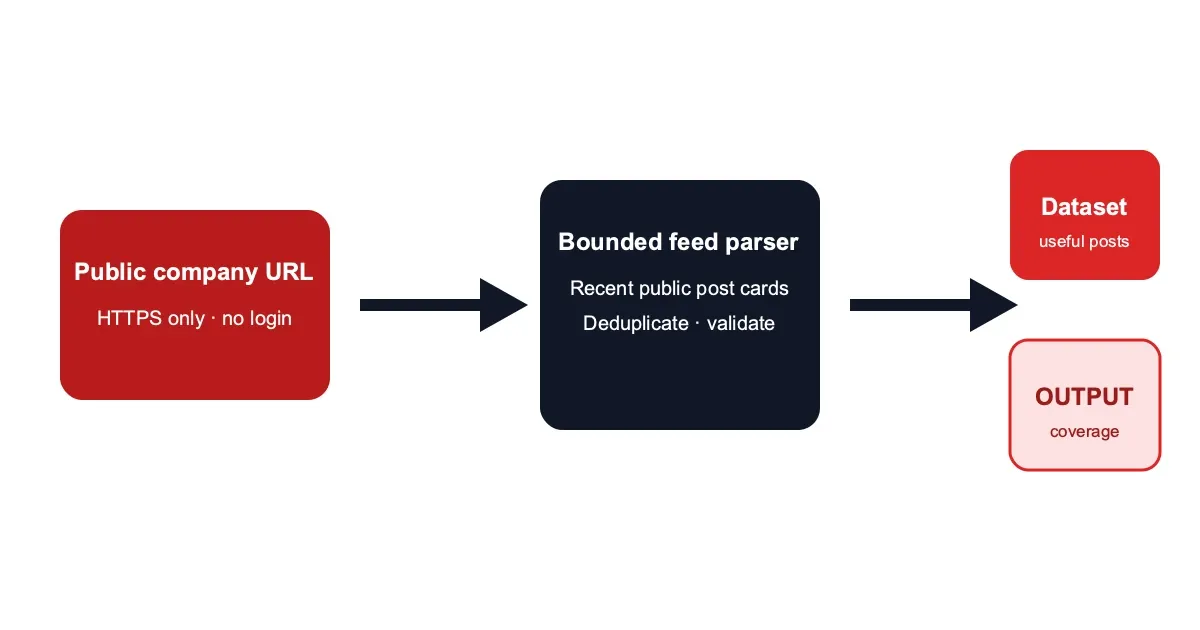
The Actor reads only https://www.linkedin.com/company/{slug}/. It blocks redirects, non-HTTPS URLs, other hosts, /posts/ input routes, query strings, credentials, and private-address substitution. The page may expose a source-derived guest-feed URL. Current source verification found that route can repeat the first page, so this Actor does not promise later-page discovery; its useful contract is a bounded current public company-feed observation.
This is a fresh observation, not a complete archive. LinkedIn can omit, reorder, restrict, or change cards. A row missing from a later run is never treated as a deletion. OUTPUT.coverage tells you whether the bounded page/item limits ended collection or a source read failed.
Quick start
The default is NASA because its public company page was used only to verify the parser against live public HTML. It is a real source URL, not demo data. Change it to a company page you are entitled to monitor.
Inputs
| Field | Range | Meaning |
|---|---|---|
companyUrls | 1–20 | Exact public LinkedIn company roots only. Personal profiles and company subpaths are rejected before any source request. |
maxItems | 1–200, default 20 | Run-wide maximum of delivered post rows. |
maxPagesPerCompany | 1–5, default 2 | Maximum source-derived feed reads per company. Repeated or non-advancing routes are recorded as incomplete coverage; later-page discovery is not promised. |
Dataset fields
| Field | Meaning |
|---|---|
postId | Numeric activity ID extracted from the public card. |
postURL | Public /posts/ overlay URL only when the source exposes one that matches postId; otherwise null. |
company, companySlug | Source-visible company display name and input company slug. Cards attributed to another organization are excluded. |
text | Public card commentary. Empty cards are not delivered. |
reactions, comments | Source-visible counts, or null when not provided. Missing is never converted to zero. |
images | Public media attachment URLs from the card's attachment container; excludes avatars and reaction icons. |
publishedTimeText | The source's relative or textual time, or null. |
publishedAt | ISO timestamp only when the source has a parseable datetime attribute; otherwise null. |
sourceURL, observedAt | Exact feed page that contained the card and the Actor's observation time. |
Real public fixture example
A parser check against a public NASA company response observed ten unique cards. One card had postId 7504184320702722048, company NASA - National Aeronautics and Space Administration, reactions 1246, comments 7, one attachment image, and source time 19h. The source exposed a matching public /posts/ link for nine of the ten cards. These are parser observations, not a claim that the posts or counts remain current.
To automate, submit the same bounded JSON to the Apify Actor API with your API token in an Authorization header, retain the returned run ID, wait for its terminal status, then GET that run's Dataset and OUTPUT. Check response.ok/HTTP status on every read and never retry an ambiguous run-start POST.
OUTPUT and repeat workflow
OUTPUT is free and contains the outcome, per-company page evidence, source errors, item/page stopping reasons, and a snapshot made only from delivered rows. Dataset rows are the only billable results.
For a repeat snapshot, run the same companyUrls, maxItems, and maxPagesPerCompany again, save the new OUTPUT, and compare snapshot.rows by postId downstream. Keep the scope stable; different item or page depth is a different coverage boundary. This Actor does not claim historical completeness or infer removed posts.
Coverage and errors
completedmeans every configured company reached a source-exhausted bounded feed path.partialmeans a valid bounded read stopped atmaxItems/page limit, or some companies failed while others yielded validated cards.source_failedmeans every company source read failed or was blocked; it is not an empty feed.emptymeans validated source reads yielded no useful post cards within the requested scope.budget_stoppedmeans the verified run budget could not cover another result; when it is zero, no source request is made.
All source diagnostics are in OUTPUT, not the Dataset. A source failure, malformed response, redirect, empty card, duplicate, or unconfirmed delivery does not create a paid row.
Pricing and budget
Pricing is $0.002 per delivered post via result-found, with Bronze 10%, Silver 20%, and Gold/Platinum/Diamond 30% discounts. There is no Actor-start fee and no default Dataset-item fee.
Set Apify's Max total charge before a run. The runtime checks the run budget before source collection and before each paid delivery. It does not retry an uncertain post write or event charge.
For API runs, use a positive maxTotalChargeUsd. In the verified platform response, passing 0 selected the account's available default limit; it did not mean “spend nothing.” A positive limit below one post's price stops this Actor before it reads LinkedIn.
Task recipes
Quick company check
Bounded multi-company batch
Repeat observation
FAQ
Does this log in or scrape personal profiles? No. It makes bounded HTTPS reads of public company pages only and rejects login redirects.
Why is publishedAt null? LinkedIn may render only relative text such as 19h. The Actor preserves that in publishedTimeText and does not invent an absolute timestamp.
Why did I get fewer rows than requested? There may be fewer public cards, a source page may be blocked, duplicate cards may repeat across pages, or the page/item boundary ended collection. Check OUTPUT.coverage before treating a short result as a business signal.
Can I automate it? Yes. Start an Actor run using the same JSON through Apify API, wait for a terminal run, then read its default Dataset and OUTPUT. If a client times out, inspect the original run before submitting another one because a delivery may already have been charged.
Source contract
The collector has one source identity: a public LinkedIn company page. It does not accept a person, a company post permalink, a search result, an employee profile, a URL shortener, a saved browser session, or a cookie. This distinction matters because a page that appears public in one browser can redirect another request to sign-in. A redirect is a source failure, not permission to follow a different route.
A page card is included only when it has a LinkedIn activity identifier, non-empty public commentary, and a company link that matches the submitted slug. The source may contain sponsored cards, links in commentary, company logos, reaction graphics, duplicate cards, or cards attributed to another organization. Those do not become independent records. An attachment image must be inside the source's post-media container; profile avatars and reaction icons are excluded.
Pagination boundary
The first company page may contain an opaque pagination token. The Actor does not compose that token, change its values, or discover a generic guest API route. It extracts and validates the complete route from received HTML before an optional bounded read. Current live verification found a valid route that repeated first-page IDs, so it is not marketed as pagination progress. A repeated URL or pagination cycle stops the company with an explicit coverage reason. At most five pages are ever read for one company.
If LinkedIn removes the pagination marker, the received page is treated as exhausted. If the page limit is reached while another source-supplied route exists, coverage remains partial. A page limit is a collection boundary, not evidence that later posts do not exist.
Freshness and snapshots
observedAt records when this Actor read a particular page. It is not the post publication time. publishedTimeText preserves source wording such as 19h; only a source datetime attribute is normalized to publishedAt. The Actor never estimates an absolute date from relative text.
Every OUTPUT.snapshot contains only rows actually delivered in that run. It is intentionally small and suitable for a downstream key-based comparison. Repeat runs must use identical companyUrls, maxItems, and maxPagesPerCompany; these are included in snapshot.scope. Different caps create different observable universes and cannot support a deletion conclusion.
A practical workflow is: store OUTPUT A, run the same bounded input later, store OUTPUT B, join the two snapshot arrays by postId, and label any difference as "not observed in this bounded run" until your own broader evidence supports a stronger statement.
Safe automation pattern
Use one immutable input object per scheduled observation. Set an explicit max charge that covers only the number of posts you intend to buy. Start one run, retain its run ID, wait for a terminal status, retrieve Dataset rows and OUTPUT from that same run, then decide whether to schedule the next observation. Do not resend a timed-out POST: a Dataset write or named event may already have completed.
For API use, keep the Apify token in an Authorization header or secret manager. Do not put it in a company URL, a public Task input, a README screenshot, or source control. The LinkedIn company URLs themselves are not credentials, but only submit pages you are allowed to monitor and use the output according to the source and LinkedIn terms that apply to you.
Partial-result decisions
A partial result can still contain useful validated cards. It does not establish whole-company completeness. Read OUTPUT.coverage.companies before combining pages, comparing days, or calculating engagement summaries. page_limit means there may be later public feed cards. max_items means the run-wide delivery cap ended the collection. pagination_cycle means a source token repeated. sourceError identifies an individual blocked or malformed company read without fabricating missing posts.
When all companies fail, source_failed is returned with zero paid rows. When the source is valid but no card satisfies the record contract, empty is returned. These outcomes have different operational meanings and should remain different in your pipeline.
Billing examples
At the FREE tier, ten delivered posts cost $0.020 and twenty cost $0.040. Bronze is $0.0018/post, Silver $0.0016/post, and Gold, Platinum, and Diamond $0.0014/post. These figures describe named result-found rows only. Diagnostics, duplicate cards, unsupported URLs, source errors, missing metrics, and OUTPUT do not create result rows.
The runtime verifies the resolved pricing before source collection. It rejects a nonzero Actor-start price, a nonzero default-Dataset-item price, an unapproved post price, or an unexpected positive event. It also checks the run's charge limit before a source read and before every paid row. Treat the Pricing tab as authoritative once published.
Limits and performance
The hard input maximum is 20 company URLs, 200 post rows, and five pages per company. One response is capped at 5 MiB. A request has a 15-second deadline; the collection reserves a shutdown margin inside a 120-second run. Network timeouts, 429, and 5xx responses may receive at most two bounded retries. Redirects, 4xx responses, content-type mismatches, invalid UTF-8, oversized bodies, and malformed pagination do not retry.
Those limits protect both the buyer budget and the source contract. They also mean the Actor is not a historical export tool or a promise to enumerate every post a company has ever made.
Data-use notes
This product returns public company-feed facts that LinkedIn's unauthenticated response exposes at observation time. It does not collect private account data, invite-only posts, direct messages, personal profile timelines, applicant data, or engagement identities. Do not use it to make employment, credit, housing, insurance, legal, or other high-impact decisions about a person.
The post text and source URLs are source content. Retain only what you need, respect applicable terms and rights, and keep any downstream storage and distribution policy under your control. Source links are evidence of where the card was observed; they do not grant affiliation, endorsement, or a license beyond the source's terms.
Operational checklist
Before a production observation, confirm that each value is an exact public company root, that maxItems and page depth match the comparison you intend to make, and that the run charge cap is intentional. After it finishes, inspect the terminal status and OUTPUT.coverage before interpreting the Dataset. Keep the run ID with any downstream export. If a source constraint changes, treat it as a new collection method rather than silently mixing it with prior snapshots.


![LinkedIn Company Data & Insights Scraper [NO COOKIE] avatar](https://images.apifyusercontent.com/svCwvsi6KESGk1EEmLtQUVYJwwmvIVkJlvWV5h9Jp7M/rs:fill:76:76/cb:1/aHR0cHM6Ly9hcGlmeS1pbWFnZS11cGxvYWRzLXByb2QuczMudXMtZWFzdC0xLmFtYXpvbmF3cy5jb20vNVRrZ2MySEM2a3ZnZWhmNmMtYWN0b3Itcmw1RVVJWVl3TjhNaDNqVWotclRoMmR2Z2NTeS1saW5rZWRpbl9jb21wYW55X2RhdGFfaW5zaWdodHNfbG9nby5wbmc.webp)


