

Store Leads — $6/1K · E-Commerce Emails, Phones & Platforms
Pricing
from $6.00 / 1,000 e-commerce store leads
Store Leads — $6/1K · E-Commerce Emails, Phones & Platforms
Search indexed e-commerce leads across seven store platforms. Filter countries and available business emails or phones, count matching records and export deduplicated domains to CSV, Excel, JSON, API or MCP.
Pricing
from $6.00 / 1,000 e-commerce store leads
Rating
0.0
(0)
Developer

Apivault Labs
Maintained by CommunityActor stats
0
Bookmarked
2
Total users
1
Monthly active users
5 days ago
Last modified
Categories
Share
Store Leads — E-Commerce Emails, Phones & Platforms
Build an e-commerce prospect list from indexed website records. Select a supported store platform, narrow your audience by country or company/domain keyword, require available business emails or phone numbers, and export a list of deduplicated domains.
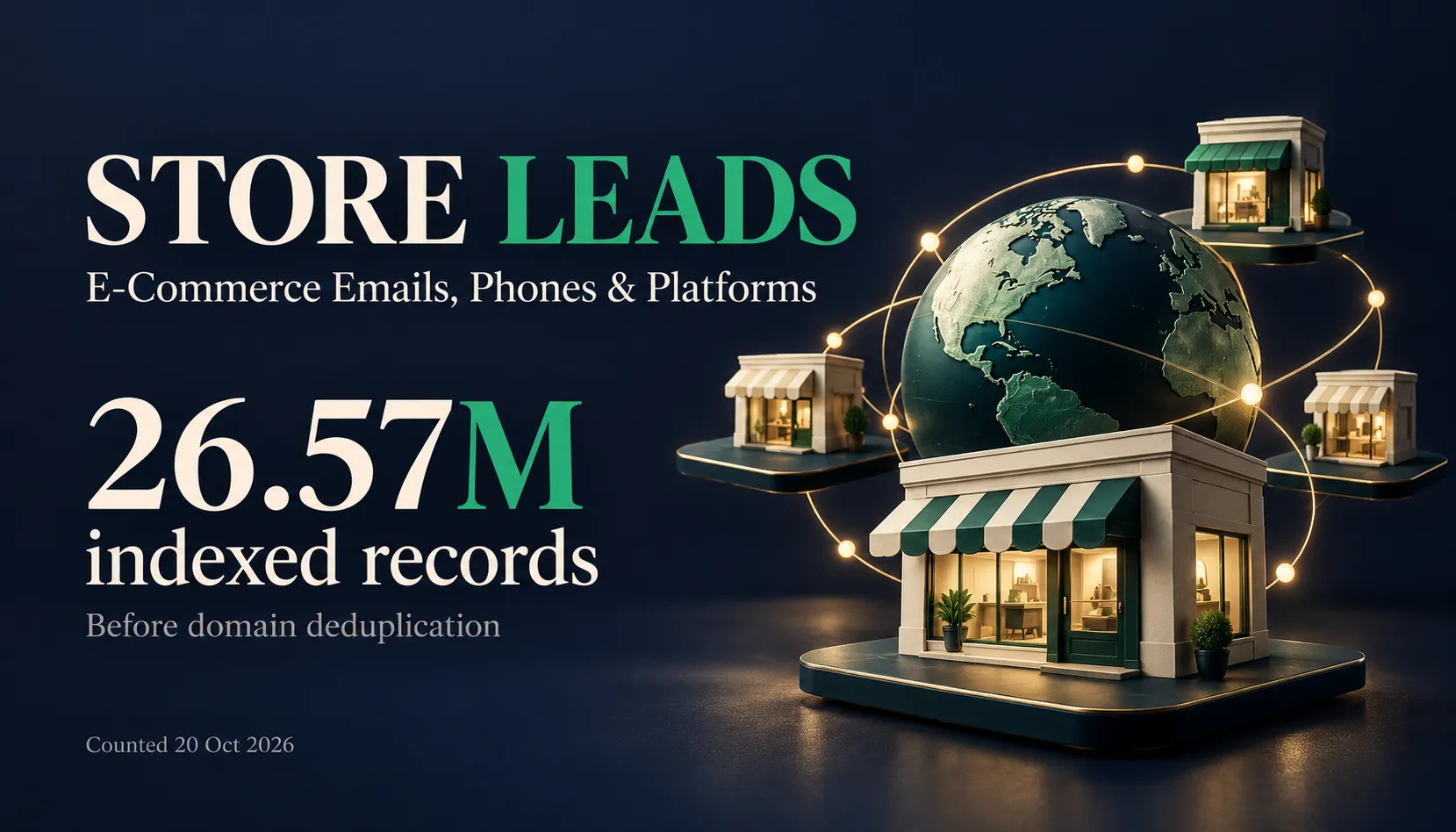
26.57 million matching indexed records, counted on 20 October 2026 across the supported commerce-platform selection with no country or contact-presence restriction. The exact count was 26,570,455 source records, with complete source coverage and no failed sources. This is a snapshot before cross-source domain deduplication, not 26.57 million unique stores, email contacts or currently active businesses. Exported results deduplicate domains; contact filters reduce the matching audience. The index and its counts can change.
This Actor requires stored commerce-platform evidence on every result. A general WordPress, Wix or Squarespace label does not qualify a website as a store. Stored evidence is historical: it does not establish that a store is currently active or that its contacts are deliverable.
First export
Start with a small list:
The dataset contains leads. SUMMARY describes completeness and warnings; ERRORS describes failures. An empty dataset can be a valid result. Read these diagnostics before increasing the export limit or retrying.
Supported store platforms
| Selection | Required stored commerce evidence |
|---|---|
shopify | Shopify or Shopify Plus |
woocommerce | WooCommerce or WooCommerce Checkout |
magento | Magento and supported version/edition labels |
prestashop | PrestaShop |
bigcommerce | BigCommerce, v2, v3 or B2B |
wix_stores | Wix Stores |
squarespace_commerce | Squarespace Add to Cart, Commerce or Active Store |
An empty storePlatforms selection searches all supported commerce platforms. Available records are checked by their stored technology fields, even when their source dataset was originally organized under another technology. Counts across source datasets and platform labels can overlap.
Use cases
- Agencies building store migration or maintenance prospect lists.
- App developers finding stores on a specific supported platform.
- Integration teams researching regional e-commerce audiences.
- Sales operations exporting indexed business contacts to a CRM.
- AI agents counting a matching audience before requesting an export.
Qualify leads independently before contacting them. The Actor does not send outreach or validate ownership, consent, mailbox delivery, telephone reachability or current trading activity.
A real output example
This example is taken from a real release QA result. Identifying and contact values are redacted; it is not a fictional customer record. Optional fields and source dates vary.
The full record is available in your own run Dataset. The exported row retains stored platform evidence; the Actor does not perform live store or mailbox verification.
Fields and export presets
| Data | Fields and limitations |
|---|---|
| Website identity | Root Domain, company and available location fields |
| Business contacts | Available emails, telephones and social profile strings; fields can be empty |
| Commerce evidence | eCommerce Platform, CMS Platform, _platformEvidence |
| Source dates | Available Last Found and Last Indexed; these are not a live check timestamp |
| Sales context | Available category, employee and estimated revenue/spend fields |
contacts focuses on contact and location information. sales includes indexed business and technology context. full returns all available columns. custom uses your columns selection. Domain, technology evidence and source dates accompany every preset.
Technology and contact values are generally semicolon-separated strings. Estimated business metrics remain estimates. Missing values do not prove that a business has no contact or technology.
Count before exporting
Read COUNT_SUMMARY. It reports matching source records; it is not a global distinct-store count. Check isComplete and errors. Count mode writes diagnostics rather than lead rows.
Phone audience
Controls and limits
| Input | Behavior |
|---|---|
workflow | export by default, or count |
storePlatforms | Supported commerce platforms; empty selects all |
country | ISO-2 country codes; empty means no country restriction |
keyword | Literal company/domain substring; not a product/category classifier |
hasEmail | Defaults to true; requires a nonempty indexed email field |
hasPhone, phoneCode | Require available indexed phone data |
maxItems | 1–10,000 unique domains per export; default 10 |
outputPreset, columns | Choose the output fields |
filters | Additional supported column comparisons combined with AND |
sortBy, sortDesc | Result ordering; choose a supported column |
offset | Skip eligible deduplicated results; prefer returned continuation |
Source records may contain the same domain more than once. Exports deduplicate across selected data sources. No guarantee is made that fields from every overlapping record will be merged into a single most-current profile.
Pagination and partial results
After a capped export, read EXPORT_CONTINUATION and copy its resumeInput into the next run. It preserves the public platform and audience settings. Recover the existing dataset when you only need to download it again; another Actor run repeats work.
The index can change between runs, so pagination is not a frozen snapshot. A source failure must be treated as partial coverage. Check SUMMARY.isComplete, source failure counts and ERRORS before treating an export or count as complete.
API, CSV and AI agents
Apify provides JSON, CSV and Excel exports for the default dataset. Use the exact Actor ID apivault_labs/store-leads-database.
The n8n example uses ordinary HTTP Request nodes and your Apify credential. It is an importable workflow, not a verified community node or an n8n Cloud verification claim. The Python example uses the standard library. No dedicated new npm or PyPI package is claimed; existing Analyzer packages target different Actors.
For MCP, expose https://mcp.apify.com?tools=apivault_labs/store-leads-database in your compatible client, authenticate through Apify, and begin with the small JSON input above. Use the returned Dataset and diagnostics, not only the run status.
Agents should start with maxItems: 10, use the exact schema enums, inspect diagnostics, and increase volume only after checking useful records and cost controls. Never interpret a successful run alone as proof of complete coverage.
Pricing and cost controls
$6 per 1,000 delivered domains ($0.006 per paid dataset row) on every plan, plus $0.00005 per start event per GB of Actor memory, with at least one start event. Apify platform resources are billed separately to the user.
A 10-row sample has $0.06 in lead events before startup and resources. Only useful rows delivered after audience filters and within-run domain deduplication are lead events. Missing optional fields do not make a delivered row free. count and empty results produce no paid dataset lead rows, but startup and resources still apply.
Set a small maxItems and an appropriate Apify Max total charge. A spending limit can stop delivery before the requested row limit; read SUMMARY and EXPORT_CONTINUATION. Resource usage varies with filters, selected platforms and source response times. The same page downloaded from its existing Dataset does not start another Actor run.
FAQ
How large is the database? The supported commerce-platform query matched 26,570,455 indexed source records on 20 October 2026, before cross-source domain deduplication. Count mode used hasEmail: false, no country filter and all supported store platforms. A global distinct-store inventory has not been measured. Record counts, unique domains, records with contacts and currently active stores are different measurements.
Are ordinary Wix or WordPress sites included? Only if the same row contains supported commerce-platform evidence. A CMS label alone is insufficient.
Is every email or phone present and verified? No. Contact availability varies. Filters test stored field presence, not delivery or reachability.
Is this live store scraping? No. It searches indexed records with stored technology evidence and available source dates.
Why can I get fewer results than requested? Audience filters, deduplication, available records, spending limits or source failures can reduce delivery. Read diagnostics to distinguish them.


