
BigCommerce Scraper: Catalog, Variants & Pricing
Pricing
from $0.74 / 1,000 product scrapeds
BigCommerce Scraper: Catalog, Variants & Pricing
Scrape BigCommerce storefronts for product catalogues: names, SKUs, prices, options, availability, categories and images. Covers a large mid-market merchant base.
Pricing
from $0.74 / 1,000 product scrapeds
Rating
0.0
(0)
Developer

Arman Hossain
Maintained by CommunityActor stats
0
Bookmarked
1
Total users
1
Monthly active users
22 days ago
Last modified
Categories
Share
Agent skill: SKILL.md
What it does
Scrape BigCommerce storefronts for product catalogues: names, SKUs, prices, options, availability, categories and images. Covers a large mid-market merchant base. Give it stores and it returns one structured record per product.
Point it at a storefront domain and it walks the store's public product sitemap, then reads each product from two public storefront surfaces: the product page's structured-data island and BigCommerce's /remote/v1/product-attributes/{id} JSON route, the same endpoint the storefront's own JavaScript calls to price a product. That second call is what makes SKUs, live prices, sale prices, currency and stock reliable instead of scraped off rendered text.
Verified live against three unrelated merchants running three different themes: cornerstone-light-demo.mybigcommerce.com, www.bulkapothecary.com and www.berlinpackaging.com.
Which BigCommerce surface this uses
This matters, so it is stated plainly. This Actor targets the public storefront a shopper sees, not the authenticated BigCommerce management API, and not the Storefront GraphQL API. No token, no store hash, no API account.
Two routes that are often assumed to work do not work unauthenticated, and this Actor does not use them:
| Route | What actually happens |
|---|---|
public API | 401, {"errors":[{"message":"GraphQL credentials were missing. No token was sent."}]}. The Storefront GraphQL API needs a token the merchant must mint; storefronts do not publish one in the page. |
public API | 404, no such route. /api/storefront/* covers carts, checkouts and orders only. |
What this Actor uses instead, all anonymous, all confirmed 200 on live merchant storefronts:
| Route | Purpose |
|---|---|
GET /xmlsitemap.php → ?type=products&page=N | Product discovery. Served on every BigCommerce storefront regardless of theme. |
GET /remote/v1/product-attributes/{productId} | Authoritative JSON: SKU, UPC/MPN/GTIN, price, MSRP/was-price, currency, stock, purchasability, weight. |
GET /{product-url} | Product page, JSON-LD Product and BreadcrumbList, Open Graph tags, image gallery, option widgets. |
GET /{category-path}?page=N&limit=50 | Optional category-scoped discovery on Stencil-standard themes. |
Input
| Field | Type | Default | Notes |
|---|---|---|---|
stores | array | - | Required. Storefront domains or URLs. Anything past the host is ignored, so https://store.com/some/page and store.com are the same input. |
categoryIds | array | [] | Restrict the sweep to categories. Pass a category page path or full URL, fragrance-oils, /shop-all/kitchen/. Empty = walk the whole product sitemap. |
maxProductsPerStore | integer | 50 | Cap per store. 0 = no limit. Each product costs two requests. |
includeOptions | boolean | true | Include configurable options and modifiers. Set false to drop the field entirely. |
Which combinations make sense.
- Whole-catalogue sweep.
storesonly,maxProductsPerStore: 0. Uses the sitemap route, which works on every theme. Budget two requests per product. - Narrow, repeatable price watch. Add
categoryIdswith the category paths you care about and keepmaxProductsPerStoresmall. Uses the category route, which is faster but theme-dependent (see below). - Cheap change detection.
includeOptions: false. Records shrink a lot on stores with large option sets, and you still get price, sale price and availability.
About categoryIds. The field keeps its name for compatibility, but numeric BigCommerce category IDs cannot be used. Public storefronts expose no id-addressable category route, ?category=23, /categories/23 and rss.php?categoryid=23 are all either ignored or 404, verified live. Numeric entries are skipped with a warning and listed in RUN_SUMMARY.filters.ignoredNumericCategoryIds. Pass the category page path instead; that is the selector the storefront actually honours.
Output
One dataset item per product. Annotated sample, real values from a live run against www.bulkapothecary.com:
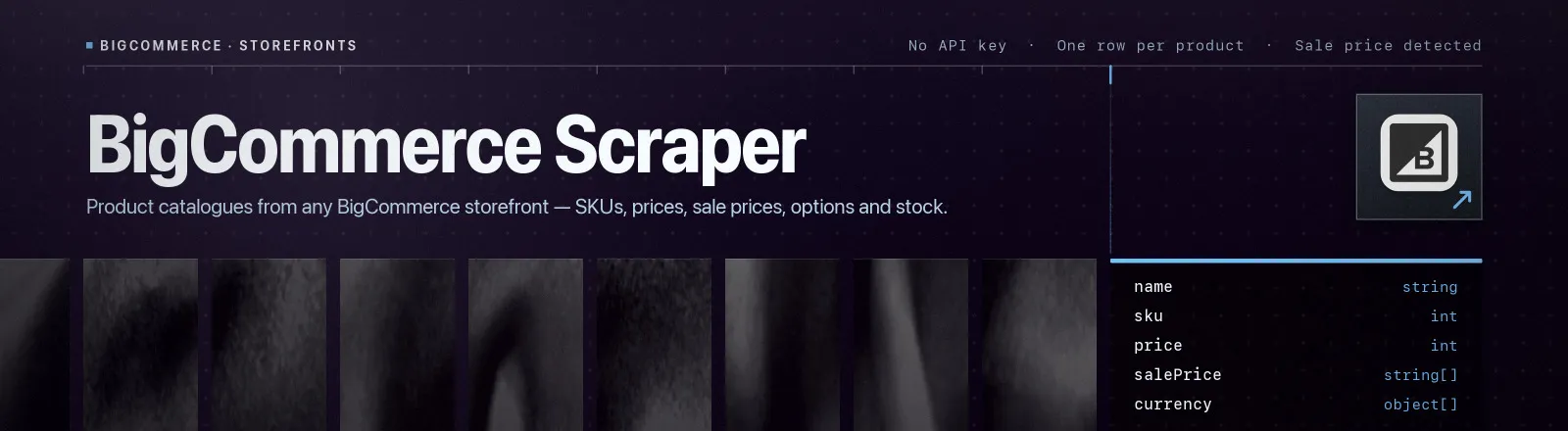
| Field | Meaning |
|---|---|
store | Storefront host the record came from |
productId | BigCommerce product ID, read from the add-to-cart form, the id you pass to /remote/v1/product-attributes/ |
name | Product name (JSON-LD, falling back to the page <h1>, then og:title) |
sku | Merchant SKU from the storefront JSON route. null when the merchant publishes none |
price | List price. The MSRP or was-price when the store publishes one, otherwise the current price |
salePrice | Discounted price currently charged, or null when not on sale. What a shopper pays today is salePrice ?? price |
currency | ISO currency of the price, per the storefront's active currency |
categories | Breadcrumb trail with Home and the product itself removed |
brand | Brand name where the theme publishes one, else null |
availability | InStock, OutOfStock or PreOrder, from the JSON route's instock / purchasable, falling back to schema.org |
inventoryLevel | Units in stock, only when the merchant enables public inventory display, otherwise null |
options | Configurable options: name, widget type, whether required, and every value with its BigCommerce value ID. Omitted when includeOptions is false |
images | Full-resolution gallery URLs (1280px zoom variants where the theme provides them) |
description | Product description as plain text, HTML stripped, entities decoded |
url | Canonical product URL |
scrapedAt | Run timestamp |
Sale detection works: in the same run, Openhouse No. 3 came back with "price": 30, "salePrice": 27.95, "currency": "CAD".
RUN_SUMMARY
A RUN_SUMMARY record in the key-value store carries per-run counts, per-source failures and the applied filters:
perStore tells you which discovery route each store resolved to, how many product URLs it found, how many became records, and whether a BigCommerce fingerprint was seen on the page, the fastest way to tell "wrong platform" from "cap reached" from "theme renders client-side".
Use cases
1. Mid-market retail price monitoring. Watch a competitor's catalogue on a schedule and diff price, salePrice and availability on productId. Drop options to keep records small and the diff clean.
2. Competitive assortment analysis. Pull several stores in one run and compare on categories and brand, who carries what, at what price, and where the gaps in your own range are.
3. Supplier catalogue extraction. Take a supplier's storefront and lift the section you resell into your own system, SKU, options with their value IDs, tiered pricing text, images and description, ready to map.
Limits and behaviour
- Storefront access varies by merchant configuration. The Actor detects the available route per store instead of assuming one shape, and reports the route it used in
RUN_SUMMARY.perStore. - The sitemap route is the reliable one.
/xmlsitemap.phpis served by every BigCommerce storefront and does not depend on the theme. Use it (leavecategoryIdsempty) whenever you want a complete catalogue. - The category route is theme-dependent. It reads Stencil's standard product-card markup. Themes that render their product grid client-side,
www.berlinpackaging.comis a live example, return a page with no server-rendered cards, so that category yields nothing. This is logged, recorded inRUN_SUMMARY.failures, and the run continues. - Numeric category IDs do not work on public storefronts. See the input section.
- A failing store never aborts the run. Discovery failures, non-BigCommerce hosts and individual product errors are all recorded in
RUN_SUMMARY.failures. The Actor only throws when every store produced zero products. - Transient errors are retried.
429and5xxget three attempts with linear backoff.404and403fail fast. - Sparse fields are honest, not broken.
sku,brandandinventoryLevelarenullwhen the merchant does not publish them.inventoryLevelin particular is only populated when the store enables public stock display; most do not. price: 0is real. Sample and quote-only products price at zero on some merchants,www.berlinpackaging.comsample SKUs return$0.00from the storefront's own pricing endpoint.- JSON-LD is parsed defensively. Some themes inject raw newlines into the structured-data island, which is invalid JSON; the Actor retries the parse with control characters flattened rather than dropping the product.
- Public data only. No authentication, no personal data, no access-control bypass, every route used is one an anonymous shopper's browser calls.
Defaults: 2 GB memory · 30 min timeout.
FAQ
Do I need a proxy? No. Proxy configuration is not required to run this Actor.
Do I need an account on the source? No. You supply no credentials.
Does this use the BigCommerce API? Not the management API and not the Storefront GraphQL API, both need credentials the merchant controls. This reads the public storefront, including the /remote/v1/product-attributes/ JSON route that the storefront's own JavaScript uses.
What happens if a source is unavailable? It is reported in RUN_SUMMARY.failures and the run continues with the remaining stores.
Can I schedule it? Yes, it is designed for scheduled runs. Diff on productId plus price / salePrice / availability.
How do I know a store is BigCommerce? Run it and check RUN_SUMMARY.perStore[].bigcommerceConfirmed. A store on another platform returns 404 on /xmlsitemap.php and is reported as failed.
Why did I get fewer products than the store sells? Either maxProductsPerStore capped the run, or you used categoryIds on a theme that renders its grid client-side. perStore.discovered versus saved distinguishes the two immediately.
Does it return variant-level prices? It returns the base product price plus the full option matrix with each value's ID. Per-variant pricing usually appears in the option labels themselves ("Bag of 50 - ($0.44 / unit) - $21.84"), because that is how BigCommerce presents it.
Can I integrate it with something else? Yes, Apify API, client libraries, webhooks, scheduled runs, dataset exports (JSON/CSV/Excel) or MCP. Output is structured JSON.
API example
JavaScript example


