
SEC Form D Scraper: Recently Funded Companies & Funding Rounds
Pricing
from $7.00 / 1,000 form d filing saveds
SEC Form D Scraper: Recently Funded Companies & Funding Rounds
Every SEC Form D filing from EDGAR as data: startup funding rounds, private placements and VC, PE and hedge fund raises, as a daily feed or a history back to 2009. Amount raised, round size, executives with titles, phone, address, EIN, fund type, first-raise flag. No API key.
Pricing
from $7.00 / 1,000 form d filing saveds
Rating
0.0
(0)
Developer

Epic Scrapers
Maintained by CommunityActor stats
0
Bookmarked
2
Total users
1
Monthly active users
4 days ago
Last modified
Categories
Share
SEC Form D Scraper: recently funded companies, funding rounds and fund raises
SEC Form D Scraper turns SEC Form D filings into clean data: one row per private raise, with the company or fund, amount raised, round size, industry, the executive who signed with their title, phone, address, year founded and whether it is the issuer's first raise. Every US company and fund that sells shares, SAFEs, notes or LP interests in a private placement (a seed or Series A round, a real estate syndication, a new VC, PE or hedge fund) has to file a Form D within 15 days of the first sale. This Actor reads those filings straight from SEC EDGAR.
Use it as a daily feed of new raises for sales and recruiting, or pull every Form D filed since 2009 (778,516 filings) to build a funding database, a market study or a fund-industry prospect list.
- Fresh funding signals. Filings appear on EDGAR the day they are filed, often weeks before a press release or a Crunchbase entry, and many raises are never announced at all.
- Full history back to 2009. Any date range, one row per filing, so you can backfill years of rounds and keep them updated with a daily run.
- Companies and funds. Operating companies by default; untick one box to add VC, PE, hedge, real estate and other pooled funds with fund type, broker-dealers and placement agents.
- A named decision maker per issuer. The person who signed the filing with their real title (CEO, CFO, Managing Member), plus every executive officer, director and promoter listed.
- Phone, address and EIN from the filing and the issuer's EDGAR profile.
- Startup filters. Companies incorporated in the last five years, first-time Form D filers, no stock ticker.
- Filter at the source. State, industry, amount raised, offering size, exemption (Rule 506(b), 506(c), 504) or keyword.
- Built for schedules and pipelines. "Only filings not returned before" delivers each filing once, so a daily run feeds your CRM, warehouse, Google Sheet or Slack with new raises only.
- Official data, no API key, no proxy. SEC EDGAR full-text search and the structured Form D XML each issuer submits. Export to CSV, Excel or JSON, or use the API.
Who uses it?
| You are | What you do with it | Typical setup |
|---|---|---|
| Data platform, fintech or alt-data team | Build a private-markets dataset: every round and fund raise since 2009, then a daily update. | Backfill year by year with funds and amendments, then a daily schedule |
| Fund administrator, fund lawyer, auditor, placement agent | Find every new VC, PE, hedge and real estate fund the week it holds its first close, with the GP's signer and phone. | Funds included, Pooled Investment Fund industry, daily schedule |
| Lead-generation agency or list broker | Deliver "recently funded companies" lists to many clients, each with their own states, industries and round sizes. | One saved task per client, each on its own schedule |
| B2B sales team | Call or email companies the week they raise, when they are buying tools and hiring. | Defaults, your states and industries, daily schedule |
| Recruiter or staffing firm | Pitch freshly funded startups that are about to grow headcount. | Young companies, first raise, amount raised $1M+ |
| VC, angel or corporate development | Track who is raising in your sector and state, how much, and how fast rounds fill (percentSold). | Industry filter, amendments included to follow each round |
| Bank, insurer, payroll or cap table tool | Find new business customers right after they get money in the bank. | Amount raised filter, daily schedule |
| Researcher or journalist | Study private capital formation by industry, state, round size and year. | Multi-year backfill, everything included |
Quick start
- Click Try for free and sign in to Apify.
- Keep the defaults (filings from the last 7 days, funds and amendments excluded) or pick states and industries.
- Click Start. A week of filings takes about three minutes.
- Open the Output tab and export the list.
To get every new raise each morning, save your input as a task, turn on Only filings not returned before and add a daily schedule.
What is in Form D data?
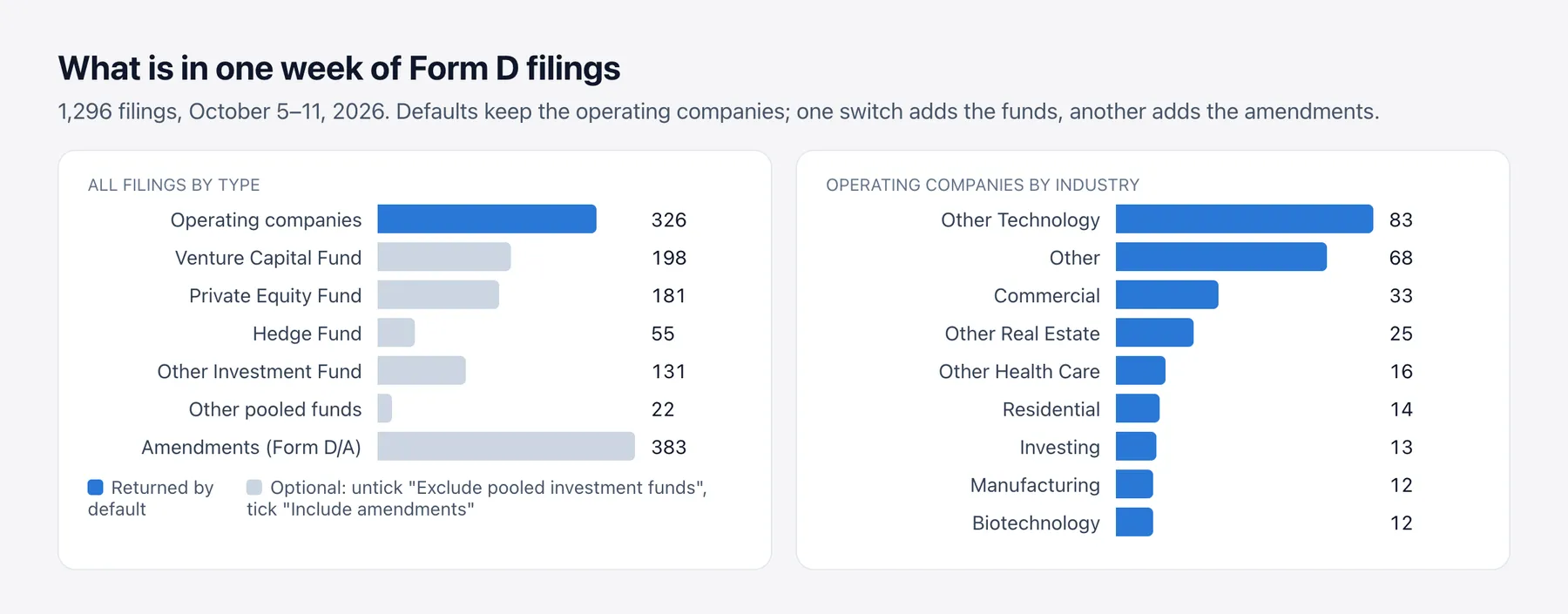
Most Form D filings are not startups. In the week above, 587 of the 913 new filings came from pooled investment funds and 383 more were amendments to earlier filings. The defaults keep only the 326 operating companies, the rows a sales or recruiting team can sell to. Fund service providers and data teams switch the funds and amendments back on and get everything.
Backfill years of funding rounds
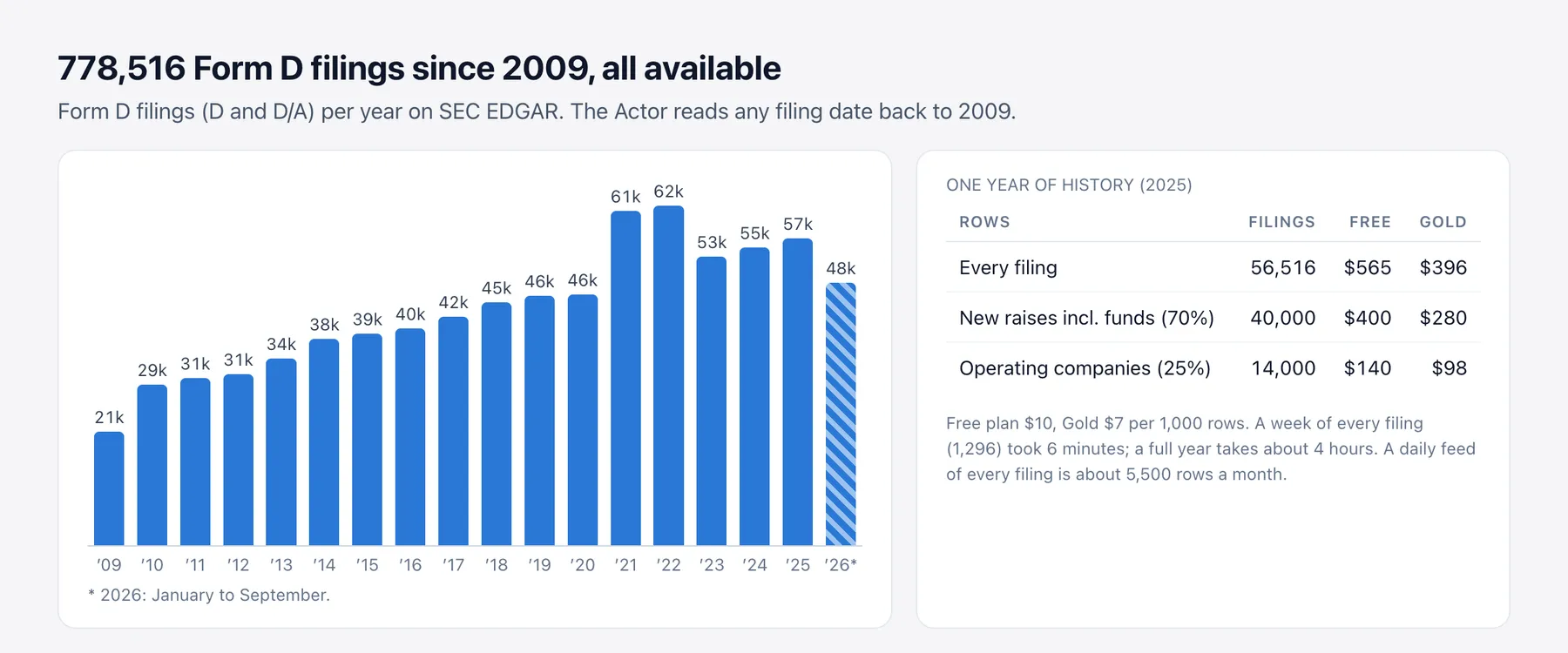
Set startDate and endDate to any range from 2009 on, with maxResults: 0. The Actor reads one filing day at a time, so any range works; there is no 10,000-result cap.
- Speed: the SEC allows 10 requests per second, and each filing takes about two. A week of every filing (1,296) took 6 minutes, so a full year takes about 4 hours. Set the run Timeout in the run options to cover it (it is 6 hours by default), or run one quarter per run.
- Cost: see the table in the image above, or How much does it cost? below. Your spending limit stops the run cleanly at your budget.
- Keep it current: after the backfill, schedule a daily task with
daysBack: 3and Only filings not returned before, so each new filing arrives once. - Follow rounds over time: with amendments included,
previousAccessionNumberlinks a Form D/A to the filing it updates, andtotalAmountSoldshows how much of the round has closed by then.
Track new funds (for fund service providers)
Every new VC, PE, hedge, real estate and credit fund files a Form D after its first sale. The rows name the fund, its type (investmentFundType), the amount raised so far, the minimum investment, the Investment Company Act exemption (3(c)(1) or 3(c)(7)), the broker-dealers and placement agents with their CRD numbers, the general partner or manager entities, and the person who signed for the GP with their title and phone.
onlyFirstFormD keeps funds filing for the first time, which are new funds, not a manager's tenth vehicle update. Add states to limit it to your region.
One task per client or segment (for agencies)
Save one task per client with that client's states, industries and round sizes, turn on Only filings not returned before and give each task a daily schedule. Each task remembers its own delivered filings, so every client gets each matching raise once, and a filing that fits two clients goes to both. Send the results anywhere with Apify integrations: Google Sheets, Slack, email, HubSpot through Make or Zapier, n8n, webhooks or the API.
What data do you get?
One row per Form D filing. The main columns:
| Group | Fields |
|---|---|
| Company | companyName, industryGroup, entityType, jurisdictionOfIncorporation, yearOfIncorporation, incorporatedWithinFiveYears, revenueRange, ein, sicCode, tickers, previousNames |
| Contact | primaryContactName, primaryContactTitle, phone, street, city, state, stateName, zipCode |
| People | relatedPersonsSummary (all names and roles in one cell), relatedPersons (array with first, middle and last name, roles, city and state), signerName, signerTitle |
| The raise | totalAmountSold, totalOfferingAmount, totalRemaining, percentSold, dateOfFirstSale, totalInvestors, hasNonAccreditedInvestors, minimumInvestment, securityTypes, exemptions, isRule506c |
| Funds | investmentFundType (venture capital, private equity, hedge, other), netAssetValueRange, isPooledFund |
| Raise history | isFirstFormD, firstFormDDate, formDFilingsTotal, isAmendment, previousAccessionNumber |
| Intermediaries | brokerDealers, salesCompensation (placement agents with CRD numbers and the states they solicit in), salesCommissions, findersFees, proceedsToInsiders |
| Filing | filingDate, formType, cik, accessionNumber, fileNumber, formDUrl (the filing on sec.gov), filingUrl, xmlUrl, companyFilingsUrl |
Example row (real filing, shortened):
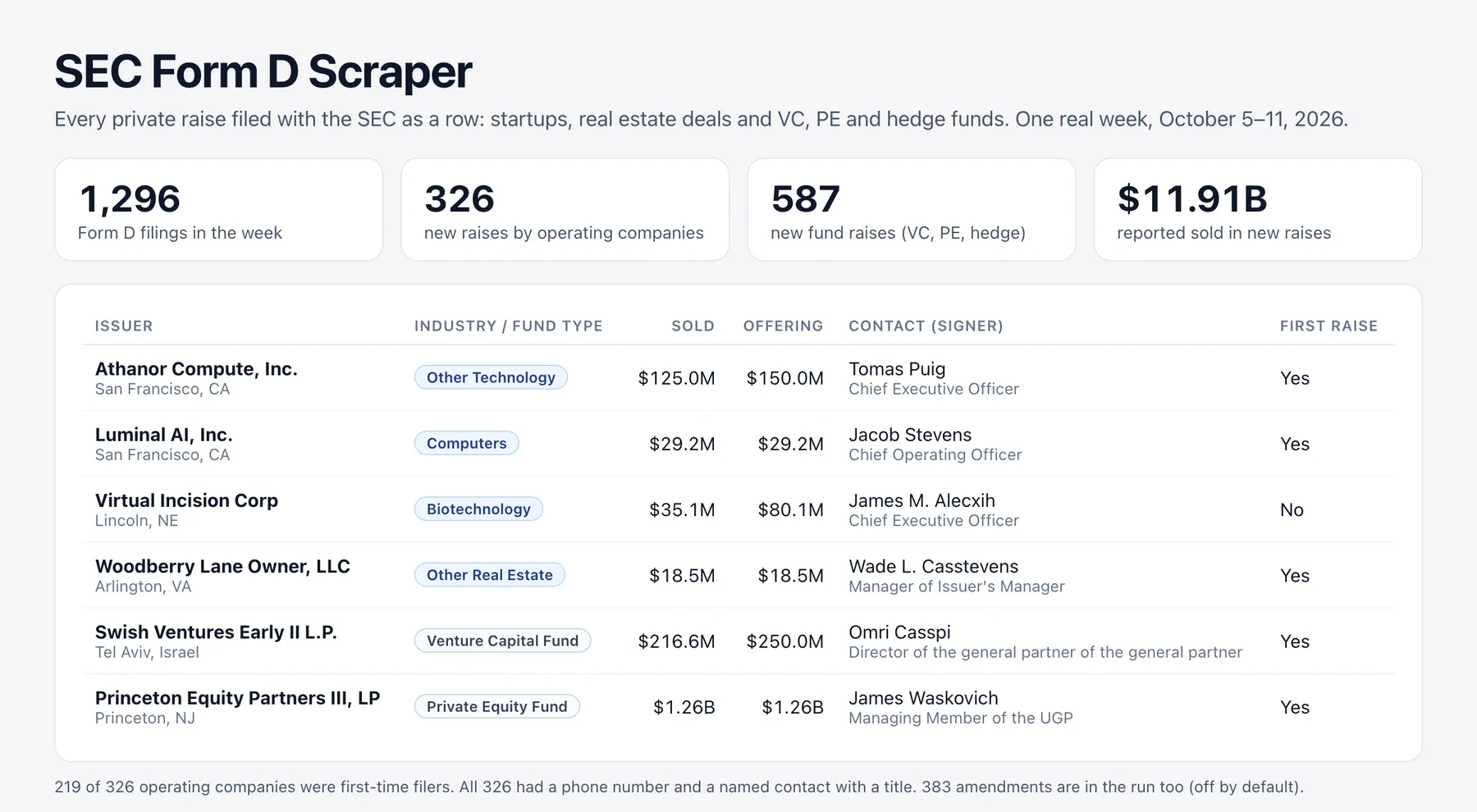
In the test week (October 5 to 11, 2026) all 326 operating companies had a phone number, an address and a named contact with a title, 219 were first-time filers and 249 were incorporated in the last five years.
Input reference
| Field | Type | Default | Description |
|---|---|---|---|
daysBack | integer | 7 | Filings from the last N days, counting today. Ignored when startDate is set. |
startDate, endDate | string | Filing date range (YYYY-MM-DD), any dates from 2009 on. endDate defaults to today. | |
states | array | all | Two-letter codes of the issuer's business address state, for example ["CA", "NY", "TX"]. |
industryGroups | array | all | Form D industry groups, for example Other Technology, Biotechnology, Pooled Investment Fund, Commercial (real estate). |
keyword | string | Words that must appear in the filing: company name, person, city or broker-dealer. SEC full-text search; quote phrases. | |
onlyYoungCompanies | boolean | false | Only companies incorporated within the last five years. |
onlyFirstFormD | boolean | false | Only issuers filing their first Form D ever. |
excludePublicCompanies | boolean | false | Drop companies with a stock ticker. |
excludePooledFunds | boolean | true | Drop VC, PE, hedge, real estate and other pooled investment funds. Set to false to include them. |
minAmountSold, maxAmountSold | integer | 0 | Amount already raised, in USD. 0 = no limit. |
minOfferingAmount, maxOfferingAmount | integer | 0 | Total offering size, in USD. Offerings of indefinite size never pass a minimum. |
exemptions | array | all | 06b (Rule 506(b)), 06c (Rule 506(c)), 04 (Rule 504), 4a5, 3C. |
includeAmendments | boolean | false | Also return Form D/A amendments (updates to earlier raises). |
onlyNewFilings | boolean | false | Skip filings this task (or the same input) returned in earlier runs. |
maxResults | integer | 100 | Maximum rows. 0 = no limit. |
Ready-to-run examples
Tech startups in California and New York that raised $500k or more, first raise only
Every new raise of the last 30 days, no filters
Daily feed of new health care raises (use with a schedule)
Companies raising publicly under Rule 506(c)
506(c) lets issuers advertise their round to accredited investors, so these companies are actively marketing.
Real estate syndications and funds
Every Form D of 2024, for a dataset
How much does it cost?
You pay per saved filing: $10 per 1,000 filings on the Free plan, $9 on Bronze, $8 on Silver and $7 per 1,000 on Gold and higher plans. Platform usage is included. Filings removed by your filters are free, and the run stops at your spending limit.
| What you pull | Rows | Free plan | Gold plan |
|---|---|---|---|
| One week, operating companies (defaults) | about 330 | $3.30 | $2.31 |
| Daily feed, operating companies, one month | about 1,400 | $14 | $9.80 |
| Daily feed, every filing incl. funds, one month | about 5,500 | $55 | $38.50 |
| One year, operating companies | about 14,000 | $140 | $98 |
| One year, every filing (2025: 56,516) | 56,516 | $565 | $396 |
| Everything since 2009 | 778,516 | $7,785 | $5,450 |
Row counts are from EDGAR's filing totals and the October 5–11, 2026 test week (25% operating companies, 45% new fund raises, 30% amendments).
How it works
- The Actor searches EDGAR full-text search for Form D filings, one filing day at a time, filtered by state and keyword on the SEC side.
- Amendments are dropped before download (unless you include them). For each remaining filing it downloads the structured
primary_doc.xmlthe issuer submitted and reads every field of the form. - Funds and your other filters are applied, and the issuer's EDGAR profile adds EIN, ticker and Form D history.
- Requests stay under the SEC's fair-access limit of 10 per second, with an identifying User-Agent.
FAQ
How fresh is the data? Filings appear in EDGAR search on the day they are filed. EDGAR doesn't accept filings on weekends and federal holidays, so a 1-day window on a Monday morning can be empty; the default 7-day window covers that.
How far back does it go? To 2009, when the SEC made Form D an electronic, structured filing. Older paper filings have no data to read.
Why are there no emails or websites? Form D doesn't ask for them. You get the issuer's phone, address and the names and titles of its executives, which is what you need to look them up in your email-finding or enrichment tool.
What does "amount raised" mean? totalAmountSold is what the issuer reports as already sold when it files. A Form D is filed within 15 days of the first sale, so many rounds are still open; amendments (Form D/A) update the number later. totalOfferingAmount is the size of the round they plan.
What is a "related person"? Form D lists every executive officer, director and promoter of the issuer. For funds and real estate deals these are often the general partner or manager entities, marked with isOrganization: true.
Why do some companies appear twice? An issuer can file several Form Ds in a week (separate rounds, securities or parallel funds). Each filing is one row; accessionNumber is unique.
Can I call it from code or an AI agent? Yes. Run it through the Apify API or the JavaScript and Python clients, or from any MCP client through the Apify MCP server, and read the dataset as JSON or CSV.
Is it legal to use this data? Form D filings are public records published by the US Securities and Exchange Commission. Follow the rules for your outreach (CAN-SPAM, TCPA, GDPR where it applies).
Related Actors
- Swapcard Exhibitor List Scraper: trade show exhibitors with emails and websites.
- LinkedIn Company Details Scraper: enrich companies with size, website and industry.
Questions or a field you need? Open an issue on the Actor's Issues tab.


