
Podcast Transcript Scraper: Any Podcast to Text & SRT
Pricing
from $4.80 / 1,000 audio minutes
Podcast Transcript Scraper: Any Podcast to Text & SRT
Podcast episode transcripts: transcribe any podcast by name, Apple Podcasts link or RSS feed. Newest episodes to text, timestamps and SRT subtitles in 99 languages, with episode title and date. Schedule it for every new episode. Whisper, no API key. Pay per minute.
Pricing
from $4.80 / 1,000 audio minutes
Rating
0.0
(0)
Developer

Fernando Guiraud
Maintained by CommunityActor stats
0
Bookmarked
1
Total users
0
Monthly active users
5 hours ago
Last modified
Categories
Share
What does Podcast Transcript Scraper do?
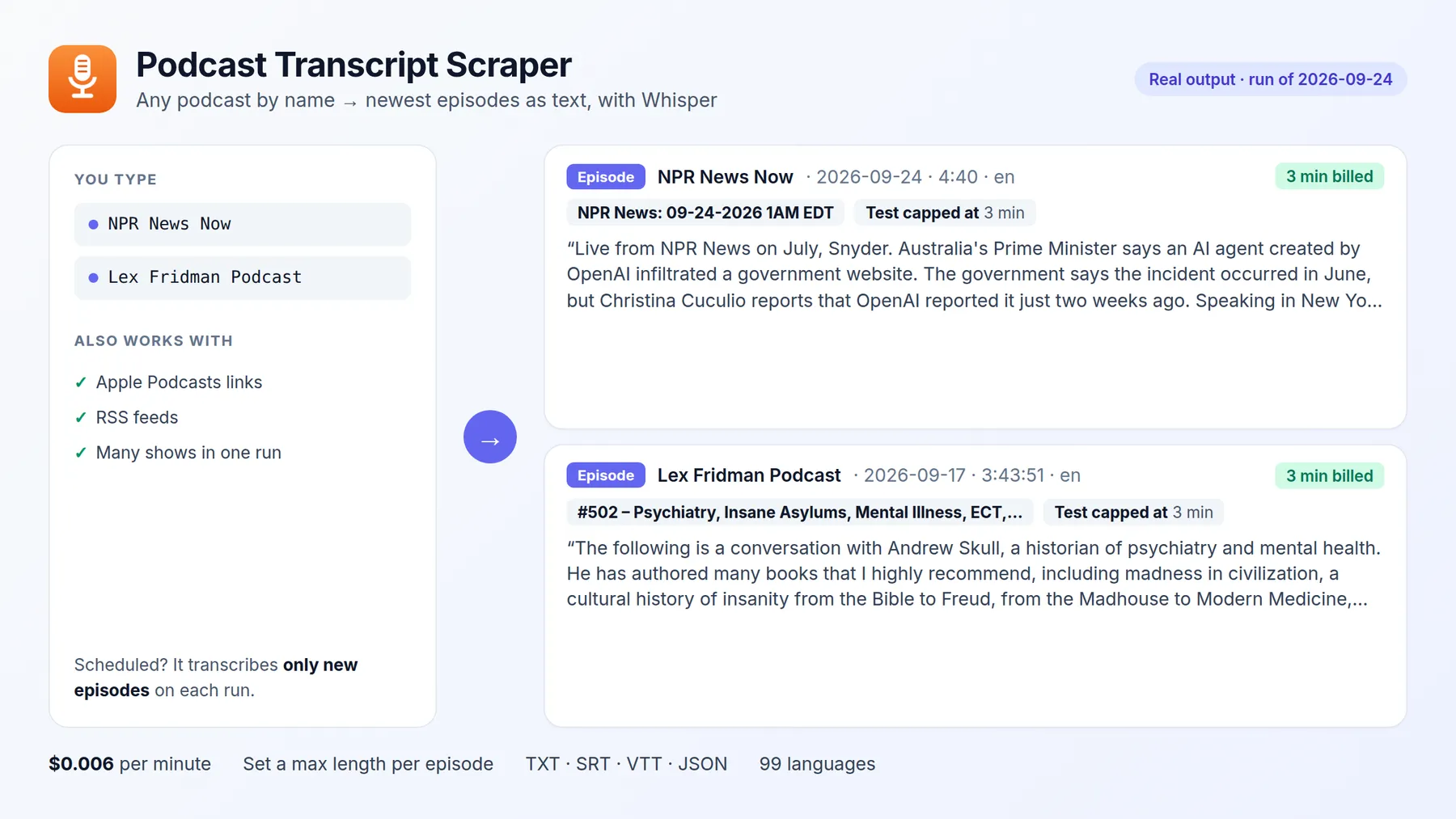
Podcast Transcript Scraper turns any podcast into text. Type the podcast's name, or paste its Apple Podcasts link or RSS feed, and get the newest episodes transcribed: full transcript, timestamped segments, Markdown with timestamps and SRT/VTT subtitles, together with the podcast name, episode title and publish date.
It finds the podcast's public RSS feed automatically and transcribes the audio with open-source Whisper in 99 languages, so there is no OpenAI key and no subscription. Schedule it daily and it transcribes only new episodes. You pay per minute of audio, and failed episodes are never billed.
It runs on the Apify platform, so you also get an API, scheduling, integrations (Google Sheets, Make, Zapier, n8n, Notion via webhooks) and access for AI agents through the Apify MCP server.
Why use it?
- 📰 Monitor podcasts in your industry: get every new episode of 10 or 50 shows as searchable text each morning.
- ✍️ Content repurposing: turn your own episodes into blog posts, show notes, newsletters and social clips.
- 🔎 Research and media monitoring: search what guests said about your company, competitors or a topic.
- 🤖 RAG and AI assistants:
chunksoutput with timestamps, ready for a vector database. - 🧠 Optional AI insights: summary, key points, chapters with start times and action items for each episode (Claude, with your own Anthropic key).
How to get a podcast transcript
- Click Try for free.
- In Podcasts, type a podcast name (e.g.
Lex Fridman Podcast) or paste its Apple Podcasts link or RSS feed. - Choose how many of the newest episodes to transcribe in Episodes per feed.
- Click Start, then download the transcripts as JSON, CSV or Excel, or as
.txt/.srtfiles with Also save downloadable files. - To get new episodes automatically, create a schedule (for example daily). With Only new episodes on, each run transcribes and bills only episodes it has not seen before.
Input
| Field | Description | Default |
|---|---|---|
podcastFeeds | Podcast names, Apple Podcasts links or RSS feed URLs | required |
maxEpisodesPerFeed | How many of the newest episodes per podcast | 3 |
onlyNewEpisodes | Skip episodes transcribed by previous runs | true |
model | base (recommended), small (most accurate) or tiny | base |
language | Spoken language code or auto | auto |
outputs | text, markdown, segments, srt, vtt, chunks | text, segments |
vocabulary | Names and jargon to recognise better (hosts, guests, products) | - |
speakerLabels | Label who said each sentence (Speaker 1, Speaker 2...), +$0.003/min | off |
numSpeakers | How many people speak, if you know it (0 = detect) | 0 |
aiInsights + anthropicApiKey | AI summary, chapters and action items | off |
maxDurationMinutes | Transcribe (and bill) at most N minutes per episode | 240 |
Output
One row per episode. You can download the dataset in various formats such as JSON, HTML, CSV, or Excel.
Who said what: speaker labels
Turn on speakerLabels and every sentence gets its speaker (Speaker 1, Speaker 2...), for interviews, podcasts, meetings and panels. The text, segments, SRT/VTT subtitles, Markdown and RAG chunks all show who speaks; the result also says how many speakers were found (speakers). It adds $0.003 per minute.
Real result on a podcast interview (SRT output: the host's question, then the guest's answer):
SRT and VTT mark the speaker on each subtitle ([Speaker 2] ... and the standard WebVTT voice tag <v Speaker 2>), and a subtitle never mixes two voices.
- Speakers are detected automatically. If you know how many people talk, set
numSpeakersfor more exact labels. - Works best when each person talks for a while. Someone who only says a word or two in the whole file can be counted as the closest other voice. Overlapping speech goes to the main voice.
- Speaker labels are names in order of appearance, not real names: Speaker 1 is whoever talks first.
- Voice fingerprints: NVIDIA NeMo TitaNet small (CC-BY-4.0), run on Apify; no audio leaves the run.
Data fields
| Field | Description |
|---|---|
podcast, episodeTitle, published | Episode metadata from the RSS feed |
audioUrl, feed | Episode audio file and its feed |
text / markdown | Full transcript, plain or with timestamps |
segments | Timestamped segments (optionally word-level) |
srt / vtt | Subtitle files |
chunks | RAG-ready passages with start/end times |
insights | AI title, summary, key points, chapters, action items (optional) |
durationSeconds, billedMinutes | Episode length and minutes charged |
How much does a podcast transcript cost?
| Event | Price |
|---|---|
| Run start (per GB of memory, default 4 GB) | $0.0005 |
| Audio minute, base or tiny model | $0.006 ($0.36 per hour) |
| Audio minute, small model | $0.012 ($0.72 per hour) |
Speaker labels per minute (optional, speakerLabels) | $0.003 |
| AI insights per episode (optional; Claude usage billed to your own key) | $0.01 |
A 1-hour episode with the base model costs about $0.36. Failed episodes and episodes with no speech are free. Use maxDurationMinutes to cap long episodes, and Max cost per run to cap a whole run.
How accurate is it? Whisper tiny vs base vs small
We measured the three models ourselves, with the same code this Actor runs:
| Model | Word error rate (lower is better) | Speed on Apify (default 4 GB) | Price per minute |
|---|---|---|---|
tiny | 11.3% | about 20–30× faster than real time | $0.006 |
base (default) | 8.2% | about 11× faster than real time | $0.006 |
small | 5.4% | about 4× faster than real time | $0.012 |
Word error rate was measured on 73 clean English recordings from the LibriSpeech test set (8.6 minutes of audio). Speed was measured on a 2.6-minute speech recording in Apify runs (tiny: scheduled test runs). Accents, background noise and other languages give higher error rates, so choose small for those. A 60-minute episode takes about 5–6 minutes with base and about 15 minutes with small.
Use it with AI agents (MCP)
Add https://mcp.apify.com?tools=fguiraud/podcast-transcript-scraper to Claude, Cursor or any MCP client and ask: "Transcribe the latest episode of the Lex Fridman Podcast and summarise the main arguments."
Agent-friendly input: common field names such as url, urls, startUrls, query or keywords are accepted, and an empty input runs a small sample from the input form (with a note in the results) instead of failing.
Need to transcribe other audio or video?
For meetings, interviews, voice notes, MP4 videos and files sent as base64, use Audio & Video to Text Transcription, built on the same engine.
FAQ and limitations
- Which podcasts work? Any podcast with a public RSS feed, which covers almost every podcast on Apple Podcasts. Spotify-exclusive shows have no public feed and are not supported.
- The name matched the wrong podcast. Paste the Apple Podcasts link or the RSS feed instead of the name.
- Who is speaking? Speaker labels (diarization) are not included yet.
- Copyright: transcripts are for your own research, accessibility and analysis. Check the podcast's terms before republishing its content.
- Found a problem or need a feature? Open an issue on the Issues tab. Replies within 48 hours. If the Actor saved you time, a quick review helps others find it.
Related tools
- TikTok, Instagram Reels, X or Facebook videos? Video to Text Transcriber takes the link (or a whole TikTok account) and returns the transcript with views and likes.
- Transcribing YouTube videos? YouTube Transcript Scraper returns the captions of any video or Short as text, SRT or Markdown in seconds, for a fraction of the cost of transcribing the audio.
- Need to transcribe your own recordings (calls, meetings, videos)? Audio & Video to Text Transcription (Whisper) accepts MP3, MP4, WAV and Google Drive or Dropbox links.


