

App Store Intelligence — iOS App Metadata & AI (iTunes)
Pricing
from $44.00 / 1,000 app analyzeds
App Store Intelligence — iOS App Metadata & AI (iTunes)
Look up any iOS app or developer via Apple's public iTunes API: ratings, rating count, category, price, version history, size and release dates — with an AI read on positioning and momentum. For app market research and competitor tracking.
Pricing
from $44.00 / 1,000 app analyzeds
Rating
0.0
(0)
Developer

Fredrik Hansson
Maintained by CommunityActor stats
0
Bookmarked
2
Total users
1
Monthly active users
7 hours ago
Last modified
Categories
Share
Point it at any iOS app and get the full picture in one row. Hand this Actor a list of app names, numeric App Store IDs, or App Store URLs. For each one it queries Apple's public iTunes API, pulls the live metadata — ratings, rating count, category, price, version, size, release dates — and layers an AI read on top: how the app is positioned and whether it has momentum.
You bring the apps. It hands back a competitor sheet.
This Actor reads Apple App Store (iOS) data only, via the official public iTunes API. No scraping, no login, no API key for the data source.
Quick start
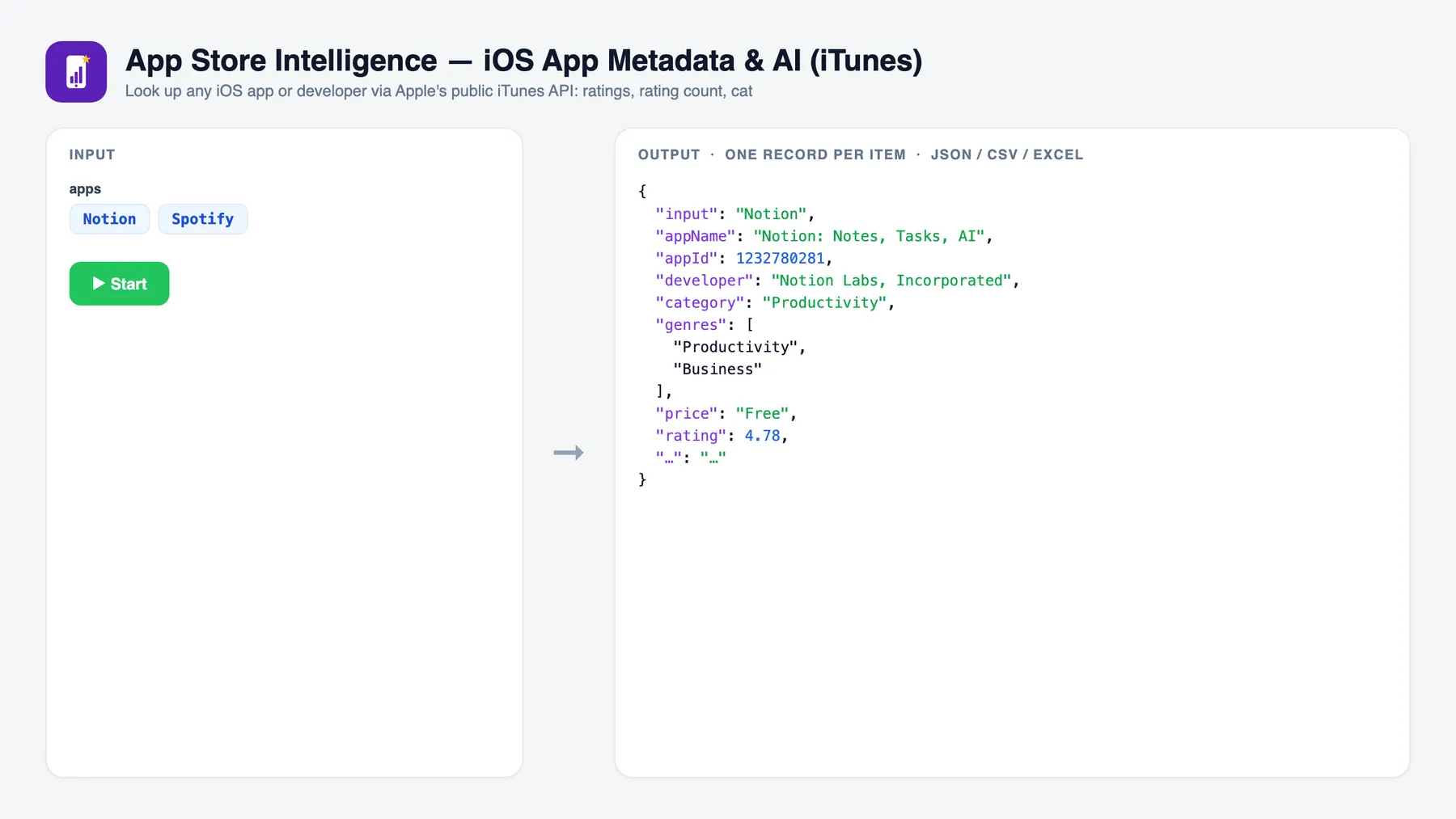
- Fill in the input — set the fields in the input tab (prefilled with a working example).
- Click Start — the Actor runs and writes one record per item to the dataset.
- Get your data — export to JSON, CSV or Excel, or pull it via the API.
The flow
- List the apps you care about — plain names (
Notion), numeric App Store IDs (1459969523), or full App Store URLs. Mix and match. - The Actor resolves each one against the iTunes API: numeric IDs and URLs go through
lookup, names go throughsearch(best match first). - Run it. Every app comes back as one structured record — metadata plus an AI positioning + momentum read — ready for a spreadsheet or your CRM.
What you get per app
For every app, the Actor:
- Resolves the app via the Apple iTunes API — a numeric App Store ID or an App Store URL (it extracts the
id…segment) goes throughlookup; a plain name goes throughsearchand takes the best match. - Pulls the core metadata:
appName,appId,developer,category,genres,price, overallrating+ratingCount, current-versioncurrentVersionRating+currentVersionRatingCount,version,lastUpdated,releaseDate,fileSizeMB,contentRating,languagesCount, screenshot count, supported-device count, and the storeurl. - Computes signals:
ageYears(from first release),daysSinceLastUpdate(from the current version's release date), andratingGap(current-version rating vs overall — a positive or negative shift). - Keeps the raw text too — the app's
descriptionand latestreleaseNotes(trimmed).
Then the AI layer (OpenAI gpt-4o-mini, a fast and low-cost model) adds, grounded only in the data above:
positioning— one sentence: the category and how the app is positioned, read from its name and description.momentumSignal— one sentence combining update recency, rating volume, and whether the current version is rated higher or lower than the app overall.strengths— concrete positives.concerns— concrete risks: stale updates, thin ratings, a rating drop in the current version.summary— two sentences.
Three ways people use it
- App market research — size up a category fast. Use the iTunes API to pull app metadata and iOS app ratings across a shortlist, and let the AI read tell you which apps actually have momentum versus which are coasting on an old release.
- Competitor app tracking — drop your rivals' App Store IDs in and re-run on a schedule. Every row is a snapshot of ratings, version, and last-update date, so app competitor analysis becomes a diff over time: who shipped, whose rating slipped, who went quiet.
- ASO / portfolio monitoring — watch your own and client apps. Catch a
ratingGapturning negative after a release, or adaysSinceLastUpdatecreeping up, before it shows up in the charts.
Keywords this Actor covers: App Store API, iTunes API, app metadata, iOS app ratings, app competitor analysis.
Input
| Field | Type | Notes |
|---|---|---|
apps | array | Required. App names to search, numeric App Store IDs, or App Store URLs. One per line. |
country | string | Two-letter App Store storefront code. Default us. |
searchLimit | integer | Results to consider per name search. 1 = best match only. Default 1. |
maxResults | integer | Cap how many apps to analyze. Default 200. |
maxConcurrency | integer | Apps processed in parallel. Default 5. |
model | string | Override the OpenAI model. Default gpt-4o-mini. |
Minimal input example
Output example
Apps that can't be resolved come back with success: false and an error field (and null metadata), so a bad name never breaks the run.
Pay-per-event pricing
This Actor uses pay-per-event billing with a single event:
| Event | Charged when | Price |
|---|---|---|
app-analyzed | Once per iOS app looked up via the iTunes API and summarized with AI. | $0.10 |
The Actor logs its OpenAI token usage and the estimated AI cost at the end of every run, so the event price always stays safely above the model cost.
Data source
All app data comes from Apple's public iTunes Search / Lookup API (itunes.apple.com). It is a public endpoint — no API key and no login are required for the data source — and this Actor sends a browser User-Agent and respects reasonable rate limits. The data reflects the Apple App Store (iOS) for the storefront country you choose.
Setup
The AI layer calls the OpenAI API. Set the environment variable / secret OPENAI_API_KEY on the Actor. The iTunes lookup itself needs no credentials.
Use it from an AI agent (Apify MCP server)
This Actor is available through the Apify MCP server, so AI agents (Claude, ChatGPT, or anything that speaks MCP) can call it as a tool — hand it a list of apps and read back the enriched App Store intelligence — with no custom integration code.
Run it locally
Related actors
- App Review Intelligence — Turn App Store reviews into concrete product insights and competitor comparisons.
- B2B Tech Stack Detector — Detect the technologies a company runs, from a list of domains.
- Google Reviews Insights (AI) — Turn Google reviews into concrete insights for a business and its competitors.
- AI Web Extractor — Turn any URL plus a plain-English prompt into structured JSON.


