
Google Ads Transparency Scraper | Domain & Advertiser Ads
Pricing
from $0.70 / 1,000 ads
Google Ads Transparency Scraper | Domain & Advertiser Ads
Get the ads of any domain or advertiser from the Google Ads Transparency Center: advertiser name, format, first and last shown dates, days shown, image or preview, political spend and impressions. Many queries per run, any region, no login.
Pricing
from $0.70 / 1,000 ads
Rating
0.0
(0)
Developer

Flowo
Maintained by CommunityActor stats
0
Bookmarked
3
Total users
2
Monthly active users
4 days ago
Last modified
Categories
Features
Share
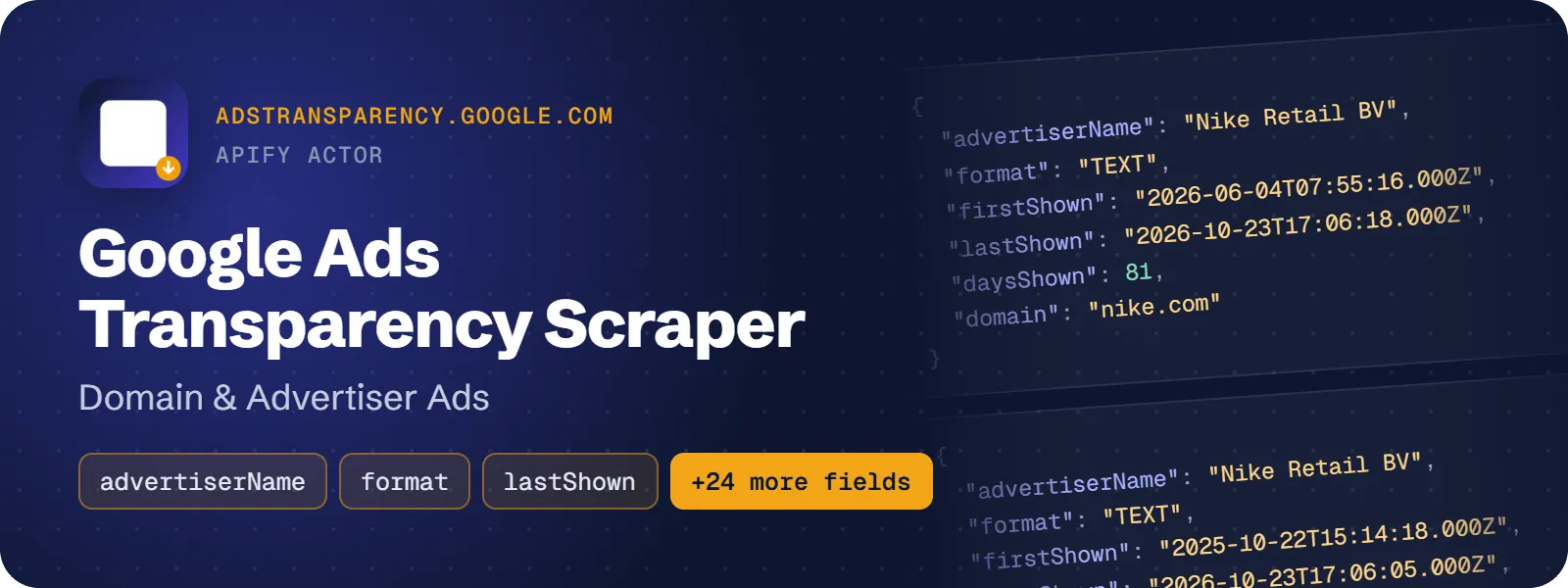
This actor returns the ads that a domain or an advertiser runs on Google, taken from the public Google Ads Transparency Center. Each row is one ad with the advertiser name, ad format (text, image or video), first and last shown dates, days shown, an archived image or preview link and the Google Ads ids. Political ads add spend and impression ranges. No login and no browser are needed.
What does Google Ads Transparency Scraper do?
You give the actor a list of domains, advertiser ids, Transparency Center URLs or advertiser names, in any mix. It finds the ads of each one on adstransparency.google.com and returns one flat row per ad. You can filter by country, platform (Search, YouTube, Shopping, Maps, Play), format and dates. It can also list all political ads shown in a country. It suits marketers, agencies, ad-intelligence tools, journalists and AI agents.
How to scrape Google Ads Transparency Center ads
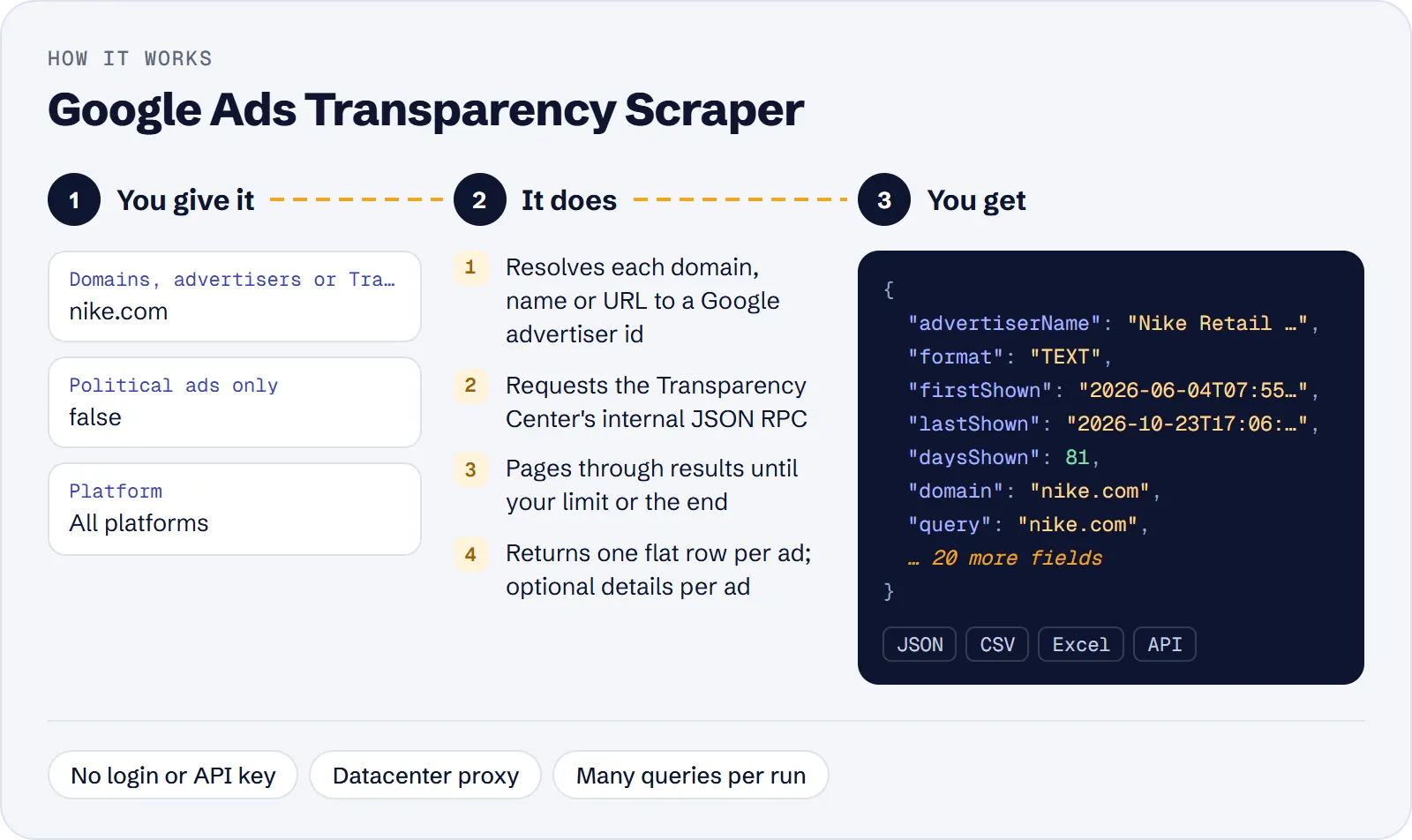
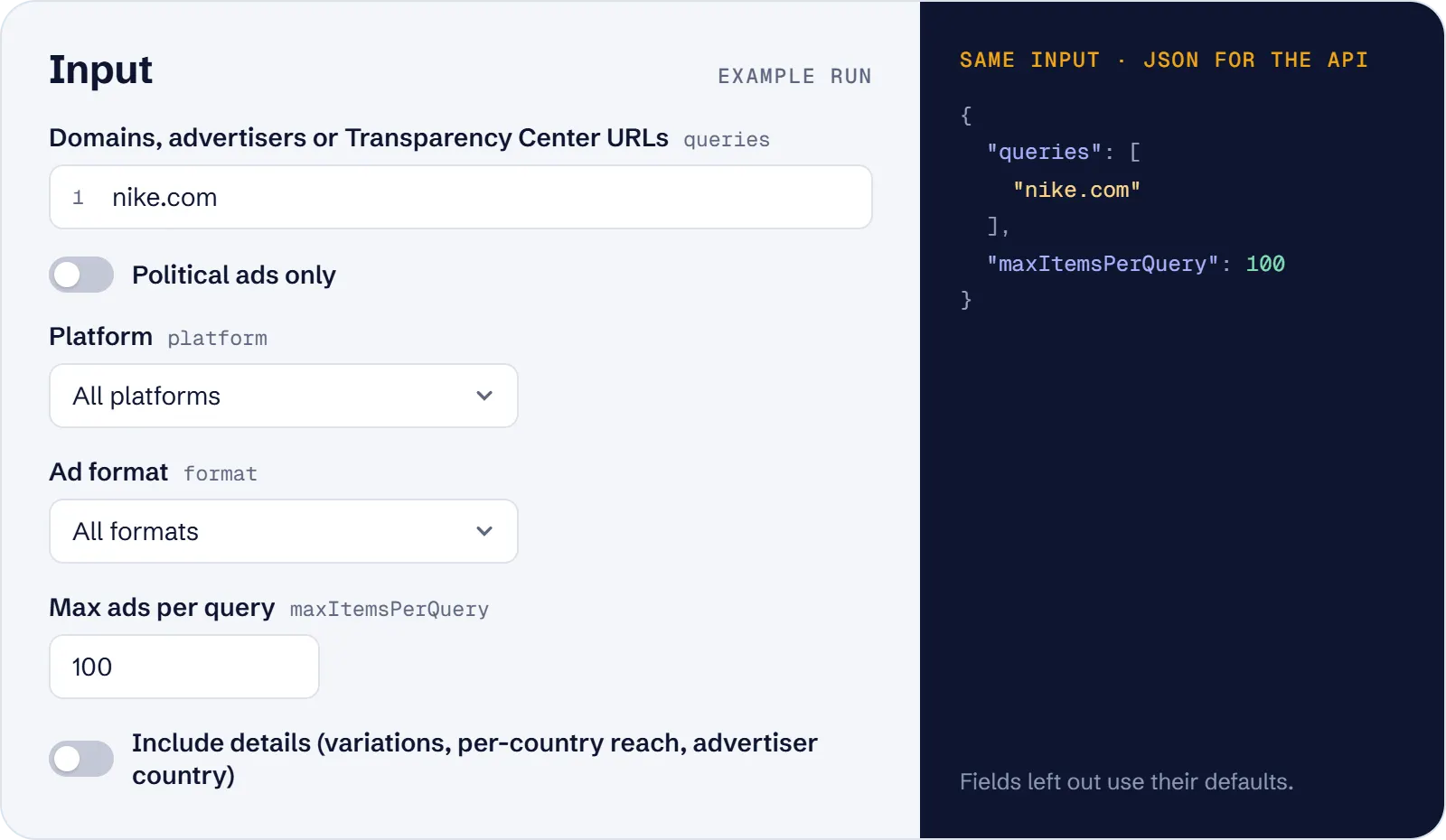
- Open the actor in Apify Console and enter one or more values in Domains, advertisers or Transparency Center URLs.
- Optionally set country, platform, format, dates and Max ads per query.
- Switch on Include details for variations, per-country reach and the advertiser's country.
- Click Start, then download the dataset as JSON, CSV or Excel, or read it through the API.
How much does it cost to scrape Google Ads Transparency?
Price per event by Apify plan:
| Event | Free | Bronze | Silver | Gold and above |
|---|---|---|---|---|
| Ad | $1.00 per 1,000 | $0.90 per 1,000 | $0.80 per 1,000 | $0.70 per 1,000 |
A test run with the API example input below returned 100 rows in 3 s.
The actor uses pay-per-event pricing: one ad event per saved ad, $0.001 per ad on the Free plan ($1.00 per 1,000 ads); higher Apify plans pay less per ad. There is no start fee, details are included at no extra charge, and queries with no ads cost nothing. An ad found by two queries in the same run is saved and charged once.
| Scenario | Ads | Cost on the Free plan |
|---|---|---|
| One domain, first page | 100 | $0.10 |
| Three competitor domains, 300 ads each | 900 | $0.90 |
| Full library of one large advertiser | 5,000 | $5.00 |
| Political ads of one country since a date | 20,000 | $20.00 |
Input
| Field | Meaning |
|---|---|
queries | Domains, advertiser ids (AR + 20 digits), Transparency Center advertiser/search URLs or advertiser names |
political | Political ads only; needs country; with queries use advertisers, not domains |
country | Two-letter ISO code (UK is accepted as GB); empty = anywhere |
platform | ALL, SEARCH, YOUTUBE, SHOPPING, MAPS, PLAY |
format | ALL, TEXT, IMAGE, VIDEO |
startDate, endDate | YYYY-MM-DD range of when the ads were shown |
maxItemsPerQuery | Ads per query, default 100, no upper cap |
maxItems | Optional cap on the whole run |
includeDetails | Adds variations, countries, per-country reach, advertiser country |
proxyConfiguration | Apify datacenter proxy by default |
What data can you extract from Google Ads Transparency?
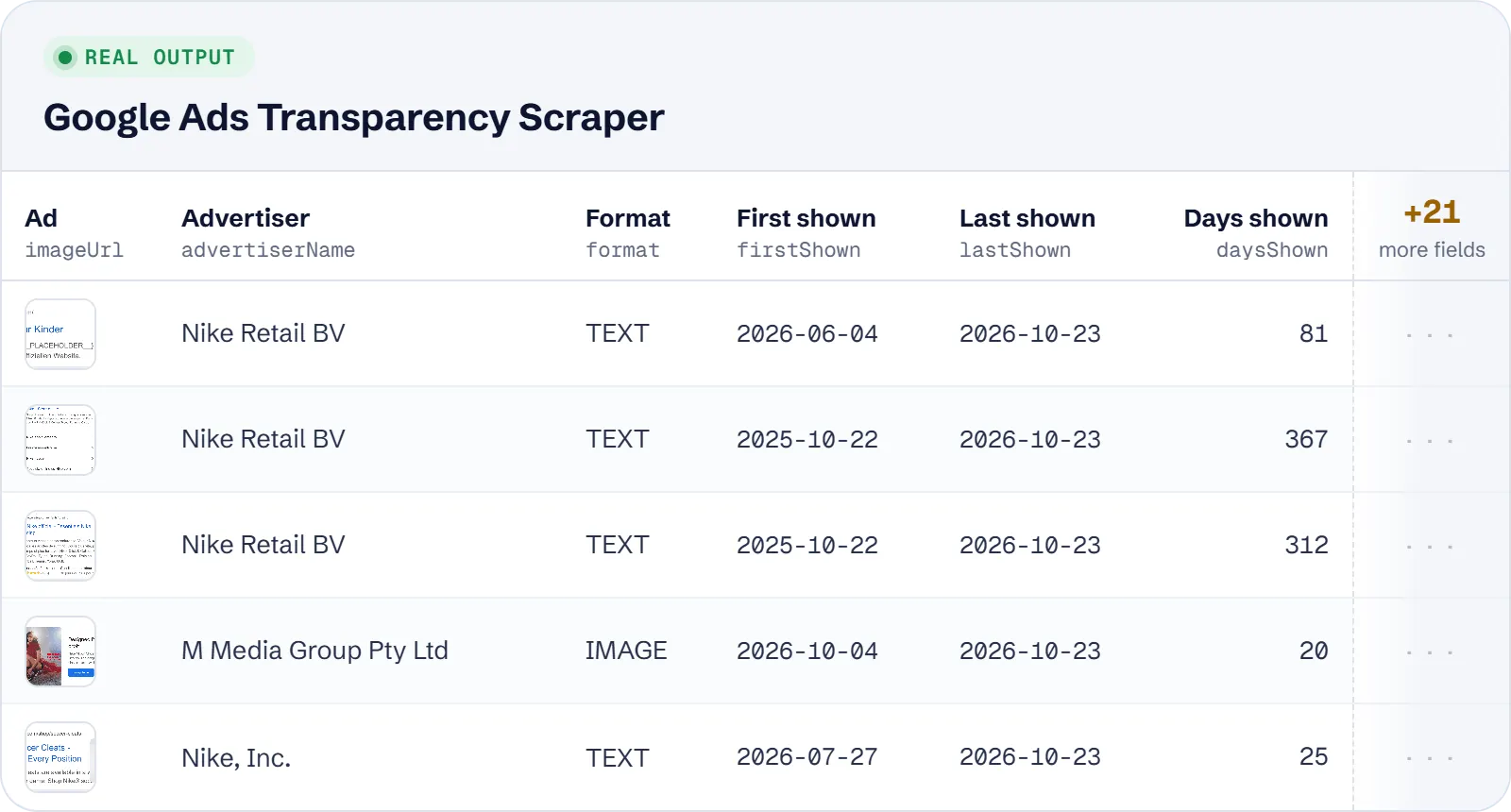
One row is one ad. Main fields:
| Field | Description |
|---|---|
creativeId, advertiserId | Transparency Center ids of the ad and the advertiser |
advertiserName | Verified advertiser name |
format | TEXT, IMAGE or VIDEO |
firstShown, lastShown, daysShown | When and for how long the ad was shown |
imageUrl, previewUrl | Archived image or Google preview script |
spendMin, spendMax, currency, regions | Political ads only |
impressionsMin, impressionsMax | Political ads, and EU-served ads with details |
variations, countries, regionStats, advertiserCountry, advertiserLegalName | With includeDetails |
Example item (shortened):
Use cases
- Competitor ad research: all YouTube or Search ads of several domains in one country.
- Advertiser library: every ad of given advertiser ids or URLs.
- EU reach analysis: with details, impression ranges per EU country and platform.
- Political ads monitoring: political ads in a country since a date, with spend and impression ranges.
- Brand lookup by name: resolve an advertiser by exact name and list its video ads.
Limitations
- Advertiser names are resolved on a best-effort basis (exact name first, then a matching domain). If nothing matches, the query returns no ads and a warning lists candidates.
- Spend and impression ranges exist only for political ads and, with details, for EU regions; elsewhere they are empty.
impressionsMaxis empty when only a lower bound is published. - Google keeps date-filterable data for about the last 365 days. An
endDateolder than that, a futurestartDate, or anendDatebeforestartDatefails the run. - Single-ad (creative) URLs are not supported; use the advertiser URL or id.
- With
political, domains are not accepted, and a country is required. imageUrlorpreviewUrlcan be empty for some ads. Details make runs slower, as they need one extra request per ad.- Subdomains are searched as given.
Tips and troubleshooting
- No ads returned: subdomains are searched as given, so try the parent domain. For a name query, check the warning in the log, which lists candidate advertisers, or use the advertiser id or URL.
- Run fails at start: check the dates. An
endDateolder than about 365 days, a futurestartDate, or anendDatebeforestartDateis rejected. - Political ads: set
politicalwith acountry; if you also give queries, use advertisers, not domains. - More ads: raise
maxItemsPerQuery(no upper cap) or usemaxItemsto cap the whole run. - Faster runs: leave
includeDetailsoff unless you need variations or per-country reach; it needs one extra request per ad. - Proxy: the default Apify datacenter proxy is used; no residential proxy is needed.
API, MCP and integrations
Run the actor from your code with the same JSON input as in Console. Your API token is in Console → Settings → API & Integrations.
Python (pip install apify-client):
Node.js (npm install apify-client):
HTTP — one request runs the actor and returns the results (runs up to 5 minutes; longer ones: run asynchronously):
AI agents (MCP). Add the actor as a tool of the Apify MCP server. Claude Code:
Claude Desktop, Cursor or VS Code: {"mcpServers": {"apify": {"url": "https://mcp.apify.com?tools=genial_candlestand/google-ads-transparency-scraper"}}}. Then ask, for example:
- "List YouTube ads of nike.com and adidas.com shown in Germany"
- "Get all ads of advertiser AR18378488041124659201"
- "Find US political video ads since 2026-09-01"
Integrations. Run it on a schedule with Apify Schedules and send the results to Google Sheets, Slack, Zapier, Make, n8n or your webhook — see Apify integrations.
FAQ
Is it legal to scrape the Ads Transparency Center?
The data is public and published by Google for transparency. The actor reads only what the site shows, with no login. You are responsible for how you use it and for following applicable laws and Google's terms.
Do I need a login or cookies?
No.
How many ads can I get?
There is no cap on maxItemsPerQuery; the actor follows pages until the ads end or your limit is reached.
How is it different from other Google Ads Transparency actors?
It costs $1.00 per 1,000 ads with details included, against $2.00 per 1,000 for the most used one. It also returns political spendMin/spendMax, impressionsMin/impressionsMax and per-country regionStats, which are not among that actor's output fields.
How does it differ from the official BigQuery dataset?
This actor needs no Google Cloud project, billing or SQL, and takes domains, ids or URLs directly.
Also useful
- Google Trends Scraper — add search-interest trends for the same brands and keywords
- Google News Scraper — follow news coverage of the advertisers you track
- Google Play Reviews Scraper — read user reviews of apps advertised on Google Play
- Trustpilot Reviews Scraper — compare advertisers' ads with their customer ratings


