

Quora Search Scraper | Answers, Questions & Posts
Pricing
from $0.64 / 1,000 quora question, answer or posts
Quora Search Scraper | Answers, Questions & Posts
Get Quora answers, questions and Space posts by keyword: full answer text, author and credential, upvotes, views, shares and publish date, plus answer count, followers and topics of questions. One flat row per item, many terms per run, date and AI-answer filters. No login or cookies.
Pricing
from $0.64 / 1,000 quora question, answer or posts
Rating
0.0
(0)
Developer

Flowo
Maintained by CommunityActor stats
0
Bookmarked
2
Total users
1
Monthly active users
4 hours ago
Last modified
Categories
Features
Share
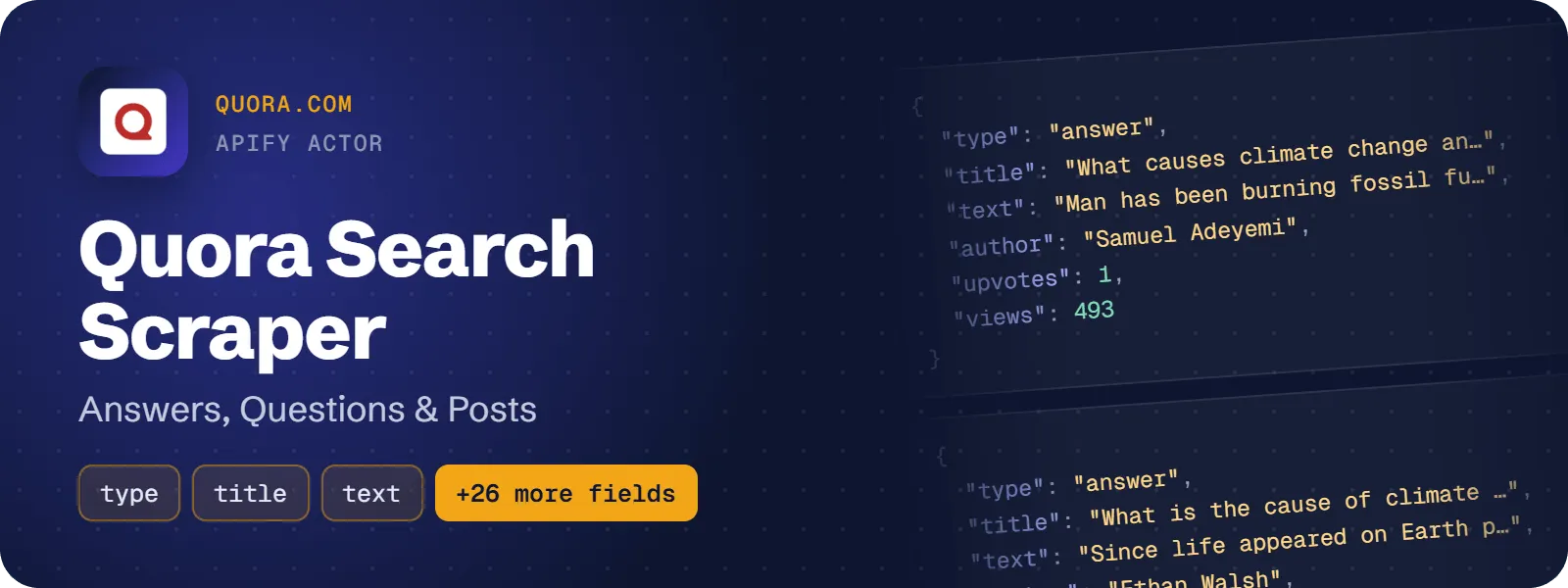
Search Quora by keyword and get the matching questions, answers and Space posts as flat rows. Each answer or post comes with its full text, author name and credential, upvotes, views, shares, comments and publish date; each question comes with its answer count, follower count and topics. No Quora account, cookies or API key are needed.
What does Quora Search Scraper do?
You enter one or more search terms. For each term the actor finds up to about 40 Quora pages (question pages and Space post pages) and returns one row per question, per answer and per Space post found on them. Every row also tells you which search term found it, its rank in the search and the search title and snippet, so you can see why it matched. It is made for content and SEO research, brand monitoring, building Q&A text datasets and AI agents that need real Quora opinions.
API, MCP and integrations
Run the actor from your code with the same JSON input as in Console. Your API token is in Console → Settings → API & Integrations.
Python (pip install apify-client):
Node.js (npm install apify-client):
HTTP — one request runs the actor and returns the results (runs up to 5 minutes; longer ones: run asynchronously):
AI agents (MCP). Add the actor as a tool of the Apify MCP server. Claude Code:
Claude Desktop, Cursor or VS Code: {"mcpServers": {"apify": {"url": "https://mcp.apify.com?tools=genial_candlestand/quora-search-scraper"}}}. Then ask, for example:
- "Find Quora answers about best laptop for programming written by people, not AI, with upvotes and views"
- "Get Quora answers and posts about chatgpt published in the last 6 months"
- "List Quora questions about web scraping with their answer and follower counts and topics"
Integrations. Run it on a schedule with Apify Schedules and send the results to Google Sheets, Slack, Zapier, Make, n8n or your webhook — see Apify integrations.
How to scrape Quora answers and questions by keyword
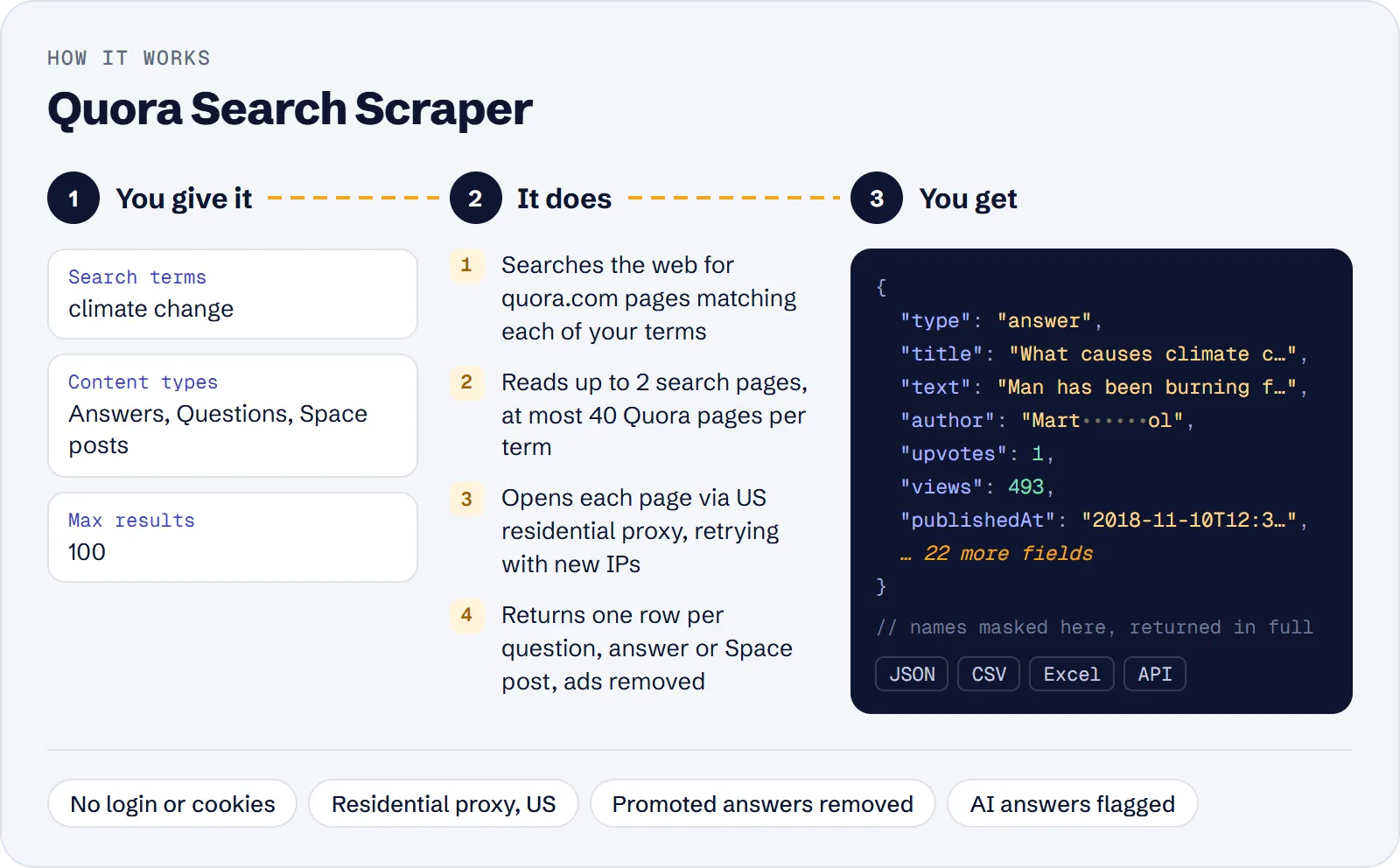
- Open the actor in Apify Console and enter your keywords in Search terms, one per line (e.g.
climate change). - Optionally choose Content types (answers, questions, Space posts), set Published after to get only recent answers and posts, or untick Include AI answers to keep only answers written by people.
- Set Max results – the total number of rows for the whole run (default 100).
- Click Start and wait for the run to finish; a 100-row run of one term typically takes well under a minute.
- Download the results as JSON, CSV or Excel, or read them through the API.
How much does it cost to scrape Quora?
Price per event by Apify plan:
| Event | Free | Bronze | Silver | Gold and above |
|---|---|---|---|---|
| Quora question, answer or post | $0.75 per 1,000 | $0.713 per 1,000 | $0.675 per 1,000 | $0.638 per 1,000 |
| Actor start | $0.00005 | $0.00005 | $0.00005 | $0.00005 |
A test run with the API example input below returned 100 rows in 37 s.
You pay for each row saved: one Quora question, one answer or one Space post is one paid event (content-item, $0.00075, which is $0.75 per 1,000 rows). Apify also charges a small actor start event ($0.00005 per run start). Not charged: duplicate rows (the same question or answer found by two terms is saved once), promoted answers (never saved), rows removed by your filters, and search terms that find nothing.
| Scenario | Rows (paid events) | Cost on the Free plan |
|---|---|---|
| One term, default settings | 100 | ≈ $0.075 |
Topic research: 2 terms, maxItems 300 | 300 | ≈ $0.225 |
| 1,000 rows across several terms | 1,000 | ≈ $0.75 |
| 10 terms × about 150 rows each | 1,500 | ≈ $1.13 |
Costs include the start event. A term gives at most about 150–180 rows (see Limitations), so you get fewer rows than maxItems if your terms run out of content.
Input
| Field | What it does |
|---|---|
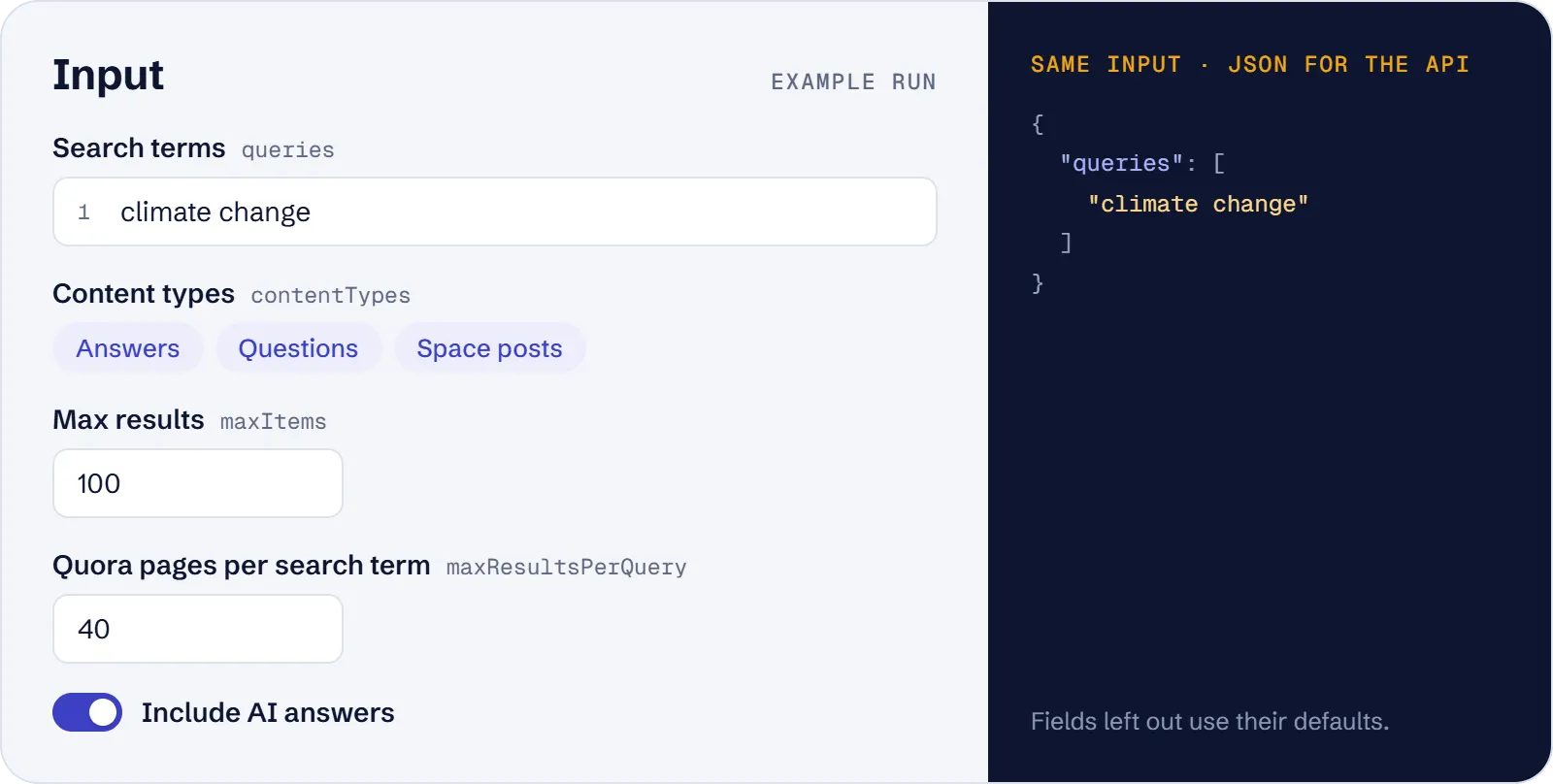
queries (required) | Search terms, one per line. Quoted phrases ("machine learning" jobs) and any language work; Quora mostly returns English pages. Blank and duplicate terms are dropped. |
contentTypes | Which rows to return: answer, question, post (Space posts). Default: all three; an empty list also means all three. |
maxItems | Total rows for the run, all terms together. 1–100,000, default 100. |
maxResultsPerQuery | How many found Quora pages to open per term, in search-rank order. 1–40, default 40. |
publishedAfter | Keep only answers and posts published on or after this date: a date such as 2025-01-01 or a relative period such as 6 months or 30 days. Question rows have no date and are always kept. |
includeAiAnswers | Default on. Turn off to drop answers written by Quora's AI assistant (isAiAnswer: true). |
proxyConfiguration | Proxy for the web-search step only. Default: Apify proxy. Quora pages are always read through Apify residential proxy. |
Example input:
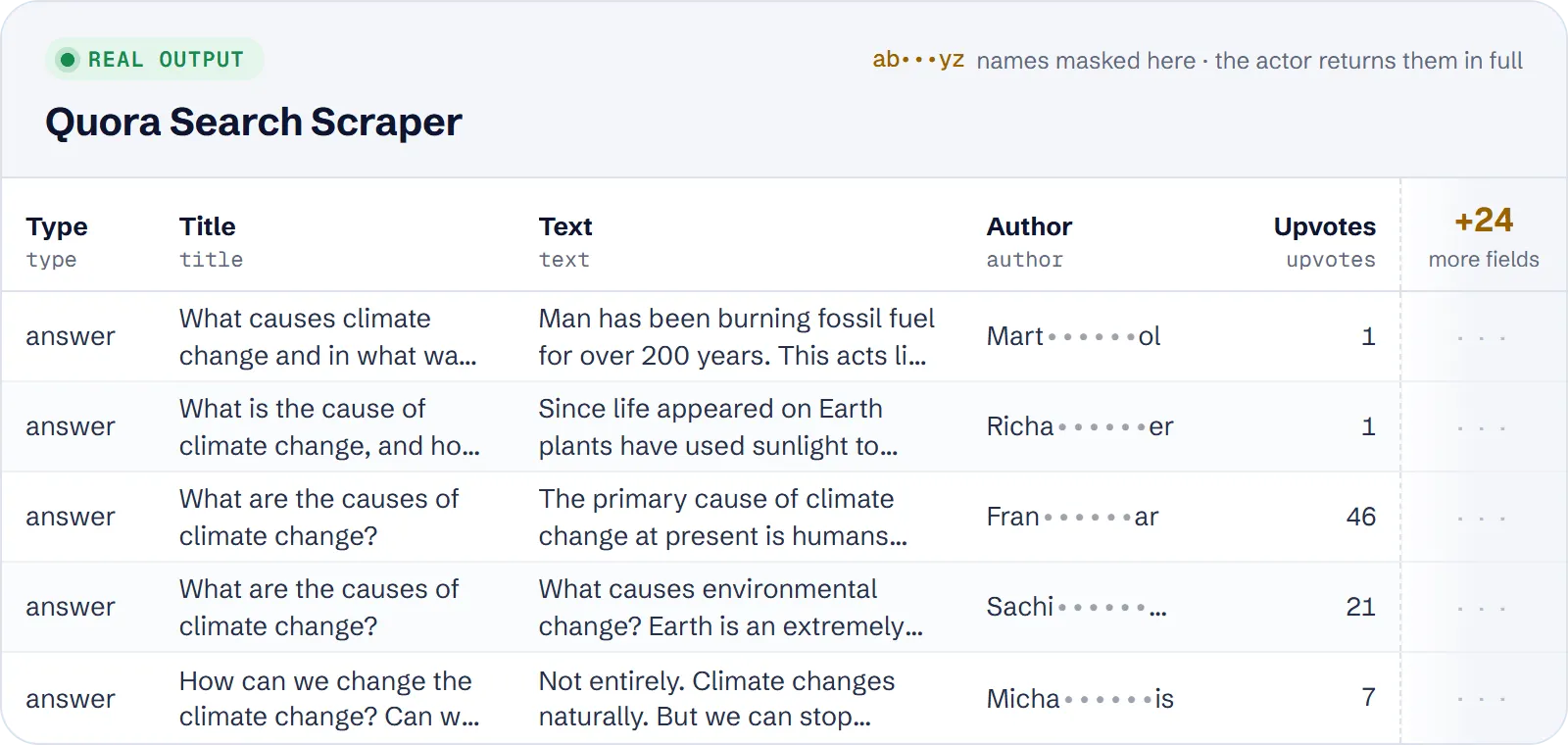
What data can you extract from Quora?
| Field | Description |
|---|---|
type | question, answer or post (a Quora Space post) |
id, url, title | Quora id, page URL and title (for an answer: the title of the question it answers) |
text, textMarkdown | Full answer or post text, plain and as Markdown (bold, italic, links, lists) |
author, authorUrl, authorCredential, authorIsVerified | Author name, profile link, credential line and verified flag |
upvotes, views, shares, comments | Engagement counts (comments is also filled for questions) |
publishedAt, updatedAt | Publish and last-edit time of the answer or post (ISO 8601) |
questionId, questionUrl | For answers: the question the answer belongs to |
isAiAnswer | For answers: true when written by Quora's AI assistant |
answerCount, followerCount, topics | For questions: answer and follower counts and topic names (posts also have topics) |
spaceName, spaceUrl | The Quora Space of a post or of an answer published in a Space |
query, position, searchTitle, searchSnippet | The search term, the page's rank among its Quora search hits, and the search hit's title and snippet |
scrapedAt | When the row was extracted |
Real answer row (text shortened):
A question row of the same run has "type": "question", "answerCount": 51, "followerCount": 0, "topics": ["Global Warming", "Climate Change", …], and null in the answer fields (text, author, upvotes, publishedAt …).
Use cases
- Topic and audience research: find what people ask and answer about a subject, with answer counts, follower counts and topics of each question.
- Opinions by people only: collect human-written answers (
includeAiAnswersoff) for sentiment analysis or an LLM summary. - Recent content monitoring: track brand or product mentions in answers and posts published in the last months with
publishedAtfiltering. - SEO and content gaps: list the Quora questions that rank for your keywords (
contentTypes: ["question"]) together with the search snippet. - Q&A text corpora: gather full answer text in plain text and Markdown for research or model training.
Limitations
- Quora's own search works only for logged-in users, so pages are found through a public web search of quora.com. Ranking and depth come from that search: at most about 40 Quora pages per term, and there are no Quora sort, type or time filters.
- A question page read without login holds only about 3–4 answers (its own and those of related or equivalent questions), so a term gives about 150–180 rows at most. An answer's
questionIdmay therefore point to a related question, not the page question. - Space posts are rare in search hits (about 5–20%), so a posts-only search returns few rows or none.
publishedAfteris applied after the pages are read: it reduces rows, not search depth. Question rows have no date on Quora (publishedAtisnull) and are always kept.- Question view counts and question creation dates are not available; answers and posts have
viewsandpublishedAt. Profiles and topic pages are not scraped. - Only
type,id,url,title,query,positionandscrapedAtare always present. Every other field can benull: answer fields arenullon question rows and question fields on answer and post rows;textandtextMarkdownare empty for image-only answers;authorCredential,updatedAt(never edited),spaceNameandspaceUrl(not in a Space) are oftennull, andsearchTitleorsearchSnippetcan be missing. - Promoted (ad) answers are never returned.
Tips and troubleshooting
- More rows: add more search terms – each term adds up to about 40 pages. Raising
maxItemsalone does not go deeper than the search allows. - 0 rows for a term: the search found no Quora questions or Space posts for it (e.g. only profile pages). The run still succeeds, costs nothing for that term and logs a warning naming the term. Try a broader or English phrasing.
- Only new content: set
publishedAfter(e.g.30 days) and schedule the run; combine it withcontentTypes: ["answer", "post"]if you do not need question rows. - Posts only:
contentTypes: ["post"]works, but expect few rows; use topics that have active Quora Spaces. - Proxy: keep the default Apify proxy for search. Without a proxy the web search is rate-limited after a few requests.
- A page that fails after retries is skipped with a warning; the other pages' rows are kept and the run does not fail.
FAQ
Do I need a Quora account or cookies?
No. The actor reads only public pages without login, cookies or an API key.
Is it legal to scrape Quora?
The actor collects publicly visible content that anyone can see without logging in. You are responsible for how you use the data, including copyright of the answer texts and data-protection rules for author names; check Quora's terms and your local law, and consult a lawyer if in doubt.
Why did I get fewer rows than Max results?
Each term yields at most about 40 Quora pages with 3–4 answers per question page. Add more terms to get more rows.
Can I get only human answers?
Yes. Turn off Include AI answers; answers by Quora's AI assistant (isAiAnswer: true) are then dropped.
How is it different from other Quora scrapers?
Keyword search works without cookies, Space posts are included as their own rows, each answer is a separate flat row with the search term and rank, promoted answers are removed, and the price is $0.75 per 1,000 rows. Question view counts, question creation dates and profile pages are not included.
Also useful
- Reddit Scraper — compare Quora opinions with Reddit posts and comments on the same topic
- Reddit Comments Scraper — get full Reddit discussion threads with replies for deeper opinion research
- Google Search Scraper — see organic results and People Also Ask questions for the same keywords
- Google AI Overview & AI Mode Scraper — check which sources Google's AI answers cite for your questions
- Google Trends Scraper — measure search interest over time and related queries for your topics


