

Website Leads - Contacts & Tech Stack Detection
Pricing
from $4.00 / 1,000 website leads
Website Leads - Contacts & Tech Stack Detection
Turn a domain list into qualified B2B leads. Returns the contact email, phone and socials a site publishes, plus what it is built on - Shopify, WooCommerce, WordPress, Wix, Webflow and more - and the marketing tags it runs, from Klaviyo to Meta Pixel. Filter by platform or tag before billing.
Pricing
from $4.00 / 1,000 website leads
Rating
0.0
(0)
Developer

DONGMIN KIM
Maintained by CommunityActor stats
0
Bookmarked
1
Total users
1
Monthly active users
a month ago
Last modified
Categories
Share
Website Leads — Contacts Plus What the Site Actually Runs On
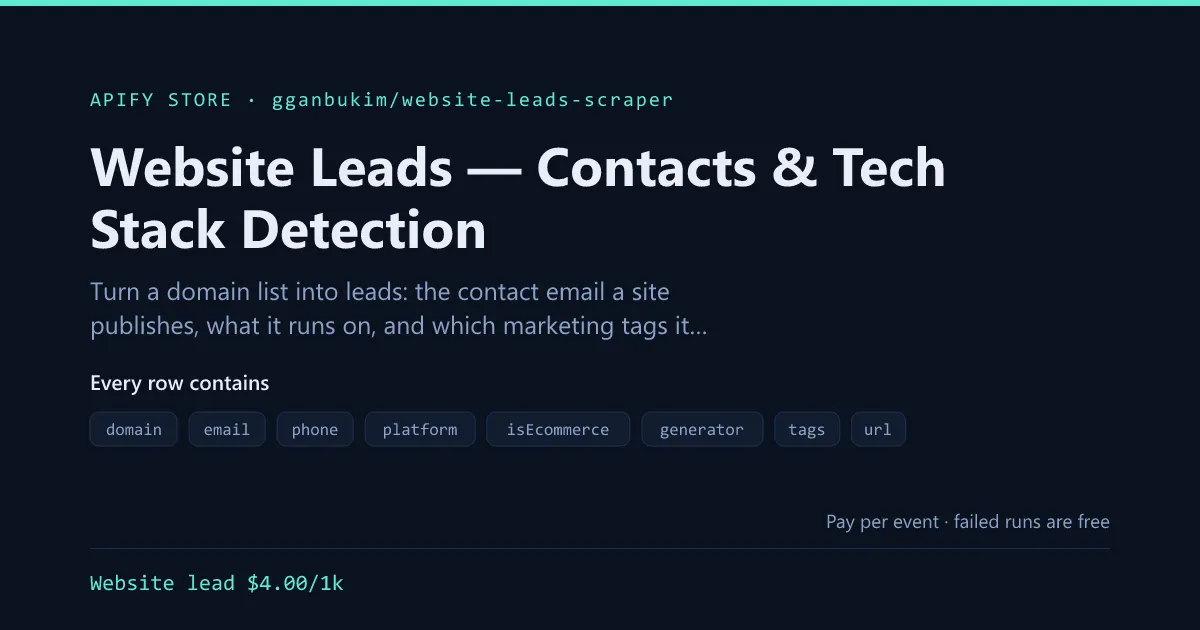
Paste a domain list. Get back one row per site: who to email, and what they are built on — Shopify, WooCommerce, WordPress, Wix, Webflow — along with the marketing tags they carry, from Klaviyo to the Meta Pixel.
Contact scrapers stop at the address. The address is the cheap part. Knowing that a prospect runs WooCommerce with Klaviyo and Gorgias is what tells you whether they are worth an email at all — and, if you sell a competing tool, it is the pitch.
What it does well
- One request answers both questions. The homepage carries the platform fingerprints and usually the contact details, so a filtered list costs one request per domain rather than eight.
- Contacts that generalise. Home, contact, about, imprint, legal and support pages — measured at 7 of 7 sites yielding an email, against 2 of 5 with Shopify-only paths.
- Tag detection is the lead filter. "Everyone running Klaviyo" or "everyone running Gorgias" is a prospect list, and
usesTagbuilds it. - Filters run before billing. Platform, tag, e-commerce-only, or must-have-an-email. Filtered sites cost nothing.
How the detection avoids lying to you
Two rules, both learned by getting them wrong on real sites while building this.
A brand word in the page is not a fingerprint. A first version matched woocommerce
anywhere in the HTML and reported stripe.com as running WooCommerce — Stripe's homepage
documents its WooCommerce integration. Signatures here match asset paths, script hosts and
generator tags: things a page contains because of how it was built, not because of what it
talks about.
A policy header is not a fingerprint either. posthog.com came back as Shopify because
its Content-Security-Policy lists *.myshopify.com as an allowed source — PostHog's
script runs on Shopify stores. A CSP says who a site talks to, not what it runs on. Only
identity headers are read: server, x-powered-by, x-shopid, x-wix-request-id,
set-cookie.
After both fixes, on a twelve-site check: allbirds, gymshark, mypatriotsupply and
deathwishcoffee identified as Shopify; wordpress.org as WordPress with generator
WordPress 7.2; and stripe, posthog, basecamp, linear and nike correctly returned no
platform rather than a guess. PostHog's generator still came back as Gatsby 4.25.9,
which is true and useful.
An unidentified site is reported as unidentified. Plenty of sites are hand-built or
behind a CDN that strips the evidence. The row ships with the contacts and an empty
platform rather than a guess.
Input
Finding everyone who runs a competitor's tool:
Every option
The same wording you see in the Apify console, with the JSON key for API and MCP callers.
| Option | What it does | Default |
|---|---|---|
Websites — websiteUrls (required) | Bare domains or any URL on the site. Each domain becomes one row. | — |
Find contact details — includeContacts | Read the home, contact, about, imprint and support pages. Stops as soon as it has an email and a social account. | true |
Only keep sites with an email — requireEmail | Drop sites publishing no address. Dropped sites are not billed. | false |
Only e-commerce sites — ecommerceOnly | Keep only storefront platforms: Shopify, WooCommerce, BigCommerce, Magento, PrestaShop, Shopware. | false |
Only these platforms — platformIs | Keep only sites whose main platform is one of these. Empty means all. | — |
Only sites running one of these tags — usesTag | Keep only sites carrying one of these marketing or commerce tags. This is how you find everyone using a competitor's tool. | — |
Concurrency — concurrency | Sites processed in parallel. | 5 |
Proxy — proxyConfiguration | Leave the default. Starts on cheap datacenter proxies and escalates only for sites that throttle. | {"useApifyProxy":true} |
Output
One row per site.
Every field
You are billed per lead delivered, so here is everything a row can contain.
What they run
| Field | What it is |
|---|---|
platform | The main platform. A storefront outranks the CMS it sits on — a WooCommerce site reports woocommerce, not wordpress. Absent when nothing identifiable was found, which is a real answer. |
platforms | Everything detected, so a WooCommerce site still shows wordpress alongside it. |
isEcommerce | true for Shopify, WooCommerce, BigCommerce, Magento, PrestaShop or Shopware. |
generator | The <meta name="generator"> tag when present — WordPress 7.2, Gatsby 4.25.9, Jekyll v3.9.2. Often the only signal a static site gives. |
tags | Marketing and commerce tags detected: klaviyo, google-analytics, meta-pixel, tiktok-pixel, hotjar, intercom, stripe, recharge, gorgias, yotpo, judgeme. |
How to reach them
| Field | What it is |
|---|---|
email | The best address found. Addresses on the site's own domain rank above a free-mail one, role addresses (info@, hello@, sales@) above personal ones, and no-reply@ is never first. |
emails | Every address found, in that order. |
emailSource | mailto when the first address came from a link somebody published to be written to, text when it only matched in the page. A text address is worth a second look - stripe.com's homepage carries a demo checkout address on its own domain. |
phone / phones | Numbers from tel: links, digits only. Anything under seven digits is treated as an extension. |
instagram, facebook, tiktok, twitter, youtube, pinterest, linkedin | The site's handle on each network, when it links one. Share buttons and network furniture are excluded. |
contactPageUrl | Which page the details came from, when it was not the homepage. |
pagesRead | How many pages were fetched for this row — usually one or two. |
Housekeeping
| Field | What it is |
|---|---|
domain / url | The site, for joining back to your list. |
scrapedAt | When this run read the site. |
Who this is for
- Agencies selling to a platform — "every WooCommerce store in my list, with an email".
- SaaS and app founders running competitive displacement:
usesTagfinds everyone on a rival's tool. - Suppliers and 3PLs filtering a bought list down to real e-commerce operators.
- Anyone with a domain list who needs to know how much of it is reachable and what it is made of.
What it does not do
It finds contact details a site publishes and platforms a site reveals. It does not
guess firstname.lastname@ patterns, verify that an address accepts mail, or fingerprint
anything a CDN hides. An unidentified platform means the evidence was not there — not that
the site is hand-built.
Common uses
- Qualify a bought list — run 5,000 domains, keep the e-commerce ones with an email, discard the rest for free.
- Competitive displacement — one
usesTagvalue turns a domain list into a target list. - Platform migration outreach — find Magento sites, the classic re-platforming prospect.
- Partner sourcing — everyone running Shopify plus Recharge is running subscriptions.
Pricing
Pay per lead delivered — $4.00 per 1,000. Sites removed by your filters, sites that could not be reached, and sites that fail cost nothing, which is what makes it safe to point at a list you have not cleaned.
Starting a run costs $0.00001 — the platform's $0.00001 minimum, charged once per GB of memory, and these Actors run on 512 MB.
Platform and tag filters are evaluated on the first request, so a run narrowed to one platform costs one request per domain rather than a full contact crawl of every site.
Other Actors in this family
Same engines, same billing, no account or API key on any of them.
YouTube & video
- YouTube Scraper — No API Key, Any URL or Search — Any YouTube URL or search term in, videos out — with subtitles, comments and sponsor deals as add-ons.
- Download YouTube Subtitles in Bulk — SRT, VTT & Text — Bulk subtitles from videos, channels or playlists — text, SRT, VTT or RAG chunks.
- Export YouTube Comments to CSV — Replies and Likes — Every comment and reply thread, with likes, authors and creator flags.
- List Every Video on a YouTube Channel — Export to CSV — A channel's whole back catalogue plus a subscriber and RSS summary row.
- Find YouTube Sponsors — Brand Deals, Codes & Links — Which brands pay which creators, with the campaign link, the code and the timestamp.
- YouTube Search API — Bulk Results, No Quota — Many search terms at once, every result as a row, filtered before you are billed.
- Track Deleted YouTube Videos & Title Changes — What a channel quietly changed: deleted videos, rewritten titles, view velocity.
- YouTube Creator Email Finder & Sponsor Lookup — A channel list into leads: the published email, audience bands, and who already sponsors them.
- Export a YouTube Playlist to CSV — Every Video — Any playlist as a table, with each video position in it.
Search demand
- AnswerThePublic Alternative — Autocomplete Keyword API — One seed into hundreds of real keywords from Google, YouTube and Amazon autocomplete.
- Google Trends API — Today's Trending Searches, No Key — Today's trending searches by country, with traffic bands and the news behind them.
E-commerce
- Export Any Shopify Store's Products to CSV or JSON — Any Shopify catalogue: variants, SKUs, live prices, stock, images, collections.
- New Shopify Product Alerts — Competitor Drop Tracker — Only what a store launched since the last run. Scanning is free.
- Shopify Store Email Finder — Qualified B2B Leads — A domain list into qualified leads: contact email, size, price band, and whether the shop still trades.
Hiring
- Greenhouse, Lever & Ashby Job Scraper — No API Key — Paste a company domain, get its open roles from Greenhouse, Ashby, Lever or SmartRecruiters.
- Ghost Job Detector — Track Reposts, Closures & Edits — What changed on a careers page: opened, closed, quietly reposted, or a ghost job.
Run it from code
Nothing here needs a login to the source, only your Apify token.
HTTP — start a run and wait for the rows:
JavaScript
Python
Scheduled or event-driven — attach a schedule to run it on a cron, or a webhook to push each finished run into your own endpoint. It also connects through Apify's Zapier, Make, n8n and LangChain integrations, and is reachable from an MCP server if you are driving it from an agent.
Standby / API mode — the run above is synchronous: one call in, rows out, no polling. That is the shape to use if you are calling this per request rather than in a batch.
Errors, limits and what you are charged for
- You pay for delivered rows only. A row your filters removed, a page that failed, a retry — none of it is billed. Starting a run costs $0.00001: the platform minimum, charged once per gigabyte, and this Actor runs on 512 MB.
- A run that delivers nothing still costs the start fee and nothing else. If the input resolved to zero items, the run fails loudly with the reason rather than finishing green on an empty dataset.
- Blocking is handled by changing address, not by waiting. The Actor starts on cheap datacenter proxies and moves up only after a tier has actually been refused several times in a row, then drops back down once the cheap tier answers cleanly again. You are not paying for residential bandwidth that was never needed.
- Rate limits belong to the source, not to this Actor. Very large inputs are worked through in batches; the run reports how many items succeeded, were filtered, and failed, so a partial result is never presented as a complete one.
- Dataset retention follows your Apify plan. Export what you need, or push it out with a webhook, if you want it past that window.
Is this legal?
This Actor reads pages and public endpoints that anyone can open in a browser without an account. It does not log in, does not defeat a paywall, and does not touch anything behind authentication.
Scraping public data is broadly lawful in the US and the EU, and courts have repeatedly said so — but "public" is not the same as "unrestricted", and what you may then do with the data is a separate question from whether you may collect it. Personal data pulls in the GDPR and similar regimes whatever the source, so if your rows contain people, you need a lawful basis for keeping them.
Apify publishes a fuller treatment in Is web scraping legal? and an ethical scraping guide. None of this is legal advice; if the use is commercial and the data is personal, ask someone qualified.
Something wrong, or missing?
Open an issue on the Actor's Issues tab — it goes straight to the developer and is the fastest route. Include the run ID; it carries the input and the log, which is usually enough to reproduce the problem without another round trip.
Sources change without warning, and a field that quietly goes null is worth reporting even if the run succeeded. A broken parser looks exactly like a quiet day in the data until someone says so.
FAQ
Will I get blocked or rate-limited? Some will, because this one points at arbitrary sites rather than one known platform, and a minority sit behind a WAF. Those escalate to residential automatically and the ones that still fail cost you nothing — a site that cannot be read is never billed.
Is it legal to collect business contact details this way? This reads pages the site
publishes publicly, with no login and nothing bypassed — a company that puts hello@ in
its footer is asking to be contacted there. Business contact details are treated
differently from personal data in most regimes, but how you use them is regulated:
GDPR, CAN-SPAM, PECR and their equivalents govern marketing email regardless of how the
address was obtained. Each site's own terms are a separate contract question. Not legal
advice.
How accurate is the platform detection? It errs toward saying nothing. Signatures are asset paths and identity headers only, never a brand word in the page and never a policy header — the two mistakes described above, both caught on real sites before release.
Why is platform empty on some rows? Because nothing identifiable was there. That is
common for hand-built sites and for anything behind a CDN that rewrites assets.
How much does 1,000 leads cost? $4.00, plus $0.00002 for the run.
Can I export the results to Excel or Google Sheets? Yes. Every run's dataset downloads as CSV, Excel, JSON, XML or RSS from the Storage tab, or straight from the API if you want a live link a spreadsheet can pull.
Can I connect it to Zapier, Make or n8n? Yes — Apify publishes integrations for all three, plus webhooks that fire when a run finishes. A common setup is a schedule here and a webhook into your CRM.
Do I need to write code? No. Fill the form in the console and press Start. It is also available over MCP so an AI agent can call it directly.
Can I run it on a schedule? Yes, via Apify Schedules, webhooks, or the API.


