
Google Patents Scraper: Search, Inventors, Assignees & Dates
Pricing
from $0.79 / 1,000 patents
Google Patents Scraper: Search, Inventors, Assignees & Dates
Scrape Google Patents by keyword, search URL with its filters (inventor, assignee, country, dates, status, type, language) or publication number: title, abstract, inventors, assignees, priority, filing, publication and grant dates, legal status, CPC codes, claims, citation counts, PDF. No login.
Pricing
from $0.79 / 1,000 patents
Rating
0.0
(0)
Developer
Hyperbach
Maintained by CommunityActor stats
0
Bookmarked
1
Total users
0
Monthly active users
6 days ago
Last modified
Categories
Features
Share
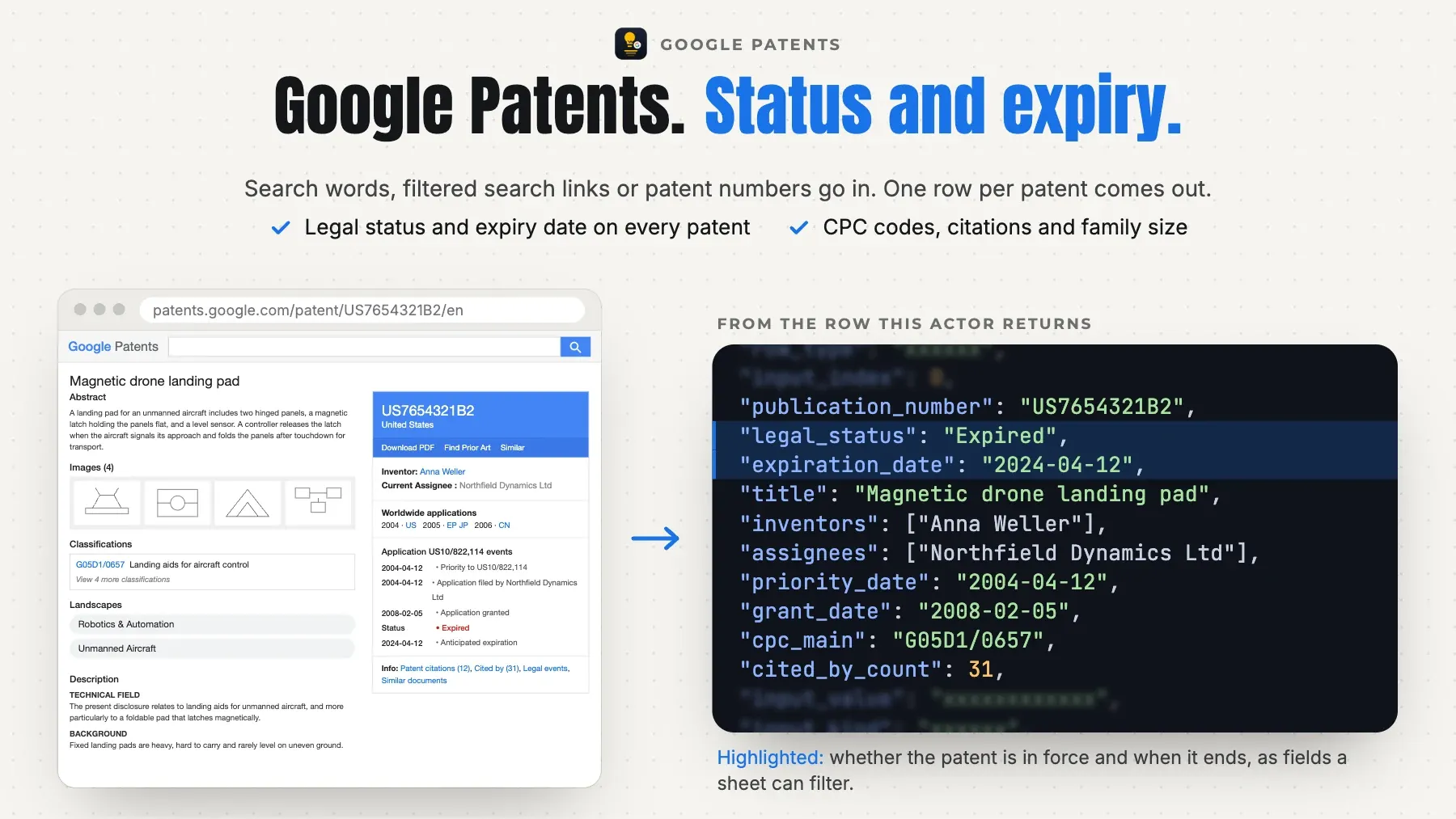
The patents of any Google Patents search, logged out: search words, Google Patents search URLs with their filters (inventor, assignee, country, dates, status, type, language) or publication numbers in, one row per patent out — the publication number and URL, title, Google's snippet, the priority, filing, publication and grant dates, the inventor and assignee, the PDF and image URLs and the family's countries — several searches in one run, a max per search. Turn on includeDetails for each patent page's abstract, every inventor and assignee, the legal status and expiry, the CPC codes, the claims count and the citation, cited-by and family counts. One free search row per input carries a completeness verdict: COMPLETE, CAPPED (your limit), TRUNCATED (Google Patents' 1,000-result limit) or PARTIAL. No login, no API key, no browser, proxies handled for you.
From $1.5725 per 1,000 rows (patent) on the Free plan, $1.33663 on Starter; every row and add-on is priced under Pricing below. A run start is $0.000698. The default input returns about 50 rows for about $0.079323. A value that names nothing is a free row that says why.
Why this Google Patents scraper
- Several searches in one run. Give search words (
solar panel), search URLs from your browser with the filters you set on Google Patents (inventor, assignee, country, before / after a priority, filing or publication date, granted or application, patent or design, language, CPC, newest or oldest first), or publication numbers and patent URLs: each search gets its own cap (maxItemsPerQuery), and the run's cap sits on top (maxItems). - The fields the search serves. The publication number and URL, the country and kind codes, the title, Google's snippet, the priority, filing, publication and grant dates (the grant date only on granted patents, never copied from the publication date), the first inventor and assignee the search lists, the language, the PDF link, the drawings and the family's countries with their state (active or not).
- Patent pages on request. With
includeDetailsevery delivered patent's own page is read too: the abstract, every inventor, the current and the original assignees, the application number, the legal status (Active, Expired, Pending …) and expiry date, the CPC codes (the most specific ones, the first one apart), the claims count, the patent citations, non-patent citations and cited-by counts and the family id and size. A publication number or patent URL is always read from its page. - Deep searches, checked. 100 patents a page in Google Patents' own order, page after page, to the end of the list. Google Patents lists at most 1,000 results a search (10 pages of 100) whatever its count says: the search row then says TRUNCATED with the count, so you know to narrow the search by dates or country.
- Honest runs. A URL that is not a search or a patent, or an empty query, is a free
invalidrow; a repeated input a freeduplicaterow; a number Google Patents does not know a freenot_foundrow (checked on a second connection). Every input gets a row; a patent is charged once a run, also when two searches list it. - Fast. Plain HTTP, the answers the site gives a browser: 451 patents of three searches and two numbers took 9 calls and 4 s on our test; 30 patents with their patent pages took 9 s; a search read to its 1,000-result end took 20 s.
Who it's for
- Patent attorneys and IP analysts — a prior-art or freedom-to-operate list for a technology: every hit of a search with its dates, owner, legal status, CPC codes and citation counts, read again on a schedule.
- R&D and competitive intelligence teams — the portfolio of a company or an inventor (an assignee or inventor search URL), by country and date, with the family and cited-by counts that show which patents matter.
- Researchers and data teams — typed rows keyed by
publication_numberandfamily_id, a free row per search with the verdict and Google Patents' count, and a run summary to check a pipeline against.
Quick start
The first 100 patents of a search
A company's granted US patents since 2020, with their patent pages
Patents by publication number
Output
One row per patent (and one free search row per input):
| field | meaning |
|---|---|
row_type | patent (one patent, charged) or search (the input's row with the walk's verdict; free). |
input_index | The 1-based position of the input this row answers: searchQueries first, then startUrls. |
input_value | The input as you gave it (the search words, the URL or the number). |
input_kind | Which input it came from: query (searchQueries) or url (startUrls). |
query | The search's words (a search URL's q); null for a number, a patent URL or a search by filters alone. |
search_url | The search on Google Patents, as a URL you can open, with its filters; null for a number or a patent URL. |
status | A search row: ok, invalid, duplicate, not_found, failed or not_read (see the FAQ). A patent row: ok. |
status_detail | Why a search row is not ok, in a sentence. |
scraped_at | When the row was read (ISO 8601, UTC). |
position | The patent's place among this search's delivered patents (1 = first), in Google Patents' order. |
page | The search page the patent was on (100 patents a page, 1 = first); null for a number or a patent URL. |
publication_number | The publication number with its country and kind code (US10000000B2, EP1000000A1). |
url | The patent's page on Google Patents. |
country_code | The patent office's two-letter code (US, EP, WO, CN, JP …). |
kind_code | The publication's kind code (B2 a granted US patent, A1 an application …). |
title | The patent's title (a long title from a search can end with …; the patent page gives it whole). |
snippet | Google Patents' snippet: the passage that matched the search (from a search only). |
abstract | With includeDetails or for a number: the patent's abstract. |
priority_date | The earliest priority date (YYYY-MM-DD), as Google Patents shows it. |
filing_date | The filing date of the application (YYYY-MM-DD). |
publication_date | The date this publication was published (YYYY-MM-DD). |
grant_date | The grant date of a granted publication (YYYY-MM-DD); null for an application or anything not granted. |
inventors | The inventors as the patent record names them: the first one from a search, every one with includeDetails or for a number. |
assignees | The assignees: the first one from a search, the current assignees with includeDetails or for a number. |
original_assignees | With includeDetails or for a number: the original assignees (the applicant at filing). |
application_number | With includeDetails or for a number: the application number (US14/643,719). |
legal_status | With includeDetails or for a number: the legal status as Google Patents shows it (Active, Expired - Fee Related, Pending, Granted …). |
expiration_date | With includeDetails or for a number: the expiry date Google Patents gives (YYYY-MM-DD), where it gives one. |
cpc_codes | With includeDetails or for a number: the CPC classification codes, the most specific ones (G01S7/4863). |
cpc_main | With includeDetails or for a number: the first CPC code Google Patents lists. |
claims_count | With includeDetails or for a number: the number of claims. |
citations_count | With includeDetails or for a number: the patents this one cites. |
non_patent_citations_count | With includeDetails or for a number: the non-patent documents (papers, books) this one cites. |
cited_by_count | With includeDetails or for a number: the later patents that cite this one. |
family_id | With includeDetails or for a number: Google Patents' family id (the publications of one invention share it). |
family_members_count | With includeDetails or for a number: the family's other publications ("Also Published As"). |
family_countries | The family's countries, a list of {country, state}: the state (ACTIVE, NOT_ACTIVE) comes with a search result, the patent page lists the countries. |
language | The language of the record as read (en; a search URL's language filter or a patent URL's /de selects another). |
pdf_url | The patent's PDF on Google's patent image store, where Google Patents has one. |
thumbnail_url | The first drawing's thumbnail, where the patent has drawings. |
image_urls | The patent's drawings in full size. |
detail_status | A patent row: read (its patent page was read), failed (not served; the row keeps the search result's values), not_found (the page is gone) or not_asked (includeDetails off). |
patents_delivered | A search row: the patent rows this input delivered in the run. |
total_results | A search row: Google Patents' own count of the search's results (it lists 1,000 of them at most). |
pages_read | A search row: the pages read (search pages of 100, or the patent page of a number). |
repeats_skipped | A search row: patents skipped because an earlier page or another input of the run already delivered them. |
verdict | A search row: COMPLETE (the end of the list, or the patent delivered), CAPPED (your limit), TRUNCATED (Google Patents' limit of 1,000 results a search, while its count says more) or PARTIAL (a refusal or the time limit). |
verdict_detail | A search row: the verdict in a sentence: how many patents from how many pages, Google Patents' count and why the walk stopped. |
Example record:
Pricing
Pay for the patents a run delivers, plus one run start; no platform usage is billed to you. The price falls with your Apify plan.
| event | unit | Free | Starter | Scale | Business |
|---|---|---|---|---|---|
Patent (patent) | per 1,000 | $1.5725 | $1.33663 | $1.10075 | $0.78625 |
Patent page add-on (patent-details) | per 1,000 | $3.00 | $2.55 | $2.10 | $1.50 |
Run start (start) | per run | $0.000698 | $0.000698 | $0.000698 | $0.000698 |
A patent from a search is $1.5725 per 1,000 on the Free plan ($0.0015725 a patent). A patent whose own page is read (includeDetails, or a publication number or patent URL you give) also pays the patent page add-on, $3.00 per 1,000: $4.5725 per 1,000 in all. Each run that delivers a charged patent also pays the run start, $0.000698 once; a run that delivers no charged patent pays nothing at all. So one search of 100 patents costs $0.1579 on the Free plan, and with includeDetails $0.4579. The free search row of every input, a value that is not a search or a patent (invalid), a repeated input (duplicate), a number Google Patents does not know (not_found), an input left at the cap or the time limit (not_read) and a refusal the run could not pass (failed) are never charged; a patent page that was not served does not pay the add-on. A patent is charged once a run, also when several searches list it. A run that stops early (a timeout, an abort) is charged for the patents it delivered. maxItems counts the charged rows; before the first request the log names the price of each row at your plan and the most the run can cost. Enterprise plans have their own rates: the Actor's Pricing tab shows the price for your plan.
Usage patterns
- Search words, search URLs and publication numbers —
searchQueriestakes the words you would type in Google Patents' search box (AND, OR, quoted phrases).startUrlstakes a search URL as your browser shows it (https://patents.google.com/?q=…): the filters it carries are kept —inventor=,assignee=,country=US,EP,before=priority:20200101/after=filing:20150101(orpublication:),status=GRANTorAPPLICATION,type=PATENTorDESIGN,language=ENGLISH,cpc=,sort=neworold. Set them on patents.google.com and copy the URL; typed into the search words they do not filter. It also takes patent URLs (https://patents.google.com/patent/US10000000B2/en) and publication numbers (US10000000B2). - What a row is —
row_type=patent: one patent, in Google Patents' order (position, and thepageit was on).row_type=search: the free row of one input value —patents_delivered,total_results(Google Patents' own count),pages_read,repeats_skipped, theverdictwith itsverdict_detail, and thestatuswith its reason. - How far a search goes —
maxItemsPerQuery(default 100; 0 = every patent the search lists) stops each search after that many new patents. Google Patents lists at most 1,000 results a search (10 pages of 100); a search with more ends there with TRUNCATED and Google Patents' count, and you can split it by date windows (before/after) to read the rest.maxItemscaps the charged rows of the whole run.
Input configuration
| field | type | default | what it does |
|---|---|---|---|
searchQueries | array | What to search for on Google Patents, one search a line (solar panel, "large language model" training), as you would type it in the site's search box (AND, OR, quotes). Each search is read apart. A publication number here (US10000000B2) is read as that patent. Up to 100 searches and patents a run. An empty line gets a free invalid row, a search given twice a free duplicate row. | |
startUrls | array | Google Patents URLs as your browser shows them, or publication numbers. A search, https://patents.google.com/?q=solar+panel&country=US&status=GRANT, keeps every filter you set on the site: inventor, assignee, country, before / after dates (priority, filing or publication), status (granted or application), type (patent or design), language, CPC and the sort. A patent page, https://patents.google.com/patent/US10000000B2/en, or a number, US10000000B2 (US-10000000-B2 works too), gives that patent read from its own page. A URL of another site, or a search URL with no query and no filter, gets a free invalid row. | |
maxItemsPerQuery | integer | 100 | Stop each search after this many patents (0 = every patent the search lists: Google Patents lists at most 1,000 a search, 10 pages of 100, whatever its count says). A patent another input of the run already delivered is skipped and not counted. |
maxItems | integer | 0 | Stop the run after this many patent rows across every input (0 = no limit). Search rows are free and not counted; an input left unread at the cap gets a free not_read row. |
includeDetails | boolean | false | Also open every delivered search result's own patent page: the abstract, every inventor, the current and original assignees, the application number, the legal status and expiry date, the CPC codes, the claims count, the patent and non-patent citation counts, the cited-by count and the family id and size. One page more a patent, charged as the patent-details add-on. Publication numbers and patent URLs are always read from their page. |
feedback | string | A note to the people who maintain this Actor: what you needed and did not get. For example a missing field, a wrong or empty result, or the Actor you switch from or to, and why. The run does not read it: the rows and the charges stay the same. A person reads every note. |
Errors
A run does not fail because of your input. When an input cannot be used — a date that is not a date, an id in the wrong form, two settings that contradict each other — the run ends Succeeded, charges nothing, and says what to change:
- the status message starts with
INPUT REJECTED; - the dataset holds one row,
{"error": true, "code": "…", "message": "…"}, and no results; - the key-value store record
ERRORholds the same object.
From code, check error on the first row before reading results.
A URL that is not a Google Patents search or patent page, or a search URL with no query and no filter, is not an error: it gets one free search row with status invalid that says why, and the run goes on with the others. A run that ends Failed is a fault on our side, never your input; it charges nothing, and we are alerted.
FAQ
Which status is which?
A search row's status is ok (served), invalid (an empty query, or a URL that is not a search or a patent), duplicate (the same input again: read once), not_found (a publication number Google Patents does not know, checked twice), failed (Google refused every try, or answered an error to that search's filters; free) or not_read (left at maxItems, the charge limit or the run's time limit). A patent row's status is ok; its detail_status says whether its patent page was read (read), not served (failed, the row keeps the search result's values), gone (not_found) or not asked (not_asked, includeDetails off).
Why does a search row list one inventor and one assignee?
Google Patents' search results carry the first inventor and the first assignee of each patent. With includeDetails (or for a publication number) the patent page gives every inventor, the current and the original assignees.
Why is the abstract empty?
The search results carry Google's snippet (the matching passage), not the abstract. Turn on includeDetails to read each patent's page: the abstract, the CPC codes, the legal status and the citation and family counts come from there.
Does it give the claims text, the description, the citations list or the legal events?
No. The row carries the claims count, the citation, non-patent citation, cited-by and family counts and the family id, the legal status and its expiry, but not the claims or description text, the lists of citing and cited patents or the legal event history.
Does it need a Google account or an API key?
No. Everything is read from Google Patents' public pages, logged out. The names are the ones the patent record publishes; nothing is added from other sources.
Do I need Apify Proxy or my own proxy?
No. The Actor uses its own connections, at no extra cost to you.
Integration
JavaScript
Python
CLI
REST
AI agents and MCP
Apify's MCP server offers this Actor as a tool to Claude, Cursor, VS Code and any other MCP client. Connect https://mcp.apify.com?tools=hyperbach/google-patents-scraper and ask, for example: "Find 50 solar panel patents on Google Patents with the assignee, inventors and filing date". The agent fills the input from the table above and reads the rows from the run's dataset. The input names are the ones in the table above. An agent or a person can add feedback to any run and say what was needed and not delivered: a missing field, a wrong or empty result, the Actor switched from or to, and why. The run returns the same rows at the same price, and a person reads every note.
n8n, Make and Zapier
The Apify node in n8n, the Apify app in Make and the Apify integration in Zapier run this Actor on a schedule or from a trigger and read its dataset. A webhook on the run's end (Integrations on the Actor page) sends the rows on to your own endpoint. Nothing to install on our side.
Support
Disagree with a charge? Write to apify@hyperbach.com with the run ID. We will ask Apify to compensate you, and the charge comes back to your Apify account as platform credit.
Did it do the job? A short review on the Store, at any rating, helps the next buyer choose.
This page is generated from the Actor's schemas and a live sample — it cannot describe a field the Actor does not have.


