

Acoustics Calculator: RT60, Decibels, STC, Noise Barriers
Pricing
Pay per event
Acoustics Calculator: RT60, Decibels, STC, Noise Barriers
Room acoustics and noise from plain text: Sabine and Eyring reverberation time by octave band, room modes, decibel addition and A-weighting, sound with distance, noise barrier insertion loss, and STC and Rw ratings from transmission loss or a panel.
Pricing
Pay per event
Rating
0.0
(0)
Developer

Jumble Mog
Maintained by CommunityActor stats
0
Bookmarked
2
Total users
1
Monthly active users
11 hours ago
Last modified
Categories
Features
Share
Room acoustics and noise numbers from one line of text. Describe a room (classroom 9 x 7 x 3 m, floor vinyl, ceiling acoustic tile, walls painted concrete block), some levels (85 dB + 82 dB + 80 dB), a noise barrier (barrier 3 m high, source 10 m from the barrier, receiver 20 m behind it) or a partition (5/8 in gypsum STC). You get back:
- Reverberation time: Sabine and Eyring RT60 in each octave band from 125 Hz to 4 kHz, from the room's size and finishes (28 common materials built in, or your own coefficients), with air absorption, NRC of each finish, critical distance and the Schroeder frequency. Give a target (
target 0.6 s, orclassroomfor ANSI/ASA S12.60) to get the absorption to add. - Room modes: the axial, tangential and oblique modes of a rectangular room up to the Schroeder frequency, with a warning when dimensions make modes pile up.
- Decibel math: add, average or subtract levels (background correction), A- and C-weighted totals from octave bands, sound pressure from sound power, and level with distance from a point or line source.
- Noise barriers: path difference, Fresnel number and insertion loss in each octave band (Maekawa), and the dBA reduction when you give the source's spectrum.
- Sound insulation: STC (ASTM E413) and Rw with C and Ctr (ISO 717-1) from transmission loss data, or estimated for a single panel of gypsum, glass, concrete, brick, wood, steel and more from its thickness, with its coincidence dip.
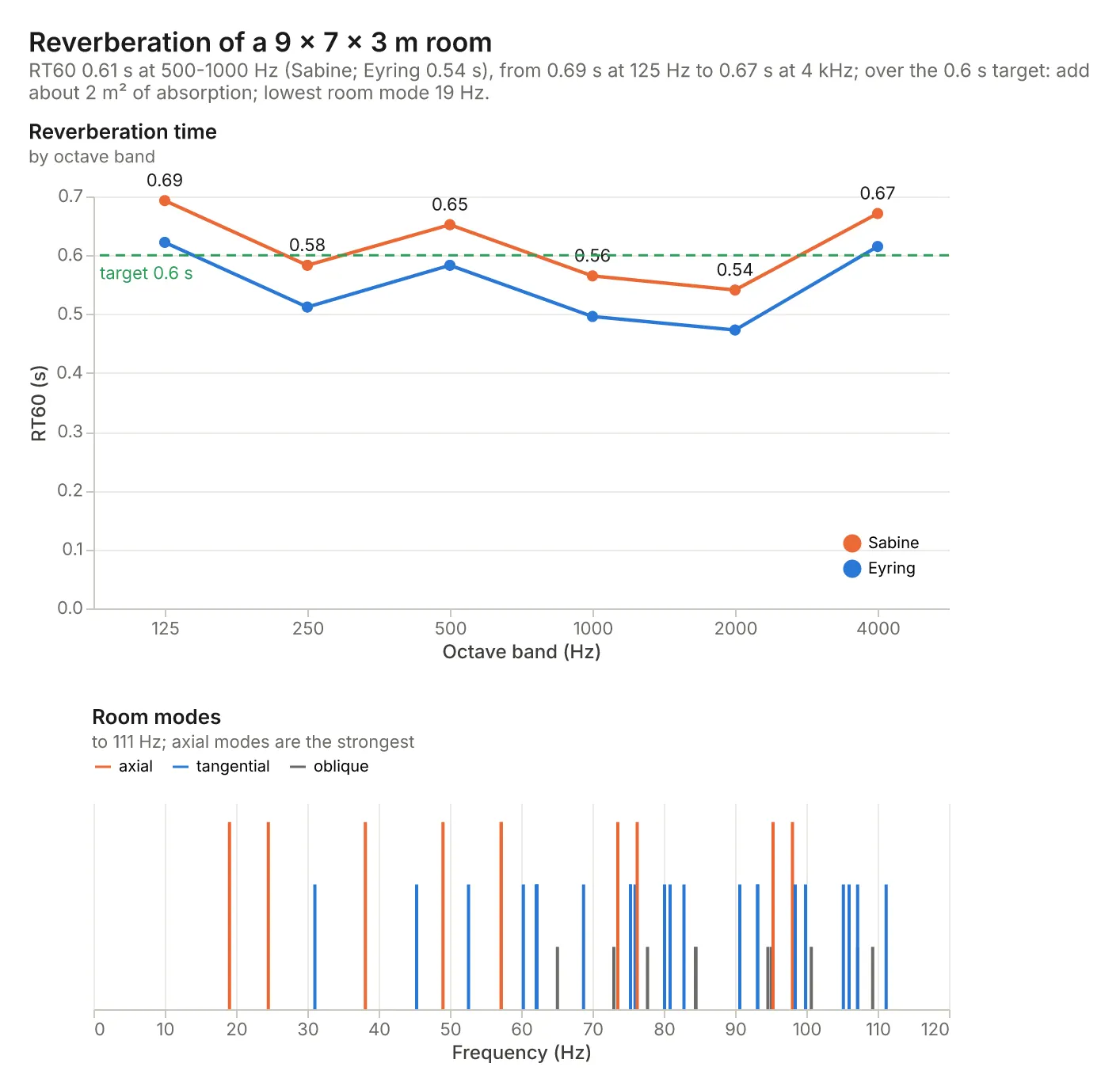
- A chart: reverberation time by band with the room modes, band levels, level against distance, the barrier section with its insertion loss, or transmission loss against the STC contour.
Metric (m, m², m³, kg/m²) or US units (ft, sq ft, cu ft, psf); results come back in the units you wrote.
It's made for:
- Architects, interior designers and acoustic consultants checking a room's reverberation or a wall's rating.
- AV integrators, home theater and studio builders sizing acoustic treatment and checking room modes.
- Environmental noise and HVAC engineers adding levels, correcting for background and sizing barriers.
- Students working acoustics problems, and AI agents that need correct decibel and RT60 numbers instead of a guess.
How to use it
- Write Rooms, levels, barriers and partitions, one per entry. The form has examples.
- Optionally set the Units for sizes written without one (metric by default).
- Click Start. Each request is a row in the results, with its summary, chart and report.
What you can write
| You write | It means |
|---|---|
9 x 7 x 3 m or volume 500 m³ | The room's size (floor, ceiling and walls are worked out from the dimensions) |
floor carpet, ceiling acoustic tile, walls gypsum board | The finishes; a finish left out is assumed and flagged |
6 m² windows, 20 m² panels NRC 0.85, 12 m² curtains alpha 0.5 | Areas of other finishes, taken out of the walls; alpha or NRC for your own product (or six coefficients 125-4000 Hz) |
target 0.6 s, classroom, 20 °C, 40% RH | A target time (ANSI/ASA S12.60 for a classroom) and the air |
85 dB + 82 dB + 80 dB, 4 x 80 dB, average 70, 72, 75 dB | Levels to add or average |
total 78 dB, background 72 dB | Background correction |
octave bands 63: 72, 125: 70, 250: 68, ... | Band levels for dBA and dBC (or a plain list of 5-9 bands) |
85 dB at 1 m, at 30 m, line source, at 1000 Hz | Level with distance (6 dB per doubling, 3 for a line source), with air absorption at a frequency |
sound power 100 dB, at 10 m, on the ground | Sound pressure from sound power (free field, ground, edge or corner) |
barrier 3 m high, source 0.5 m high 10 m from the barrier, receiver 1.5 m high 20 m behind it | A barrier's geometry (source and receiver heights default to 0.5 and 1.5 m) |
TL 125: 19, 160: 22, ... 4000: 48 | One-third octave transmission losses for STC (18 values 100-5000 Hz also give Rw, C and Ctr) |
6 mm glass, 5/8 in gypsum, two layers 1/2 in drywall, 150 mm concrete, 25 kg/m² | A single panel to estimate |
The same as an object: {"type": "room", "length": "20 ft", "width": "14 ft", "height": "8 ft", "target": 0.4, "surfaces": [{"surface": "floor", "material": "carpet on pad"}, {"surface": "walls", "material": "gypsum board"}, {"material": "fabric panel 50 mm", "area": "64 sq ft"}]} or {"type": "stc", "tl": [20, 23, 26, 29, 32, 35, 38, 40, 42, 44, 46, 47, 47, 45, 46, 49, 52, 55]}.
Examples
classroom 9 x 7 x 3 m, floor vinyl, ceiling acoustic tile, walls painted concrete block, 6 m² windows→ RT60 0.61 s at 500-1000 Hz (Eyring 0.54 s), just over the 0.6 s ANSI S12.60 limit; lowest room mode 19 Hz.85 dB + 82 dB + 80 dB→ 87.6 dB;4 x 80 dB→ 86.0 dB;total 78 dB, background 72 dB→ the source alone is 76.7 dB.octave bands 63: 72, 125: 70, 250: 68, 500: 65, 1k: 62, 2k: 60, 4k: 58, 8k: 55→ 68.2 dBA, 75.5 dBC.sound power 100 dB, at 10 m, on the ground→ 72.0 dB.barrier 3 m high, source 0.5 m high 10 m from the barrier, receiver 1.5 m high 20 m behind it→ path difference 0.347 m, 13.1 dB at 500 Hz, 7 dB at 63 Hz to 20 dB at 8 kHz.TL 125: 19, 160: 22, 200: 25, ..., 4000: 48→ STC 39 (deficiencies 28 dB, at most 4 dB).6 mm glass STC→ STC 29, Rw 31 (C −2, Ctr −3), coincidence dip near 1,950 Hz.
How-to examples
Each example is a complete input; the results are from runs of the Actor (also listed under Examples).
How to calculate a room's reverberation time (RT60)
Result: RT60 0.61 s at 500-1000 Hz by Sabine (Eyring 0.54 s), just over the 0.6 s ANSI S12.60 limit; the lowest room mode is 19 Hz.
How to add decibels and convert octave bands to dBA
Result: 87.6 dB in total; the octave bands come to 68.2 dBA and 75.5 dBC.
How to estimate the noise reduction of a barrier
Result: path difference 0.347 m and 13.1 dB at 500 Hz, from 7 dB at 63 Hz to 20 dB at 8 kHz.
How to let an AI agent answer acoustics questions
Add this Actor to the Apify MCP server with https://mcp.apify.com/?tools=jumblemog/acoustics-calculator. The agent describes the room, levels, barrier or partition in one line and answers with the reverberation time, total level, insertion loss or STC.
FAQ
Can it rate a wall's STC? Yes, from transmission loss by the ASTM E413 contour (and Rw by ISO 717-1), or estimated for a single panel: 6 mm glass STC gives STC 29, Rw 31.
Sabine or Eyring? Both. Sabine fits live rooms; Eyring is better when the mean absorption is over about 0.2, and the result says which to trust.
Where do the absorption coefficients come from? Typical published values for common finishes. Give your product's coefficients or NRC when you have them.
Can it subtract background noise? Yes: total 78 dB, background 72 dB gives 76.7 dB for the source alone.
Input
| Field | What it is |
|---|---|
requests | The rooms, levels, barriers and partitions, as lines of text or objects (up to 200 per run) |
units | For sizes without a unit: metric (m, m², m³, kg/m²) or us (ft, sq ft, cu ft, psf) |
charts | Draw a chart for each request (default on) |
Output
One dataset item per request, also saved together in the run's OUTPUT record:
Decibel results have levels (and bands for weighting), barriers barrier and bands (Fresnel number and insertion loss per octave), ratings rating (STC, Rw, C, Ctr, the panel) and bands (transmission loss, the STC contour and its deficiencies). Every item has units, summary, warnings, notes (the method and every assumed value), a Markdown report and links to the chart and report. A request that can't be computed has "status": "failed" and the reason in error, and isn't billed.
How it works
- Reverberation: Sabine T = 0.161·V/(A + 4mV) and Eyring T = 0.161·V/(−S·ln(1 − ᾱ) + 4mV), with A the sum of area x absorption coefficient and m the ISO 9613-1 air absorption at the temperature and humidity.
- Room modes: f = (c/2)·√((nx/L)² + (ny/W)² + (nz/H)²); Schroeder frequency 2000·√(T/V); critical distance 0.057·√(QV/T).
- Decibels: energy sums 10·log Σ 10^(L/10); IEC 61672 octave A and C weightings; Lp = Lw + 10·log(Q/(4πr²)); 20·log (point) or 10·log (line) spreading.
- Barriers: path difference δ = A + B − d over the top edge, Fresnel number N = 2δf/c, insertion loss 5 + 20·log(√(2πN)/tanh√(2πN)) (Kurze-Anderson fit of Maekawa's chart), at most 20 dB.
- Ratings: the ASTM E413 contour (deficiencies 32 dB in all and 8 dB at most) and the ISO 717-1 reference curve with spectra 1 and 2 for C and Ctr; panels by Sharp's method (mass law below half the coincidence frequency, with the coincidence dip from the panel's stiffness and loss factor above it).
Pricing
You pay one low price per request, at the prices shown on this page; decibel, barrier and STC requests cost less than room requests. The chart and report are included. Requests that can't be computed are never charged. If you set a maximum cost per run, the Actor stops before a request that wouldn't fit.
Speed
Each request takes a few milliseconds. A run through the API answers in about 10 seconds, including the cloud container starting.
Tips and limits
- Absorption coefficients are typical published values; products vary, so give your product's coefficients or NRC (
alpha,NRC, or six values) when you have them. - Sabine vs Eyring: Sabine is the standard and fits live rooms; Eyring is better when the mean absorption is over about 0.2 (the result says which to trust).
- Rooms are treated as diffuse; very long, very flat or very absorbent rooms, and rooms with strong focusing, need a model or measurement.
- Barriers are taken as long, solid and without gaps; ground effect and reflections aren't modelled, and real barriers seldom give more than 15-20 dB.
- Panel STC estimates are for single solid panels and are typically within a few points of tests; stud walls, double glazing and insulated cavities do much better than their mass suggests, so use lab data for them.
- Limits: rooms 1 to 1,000,000 m³, 200 requests per run.
For AI agents and developers
This Actor works with the Apify MCP server, so AI agents can call it as a tool. Pass requests as plain text and read summary, room, levels, barrier, rating, bands and warnings. A direct API call that waits for the answer:
run-sync instead returns the run's OUTPUT: the status, the counts and every result as JSON.
In Python, with the apify-client package:
Credits
- Charts: Vega-Lite and vl-convert (BSD-3-Clause), with the Inter font (SIL Open Font License).
- Methods: Sabine and Eyring; ISO 9613-1 (air absorption); IEC 61672 (weightings); Maekawa (1968) and Kurze and Anderson (1971) for barriers; ASTM E413 and ISO 717-1 (ratings); Sharp (1978) for single panels; ANSI/ASA S12.60 (classrooms).


