

Well Pump & Pressure Tank Size Calculator
Pricing
Pay per event
Well Pump & Pressure Tank Size Calculator
Well pump and pressure tank sizing for a home, from plain text: peak demand, total dynamic head, pump gpm and horsepower, pipe size and friction, the pressure tank for a minimum run time, and a low-yield well check.
Pricing
Pay per event
Rating
0.0
(0)
Developer

Jumble Mog
Maintained by CommunityActor stats
0
Bookmarked
2
Total users
1
Monthly active users
6 hours ago
Last modified
Categories
Features
Share
Size a private well's pump and pressure tank from one line of text. Ask well pump for a 3 bathroom house, static water level 80 ft, 200 ft well, house 30 ft above the well, 150 ft from the well and you get back:
- The peak demand in gpm from the bathrooms or fixtures, plus any irrigation.
- The total dynamic head: the lift to the pumping level, the rise to the house, the pressure switch's cut-out and the pipe friction.
- The pump: flow, water and brake horsepower, the motor size to buy, and submersible or jet.
- The pipe size that keeps the water under 5 ft/s, and its friction loss.
- The pressure tank for the pump's minimum run time, by Boyle's law for your switch and precharge, with the run time and the most starts an hour.
- Checks: a low-yield well (with a storage tank and booster pump), a pump that's too small, a tank that short-cycles.
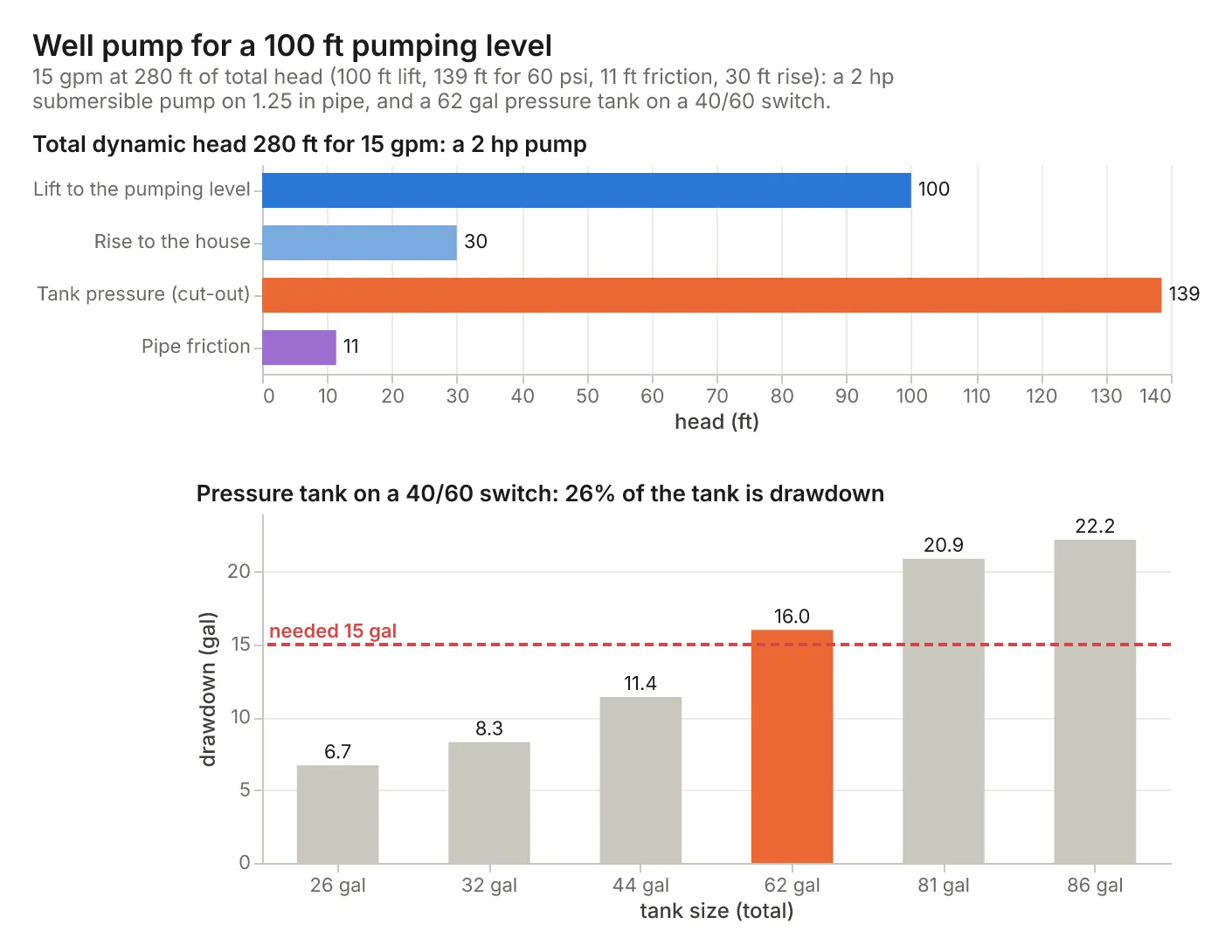
- Charts (head by part, and the drawdown of each tank size against what's needed) and a Markdown report.
It's made for:
- Homeowners replacing a well pump or a waterlogged pressure tank.
- Well drillers, pump installers, plumbers and home inspectors.
- AI agents, quoting tools and rural property apps that need well numbers they can show their work for.
How to use it
- Write Requests, one per entry. The form has examples.
- Optionally set the pressure switch and the pipe run to use when a request doesn't say.
- Click Start. Each request is a row in the results, with its summary, chart and report.
What you can write
| You write | It means |
|---|---|
3 bathrooms, 2.5 baths, 12 fixtures, 15 gpm, irrigation 6 gpm | The peak demand |
static water level 80 ft, drawdown 30 ft, pumping level 140 ft | The water level |
pump set at 150 ft, 200 ft well, well yields 4 gpm | The well |
house 30 ft above the well, 20 ft below, 150 ft from the well, 1-1/4 inch pipe | The run to the house |
40/60 (default), 30/50 psi, 50/70 pressure switch, precharge 38 psi | The pressure switch and tank |
submersible, jet pump, shallow well | The pump type |
1 hp pump, 20 gallon tank | What you have, to check |
pressure tank for a 10 gpm pump, 40/60 switch | A tank alone |
The same as an object: {"bathrooms": 4, "staticLevel": 150, "drawdown": 40, "elevation": -10, "run": 400, "switch": "50/70", "hp": 1}.
Examples
well pump for a 3 bathroom house, static water level 80 ft, 200 ft well, house 30 ft above the well, 150 ft from the well→ 15 gpm at 280 ft of head: a 2 hp submersible on 1¼ in pipe and a 62 gal pressure tank.submersible pump set at 300 ft, 2 bathrooms, 1-1/4 inch pipe→ 13 gpm at 450 ft: a 3 hp pump and a 119 gal tank (2-minute runs for a motor over 2 hp).well yields 4 gpm, 2.5 baths, water level 120 ft, 250 ft deep well, irrigation 6 gpm→ pump the well at 4 gpm (½ hp) into a 1,950 gal storage tank with a booster pump.shallow well jet pump, water level 18 ft, 1 bath, 30/50 psi→ a ¾ hp shallow-well jet pump and a 32 gal tank.pressure tank for a 10 gpm pump, 40/60 switch→ 38.8 gal of tank, so a 44 gal tank (11.3 gal drawdown).20 gallon tank with a 12 gpm 1.5 hp pump, 30/50 pressure switch→ only 5.9 gal of drawdown, half a minute of pumping: use a 44 gal tank.
How-to examples
These are examples from Examples above, written as complete inputs; the result lines are from their runs.
How to size a submersible well pump
Result: 15 gpm at 280 ft of head: a 2 hp submersible on 1¼ in pipe and a 62 gal pressure tank.
How to size a pressure tank
Result: 38.8 gal of tank, so a 44 gal tank (11.3 gal drawdown).
How to plan for a low-yield well
Result: Pump the well at 4 gpm (½ hp) into a 1,950 gal storage tank with a booster pump.
How to let an AI agent size a well pump and tank
Add this Actor to the Apify MCP server with https://mcp.apify.com/?tools=jumblemog/well-pump-calculator. The agent writes the well and the house ("3 bathrooms, static water level 80 ft, 200 ft well") and passes on the flow, total head, pump horsepower and tank size instead of guessing them.
FAQ
What does it size? The flow a house needs, total dynamic head, a submersible or jet pump's horsepower, the drop pipe and the pressure tank.
Which pressure switch does it assume? 40/60 psi unless the request or switch says otherwise.
What if my well yields less than the house needs? It pumps at the well's yield into a storage tank with a booster pump, as in the 4 gpm example.
Is the horsepower final? No. Pick the pump whose curve passes your flow at the total head; this gives the duty point to start from.
How many can I run at once? Up to 200 wells or pumps per run, each as a line of text or an object. A request that can't be computed isn't billed.
Does it work with Zapier, Make or n8n? Yes. Call the Actor with its Apify app or an HTTP request and pass the results on.
Input
| Field | What it is |
|---|---|
requests | Wells or pumps as lines of text or objects (up to 200 per run) |
switch | The pressure switch when a request doesn't say (40/60 by default) |
run | Feet of pipe from the well head to the pressure tank when a request doesn't say (50 by default) |
charts | Draw a chart for each request (default on) |
Output
One dataset item per request, also saved together in the run's OUTPUT record:
A tank request has only pump and tank; a low-yield well adds storage. Every item has warnings, notes (every assumption and default), a Markdown report and links to the chart and report. A request that can't be computed has "status": "failed" and the reason in error, and isn't billed.
How it works
- Demand: about 9 gpm for 1 bathroom, 11 for 1½, 13 for 2, 14 for 2½, 15 for 3, 17 for 4 (or 1 gpm a fixture), plus irrigation.
- Lift: to the pumping level, the static level plus the drawdown (a quarter of the static level, 5-20 ft, when not given); with no water level, to the pump itself. The pump hangs 20 ft below the pumping level and at least 10 ft above the bottom.
- Head: lift + rise to the house + cut-out psi × 2.31 + friction in the drop pipe and the run (Hazen-Williams, C 140 plastic pipe, plus 20% for fittings). The pipe is the smallest that keeps the flow under 5 ft/s.
- Pump: water hp = gpm × head ÷ 3,960, ÷ 60% pump efficiency, up to the next standard motor. Jet pumps lift up to 25 ft (shallow well) or about 90 ft (deep well); past that, a submersible.
- Pressure tank: the pump should run at least 1 minute a start (2 minutes over 2 hp). A diaphragm tank delivers (Pp + 14.7)/(Pin + 14.7) − (Pp + 14.7)/(Pout + 14.7) of its volume between cut-out and cut-in, with the precharge 2 psi below the cut-in; tank = gpm × minutes ÷ that factor, up to a common size. The most starts an hour, at half the pump's flow, is 60 × gpm ÷ (4 × drawdown).
- Low yield: a pump bigger than the well's yield pumps it dry; pump at the yield into storage holding two hours of the shortfall, with a booster pump.
Pricing
You pay one low price per request, at the price shown on this page, whether it's a whole system or a tank. The charts and report are included. Requests that can't be computed are never charged. If you set a maximum cost per run, the Actor stops before a request that wouldn't fit.
Speed
A request takes milliseconds. A run through the API answers in about 10 seconds, including the cloud container starting.
Tips and limits
- The pump curve decides: pick the pump whose curve passes your flow at the total head; this gives the duty point and a motor size to start from.
- The driller's log has the real static level, pumping level and yield; use them over the defaults.
- A constant-pressure drive or cycle-stop valve lets a smaller tank work; this tool sizes a conventional tank.
- Limits: 200 requests per run; single homes and small farms, clean water, plastic pipe.
For AI agents and developers
This Actor works with the Apify MCP server, so AI agents can call it as a tool. Pass requests as plain text and read summary, pump, tank, head and warnings. A direct API call that waits for the answer:
run-sync instead returns the run's OUTPUT: the status, the counts and every result as JSON.
In Python, with the apify-client package:
Credits
- Methods: Hazen-Williams pipe friction, water horsepower (gpm × ft ÷ 3,960), Boyle's law for diaphragm tank drawdown, and the well industry's demand and minimum run-time rules of thumb.
- Charts: Vega-Lite and vl-convert (BSD-3-Clause), with the Inter font (SIL Open Font License).


