
Kalshi Weather Markets — Odds, Brackets & Forecast
Pricing
from $0.70 / 1,000 brackets
Kalshi Weather Markets — Odds, Brackets & Forecast
Every Kalshi daily temperature market — 24 US cities, highs and lows — with per-bracket prices, fair probabilities with the exchange's overround stripped out, and the weather forecast for the exact station a market settles on next to the market's own expected temperature. No API key, no login.
Pricing
from $0.70 / 1,000 brackets
Rating
5.0
(2)
Developer

Matvey
Maintained by CommunityActor stats
1
Bookmarked
28
Total users
18
Monthly active users
15 hours ago
Last modified
Categories
Share
Kalshi Weather Markets turns every daily temperature market on Kalshi into a table — 24 US cities, highs and lows — and puts a weather forecast next to each price. Every bracket comes back with its temperature band, the price, the implied probability, the fair probability with the exchange's overround stripped out, volume, open interest and the close time. No API key, no login, no browser.
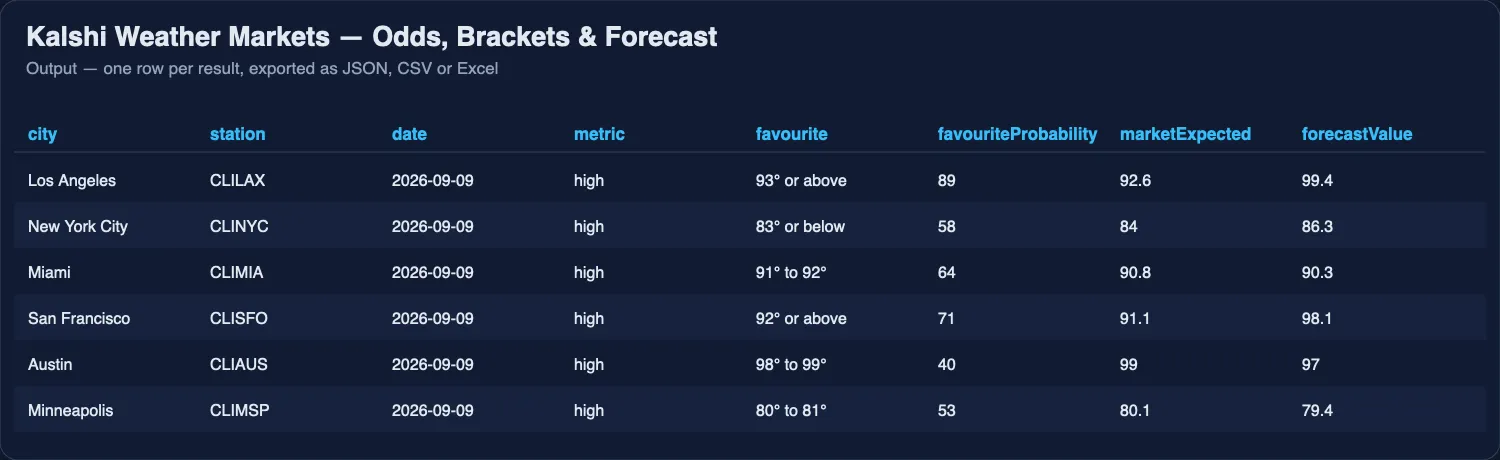
Four modes: brackets (one row per tradable band), days (one row per city and day with the whole distribution), forecast vs market (where the models and the crowd disagree), and series (what Kalshi lists right now).
Tested head-to-head — 24 September 2026
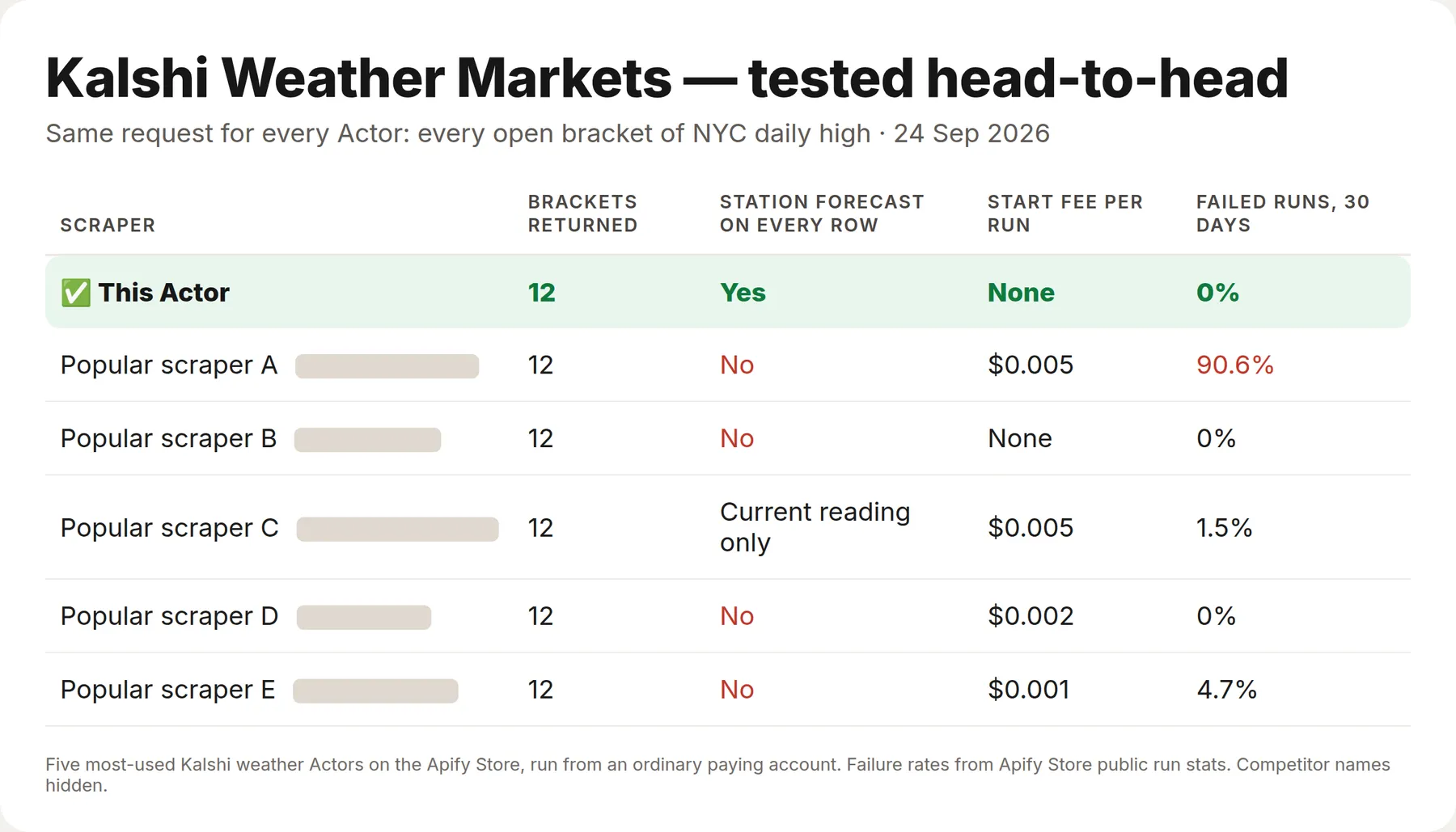
Same request for every Actor — every open bracket of New York City's daily-high market — run against the five most-used Kalshi weather Actors on the Apify Store, from an ordinary paying account. All six returned the same 12 brackets.
| This Actor | The five others | |
|---|---|---|
| Weather forecast for the settlement station on every row | Yes | 0 of 5 (one adds the current station reading) |
| Start fee per run | None | 4 of 5 charge one |
| Failed runs, last 30 days (Store stats) | 0% | 0–90.6% — the most-used one 90.6% |
What is Kalshi Weather Markets?
Kalshi runs a temperature market for each major US city, every day: a ladder of brackets — "83° or below", "84° to 85°", "86° to 87°" — where each contract pays $1 if the day's high or low lands in that band. The prices are the crowd's probability distribution over tomorrow's weather.
This Actor reads that distribution and hands it back as data, alongside the two things you need to judge it: the forecast for the exact station the market settles on, and what that station has already recorded today.
What makes it different
The forecast is matched to the settlement station, not to the city. A Kalshi market settles against one specific NWS climate report, and that station is often not where you would guess. Chicago settles at Midway, not O'Hare. Los Angeles settles at the airport by the ocean, ten degrees cooler than downtown on a hot day. One series titled "HIGHEST Temperature SATX" settles in Louisville. This Actor reads the station out of each market's own resolution rules and fetches the forecast for that point — the difference against a naive city-centre lookup ran to seven degrees on the day this was written.
Probabilities that add up. The prices of a bracket ladder sum to more than 1; the surplus is the exchange's overround. Every row carries both the raw probability and the fairProbability with that surplus removed, plus the overround itself.
Dead days are labelled, not dressed up. Kalshi lists city-days nobody has traded, where all six brackets sit at a fraction of a cent. Normalising those produces confident-looking probabilities out of two cents of volume. Those days come back flagged illiquid, with fair probabilities withheld, and are left out of the forecast mode entirely.
What data does it return?
Brackets
| Field | Example |
|---|---|
city, station, date | New York City · CLINYC · 2026-09-09 |
metric | high · low |
bracket, floor, cap, strikeType | 84° to 85° · 84 · 85 · between |
probability, fairProbability | 34.0 · 32.4 (per cent) |
yesPrice, noPrice, bestBid, bestAsk, spread | 0.34 · 0.66 · 0.33 · 0.35 · 0.02 |
volume, volume24h, openInterest | 6,802 · … · 4,120 |
marketExpected, overround, illiquid | 84.1° · 0.05 · false |
forecastValue, forecastPicksThisBracket | 86.3 · false |
status, result, closeTime, rules, url | active · empty until it settles · … |
Days
One row per city and day: every bracket with its probability, the favourite band, the market's own marketExpected temperature, the forecast, the gap between them, and which bracket the forecast lands in together with what the market charges for it. That last number is the useful one — a forecast pointing at a bracket the market prices at 2% is a disagreement worth reading.
Forecast vs market
The same rows, filtered to days where a forecast exists and the market is actually priced. For a day already under way it also carries observedHigh and observedLow: what the station has recorded so far. A model that still disagrees with a market at 2pm is usually a stale model, not an edge, and the observation is what tells you which.
How much does it cost?
Pay per row, and only for rows you actually get:
| Event | Price |
|---|---|
| Bracket | $0.001 |
| Day | $0.003 |
| Forecast row | $0.004 |
| Series row | $0.0005 |
Error rows are never charged, and there is no charge for starting a run. Two public JSON APIs, no browser and no proxy, so platform usage is negligible.
| Job | Cost |
|---|---|
| Every city, highs and lows, today and tomorrow (≈290 brackets) | $0.29 |
| A daily snapshot of all cities for a month | $8.70 |
| Forecast vs market for every city, once a day for a month | $4.90 |
The other Kalshi weather Actor charges $0.001 per row plus $0.005 for every run and returns market records only. This one matches the row price, drops the start fee, and adds the forecast and the observations.
Bulk export: what 50,000 brackets actually cost
This Actor is built for bulk jobs — put hundreds of inputs into one run, or call it from the API on a schedule. There is no fee per run, no fee per page and no proxy charge: you pay for the rows you keep, and error rows are free.
| Job | This Actor | Most-used Actor in this category |
|---|---|---|
| 50,000 bracket rows across 100 runs | $50 | $50.50 |
Checked on the Apify Store on 24 September 2026 against the Kalshi weather Actor with the most monthly users: the same $1 per 1,000 markets plus a $0.005 start fee on every run. Every row here also carries the weather forecast for the settlement station at no extra cost.
How to use it
- Choose 📋 What to get: brackets, days, forecast vs market, or the series list.
- Pick 🌡️ What kind of weather — daily high and low are the ones traded every day.
- Narrow to 🏙️ Cities if you want (partial names work), and set 📅 Days ahead.
- Leave 🔭 Add the weather forecast on unless you want a pure market snapshot.
- Click Start, then export as JSON, CSV or Excel, or read the dataset through the API.
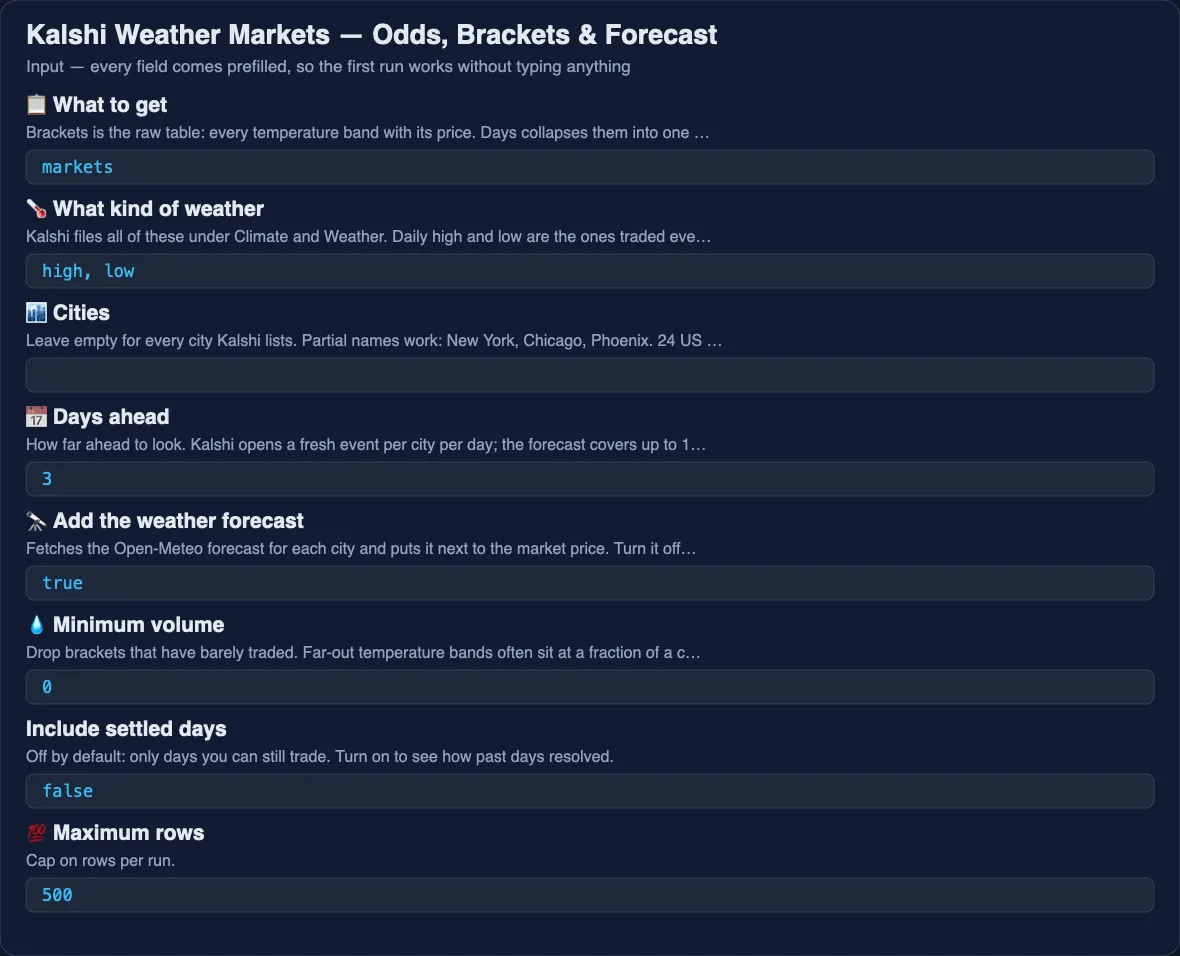
⬇️ Input
Where the forecast and the market disagree
One city, several days
Named series only
⬆️ Output
A source that fails arrives as a type: "error" row with the reason, never as a silently short list.
Use cases
Trading the temperature ladder
Pull every bracket with its fair probability and compare it against the forecast for the station that actually settles the market.
Weather desks and newsletters
One row per city and day with the crowd's full distribution — a cleaner "what does the market think it will be tomorrow" than any single number.
Research
Schedule the run and keep a time series of how the distribution moved as the day approached, then compare it against what the station recorded.
Energy and logistics
Temperature markets are a live, priced consensus for the days ahead, in the cities where load and delivery costs actually move.
AI agents
An agent asked "what does the market think tomorrow's high in Chicago will be" runs the days mode for one city and reads favourite and marketExpected off the row.
🤖 For AI Agents & LLM Apps
Compact reference for agents calling this Actor through the Apify MCP server or the Apify API (lergassy/kalshi-weather-scraper).
Purpose: returns Kalshi's daily temperature markets as a probability distribution per city and day, with a forecast and today's observations beside them.
Minimal input:
Behaviors an agent should know:
- Quote
fairProbability, notprobability: the raw prices of a ladder sum to more than 100%, and the fair figure is the one that adds up. marketExpectedis a fair-weighted average of bracket midpoints. WhenmarketExpectedIsBoundedis true, most of the money sits in an open-ended end bracket ("93° or above"), the average is capped by construction, and a gap against the forecast there is an artefact — readforecastBracketFairProbabilityinstead.- Rows flagged
illiquidhave no meaningful prices; the forecast mode drops them already. stationis the NWS climate report the market settles against, and it is authoritative — the city in a series title can be wrong.- For today's date,
observedHighandobservedLoware what the station has already recorded. A forecast that disagrees with the market after those are in is usually stale. - Temperatures are in Fahrenheit, because that is the unit Kalshi settles in.
- Both APIs are public: no key, no account, no proxy.
Kalshi weather API without a key
Kalshi publishes open endpoints for series, events and markets, and this Actor handles the nesting, the bracket strike types and the two flavours of open-ended band. The forecast comes from Open-Meteo and the observations from the US National Weather Service, both public and both keyless.
❓ FAQ
Is this financial advice or a trading tool?
No. It reads public market data and public weather data and returns them as a table. It places no orders and holds no positions.
Which cities are covered?
The 24 US cities Kalshi runs daily temperature markets for, from New York, Chicago and Los Angeles to Phoenix, Seattle and New Orleans. Run the series mode to see the current list — Kalshi adds and retires series.
Why is the forecast sometimes far from the market?
Two honest reasons and one artefact. The models can genuinely disagree with the crowd; a model run for a day already under way can be stale while the market has seen the morning readings; and when the money sits in an open-ended end bracket, marketExpected understates by construction — that case is flagged.
Does it cover rain, snow and hurricanes?
The filters accept them and the series mode lists them, but Kalshi frequently has no open event on those series. Daily highs and lows are what trades every day.
How fresh are the numbers?
Live at the moment of the run. Schedule the Actor to build your own time series.
Can I use it with the Apify API or an MCP server?
Yes. It runs from the API and the official clients, and AI agents reach it through the Apify MCP server without extra setup.
Your feedback
Missing a city, or a field you need? Open an issue on the Issues tab — every one gets answered.
You might also like
| Actor | What it does |
|---|---|
| Kalshi Scraper & API | Every Kalshi market, not just weather |
| Polymarket Scraper & API | The same shape for Polymarket |
| Prediction Markets API | Kalshi and Polymarket in one table |
| Sports Betting Odds API | Bookmaker lines, arbitrage and value bets |
Also known as
People look for this Actor as a Kalshi weather API, KXHIGH and KXLOW data, temperature market odds, weather prediction market data, Kalshi temperature brackets and daily high temperature betting odds.
Use via API
Run this Actor from your own code or pipeline. Get your token in Apify Console → Settings → API & Integrations. Every input field below has the same name as in the JSON tab of the input form.
Python
JavaScript
cURL (runs the Actor and returns the results in one call)


