

Shopify Store Scraper — Emails, Apps & Catalogue
Pricing
from $3.50 / 1,000 store profiles
Shopify Store Scraper — Emails, Apps & Catalogue
Profile any Shopify store in one row: shop identity, email, phone and socials, theme and installed apps, catalogue size, price band, and how many products were created in the last 90 days. No login, no API key, no proxy.
Pricing
from $3.50 / 1,000 store profiles
Rating
5.0
(2)
Developer

Matvey
Maintained by CommunityActor stats
0
Bookmarked
34
Total users
23
Monthly active users
a day ago
Last modified
Categories
Share
Tested head-to-head — 26 September 2026
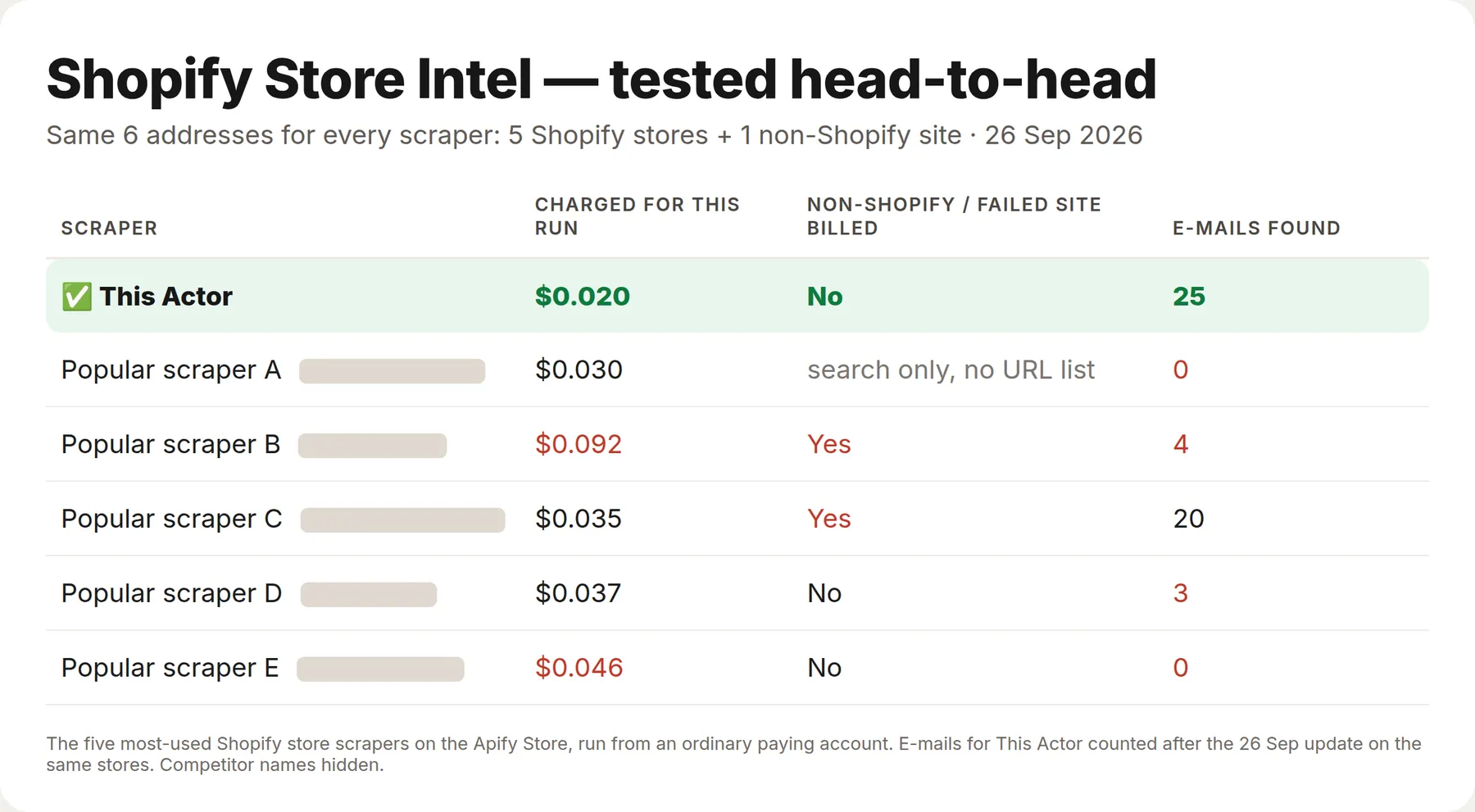
The same six addresses went to this Actor and to the five most-used Shopify store Actors on the Apify Store, from an ordinary paying account: five Shopify stores and one site that is not on Shopify.
| This Actor | The five others | |
|---|---|---|
| Charged for this run | $0.020 | $0.030–0.092 |
| Non-Shopify or failed site billed | No | Yes at two of five |
| E-mails found | 25 | 0–20 |
E-mails come from every content page the store publishes (about, press, wholesale, team pages — Shopify's own /pages.json), the contact page and the privacy, terms and refund policies, also for headless storefronts through the store's myshopify host. The store's own addresses are listed first. Each row also carries pageCount and firstPageAt (the date of the store's oldest page — a rough store age).
What is Shopify Store Scraper?
Shopify Store Scraper turns a list of shop addresses into one flat row per store: who the merchant is, how to reach them, what the storefront runs on, and what the catalogue actually looks like. It reads the JSON that every Shopify storefront publishes for its own use, so there is no login, no API key, no browser and no proxy bill — and no official Shopify API needed.
Give it gymshark.com and you get back the shop's name and country, the e-mail and phone the
merchant published, every social profile, the theme and the apps installed, the size and price band
of the catalogue, and how many products were created in the last ninety days.
What data does Shopify Store Scraper extract?

| Group | Fields | Example |
|---|---|---|
| Identity | shopName, shopId, myshopifyDomain, currency, city, province, country | Allbirds · 11044168 · weareallbirds.myshopify.com · USD · Beverly Hills · California · US |
| Contacts | email, emails, phone, phones | help@allbirds.com |
| Socials | instagram, facebook, tiktok, youtube, x, linkedin, pinterest | https://www.instagram.com/allbirds |
| Storefront tech | theme, apps | Hydra 1.15.0 · Klaviyo, Judgeme, Gorgias, Recharge, Okendo |
| Catalogue | totalProducts, catalogueComplete, productCount, variantCount, inStockVariants, outOfStockVariants, vendorCount, productTypes | 294 · false · 250 · 1 908 · 1 640 · 268 · 3 |
| Price band | priceMin, priceMedian, priceMax | 18 · 98 · 285 |
| Activity | newestProductAt, oldestProductAt, productsCreatedLast90Days | 2026-09-02 · 2019-04-11 · 37 |
| Housekeeping | rowType, isShopify, dataLimited, notice, error, scrapedAt | store · true · false |
totalProducts is the size of the whole catalogue, counted from the shop's product sitemap when it is
larger than the sample; productCount and the other catalogue figures describe the products actually
read (💯 Products per store, 250 by default), and catalogueComplete says whether that sample was the
whole catalogue.
Switch on Add product rows and every product arrives as its own row too, with title,
handle, productUrl, vendor, productType, tags, publishedAt, available, imageCount
and the price range of its variants.
Why the activity figures matter
A list of Shopify stores is easy to buy and mostly useless: half of it is abandoned shops. Three
fields answer the only question that decides whether a store is worth contacting — is anyone still
working on it? productsCreatedLast90Days counts products by their creation date, not their
publish date, because Shopify bumps the publish date on any re-publish and a dormant store would
otherwise look brand new.
What the Actor will not invent
Phone numbers come only from tel: links the merchant published. Scanning page text for runs of
digits returns map coordinates, order ids and timestamps dressed up as phone numbers, so an empty
phone cell here means the merchant published none — not that the Actor guessed badly.
A shop that rate-limits or blocks the request comes back as an error row saying so, never as "not a Shopify store", so real stores never quietly drop out of your list.
How much does it cost to scrape Shopify stores?
Pay per event, billed on results — not on time:
| Row | Price |
|---|---|
| Store profile | $0.005 — $5 per 1,000 stores |
| Product row | $0.0005 — $0.50 per 1,000 products |
| Error row, notice row, "not a Shopify store" | free |
Prices fall on higher Apify plans. The Apify free plan's $5 of monthly usage is about 1,000 store profiles, and profiling a store takes two or three HTTP requests — there is no browser and no residential proxy in the bill.
Bulk export
This Actor is built for bulk jobs — put hundreds of inputs into one run, or call it from the API on a schedule. There is no fee per run, no fee per page and no proxy charge: you pay for the rows you keep, and error rows are free, so a 50,000-row job costs exactly 50,000 × the row price with nothing added on top.
How to scrape a Shopify store
- Open the Actor and press Try for free — the form arrives filled in with
gymshark.com. - Paste your own addresses into Store URLs, one per line. A bare domain works; so does a full
https://address or a*.myshopify.comhost. - Pick a Mode: Store profile for one row per shop, Products to add the catalogue, Detect only to sift a large domain list cheaply.
- Press Start. A hundred stores take about a minute.
- Export from the Storage tab as CSV, JSON or Excel, or call the API endpoint shown under API to pull the rows straight into your own tool.
⬇️ Input
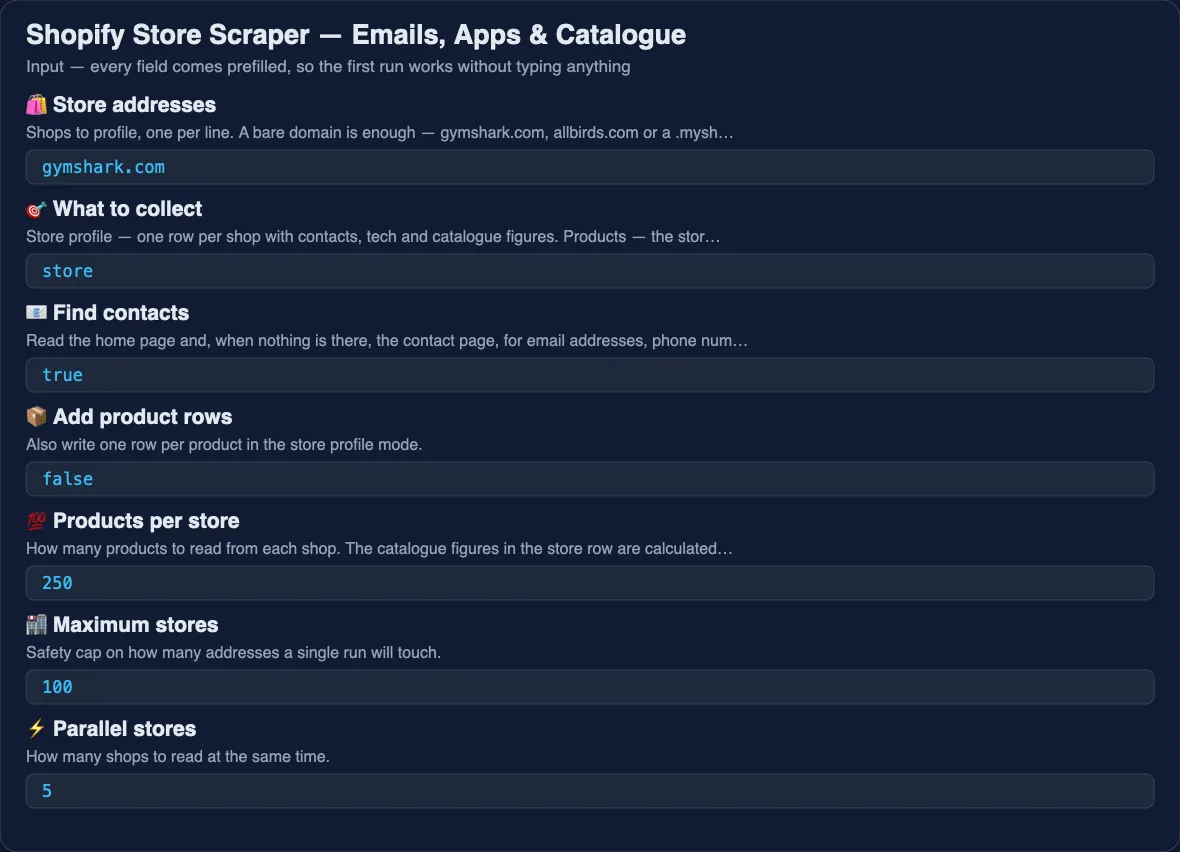
| Field | What it does |
|---|---|
storeUrls | The shops to profile. Bare domain, full URL or *.myshopify.com — all accepted. |
mode | store (one row per shop), products (shop row plus catalogue), detect (is this Shopify at all). |
includeContacts | Read e-mail, phone and social links from the storefront. On by default. |
includeProducts | Add one row per product on top of the store row. |
maxProductsPerStore | Cap on product rows per shop, default 250. |
maxStores | Safety cap on how many shops one run profiles, default 100. |
concurrency | How many shops are read at once. Five is gentle and fast enough for a hundred shops. |
Sift a large domain list before paying for profiles
Profile a shop and pull its whole catalogue
⬆️ Output
One flat row per store — no nested objects, so the result drops straight into a spreadsheet, a CRM import or an LLM context window.
Product rows
Use cases for Shopify store data
Agencies and freelancers
Build a prospect list of live Shopify stores in a price band, then filter by the apps they already run: shops with no review app, no e-mail tool or no subscription app are a pitch that writes itself.
E-commerce competitor tracking
Follow a competitor's catalogue over time — price band, how fast they launch, what goes out of stock — by running the same list on a schedule and comparing the exports.
Sales and lead enrichment
Take a domain list you already have, run Detect only to find which ones are Shopify, then profile just those. You pay for detection at a fraction of a profile.
App and SaaS vendors
Find the stores that already run a competing app, or none at all, and size the market by catalogue and price band rather than by guesswork.
AI agents and RAG
One store, one flat row, stable field names. Call it from an agent through Apify's MCP server and drop the row into a prompt without any reshaping.
Integrations
Use it as a Shopify store API through the Apify API, the JavaScript or Python client, or connect it without code to Google Sheets, HubSpot, Slack, n8n, Make, Zapier and webhooks.
One HTTP call that runs the Actor and returns the rows in the same request — this is the endpoint n8n, Make and AI agents use:
🤖 For AI agents and LLM apps
Available over the Apify MCP server, so an agent can call it directly:
What it answers: is this domain a Shopify store, who runs it, how to contact them, what apps and theme it uses, how big and how expensive the catalogue is, and whether anyone is still adding products.
Troubleshooting and error rows
Error and notice rows are free, and one bad address never stops the run.
| What you see | What it means | What to do |
|---|---|---|
isShopify: false with no error | The address answered, and it is not a Shopify store | Nothing — that is the answer, and it was free |
| An error row with HTTP 403 or 429 | The storefront rate-limited this request | Re-run those addresses, or lower concurrency |
dataLimited: true | The shop hides part of its catalogue JSON | Store-level figures are still right; product rows may be short |
phone empty | The merchant published no tel: link | Use email or the socials — the Actor does not guess numbers from page text |
| Zero rows and one explanation row | No store addresses were given | Fill Store URLs, one address per line |
❓ FAQ
Is it legal to scrape Shopify stores?
The Actor reads only what a storefront publishes publicly for its own front end — the same data your browser downloads when you open the shop. It collects no personal data beyond the business contact details the merchant chose to publish, and it never signs in.
Do I need a Shopify API key or a partner account?
No. There is no login, no API key and no OAuth. That is why it costs what it costs.
How fast is it?
Two or three HTTP requests per shop, five shops at a time by default — about a minute for a hundred stores. Adding the catalogue makes it slower in proportion to the number of products.
Can I use it with the Apify API?
Yes — run it from the API, the JavaScript or Python client, or with
run-sync-get-dataset-items to get the rows back in the same request. See Integrations above.
Can I use it through an MCP server?
Yes, through the Apify MCP server, with the config shown above.
Does it find every app a store uses?
It finds the apps that leave a trace in the storefront — the common review, e-mail, subscription, helpdesk and pixel apps. An app that runs only in the admin leaves nothing public to detect.
What does one row cost?
$0.005 per store profile and $0.0005 per product row; errors and non-Shopify answers are free.
Your feedback
Something missing or wrong? Open an issue on the Actor page — issues are read and answered, and fixes ship the same week.
You might also like
| Actor | What it does |
|---|---|
| Website Contacts API | E-mails, phones and socials from any website, Shopify or not |
| Email Verifier & Phone Validator | Check the addresses this Actor found before you mail them |
| US New Business Leads | Newly registered US companies, with contact details |


