🕊️ CMS Hospice Compare
Pricing
from $20.00 / 1,000 results
🕊️ CMS Hospice Compare
CMS Hospice Compare data: 6,800+ Medicare-certified hospice providers with provider, location, ownership, and quality ratings. For healthcare analysts, payers, and hospice-sector M&A.
Pricing
from $20.00 / 1,000 results
Rating
0.0
(0)
Developer
NexGenData
Maintained by CommunityActor stats
0
Bookmarked
5
Total users
3
Monthly active users
a day ago
Last modified
Categories
Share
Every Medicare-certified hospice provider in the United States — name, full address, ownership type, CCN, region, and certification date — pulled straight from the official CMS Provider Data Catalog and delivered as clean, structured JSON for a flat $0.10 per result. No Definitive Healthcare seat, no IQVIA contract, no enterprise data wall.
Overview
The Centers for Medicare & Medicaid Services (CMS) publishes the authoritative national roster of Medicare-certified hospice agencies through its open Provider Data Catalog. It is the same source dataset that powers the public Medicare Care Compare hospice tool — the agency name, its physical location, its ownership structure, its CMS Certification Number (CCN), and its certification history. It is the single most reliable public-domain view of who is delivering hospice care under Medicare, and where.
The catch is access. CMS distributes the data through a JSON API keyed by opaque dataset IDs, with paginated socrata-style endpoints, inconsistent column naming across releases, and no built-in filtering for the slices most teams actually want. Getting a current, deduplicated, state-filtered list into a spreadsheet or a database usually means writing and maintaining your own ingestion job — or paying a provider-intelligence vendor five figures a year for what is, at its core, the same public CMS data with a markup.
This actor removes both problems. It reads directly from the live CMS hospice dataset, normalizes the core provider fields into stable snake_case keys, lets you filter by state and cap your result count, and emits one clean JSON record per hospice provider. You pay only for the records you pull. There is no subscription, no seat license, and no minimum commitment — just authoritative CMS hospice data on demand.
Why use this
- Official, public-domain source. Data comes from
data.cms.gov, the CMS Provider Data Catalog — the same authority behind Medicare Care Compare. Not a scraped third-party copy. - Pay only for what you pull. A flat $0.10 per result. Need 200 hospices in one state? Pay for 200. No annual contract, no per-seat license.
- Structured and ready to load. Stable snake_case keys map cleanly to CSV columns, database fields, and dataframes. No HTML parsing, no PDF scraping, no API plumbing on your end.
- State filtering built in. Pass a two-letter state code and get just that market, instead of downloading the national file and filtering it yourself.
- CCN-keyed for joins. Every record carries the CMS Certification Number, the canonical Medicare provider identifier, so you can join hospice rows to claims, cost reports, and other CMS datasets.
- Fraction of the vendor price. The provider-intelligence platforms that license this same CMS public data resell it on tens-of-thousands-per-seat annual contracts. This actor delivers the underlying records for cents apiece.
What you get
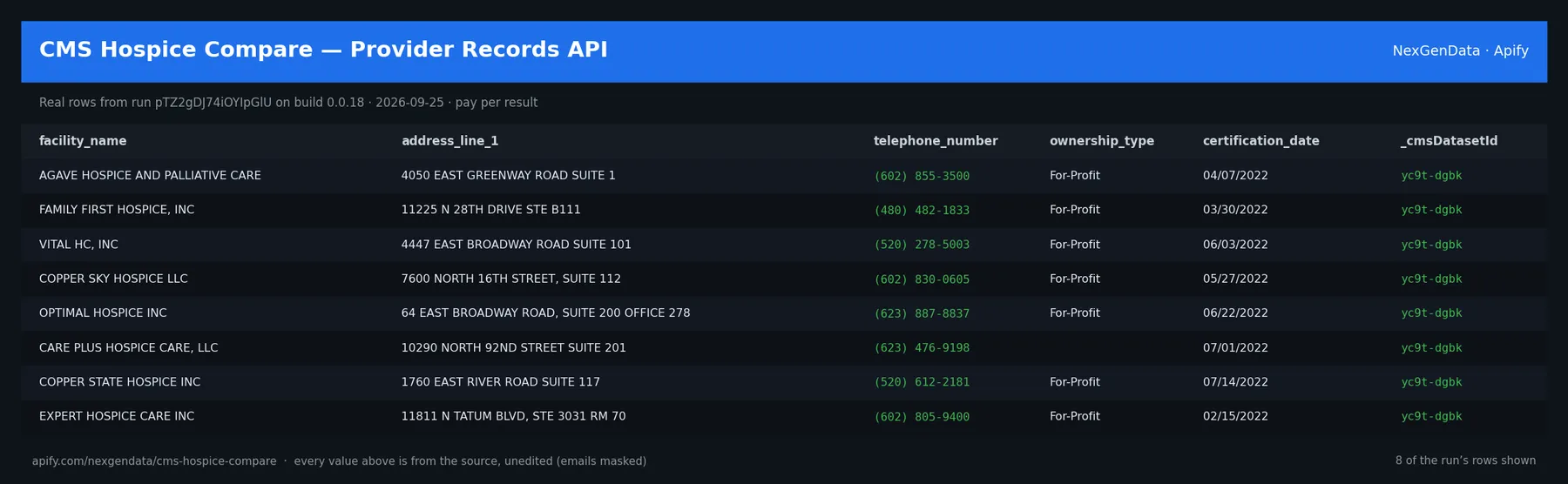
Each result is one Medicare-certified hospice provider, emitted as a flat JSON object with the following fields (real CMS column names, in snake_case):
| Field | Description |
|---|---|
cms_certification_number_ccn | The CMS Certification Number (CCN) — the canonical Medicare provider identifier used across CMS datasets. The primary key for joins. |
facility_name | Legal/operating name of the hospice provider as recorded by CMS. |
address_line_1 | Primary street address of the provider. |
address_line_2 | Secondary address line (suite, building) — may be empty. |
citytown | City or town of the provider's physical location. |
state | Two-letter U.S. state/territory code. |
zip_code | Postal ZIP code. |
countyparish | County (or parish, in Louisiana) where the provider is located. |
telephone_number | Provider's listed telephone number. |
cms_region | The CMS regional office number governing the provider. |
ownership_type | Ownership structure — e.g. Non-Profit, For-Profit, Government. |
certification_date | Date the provider was Medicare-certified (MM/DD/YYYY). |
_cmsDatasetId | The data.cms.gov dataset ID the record was pulled from — provenance for audit and reproducibility. |
Together these give you a market-ready provider master: who the hospice is, exactly where it operates, how it is owned, when it entered the Medicare program, and the identifiers needed to enrich it further.
Use cases
Healthcare market research & sizing. Build a national or state-level census of Medicare hospice providers segmented by ownership type, county, and certification vintage. Quantify how many for-profit vs. non-profit agencies serve a given market and how long they have been certified.
Payers & managed-care network design. Health plans and Medicare Advantage organizations can map the hospice supply in each county, assess geographic coverage and adequacy, and identify gaps when building or auditing provider networks.
Hospice / home-health M&A and private equity. Deal teams screening the fragmented hospice sector can pull the full provider universe, filter to target states, segment by ownership and certification date, and build target lists and roll-up maps without standing up a data pipeline mid-diligence.
Medical sales & GPO targeting. Suppliers of pharmacy, durable medical equipment, EHR/software, and clinical staffing services can build precise call lists by state and county, prioritize by ownership type, and route territories using clean address and phone fields.
Patients, families & care navigators. Discharge planners, social workers, and patient-advocacy organizations can generate localized lists of certified hospice options by ZIP, city, or county to support care-transition decisions.
Journalists & policy researchers. Reporters and academics investigating hospice ownership trends, the for-profit shift, or geographic access can work from the authoritative CMS roster with clear provenance for every record.
Compliance, credentialing & verification. Compliance and credentialing teams can confirm Medicare certification status, CCN, and certification dates against the official CMS source as part of vendor or partner due diligence.
Sample output
{"cms_certification_number_ccn": "451501","facility_name": "COMMUNITY HEALTHCARE OF TEXAS","address_line_1": "6100 WESTERN PL STE 105","address_line_2": "","citytown": "FORT WORTH","state": "TX","zip_code": "76107","countyparish": "Tarrant","telephone_number": "(817) 870-2795","cms_region": "6","ownership_type": "Non-Profit","certification_date": "01/10/1984","_cmsDatasetId": "yc9t-dgbk"}
Input parameters
| Parameter | Title | Type | Required | Default | Description |
|---|---|---|---|---|---|
datasetId | CMS dataset ID | string | No | yc9t-dgbk | The data.cms.gov dataset ID to read from. Prefilled with the current hospice dataset; override only if CMS reassigns the dataset. |
state | State | string | No | — | Two-letter state code filter (e.g. TX, CA, FL). Omit to pull all states. |
maxResults | Max results | integer | No | 2000 | Maximum number of records to return. Use it to cap volume and control cost. |
How to use it
Python (apify-client)
from apify_client import ApifyClientclient = ApifyClient("<YOUR_APIFY_TOKEN>")run_input = {"datasetId": "yc9t-dgbk","state": "TX","maxResults": 500,}run = client.actor("nexgendata/cms-hospice-compare").call(run_input=run_input)for item in client.dataset(run["defaultDatasetId"]).iterate_items():print(item["cms_certification_number_ccn"], item["facility_name"], item["citytown"])
cURL
curl -X POST "https://api.apify.com/v2/acts/nexgendata~cms-hospice-compare/run-sync-get-dataset-items?token=<YOUR_APIFY_TOKEN>" \-H "Content-Type: application/json" \-d '{"datasetId": "yc9t-dgbk","state": "TX","maxResults": 500}'
The run-sync-get-dataset-items endpoint runs the actor and returns the dataset items in a single call — convenient for smaller pulls. For large national runs, trigger the run asynchronously and page through the dataset.
Pricing
$0.10 per result. You are charged for each provider record returned — nothing else. No platform subscription, no monthly minimum, no per-seat license.
Worked example. Suppose you need every Medicare-certified hospice in Texas and the run returns 500 providers:
500 results × $0.10 = $50.00
A single statewide market map for $50. A national pull capped at 2,000 records costs $200; the same data behind a provider-intelligence seat license typically runs into the tens of thousands of dollars per year. Use maxResults and the state filter to scope each run to exactly the slice you need and keep cost predictable.
How this compares to Definitive Healthcare / manual data.cms.gov downloads
| This actor | Definitive Healthcare / IQVIA | Manual data.cms.gov download | |
|---|---|---|---|
| Cost model | Pay-per-result, $0.10/record | Enterprise annual contract, per seat | Free |
| Commitment | None | Multi-year contract typical | None |
| Source authority | Official CMS public data | Licenses the same CMS data, marked up | Official CMS public data |
| Structure | Clean JSON, stable snake_case keys | Polished platform UI | Raw API / CSV, shifting column names |
| State filtering | Built-in parameter | Yes | Manual |
| Engineering effort | None — one API call | None | You build & maintain ingestion |
| CCN for joins | Included | Included (plus proprietary IDs) | Included |
The premium vendors enrich CMS data and wrap it in dashboards — valuable if you need that whole platform and can fund the contract. The manual CMS download is free but pushes pagination, dataset-ID drift, and column normalization onto you. This actor sits in between: the official data, structured and filterable, with zero infrastructure and pay-as-you-go pricing.
FAQ
How fresh is the data? The actor reads the live CMS dataset at run time, so each run reflects the current published state of the CMS Provider Data Catalog. CMS refreshes its provider datasets on its own cadence; pulling on a schedule keeps your copy in sync with the source.
What is the geographic coverage? National — all U.S. states and territories that appear in the CMS hospice dataset. There are roughly 6,800 Medicare-certified hospice providers in the source dataset.
Can I filter by state?
Yes. Pass a two-letter code in the state parameter (e.g. FL). Omit it to pull the full national roster.
What identifiers are included?
Each record carries the cms_certification_number_ccn (CCN) — the canonical Medicare provider identifier — which you can use to join to other CMS datasets such as claims, cost reports, and quality files. The _cmsDatasetId field records the source dataset for provenance.
How do I control how many records I get (and what it costs)?
Use maxResults to cap the record count. Because billing is per result, the cap directly bounds your cost.
Does it include ownership and certification details?
Yes — ownership_type (e.g. Non-Profit, For-Profit, Government) and certification_date (the Medicare certification date) are included on every record.
What if CMS changes the dataset ID?
The datasetId parameter is prefilled with the current ID (yc9t-dgbk) but is fully overridable. If CMS reassigns the dataset, pass the new ID without waiting for an actor update.
Schema stability & versioning
The core output fields documented above use stable snake_case keys that mirror the CMS source column names, so downstream loaders and dataframes can rely on them. The _cmsDatasetId field is prefixed with an underscore to mark it as actor-added metadata rather than a CMS column. Because CMS periodically adds, renames, or re-keys columns in its hospice datasets between releases, treat the documented core fields as the contract and tolerate additional fields appearing over time. We aim to keep changes additive and backward-compatible; any breaking change to the documented fields will be reflected in the actor version and changelog.
Compliance & legal
This actor returns information sourced from the CMS Provider Data Catalog (data.cms.gov), which CMS publishes as public, open data. The records describe Medicare-certified hospice providers and are intended for research, market analysis, network planning, and informational use.
This actor and its output are not medical advice and are not a substitute for professional clinical or legal judgment. Provider details (including certification status and contact information) should be independently verified against the official CMS source before being relied upon for credentialing, care decisions, or regulatory purposes. NexGenData is not affiliated with or endorsed by CMS or the U.S. government. Use of the data is subject to the applicable CMS data-use terms and any laws governing the use of healthcare provider information in your jurisdiction.
Related actors
Building a broader picture of the post-acute and facility-based care market? Pair this actor with the rest of the NexGenData CMS Compare suite, all on the same official-source, pay-per-result model:
- CMS Dialysis Facility Compare — every Medicare-certified dialysis facility, with location and ownership detail.
- CMS Nursing Home Compare — the national roster of Medicare- and Medicaid-certified nursing homes.
- CMS Home Health Agencies — Medicare-certified home health agencies, the natural complement to hospice for post-acute coverage analysis.
Together they let you map the full continuum of certified post-acute care across any market, using one consistent, structured, official-source data feed.