🩺 CMS Dialysis Facility Compare avatar

🩺 CMS Dialysis Facility Compare

Pricing

from $20.00 / 1,000 results

Go to Apify Store
🩺 CMS Dialysis Facility Compare

🩺 CMS Dialysis Facility Compare

CMS Dialysis Facility Compare data: 7,500+ Medicare-certified dialysis facilities with provider, location, ownership, and quality ratings. For healthcare analysts, payers, and dialysis-sector M&A.

Pricing

from $20.00 / 1,000 results

Rating

0.0

(0)

Developer

NexGenData

NexGenData

Maintained by Community

Actor stats

0

Bookmarked

4

Total users

2

Monthly active users

a day ago

Last modified

Categories

Share

Pay-per-result access to every Medicare-certified dialysis facility in the United States — official CMS Dialysis Facility Compare data, including five-star quality ratings, ownership, modalities, and clinical-outcome measures — for $0.10 per facility record. No Definitive Healthcare seat, no IQVIA contract, no enterprise data license.


Overview

Every dialysis facility in the United States that bills Medicare is tracked by the Centers for Medicare & Medicaid Services (CMS) and published through the official Dialysis Facility Compare dataset on data.cms.gov. That covers roughly 7,500+ Medicare-certified facilities — from national ownership chains like DaVita and Fresenius down to independent and hospital-based units — each carrying a CMS Certification Number (CCN), full address, ESRD Network assignment, and the quality, staffing, and clinical-outcome measures CMS publishes for its consumer-facing Care Compare tool.

This actor reads the CMS dataset directly through the official open-data API, optionally filters by state, and emits every facility as clean, structured JSON. Because the source is a CMS open dataset, the actor is a faithful passthrough: it returns the core identity fields (facility name, CCN, network, full address, phone) alongside the complete set of measures CMS publishes — the five-star quality rating, mortality, hospitalization, readmission, transfusion, transplant-waitlist, emergency-department, infection, vascular-access, and dialysis-adequacy (Kt/V) metrics, exactly as CMS reports them.

The result is the official Medicare record for U.S. dialysis care, delivered as queryable JSON — without you having to stand up and maintain your own CMS-API integration, parse the agency's column conventions, or pay for an enterprise healthcare-data platform you only need a slice of.


Why use this

  • It is the official CMS record. Data comes directly from data.cms.gov's Dialysis Facility Compare dataset — the same source that powers Medicare's Care Compare tool — not a re-keyed, modeled, or estimated copy.
  • Full field passthrough. Beyond the core identity fields, the actor returns every measure column CMS publishes in the dataset. When CMS revises or adds measures, the passthrough design carries them through without breaking your pipeline.
  • Pay only for what you pull. $0.10 per facility record. Pull one state or the whole country — there is no platform subscription, seat license, or annual minimum.
  • Structured and queryable. Snake_case JSON keyed to the original CMS column names, ready to load into a warehouse, notebook, CRM, or BI tool.
  • State-level targeting. Filter to a single state with a two-letter code, or omit the filter to retrieve nationwide records.
  • Stable, documented schema. Field names mirror CMS's published columns, so your downstream mappings stay predictable run to run.

What you get

Each record is one Medicare-certified dialysis facility. Fields use CMS's own snake_case column names. The dataset groups into a few logical families:

Facility identity and contact

  • cms_certification_number_ccn — the unique CMS Certification Number (CCN), the canonical identifier for the facility across all Medicare systems.
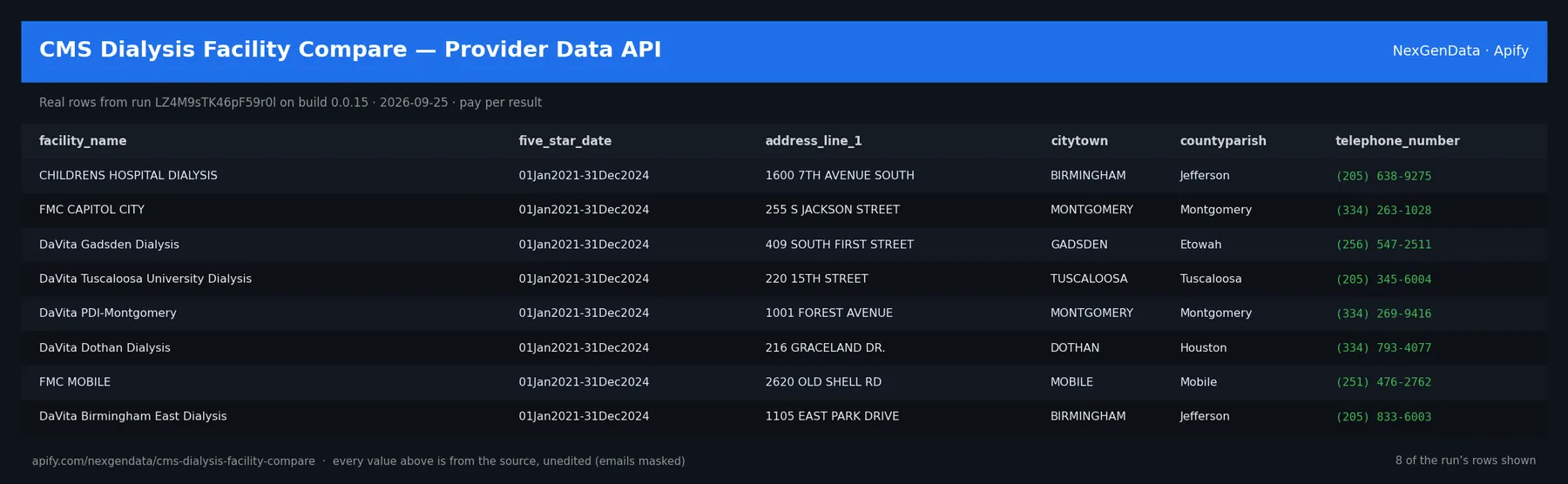
  • facility_name — the facility's legal/operating name.
  • network — the ESRD Network number the facility is assigned to (CMS organizes dialysis oversight into 18 regional ESRD Networks).
  • address_line_1, address_line_2, citytown, state, zip_code, countyparish — the full street address, including county/parish.
  • telephone_number — the facility's listed phone number.

Ownership and operations

  • profit_or_nonprofit — for-profit vs. non-profit status.
  • chain_owned — whether the facility is part of a dialysis chain.
  • chain_organization — the chain operator (or "Independent").
  • late_shift — whether the facility offers a late dialysis shift.
  • of_dialysis_stations — number of dialysis stations.
  • offers_incenter_hemodialysis, offers_peritoneal_dialysis, offers_home_hemodialysis_training — the modalities offered.
  • certification_date — the date the facility was Medicare-certified.

Quality rating

  • five_star — the CMS Dialysis Facility five-star quality rating (1.0–5.0). Higher is better; the rating summarizes a facility's performance across CMS's clinical measures relative to peers.
  • five_star_date, five_star_data_availability_code — the rating period and a code indicating data availability/suppression.

Clinical-outcome measures (each typically reported with a measurement period date, a plain-text performance category, a data-availability code, patient counts, the facility rate, and 97.5%/2.5% confidence limits):

  • Survival / mortalitypatient_survival_category_text, mortality_rate_facility, mortality_rate_upper_confidence_limit_975, mortality_rate_lower_confidence_limit_25, and related count/date fields.
  • Hospitalizationpatient_hospitalization_category_text, hospitalization_rate_facility, plus confidence limits and counts.
  • Hospital readmissionpatient_hospital_readmission_category, readmission_rate_facility, plus confidence limits.
  • Blood transfusionpatient_transfusion_category_text, transfusion_rate_facility, plus confidence limits.
  • Transplant waitlisting — first-year standardized waitlist ratio (first_year_standardized_kidney_transplant_waitlist_ratio, fyswr_category_text) and prevalent-patient waitlist percentage (percentage_of_prevalent_patients_waitlisted_for_kidney_tran_ecca).
  • Emergency department use — standardized ED-visit ratio (standardized_ed_visits_ratio_facility) and 30-day post-discharge ED measures (ed30_category_text).
  • Infectionstandard_infection_ratio and patient_infection_category_text.
  • Vascular access — arteriovenous fistula rate (fistula_rate_facility) and long-term catheter use (percentage_of_adult_patients_with_long_term_catheter_in_use).
  • Dialysis adequacy (Kt/V) — adult and pediatric, hemodialysis and peritoneal (e.g., percent_of_adult_hd_patients_with_ktv__12).
  • Mineral & anemia management — hemoglobin (percentage_of_medicare_patients_with_hgb10_gdl), serum phosphorus, and hypercalcemia measures.
  • Staff vaccinationhealthcare_worker_covid19_vaccination_adherence_percentage.

Every record also includes _cmsDatasetId, the source dataset identifier, for provenance.


Use cases

  • Healthcare market research. Map the national or state-level dialysis landscape — facility counts, ownership concentration, modality mix, and quality distribution — without licensing an enterprise provider database.
  • Payers and insurers. Build and validate dialysis network adequacy, compare in-network facilities on CMS quality ratings and outcome measures, and support value-based contracting decisions.
  • Medical device and pharma sales targeting. Segment and prioritize accounts by station count, modality offerings, chain affiliation, and geography to focus field reps on the right facilities.
  • M&A and private equity in dialysis. Source and screen targets, profile chain vs. independent ownership, and benchmark candidate facilities on quality and outcome measures during diligence.
  • Patients and care navigators. Compare facilities by five-star rating, distance, modalities offered (in-center, peritoneal, home training), and late-shift availability when helping someone choose where to receive treatment.
  • Journalists and policy researchers. Investigate quality disparities, ownership patterns, and outcome variation across regions using the same official data Medicare publishes.
  • Compliance and provider-data teams. Maintain an up-to-date, structured registry of Medicare-certified dialysis facilities keyed to CCN for credentialing, provider directories, and reference data.

Sample output

A single facility record (real CMS fields):

{
"cms_certification_number_ccn": "052305",
"network": "17",
"facility_name": "SANTA CLARA VALLEY RENAL CARE CENTER",
"five_star_date": "01Jan2021-31Dec2024",
"five_star": "4.0",
"five_star_data_availability_code": "001",
"address_line_1": "2220 MOORPARK AVENUE",
"address_line_2": "",
"citytown": "SAN JOSE",
"state": "CA",
"zip_code": "95128",
"countyparish": "Santa Clara",
"telephone_number": "(408) 885-5730",
"profit_or_nonprofit": "Non-profit",
"chain_owned": "No",
"chain_organization": "Independent",
"late_shift": "Yes",
"of_dialysis_stations": "25",
"offers_incenter_hemodialysis": "Yes",
"offers_peritoneal_dialysis": "Yes",
"offers_home_hemodialysis_training": "No",
"certification_date": "1977-08-22",
"claims_date": "01Jul2024-30Jun2025",
"eqrs_date": "01Jul2024-30Jun2025",
"smr_date": "01Jan2021-31Dec2024",
"patient_survival_category_text": "As Expected",
"patient_survival_data_availability_code": "001",
"number_of_patients_included_in_survival_summary": "476.0",
"mortality_rate_facility": "20.6",
"mortality_rate_upper_confidence_limit_975": "32.1",
"mortality_rate_lower_confidence_limit_25": "13.7",
"shr_date": "01Jan2024-31Dec2024",
"patient_hospitalization_category_text": "As Expected",
"patient_hospitalization_data_availability_code": "001",
"number_of_patients_included_in_hospitalization_summary": "108.0",
"hospitalization_rate_facility": "106.6",
"hospitalization_rate_upper_confidence_limit_975": "177.1"
}

The full record includes the complete set of CMS measure columns described above (readmission, transfusion, transplant-waitlist, ED, infection, vascular-access, Kt/V, mineral/anemia, and vaccination), each with its own date, category, data-availability code, counts, and confidence limits.


Input parameters

ParameterKeyTypeRequiredDefaultDescription
CMS dataset IDdatasetIdstringNo23ew-n7w9The data.cms.gov dataset ID for Dialysis Facility Compare.
StatestatestringNoTwo-letter state code filter (e.g. CA, TX, NY). Omit to retrieve nationwide records.
Max resultsmaxResultsintegerNo2000Maximum number of facility records to return.

How to use it

Python (apify-client)

from apify_client import ApifyClient
client = ApifyClient("<YOUR_APIFY_TOKEN>")
run_input = {
"datasetId": "23ew-n7w9",
"state": "CA",
"maxResults": 2000,
}
run = client.actor("nexgendata/cms-dialysis-compare").call(run_input=run_input)
for item in client.dataset(run["defaultDatasetId"]).iterate_items():
print(item["cms_certification_number_ccn"], item["facility_name"], item["five_star"])

cURL

curl -X POST "https://api.apify.com/v2/acts/nexgendata~cms-dialysis-compare/run-sync-get-dataset-items?token=<YOUR_APIFY_TOKEN>" \
-H "Content-Type: application/json" \
-d '{
"datasetId": "23ew-n7w9",
"state": "CA",
"maxResults": 2000
}'

Replace <YOUR_APIFY_TOKEN> with your Apify API token (found in Settings → Integrations in the Apify Console).


Pricing

This actor uses pay-per-result pricing: $0.10 per facility record returned.

You pay only for the records you actually receive — no monthly platform fee, no seat license, no annual minimum.

Worked example:

ScenarioRecordsCost
One mid-size state300$30.00
A large state (e.g. CA)700$70.00
Nationwide pull~7,500$750.00
Single facility lookup1$0.10

A full nationwide refresh of every Medicare-certified dialysis facility costs roughly $750 — a fraction of an enterprise healthcare-data license, with no contract to sign.


How this compares to Definitive Healthcare / manual data.cms.gov downloads

This actorDefinitive Healthcare / IQVIAManual data.cms.gov download
SourceOfficial CMS Dialysis Facility CompareModeled/enriched, multi-sourceOfficial CMS
Pricing$0.10 per result, pay-as-you-goEnterprise annual contract / per-seatFree
Output formatClean structured JSON, ready to loadPlatform UI / exportRaw CSV; manual cleanup
IntegrationOne API call (Python, cURL, any HTTP)Vendor platform / connectorsBuild your own parsing
MaintenanceHandled — passthrough tracks CMS changesVendor-managedYou re-download and re-parse
CommitmentNoneMulti-year licenses typicalNone, but ongoing manual effort

If you need a curated, enriched commercial intelligence platform with firmographics beyond CMS, an enterprise vendor may fit. If you need the official CMS record, structured and on demand, without a contract, this actor delivers exactly that — and unlike a manual CSV download, you get parsed JSON through a single API call with no scripting on your end.


FAQ

How fresh is the data? The actor reads CMS's published Dialysis Facility Compare dataset live at run time. The underlying clinical measures are reported by CMS on its own refresh cycle (typically updated a few times per year), and each measure carries its own measurement-period date field (e.g. five_star_date, shr_date) so you can see exactly which period a value reflects.

What does the five-star rating mean? five_star is CMS's Dialysis Facility quality rating on a 1.0–5.0 scale, where a higher number indicates better measured performance relative to other facilities. It summarizes a facility's standing across the clinical measures CMS uses for the rating. Always read it alongside the per-measure category fields for a complete picture.

What's the coverage? All Medicare-certified dialysis facilities in the United States — roughly 7,500+ — spanning national chains, independents, and hospital-based units. Coverage reflects whatever CMS currently publishes in the dataset.

Can I filter by state? Yes. Pass a two-letter state code (e.g. TX) to limit results to one state, or omit it to pull nationwide records up to your maxResults limit.

Why are some measure fields blank or coded? CMS suppresses or marks measures when a facility has too few patients for a reliable statistic or when data isn't available. The *_data_availability_code fields indicate this, mirroring CMS's own suppression conventions.

Can I look up a single facility? Yes — set maxResults to a small number, or pull a state and filter on cms_certification_number_ccn (the CCN) downstream. Each record is uniquely keyed by CCN.

What identifier should I join on? Use cms_certification_number_ccn. The CCN is the canonical Medicare identifier and is stable across CMS systems, making it the reliable key for joining to claims, provider directories, or other CMS datasets.


Schema stability & versioning

Field names mirror CMS's published column names in snake_case, so your mappings stay predictable from run to run. Because the actor is a faithful passthrough of the CMS dataset, when CMS adds, renames, or revises measures, those changes flow through to the output. Identity fields (cms_certification_number_ccn, facility_name, network, address fields) and the five_star rating are the most stable; individual clinical-measure columns may change as CMS updates its methodology. We recommend keying joins on cms_certification_number_ccn and treating measure columns defensively (handle missing/suppressed values), so your pipeline remains resilient across CMS refreshes.


This actor returns public data published by the Centers for Medicare & Medicaid Services (CMS) through the official data.cms.gov open-data platform. It is provided for informational and research purposes only.

The five-star ratings, clinical measures, and outcome statistics are CMS's own published figures and are reproduced as-is. They are not medical advice and must not be used as the sole basis for any clinical, treatment, or care decision. Patients and caregivers should consult qualified healthcare professionals. Verify current figures against the official CMS source before relying on them for regulatory, contractual, or clinical purposes. NexGenData is not affiliated with or endorsed by CMS or the U.S. government.


Building out a Medicare provider dataset? Pair this with our other CMS Care Compare actors:

  • 🏠 CMS Home Health Agencies Compare — Medicare-certified home health agencies with quality ratings and outcome measures.
  • 🛏️ CMS Nursing Home Compare — Medicare- and Medicaid-certified nursing homes with overall and domain star ratings, staffing, and inspection data.
  • 🕊️ CMS Hospice Compare — Medicare-certified hospice providers with quality measures and family-experience scores.

Each follows the same pay-per-result model and faithful-passthrough design, so you can assemble a unified, official post-acute and dialysis provider dataset across CMS Care Compare.