

SEC Form NT Tracker — Late Filing (NT 10-K/10-Q)
Pricing
from $50.00 / 1,000 nt filings
SEC Form NT Tracker — Late Filing (NT 10-K/10-Q)
Track Form NT late-filing notifications from SEC EDGAR — parsed, source-linked JSON for analysts, funds and AI agents.
Pricing
from $50.00 / 1,000 nt filings
Rating
0.0
(0)
Developer
NexGenData
Maintained by CommunityActor stats
0
Bookmarked
2
Total users
0
Monthly active users
7 days ago
Last modified
Share
SEC Form NT Tracker
Track Form NT late-filing notifications from SEC EDGAR, parsed into clean JSON. Built for analysts, funds, fintech builders and AI agents. Factual public SEC/EDGAR data — not financial or investment advice. Not affiliated with the U.S. SEC.
📊 Sample Output
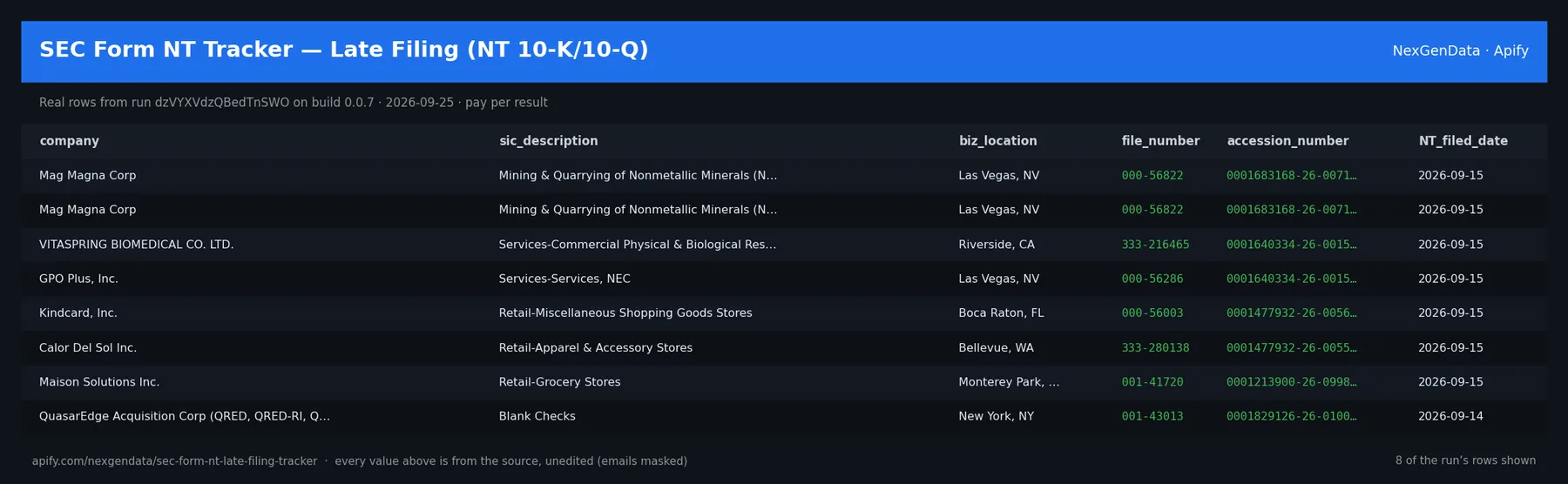
form_type | company | cik | sic_description | biz_location | file_number |
|---|---|---|---|---|---|
| NT 10-Q | Mag Magna Corp | 1949864 | Mining & Quarrying of Nonmetallic Minerals (No Fuels) | Las Vegas, NV | 000-56822 |
| NT 10-K | Mag Magna Corp | 1949864 | Mining & Quarrying of Nonmetallic Minerals (No Fuels) | Las Vegas, NV | 000-56822 |
| NT 10-Q | VITASPRING BIOMEDICAL CO. LTD. | 1697884 | Services-Commercial Physical & Biological Research | Riverside, CA | 333-216465 |
| NT 10-Q | GPO Plus, Inc. | 1673475 | Services-Services, NEC | Las Vegas, NV | 000-56286 |
| NT 10-Q | Kindcard, Inc. | 1696025 | Retail-Miscellaneous Shopping Goods Stores | Boca Raton, FL | 000-56003 |
| NT 10-Q | Calor Del Sol Inc. | 2008027 | Retail-Apparel & Accessory Stores | Bellevue, WA | 333-280138 |
Real rows from run dzVYXVdzQBedTnSWO on build 0.0.7 (2026-09-25), unedited apart from masked emails/phones and shortened long text; fields the source does not publish are empty.
🔧 Input reference
| Field | Type | Default | What it does |
|---|---|---|---|
form_type | string (NT 10-K, NT 10-Q, NT 20-F, NT 15-F, all) | "all" | Which Form NT type(s) to pull. NT 10-K = annual report late; NT 10-Q = quarterly report late; NT 20-F = foreign annual report late; NT 15-F = foreign deregistration late. Use `all… |
days_back | integer | 90 | Look-back window in days. NT filings cluster around 10-K (Q1) and 10-Q (Q1/Q2/Q3) due dates. 90 days catches most of a full quarterly cycle; 365 days catches an entire fiscal year… |
min_market_cap | integer | 0 | Optional minimum-market-cap filter in USD. NOTE: SEC EDGAR does not publish market cap directly — this actor surfaces SEC XBRL shares-outstanding as a proxy basis (joinable with a… |
subsequent_filing_status | string (filed, not_filed, any) | "any" | Filter by whether the registrant has ALREADY filed the underlying 10-K/10-Q (or 20-F/15-F) the NT pointed to. filed = NT was followed by the actual periodic report; not_filed… |
max_filings | integer | 100 | Hard cap on how many NT filings to push to the dataset. Each filing fans out to 2 SEC HTTP requests (primary HTML + submissions JSON + optional XBRL shares concept), so 100 filing… |
🧾 JSON sample record
One real record from run dzVYXVdzQBedTnSWO (emails/phones masked, long text shortened):
💰 Pricing
| Event | Price (USD) | When it is charged |
|---|---|---|
Actor Start (apify-actor-start) | $0.005 | Charged when the Actor starts running. Number of events charged depends on Actor memory (one event per GB, minimum one event). |
NT filing (nt-filing) | $0.05 | Per Form NT (Notification of Late Filing) record extracted |
Pay-per-event: you pay only for what the run delivers. A run that delivers nothing bills no result events (only the actor-start event, when the actor defines one). Example: a run that delivers 100 results costs 100 × $0.05 = $5.00 plus the start fee.
🔗 Related Actors
More from the NexGenData SEC & US filings family:
- Fund Portfolio & Security Ownership Lookup — SEC N-PORT API
- SEC Fund Holdings Monitor — N-PORT Filing Tracker API
- SEC Form N-PX Tracker — Mutual Fund Proxy Votes
- SEC Form 4 Insider Tracker — OpenInsider-Style Screener
- SEC Going-Private Tracker — SC 13E-3 Filings API
- SEC IPO Prospectus Tracker — S-1 & 424B Filings
48 more in this family on the NexGenData Store page.
📊 What you get
Clean JSON, one record per filing. Key fields (full output has 26 fields):
accession_number— SEC accession numbercik— Filer CIKticker— Ticker symbolcompany— Company / filer nameexpected_filing_date— Filing dateform_type— Filing form typefiling_index_url— Direct sec.gov filing linkshares_outstanding_as_of— Detection / fetch timestamp Every record carries a direct sec.gov source link.
Pricing: $0.05 per filing (Pay-Per-Event) — about 20 per $1. Actor start fee $0.005 per run. Live prices are in the Pricing table below.
🤖 Use with AI agents
Structured, source-linked SEC data built for LLM and agent pipelines — point Claude, the OpenAI Agents SDK, an n8n flow or any MCP-aware client at it and pull Form NT late-filing notifications on demand.
Sample agent prompt:
Agentic payments (x402): Supports agentic payment via x402 — agents can call this actor with USDC, no API key required.
⏰ Run on a schedule
The recurring frame is the point — schedule a daily or weekly pull:
🔗 Related SEC actors
More compliance & oversight trackers: Comment Letter Monitor, Litigation Releases, Fails-to-Deliver, Reg SHO Threshold
Agent front doors: SEC Corporate Events MCP, Regulatory Filings MCP
Data parsed from public SEC EDGAR filings. Factual public SEC/EDGAR data — not financial or investment advice. Not affiliated with the U.S. SEC.


