O*NET Occupation Skills & Software — Workforce Taxonomy Data
Pricing
from $33.50 / 1,000 association records
O*NET Occupation Skills & Software — Workforce Taxonomy Data
Official O*NET links between occupations and the skills and software they use — the taxonomy layer for skills graphs, job-matching and reskilling models.
Pricing
from $33.50 / 1,000 association records
Rating
0.0
(0)
Developer
NexGen Signal
Maintained by CommunityActor stats
0
Bookmarked
1
Total users
0
Monthly active users
17 days ago
Last modified
Categories
Share
The official O*NET links between US occupations and the skills and software they use — one clean record per association, pay per record, no API key.
ONET is the US Department of Labor's occupation taxonomy. It says which skills each occupation needs (rated for importance and level) and which software tools people in that job use, with a flag for technologies in high employer demand. This actor turns the ONET database files into flat JSON records you can filter by occupation code, association type and element name, so a skills graph, a job-matching engine or a reskilling model can load the taxonomy without unzipping and joining tab-separated files by hand.
The unit of output is one association record: one occupation linked to one skill rating, or one occupation linked to one software tool. You pay per record delivered.
Who this is for and the decision it supports
HR-tech, workforce-planning, skills-taxonomy and job-matching teams who need the official O*NET links between occupations and the skills and software they use.
One record answers: which skill or software tool is associated with an occupation, and how strongly — a building block for skills graphs, job-to-skill mapping, and reskilling models.
- HR-tech and job-matching products loading O*NET data on which skills and software each occupation uses.
- Workforce-planning and reskilling teams mapping roles to an occupation skills taxonomy.
- Recruiters and labour-market analysts spotting hot-technology and in-demand software by occupation.
Buyers usually search for this as "o*net data" or "occupation skills taxonomy".
📊 Sample Output
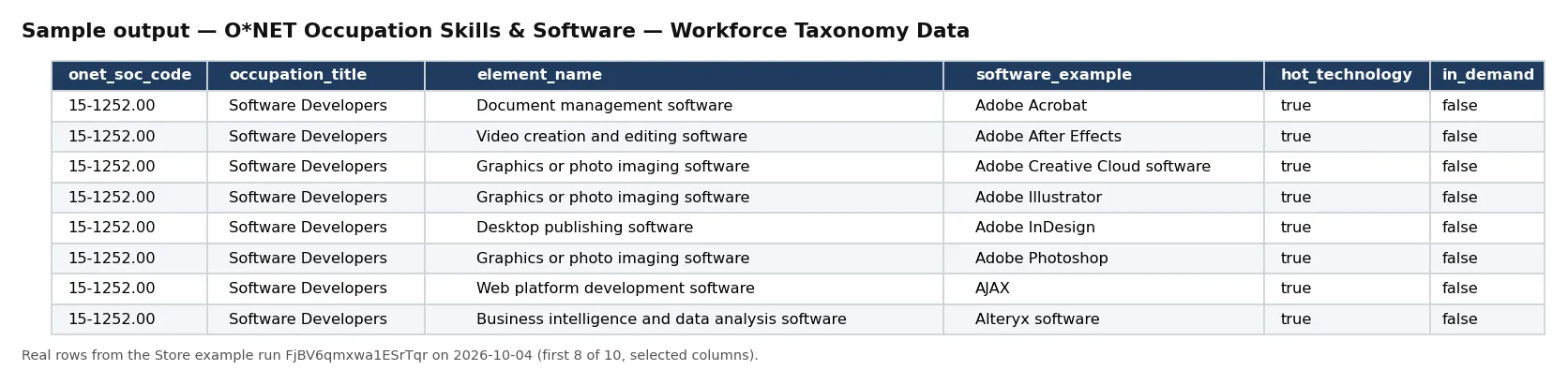
These are the first 8 of the 10 rows from the Store example run on 4 Oct 2026 (run FjBV6qmxwa1ESrTqr): Software Developers, software associations only, hot technologies only.
| onet_soc_code | occupation_title | element_name | software_example | hot_technology | in_demand |
|---|---|---|---|---|---|
| 15-1252.00 | Software Developers | Document management software | Adobe Acrobat | true | false |
| 15-1252.00 | Software Developers | Video creation and editing software | Adobe After Effects | true | false |
| 15-1252.00 | Software Developers | Graphics or photo imaging software | Adobe Creative Cloud software | true | false |
| 15-1252.00 | Software Developers | Graphics or photo imaging software | Adobe Illustrator | true | false |
| 15-1252.00 | Software Developers | Desktop publishing software | Adobe InDesign | true | false |
| 15-1252.00 | Software Developers | Graphics or photo imaging software | Adobe Photoshop | true | false |
| 15-1252.00 | Software Developers | Web platform development software | AJAX | true | false |
| 15-1252.00 | Software Developers | Business intelligence and data analysis software | Alteryx software | true | false |
What to notice: element_name is O*NET's software category and software_example is the named tool. Every row here has hot_technology true because the example input asks for hot technologies only.
✅ What you get
Each record has these fields:
record_id— stable key built from the occupation code, association type, skill class, element id, scale and software example (whichever apply), so re-runs upsert cleanly. String.association_type—skillorsoftware. String.onet_soc_code— O*NET-SOC occupation code, e.g.15-1252.00. String.occupation_title— occupation title from O*NET's occupation file. String.skill_class— for skills,essentialortransferable; null for software.element_id— O*NET content-model element id, e.g.2.A.1.a. String.element_name— the skill (e.g. "Reading Comprehension") or the software category (e.g. "Document management software"). String.scale_id— for skills,IM(importance) orLV(level); null for software.data_value— for skills, the O*NET rating on that scale; null for software. Number.software_example— for software, the named tool (e.g. "Adobe Acrobat"); null for skills.hot_technology— for software, true when O*NET flags it a Hot Technology; null for skills. Boolean.in_demand— for software, true when O*NET flags it In Demand; null for skills. Boolean.source,source_url— the ONET release and the ONET Resource Center database page.licence,attribution,disclaimer— the CC BY 4.0 licence text, the required attribution and the fitness note, on every record.observed_at— run timestamp (UTC).
⚙️ Sample inputs
1. The Store example — hot software for Software Developers. Returns the 10 rows above; $0.50 on the Free plan.
2. Skills for one occupation. Skill ratings for Registered Nurses (29-1141). On 4 Oct 2026 this returned 20 rows (run veW80PNcZelANCCcI), starting with Reading Comprehension at importance 3.88 and level 4.25; $1.00 on the Free plan.
3. One software category across all occupations. Occupations linked to database-management software that O*NET flags as hot, up to 50 rows. On 4 Oct 2026 this returned 50 rows across 21 occupations (run PIhCuyDWpFNfB9mFG), with tools such as Amazon DynamoDB, Apache Cassandra, Apache Hadoop, Apache Hive, Elasticsearch; $2.50 on the Free plan. Raise maxRecords for the full list.
🧾 JSON sample record
The first record from the Store example run, exactly as delivered:
🔧 How it works
- The actor checks the O*NET Resource Center's robots file and stops if it disallows the database download.
- It downloads the O*NET database text files for release 30.3 (
db_30_3_text.zipfrom onetcenter.org) in one request, with a plain, identified user agent. No proxy, no API key, no login. - It reads the occupation titles, the essential and transferable skill files and the software file, and joins each row to its occupation title. On 4 Oct 2026 the release held 94,401 association rows in total.
- It applies your filters, drops exact duplicates on
record_id, delivers each record and then charges for it, stopping atmaxRecords. - It writes a run receipt (rows seen, matched, duplicates dropped, delivered, charged) to the run's key-value store.
What it does not do: it does not call ONET's web-services API, does not read job postings, salaries or any person data, and does not recompute ONET's values.
💰 Pricing example
One event, Association record, charged once per record delivered: $0.05 on the Free plan, $0.045 Bronze, $0.04 Silver, $0.0335 Gold, Platinum and Diamond. There is no start fee.
- The Store example: 10 records × $0.05 = $0.50 (Free plan).
- A run with no
maxRecordsset delivers up to 500 records: 500 × $0.05 = $25.00 on the Free plan, 500 × $0.0335 = $16.75 on Gold. - 5,000 records × $0.0335 = $167.50 on Gold.
A run that matches nothing succeeds with "No O*NET associations matched the selected filters" and is charged nothing.
Coverage and yield. This is US ONET-SOC occupations only. Skill rows exist for occupations ONET rates; software rows list ONET's named examples, not every tool in use. elementContains matches element_name — the skill or the software category — not the tool name, so "Python" or "PostgreSQL" match nothing; use the category wording ONET uses (note ONET writes "Data base", two words). This build reads release 30.3; when ONET publishes a newer release, the actor keeps reading 30.3 until it is updated.
⚖️ Legal & ToS
The ONET database is published by the U.S. Department of Labor, Employment and Training Administration (USDOL/ETA) under the Creative Commons Attribution 4.0 International licence (CC BY 4.0): free to reuse, including commercially, with attribution. Every record carries the licence and the attribution text; keep the attribution when you republish. ONET is a trademark of USDOL/ETA. The data is at occupation level only — there are no natural-person fields — and the actor honours the source's robots file. It is meant for B2B products such as skills taxonomies, job matching and workforce planning.
❓ FAQ
Is this job postings? No. It is the O*NET occupation-to-skill and occupation-to-software taxonomy. For live vacancies use a job-postings feed.
What is a Hot Technology?
O*NET's flag for software and technology in high employer demand. Turn on hotTechnologyOnly to keep only those rows (it applies to software rows).
What do IM and LV mean?
Two O*NET scales for each skill: IM is how important the skill is to the occupation, LV is the level needed. Each skill appears once per scale.
Do I need an O*NET API key or account? No. The actor reads O*NET's public database download.
Why did my run return 0 rows?
Nothing matched your filters. The most common cause is searching elementContains for a tool name; it matches skill names and software categories only.
How current is the data?
It is O*NET release 30.3, as stamped in source on every record.
🆘 Troubleshooting
- 0 rows with
elementContains→ you searched a tool name → search the category instead (e.g. "Data base management", "Web platform development"). - 0 rows with an occupation prefix → the prefix does not match an O*NET-SOC code → use digits like
15,15-1252or29-1141.00. - Only skill rows or only software rows →
associationTypeis set → set it toall. hotTechnologyOnlyremoved every skill row → that filter keeps software rows only → turn it off for skills.- The run stopped at 500 rows →
maxRecordsdefaults to 500 → raise it (up to 100,000). - Run failed with "BLOCKED ONET door" or "ONET fetch/parse failed" → the robots check or the database download failed at run time → run again later; nothing is charged for rows that were not delivered.
🔗 Related Actors
- UK Labour Market Time Series - ONS — UK employment, unemployment and pay series.
- Sweden Active Job Ads - Structured Live Feed — live job ads, when you need vacancies rather than the taxonomy.
- EU Job Vacancy Benchmark — Quarterly by Industry — job-vacancy rates across the EU by industry.
- Australia Wage Price Index - ABS — wage growth by sector and industry.
- Sweden Labour Force Monthly - SCB — monthly employment and unemployment for Sweden.
🏢 About NexGen Signal — official-source data products from government and regulator publications. Browse the catalog: apify.com/nexgensignal
⭐ Found this useful?
If this actor saved you time, a rating on its Apify Store page helps other buyers find it.
Part of NexGen Signal — official-source data products.