

Proff Bussiness Search Scraper
Pricing
from $3.00 / 1,000 results
Proff Bussiness Search Scraper
Scrape comprehensive business data from Proff.no, Proff.dk, Proff.fi, and Allabolag.se—the leading Nordic business intelligence platforms. Extract company details, contact information, financial data, and organizational records across Norway, Denmark, Finland, and Sweden for B2B prospecting.
Pricing
from $3.00 / 1,000 results
Rating
0.0
(0)
Developer

Stealth mode
Maintained by CommunityActor stats
2
Bookmarked
85
Total users
1
Monthly active users
4 months ago
Last modified
Categories
Share
Proff Business Search Scraper: Extract Nordic Company Data at Scale
Understanding Nordic Business Intelligence Platforms
Proff operates as Scandinavia's premier business information service, providing official company data across Norway (Proff.no), Denmark (Proff.dk), and Finland (Proff.fi). Allabolag.se serves the same role in Sweden. These platforms aggregate official registry data, financial statements, credit ratings, and company profiles—making them essential resources for understanding Nordic business landscapes.
Unlike generic business directories, these platforms contain verified data from official sources: tax authorities, company registries, and financial reporting systems. This creates unique value for B2B sales teams prospecting Nordic markets, researchers analyzing Scandinavian industries, investors evaluating companies, and compliance teams conducting due diligence.
Manually collecting company data across thousands of businesses and multiple Nordic countries requires extensive clicking, copying, and organizing. This scraper automates the process, transforming search results into structured datasets ready for CRM integration, market analysis, or lead generation.
What This Scraper Extracts and Target Users
The Proff Business Search Scraper processes search result pages from all four Nordic platforms. It captures multiple business listings per search, extracting company identification, contact details, financial metrics, and organizational data.
Core Data Categories:
Company Identification: Organization number (orgnr), legal name, business unit ID, company ID, listing ID, and customer ID enable unique identification and tracking across databases.
Contact Information: Phone numbers (primary and secondary), mobile numbers, fax, email addresses, and homepage URLs provide direct outreach channels for B2B prospecting.
Physical Presence: Visitor addresses (physical locations) and postal addresses distinguish operational sites from administrative addresses—critical for field sales and logistics planning.
Financial Metrics: Revenue, profit, currency, and last updated date offer financial health indicators for credit assessment and market sizing.
Organizational Data: Employee count, main office designation, business unit type, and company status provide operational scale and legal standing insights.
Industry Classification: Industries array and current industry field enable sector-specific filtering and competitive analysis.
Marketing Intelligence: Marketing protection flags indicate opt-out preferences. Contact persons, descriptions, logos, and search result images support personalized outreach.
Quality Indicators: Certificates, ratings, status remarks, and search highlights reveal credibility, specializations, and distinguishing features.
Primary Users:
B2B Sales Teams build prospecting lists filtered by industry, location, and company size across Nordic markets. Market Researchers analyze business demographics, industry distributions, and economic patterns in Scandinavia. Investors and Analysts screen companies by financial performance and employee growth trajectories. Compliance Teams verify company legitimacy, check status remarks, and assess credit ratings. Recruitment Agencies identify companies by size and industry for targeted candidate placement. Business Development Managers map competitive landscapes and identify potential partners or acquisition targets.
Input Configuration: Targeting Nordic Business Searches
The scraper processes search result pages from Proff.no, Proff.dk, Proff.fi, and Allabolag.se—not individual company detail pages. These URLs display multiple business listings based on search criteria.
Example Input Configuration:
Example Screenshot:
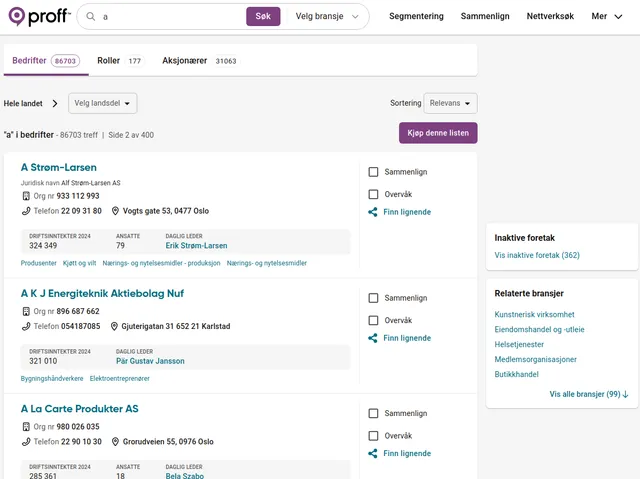
Parameter Details:
proxy configuration: Set useApifyProxy: false when scraping from Nordic countries or when target platforms don't require proxies. Enable with residential proxies if you encounter rate limiting or blocking. Nordic platforms are generally more accessible than US counterparts.
max_items_per_url: Limits extraction to 20 businesses per search page. Most Nordic business searches return 10-50 results per page. Adjust higher (50-100) for comprehensive extraction or lower (10) for testing.
ignore_url_failures: When true, the scraper continues processing remaining URLs even if some fail. Essential for multi-country scraping where individual platform issues won't stop entire runs.
urls array: Contains search result URLs from any combination of Proff.no, Proff.dk, Proff.fi, and Allabolag.se. Mix countries and search criteria in single runs for comprehensive Nordic coverage.
URL Construction Tips: Perform manual searches on target platforms to build URLs with correct filters (industry, location, size). Copy resulting URLs into configuration. URL parameters vary by platform—Danish uses "branchesøg," Norwegian "branchesøk," Finnish "toimialahaku," Swedish "bransch-sök."
Complete Output Structure: Field-by-Field Analysis
Understanding each output field's meaning and application ensures effective data utilization for prospecting, analysis, or compliance.
Main Office: Boolean indicating if this is the company's primary location. Purpose: Distinguishing headquarters from branch offices when targeting decision-makers or analyzing geographic expansion patterns.
Name: Company's trading name or brand name. Purpose: Primary identifier for outreach, differs from legal name which may include corporate suffixes.
Orgnr (Organization Number): Official government-issued company identifier unique in each Nordic country. Purpose: Primary key for data linkage, regulatory compliance verification, avoiding duplicates in multi-source datasets.
Business Unit ID: Internal identifier for specific business units within larger organizations. Purpose: Tracking divisions, subsidiaries, or departments separately from parent companies.
Business Unit Type: Classification of organizational structure (e.g., "HQ," "branch," "subsidiary"). Purpose: Understanding corporate hierarchy, targeting appropriate organizational levels.
Company ID: Platform-specific company identifier. Purpose: Linking to detailed company pages, tracking across multiple scraping sessions.
Listing ID: Unique identifier for this search result listing. Purpose: Deduplication when scraping overlapping searches, referencing specific results.
Customer ID: Identifier for premium or registered company accounts on the platform. Purpose: Identifying companies with enhanced profiles who may be more actively seeking business opportunities.
Phone / Phone2: Primary and secondary landline numbers. Purpose: Direct calling channels, main reception contacts.
Mobile / Mobile2: Primary and secondary mobile numbers. Purpose: Direct contact to decision-makers, often faster response than landlines.
Fax Number: Fax contact (still used in Nordic business contexts). Purpose: Formal document transmission, particularly in legal or government-related industries.
Home Page: Company website URL. Purpose: Research before outreach, verifying legitimacy, accessing additional company information.
Email: Primary email contact. Purpose: Cold emailing, newsletter signup, initial outreach channel.
Marketing Protection: Boolean indicating GDPR marketing opt-out status. Purpose: Compliance filtering—remove these companies from marketing lists to respect privacy preferences and avoid penalties.
Industries: Array of industry classifications. Purpose: Multi-sector filtering (companies operating across industries), competitive analysis, market segmentation.
Location: Geographic location object with city, region, country details. Purpose: Territory-based prospecting, logistics planning, regional market analysis.
Current Industry: Primary industry classification. Purpose: Main business activity when company operates across sectors, most relevant industry filter.
Visitor Address: Physical street address where business operates. Purpose: Field sales routing, in-person meetings, verifying active operations.
Postal Address: Mailing address (may differ from visitor address). Purpose: Sending physical materials, formal correspondence, invoicing.
Description: Company description or profile text. Purpose: Understanding services/products, identifying value propositions, qualifying leads.
Advert Type: Indicates if listing is premium/promoted. Purpose: Identifying companies investing in visibility—may indicate growth phase or sales focus.
Logo: Company logo image URL. Purpose: Brand recognition, visual assets for CRM enrichment, presentation materials.
Search Result Image: Featured image in search listings. Purpose: Visual identification, branding analysis, enhanced data displays.
Legal Name: Official registered company name. Purpose: Legal documentation, contract preparation, formal correspondence, regulatory compliance.
Revenue: Annual revenue figure. Purpose: Company size qualification, market sizing, sales territory prioritization, credit assessment.
Currency: Currency for financial figures (NOK, DKK, EUR, SEK). Purpose: Accurate financial comparison across Nordic countries, exchange rate calculations.
Profit: Profit/earnings figure. Purpose: Financial health assessment, identifying profitable vs. struggling companies, investment screening.
Company Accounts Last Updated Date: Timestamp of most recent financial data. Purpose: Data freshness verification, identifying companies with delayed reporting (potential issues).
Employees: Number of employees. Purpose: Company size segmentation, staffing growth analysis, estimating decision-making complexity.
Contact Person: Named individual contact. Purpose: Personalized outreach, bypassing general inquiries, relationship building.
Status: Company operational status (active, dissolved, bankruptcy). Purpose: Filtering defunct companies, risk assessment, opportunity identification (acquisitions of distressed companies).
Status Remarks: Additional status details or flags. Purpose: Identifying special circumstances (restructuring, mergers, legal issues).
Certificates: Industry certifications or quality standards (ISO, etc.). Purpose: Qualifying suppliers, identifying quality-conscious companies, compliance verification.
Rating: Credit rating or business score. Purpose: Risk assessment, payment terms decisions, partnership evaluation.
Search Highlights: Matched keywords or featured attributes. Purpose: Understanding why company appeared in search, relevance scoring.
Sample Output:
Step-by-Step Implementation Guide
1. Define Target Market: Identify which Nordic countries, industries, and company sizes you need. Consider whether you're prospecting (need contacts), researching (need financials), or screening (need status/ratings).
2. Build Search URLs: Manually perform searches on Proff.no, Proff.dk, Proff.fi, and Allabolag.se with your criteria. Copy resulting URLs. For broad coverage, create multiple URLs per country with different industry or location filters.
3. Configure Input: Assemble JSON with collected URLs. Set max_items_per_url based on needs (20 standard, 50+ for deep extraction). Enable ignore_url_failures for multi-country runs to ensure robustness.
4. Execute Scraping: Launch through Apify console. Monitor real-time progress. Processing 10 search pages with 20 items each typically completes in 3-5 minutes, varying with platform load.
5. Validate Output: Preview dataset for completeness. Check critical fields (orgnr, name, contact info) are populated. Verify no systematic issues with specific countries or search types.
6. Export and Clean: Export as JSON (databases), CSV (spreadsheets), or Excel (business reporting). Filter by status: "Active" to remove defunct companies. Remove marketing_protection: true entries if building marketing lists.
7. Enrich and Integrate: Cross-reference organization numbers with official registries for additional data. Import into CRM with proper field mapping. Segment by revenue, employees, or location for targeted campaigns.
Error Handling: If URLs consistently fail, verify they're search result pages from correct platforms. Check URL encoding (Scandinavian characters must be properly encoded). Activity logs provide detailed troubleshooting information.
Multi-Country Strategy: When scraping all four platforms, process each country separately first to identify platform-specific issues before large combined runs.
Strategic Applications for Nordic Business Intelligence
B2B Lead Generation: Build targeted prospect lists filtered by industry, size, and location. Export contact information directly to sales automation tools. Prioritize companies with recent financial updates (indicates active operations) and no marketing protection.
Market Entry Analysis: Analyze competitor density by region and industry. Revenue and employee distributions reveal market concentration. Identify underserved areas or growing segments for expansion.
Credit Risk Assessment: Filter by status, ratings, and financial metrics to qualify suppliers or partners. Track profit trends and last updated dates to identify companies with deteriorating financials.
Competitive Intelligence: Monitor competitor employee growth, new locations (visitor addresses), and certificate acquisitions. Description changes signal strategic pivots or new service offerings.
Investment Screening: Filter by revenue growth, profitability, and employee expansion to identify growth companies. Certificate holdings indicate quality focus and operational maturity.
Recruitment Market Mapping: Identify companies by size and industry for candidate sourcing. Employee counts reveal staffing levels—growing companies need more hires. Contact persons provide direct HR access points.
Supply Chain Due Diligence: Verify supplier legitimacy through organization numbers and status fields. Check certificates for compliance. Assess financial stability through revenue and profit metrics.
Geographic Expansion Planning: Analyze business density across Nordic regions. Revenue concentrations show lucrative markets. Industry distributions reveal specialization clusters (e.g., maritime in Western Norway, tech in Stockholm).
Maximizing Data Value: Advanced Techniques
Historical Tracking: Scrape same searches monthly to track new company formations, status changes, and financial trends. Store time-series data to identify market evolution and seasonal patterns.
Multi-Source Enrichment: Combine Nordic platform data with LinkedIn profiles, company websites, and news sources. Cross-reference organization numbers with official registries (Brønnøysundregistrene in Norway, Virk in Denmark) for additional ownership and reporting data.
Marketing Compliance Filtering: Build separate lists for marketing vs. information purposes. Flag marketing_protection: true companies—contact only for transactional purposes, not promotional campaigns, to maintain GDPR compliance.
Financial Health Scoring: Create composite scores from revenue, profit, employees, and ratings. Weight recent last_updated_date higher as indicator of accurate current state. Flag declining profit despite revenue growth as efficiency concern.
Contact Prioritization: Rank leads by contact completeness—companies with named contact persons, direct mobile numbers, and email addresses convert better than those with only general phone numbers.
Industry Cluster Analysis: Map industries array data to identify companies operating across sectors. These diversified companies may have broader needs or represent partnership opportunities.
Premium Listing Tracking: Companies with premium advert_type are actively investing in visibility—potentially in growth phase or actively seeking customers. Prioritize outreach to these businesses.
Certificate-Based Segmentation: Filter by specific certifications (ISO 9001 for quality, ISO 27001 for security) when targeting industries with strict compliance requirements (healthcare, finance, government contracting).
Data Governance and Best Practices
GDPR Compliance: Nordic countries strictly enforce GDPR. Respect marketing_protection flags—violations carry severe penalties. Document data processing purposes and lawful bases. Implement data retention policies and deletion procedures.
Update Frequency: Financial data updates annually (fiscal year-end). Contact information changes quarterly on average. Scrape core datasets quarterly, financial data annually, high-priority accounts monthly.
Data Quality Assurance: Validate organization numbers with official registries. Flag companies with stale financial data (>18 months old) for manual verification. Check status fields before large outreach campaigns—dissolved companies waste resources.
Cross-Country Normalization: Financial figures use different currencies—implement exchange rate conversions for comparison. Employee count definitions vary slightly by country—document methodology when analyzing cross-border.
Contact Verification: Phone numbers and emails scrape from public sources but may be outdated. Implement bounce tracking for emails and wrong number logging for phones. Update records progressively.
Ethical Scraping: Nordic platforms generally allow scraping for business purposes but prohibit bulk downloads for competing directories. Space out large runs (500+ companies) over hours, not minutes. Respect robots.txt guidelines.
Data Security: Nordic company data includes personal information (contact persons). Store securely with encryption. Limit access to authorized users. Log data access for audit trails.
Attribution and Verification: Store source URLs and scrape timestamps. When data drives critical decisions (credit extension, investment), verify key facts through official registries or direct company contact.
Conclusion
The Proff Business Search Scraper unlocks comprehensive Nordic business intelligence across Norway, Denmark, Finland, and Sweden. From B2B prospecting and market research to investment screening and compliance verification, this tool transforms scattered public data into actionable datasets. Navigate the Nordic business landscape with confidence—extract, analyze, and act on Scandinavian company data today.
![Google Ads Transparency Leads Scraper [Download assets] avatar](https://images.apifyusercontent.com/oknxQ93w2Fd6a4aKpy558OKGwpbe2RcvL0PiMi7L_T0/rs:fill:76:76/cb:1/aHR0cHM6Ly9hcGlmeS1pbWFnZS11cGxvYWRzLXByb2QuczMudXMtZWFzdC0xLmFtYXpvbmF3cy5jb20vbmduOHZSRVNUa3NleVdFNnAtYWN0b3ItVlFPdTJHT0hiZVJBb09TR2ktQWdPbEpSajBFVi1Hb29nbGVfQWRzX2xvZ28uc3ZnLnBuZw.webp)


