

Apify Actor Idea Validator
Pricing
from $42.50 / 1,000 delivered store evidence reports
Apify Actor Idea Validator
Validate one proposed Apify Actor idea against current public Store similarity, activity, quality, competition, and visible pricing evidence. Get source coverage, confidence, gaps, and a manual validation action. Deterministic research without an LLM—not a revenue forecast.
Pricing
from $42.50 / 1,000 delivered store evidence reports
Rating
0.0
(0)
Developer

Tim Zinin
Maintained by CommunityActor stats
0
Bookmarked
1
Total users
0
Monthly active users
13 days ago
Last modified
Categories
Share
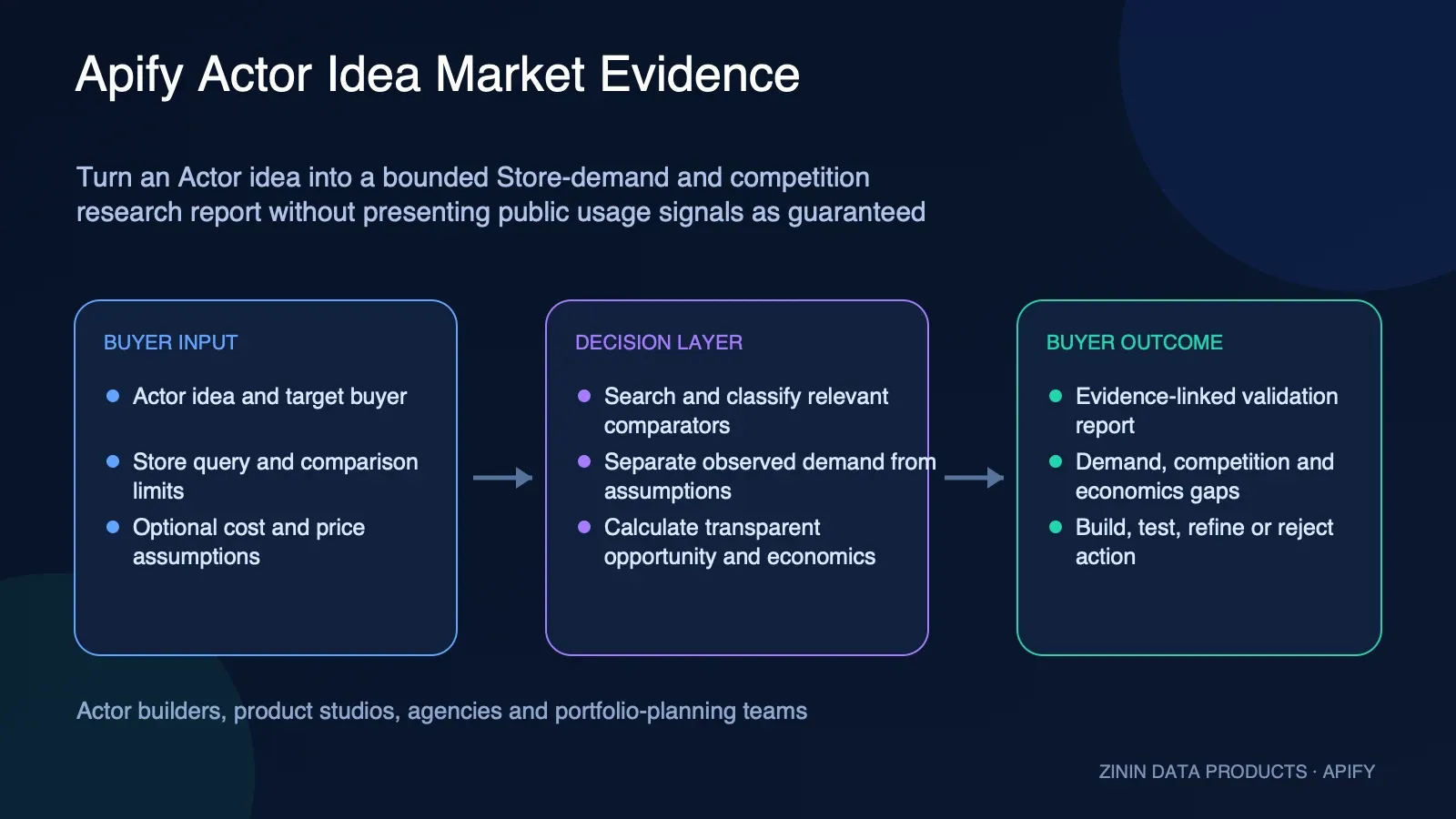
Assess one proposed Apify Actor idea against the public Apify Store. The Actor uses
only GET https://api.apify.com/v2/store, applies the contract-scoped local scoring
rules, and returns one report row when the idea has enough evidence.
Use it for Apify Actor idea validation, competitor discovery, and evidence-first
product research before development.
What you get
- Compares your idea to public Store actors by title, description, keywords and categories.
- Scores the Store cohort with the shared market formula from the Wave 3 contract.
- Returns a single dataset report row with:
- the closest public actors
- the similarity threshold outcome
- a
validate/refine/rejectrecommendation - the derived opportunity score and source metrics
- Writes the compact run summary to default KVS key
OUTPUT.
How to run
- Click Try for free and provide a proposed Actor idea.
- Set a unique
requestId, then choose compact or evidence detail. - Start the run and read the useful report row from the dataset or the compact summary from
OUTPUT.
public-task.json is the ready-to-run Task input and is identical to
examples/input.json and the Input schema prefill. On Apify, the
*-daily-prefill-001 request ID is extended with the trusted run ID, so repeated
Task runs remain separately idempotent.
Limits
- Public Store API only
- No LLM
- No login, token, proxy or browser
requestIdis required for replay/conflict semanticsmaxResultscaps the detailed evidence list, not the number of dataset rowsfreshnessMinutes=0bypasses report-cache reuse
Pricing
Pay-per-event:
apify-actor-start: $0.005result-found: $0.05
Only a confirmed useful report is intentionally linked to the result-found event.
Failed validation, missing evidence, source errors, and budget denial do not create a
result charge. A thrown delivery can be indeterminate, so the Actor records unknown
state and forbids blind replay instead of claiming the operation was free. The business
envelope is written to KVS key OUTPUT; replaying a completed request with the same
requestId never writes or charges again.
Input contract
Output contract
The output schema exposes REPORTS for Dataset items and OUTPUT for the
authoritative terminal envelope.
The exact Dataset shape is closed by the published schema and runtime builders. This README deliberately does not fill that shape with invented scores, dates, customers, or outcomes. The next section uses retained Apify run, Dataset, KVS, and billing projections instead. A result row is derived only from public Store evidence; missing fields stay null, and no revenue, profit, or private-account data is inferred.
Happy, partial, and failure output
These examples are projections from completed Apify runs, not invented demonstration data. Timestamps, request IDs, cohort counts, recommendations, confidence and billing facts are retained so a buyer can compare the documentation with a real run. Large arrays are shortened only where the omitted values do not change the contract.
Paid evidence run: refine before building
Run 9empNWSnxKnwVbghF used candidate build Ia5IQIodYLR6DXzT4 on 11 August 2026.
It read 499 eligible Store records across six successful requests, delivered exactly
one Dataset report, and the platform settled one result-found event. The previous
runtime misread the SDK's post-charge limit signal in its KVS summary; that defect is
why the current runtime additionally requires the named event counter to move exactly
from zero to one. The Dataset business evidence itself was:
Interpretation: the public evidence was broad and current enough for high sample confidence, but the concept overlapped with visible alternatives. The correct next step was to narrow the buyer, source, or output promise and validate that distinction with interviews. It was not a direction to abandon the category, nor proof that the visible competitors had revenue.
Production run: validate a narrower Store research tool
Run 9ftgAc8QFU0u9oYrx used production build H7cyALJawkH8BFszV on 12 August 2026.
It produced one report for the public Task input. This earlier contract version did not
yet include the additive Commercial115 decision fields, so the example shows only the
historically present fields rather than pretending they existed.
Interpretation: validate means the bounded public cohort justified the next research
step. It does not mean “build automatically.” A buyer should inspect the comparator
list, specify the paid outcome unit, model delivery cost, interview target users, and
run a paid pilot before committing a full roadmap.
Second accepted production observation
Run cf54sI4gDNSOkY5ab used the same production build H7cyALJawkH8BFszV on
11 August 2026. It completed SUCCEEDED, wrote exactly one report to Dataset
FC14ooMfH4X5wCLi0, and stored a consistent ok envelope in KVS
gEKtnb5WAATVsO0NP. The event ledger recorded start1/result1. Four source requests
all succeeded; 302 records were read and eligible; the bounded cohort contained 56
Actors; the deterministic recommendation was validate, similarity 0.2, and score
77.2. Those are public Store snapshot measurements, not customer demand, financial
performance, or a forecast.
This independently proves another paid production report with a reconciled legacy Dataset/KVS result. The current source still requires its one exact-build enhanced canary before publication of the repaired settlement contract.
Field dictionary
Identity and observation fields
| Field | Meaning |
|---|---|
schemaVersion | Closed business contract version. The current value is 1.0. |
requestId | Buyer-controlled commercial request identity. Compatible replay is suppressed; incompatible reuse is rejected. |
reportType | Stable discriminator idea_validation. |
recordType | Stable Dataset discriminator idea_validation_report. |
generatedAt | UTC report-construction time. |
observedAt | UTC source-observation time used by the decision layer. |
dedupeKey | SHA-256-derived identity of canonical semantic input; it excludes the transport request ID. |
entityId | Stable join key derived from the canonical input digest. |
detailLevel | compact or evidence; this changes retained evidence, not the commercial unit. |
Evidence and confidence fields
| Field | Meaning |
|---|---|
sourceEvidence | Source URL, observation time and records read from the public Store API. |
sourceMetrics.actorCount | Relevant observed Actors after bounded collection and ranking. |
sourceMetrics.recordsRead | Raw Store records examined across successful requests. |
sourceMetrics.recordsEligible | Records eligible for the deterministic report calculation. |
sourceMetrics.coverage | Measured availability of expected evidence. It is not whole-market coverage. |
sampleConfidence | Compatibility band based on cohort size and measured evidence coverage. |
confidenceScore | Integer mapping of evidence sufficiency for filtering. It is not probability of success. |
confidenceBand | low, medium, or high evidence-sufficiency label. |
confidenceReasons | Machine-readable explanations for the assigned confidence. |
dataGaps | Facts the source and method cannot establish. Always read these before acting. |
negativeSignals | Conditions such as partial coverage, thin cohorts, or close substitutes. |
Decision and action fields
| Field | Meaning |
|---|---|
assessment.recommendation | Deterministic validate, refine, or reject routing result. |
assessment.closestSimilarity | Highest measured text similarity to a visible alternative. |
assessment.matchedActorCount | Number of relevant public Store Actors in the bounded cohort. |
assessment.opportunity.score | Shared opportunity formula output for comparison inside this method. |
recommendedAction | Closed operational next-action constant for a human review queue. |
actionPriority | Relative review urgency derived from the recommendation. |
actionReason | Human-readable explanation of why that route was chosen. |
safeToAutomate | Always false; collection can be automated, the roadmap decision cannot. |
interpretationBoundary | Explicit statement of what the report does not prove. |
change | States that a single report is not a prior-snapshot comparison. |
Delivery and failure fields
| Field | Meaning |
|---|---|
partial | Useful report delivered with an incomplete bounded source observation. |
failureType | null on a successful paid report; failures stay in KVS OUTPUT. |
retryable | false on paid rows. Terminal errors specify their own retry guidance. |
billing.billable | Declared business eligibility of the delivered report row. |
billing.eventName | Named PPE event result-found. |
billing.unit | The sole product noun: one delivered useful idea-validation report. |
metadata.datasetWriteCount | Number of Dataset reports confirmed by current-run delivery logic. |
metadata.billedResultCount | Number of named result events confirmed by the current run. |
metadata.requestReplay | Whether the request reused completed compatible state without another paid row. |
Integration recipes
Keep APIFY_TOKEN in an environment variable or secret manager. It is an API client
credential, not Actor input. Never paste it into a Dataset, Task input, issue, public
run link or screenshot.
cURL: start a run and retain the run identity
The response contains id, defaultDatasetId, and defaultKeyValueStoreId. Read
OUTPUT first, then read the Dataset only when the envelope reports a delivered
result. Do not use the synchronous Dataset-only endpoint in workflows that need full
failure, replay, or billing truth.
JavaScript: enforce terminal and billing reconciliation
Python: route the report to human review
Webhook, Make, Zapier, n8n and MCP routing
Use the run-finished event as a wake-up signal, not as evidence that a report exists.
The integration should fetch OUTPUT, branch on its closed status, verify the two
delivery counters, and only then fetch the Dataset. Route recommendedAction to a
human product-review queue. Include entityId, observedAt, confidenceBand,
dataGaps, negativeSignals, and the Apify run ID in the ticket.
An MCP or agent workflow may summarize the evidence and draft interview questions.
Its system instructions should require citation of the observation time and data
gaps, forbid converting opportunity score to revenue, and retain
safeToAutomate:false. The tool response is evidence for a human decision, not an
autonomous authorization to build, price, publish, contact people, or spend budget.
Decision routing
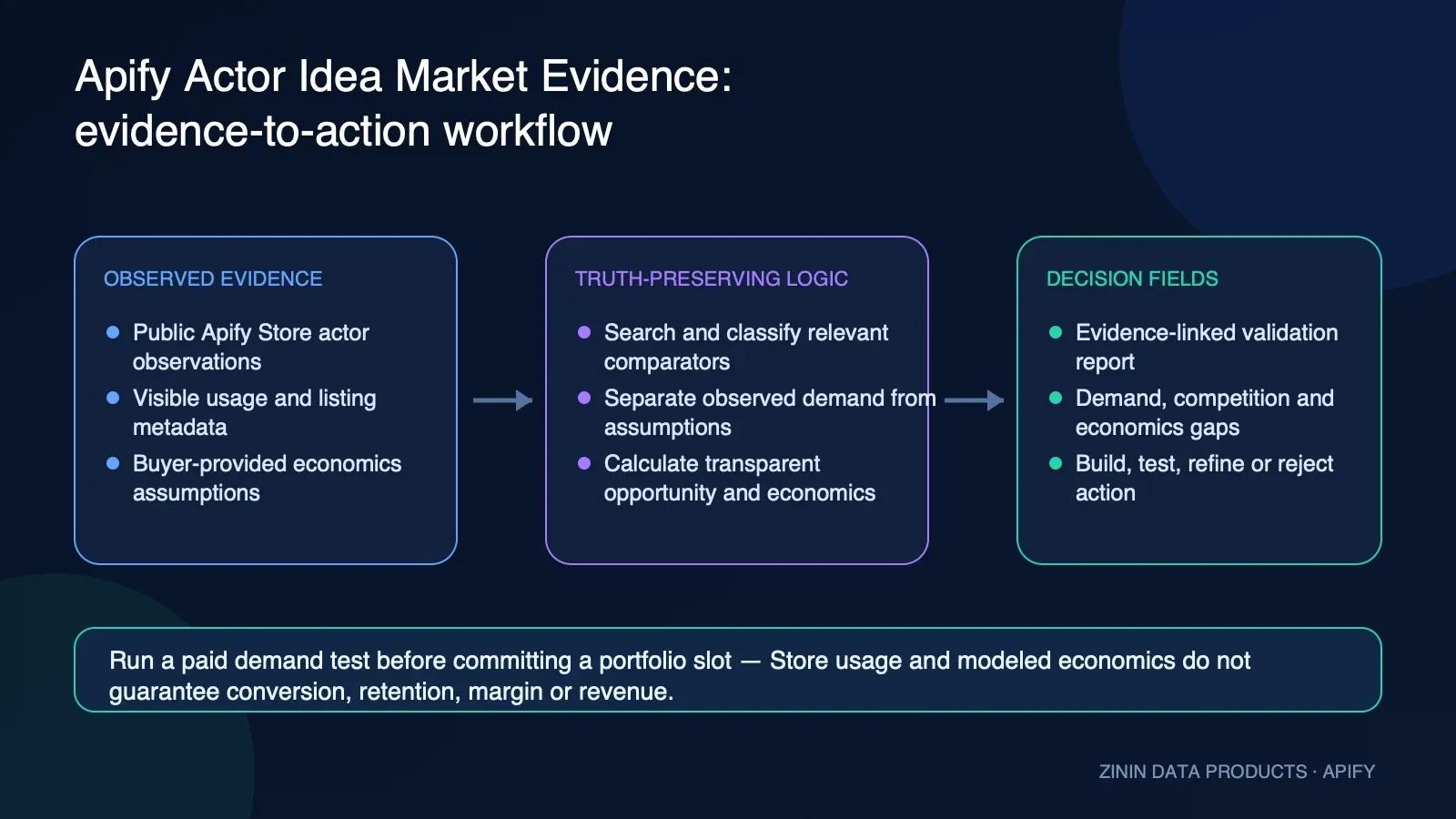
The Actor answers a narrow question: “Given the submitted wording and the current public Apify Store evidence we could measure, should I validate this concept, refine it, or stop building it unchanged?” It does not answer “will this make money?”
That distinction matters. Public user counts, ratings, descriptions, activity and visible pricing can show that buyers use adjacent tools and reveal how crowded a search space is. They cannot show a competitor’s revenue, retention, profit, customer-acquisition cost, private usage, support burden or why a user chose one product. A Store report is therefore a research gate before expensive development, not a business forecast.
Use the output to choose the next research action:
validate— the measured opportunity and differentiation are strong enough to justify interviews and a paid pilot;refine— relevant demand or competition exists, but the submitted positioning is too similar or the opportunity score is not yet strong;reject— the current public evidence does not support building the idea unchanged; reframe the problem and research again.
Every outcome keeps safeToAutomate: false. The Actor can automate collection, comparison and routing. It should not automatically approve a development budget, hire a team, set pricing or promise revenue.
Who uses it
Independent developers and small studios
Run a concept before spending a week on scaffolding. Inspect the closest Actors, their public activity and positioning, then interview people who already pay for or struggle with the workflow.
Apify portfolio operators
Use one request ID per concept and compare reports across a backlog. The same deterministic formula makes internal triage more consistent, while explicit evidence gaps prevent a score from becoming an unquestioned roadmap order.
Agencies and automation consultants
Test whether a proposed client solution already has strong substitutes in the Store. A close substitute may be a partner, component or proof that the workflow exists—not automatically a reason to reject the project.
Product marketers
Read competing titles, descriptions, categories and visible pricing evidence before choosing positioning. Use the report to identify a differentiation hypothesis, then validate the language with real buyers.
Researchers and analysts
Use detailLevel: evidence to retain a larger closest-Actor list and source metrics. Cite the observation time and remember that the Store changes after the snapshot.
Input fields
| Field | Required | What it controls |
|---|---|---|
schemaVersion | yes | Closed business contract version, currently 1.0. |
requestId | yes | Idempotency key. Reusing it with the same semantic input returns the prior report as a free replay Dataset row without a second result-found charge. Reusing it with different input creates a conflict. |
maxResults | no | Maximum detailed closest-Actor evidence retained, 1–100. It does not create more Dataset rows. |
freshnessMinutes | no | How long an identical digest report can be reused. Set 0 to bypass digest-cache reuse. |
detailLevel | no | compact retains up to three closest Actors; evidence can retain up to maxResults. |
idea.title | yes | Clear working title, 3–120 characters. |
idea.description | no | Problem, buyer and output in up to 1,000 characters. Better specificity improves cohort relevance. |
idea.keywords | yes | 1–10 unique terms used for Store matching. Include workflow and buyer-language terms, not only technology names. |
idea.categories | no | Up to five public Store categories to narrow evidence collection. |
Input is closed and rejects unexpected fields, URLs in business text, control characters and duplicate list entries. The Actor needs no token, login, browser or proxy.
Writing a useful idea
A weak idea says “AI lead scraper.” A stronger idea says what public source or workflow is involved, who receives the result, and what decision becomes easier. For example:
Do not stuff unrelated keywords to enlarge the cohort. Broader search can inflate matched Actor count while reducing relevance. Run separate ideas when they target different buyers or deliver different decisions.
Evidence and boundaries
The Actor queries the public Apify Store API with bounded terms derived from title, keywords and categories. It deduplicates public Actors, measures source requests and eligible records, and ranks the cohort using deterministic textual similarity and market metrics. It does not call an LLM.
sourceEvidence identifies the public Store endpoint, snapshot time, records read and source success/failure counts. sourceMetrics carries the fuller cohort measurements used by the opportunity formula. If part of the bounded source collection fails but enough useful evidence remains, the report can be delivered as partial with explicit warnings.
The closest-Actor list is evidence for review, not an exhaustive competitor map. Differently worded substitutes, off-platform products and private enterprise solutions may not appear.
Decision fields
| Field | Meaning |
|---|---|
recordType | idea_validation_report on a useful delivered Dataset row. |
decisionSchemaVersion | Version of the additive decision layer. |
entityId | Digest-derived identity for this semantic idea report. |
observedAt | Public Store snapshot time. |
confidenceScore / confidenceBand | Evidence coverage confidence, not probability of commercial success. |
confidenceReasons | Explains cohort size, measured coverage and deterministic scoring basis. |
sourceEvidence | Public Store API endpoint and bounded collection metrics. |
dataGaps | What public Store evidence cannot establish. |
negativeSignals | Machine-readable concerns such as insufficient sample, close substitute or partial coverage. |
recommendedAction | Interview/pilot, refine/retest, or stop building unchanged. |
actionPriority / actionReason | Urgency and rationale for the next manual step. |
interpretationBoundary | Explicit prohibition on reading the result as a revenue or success forecast. |
safeToAutomate | Always false for roadmap or spending decisions. |
failureType / retryable | Null and false on a useful delivered row; terminal failures are represented in OUTPUT.errors. |
partial | True when useful evidence was delivered from incomplete bounded source coverage. |
billing | One useful delivered report is linked to result-found. |
freshness | Marks evidence as fresh at run time; downstream users must recalculate age. |
change | Unavailable because one run does not compare a previous snapshot. |
Reading confidence correctly
sampleConfidence is the original market-sample band. confidenceScore maps that evidence coverage into a 0–100 decision field for easier filtering. Neither is a forecast confidence interval. High confidence means the Actor had a comparatively strong public Store cohort for its deterministic calculation. It does not mean the idea has a high chance of commercial success.
Always show confidenceReasons, dataGaps and interpretationBoundary next to the score. A dashboard that displays only “90/high” removes the most important commercial caveat.
Reading similarity and opportunity
closestSimilarity measures text overlap with the closest public Store alternatives. High similarity can mean strong existing demand, strong competition, or overly generic positioning. It is not automatically good or bad.
matchedActorCount indicates how many public Actors entered the relevant cohort after bounded collection and filtering. Fewer than three comparable Actors is not enough for a useful paid report.
The opportunity score combines visible market evidence under the published factory formula. Treat it as a ranking device across similarly constructed ideas. Do not compare it with a financial return percentage or interpret a ten-point difference as a precise economic advantage.
Commercial playbooks
The three routes below turn the closed recommendation into bounded human research. They do not authorize spend, publication, outreach, or an automatic product decision.
Recommended validation after validate
A validate result authorizes research, not a full build. A reasonable next step is:
- interview five to ten people in the named buyer role;
- verify the problem happens frequently and carries measurable cost;
- show the proposed output, not only the feature list;
- ask what current tool or manual process they would replace;
- request a paid pilot or binding pre-commitment;
- document access rights, source reliability and variable data cost;
- build the smallest workflow that proves repeated value.
Store demand and a paid pilot answer different questions. The report finds public analogues; buyers prove willingness to pay for your differentiation.
Recommended refinement after refine
Inspect the closest Actors and identify a meaningful axis the buyer cares about:
- a higher-value decision instead of more raw rows;
- a neglected buyer segment or geography;
- a public source that competitors do not join;
- stronger freshness, history, reconciliation or data-quality evidence;
- an integration or workflow output that removes manual work;
- explicit compliance, rights and privacy boundaries;
- better error, partial-result and billing semantics.
Rewrite the title, description and keywords to reflect the new buyer and outcome, then submit a new requestId. Do not merely change synonyms to manipulate similarity.
What to do after reject
Do not interpret reject as proof no business exists. It means this submitted concept is not supported by the current measured evidence. You can:
- interview the intended buyer to discover a more expensive adjacent problem;
- narrow the use case until the output supports one concrete decision;
- combine several public signals into a differentiated enrichment product;
- choose a different distribution channel when Apify Store is not the primary market;
- archive the idea and revisit it after market conditions change.
If your thesis depends on off-platform competitors or private enterprise demand, supplement this report with relevant primary research.
OUTPUT reconciliation
The Dataset holds at most one full useful report. OUTPUT is the authoritative terminal envelope for every run, including runs with no Dataset item. It reports:
- terminal
status:ok,partial,not_found,invalid_input,source_unavailableorbudget_exhausted; - compact
results, at most one; - structured
errorswith retry guidance; resultCount,datasetWriteCount,outputResultCount,omittedResultCountandbilledResultCount;requestReplayandcacheHit;partial, warnings, Dataset ID and duration.
Use these counters before assuming a run delivered a paid report. A successful Actor process with not_found may correctly have zero Dataset rows and zero result charges. A compatible useful replay writes one free Dataset copy so Store health checks and users still receive a visible result; OUTPUT.metadata.requestReplay:true, billedResultCount:0, and row billing.billable:false prove that it is not a fresh paid observation.
Idempotency and replay behavior
requestId protects buyers from accidental duplicate billing. The Actor stores a bounded request state. The same request ID and semantic input can be replayed as one free Dataset copy without another result-found charge. The same request ID with different input returns REQUEST_ID_CONFLICT.
If delivery or charge confirmation becomes indeterminate, request state is marked unknown. A later call refuses to guess and returns REQUEST_STATE_UNKNOWN; blind replay could duplicate billing. Review the original run’s Dataset and charge events before choosing a new request ID.
Use a meaningful unique ID per business decision, such as portfolio-2026q3-shopify-review-radar-v1. The daily public Task uses a special suffix that the on-platform runtime extends with the trusted run ID so scheduled demonstrations remain independently idempotent.
Billing guarantees
The Actor charges result-found only for a useful report with enough comparable Actors and at least 50% measured source coverage. Invalid input, insufficient evidence, source failure, budget denial, replay and indeterminate delivery do not intentionally create a second result charge.
Before paid delivery it verifies the deployed pay-per-event contract, recognized start/result tier, zero-priced default Dataset event and buyer budget. The budget check and linked pushData(report, "result-found") execute inside a billing lock. This prevents concurrent work from racing the same remaining budget.
The delivery receipt must confirm the charge. If it cannot, the terminal envelope records delivery uncertainty and the request state becomes non-replayable without review. Actual deployed pricing and run charge events remain authoritative.
Failure handling
| Status or error | Meaning | Retry guidance |
|---|---|---|
invalid_input / INVALID_INPUT | Closed schema, request conflict or field validation failed. | Fix input; do not retry unchanged. |
not_found | Bounded public evidence did not meet usefulness thresholds. | Refine title/keywords/categories or perform different research. |
source_unavailable | Store request failed, timed out, or delivery state is unknown. | Retry only when the error says retryable; inspect unknown delivery first. |
budget_exhausted | Buyer cap or pricing contract did not permit safe delivery. | Raise budget or correct deployed pricing, then use a new safe request only if no unknown delivery exists. |
partial | Useful report delivered with incomplete bounded source coverage. | Use the evidence, but resolve gaps and rerun later before consequential decisions. |
Errors remain in OUTPUT. Useful compatible replays are the only free Dataset report rows; their billing object is explicitly { billable:false, eventName:null, unit:"one_free_replay_of_previous_report" }, while fresh paid rows remain linked to result-found.
Sources and rights
The Actor reads public Store data and buyer-supplied idea text. It needs no Apify token, login, cookie, proxy, browser or LLM key. Do not include secrets, customer lists or confidential strategy in public Tasks or shared run links. Configure storage access and retention for private research.
The public Store API is the source of observed marketplace fields. The Actor transforms a bounded sample into similarity and opportunity metrics. It does not claim ownership of upstream content or grant redistribution rights. Review current Apify terms and policies for your intended retention, publication and commercial reuse.
Business text is validated and treated as data. It is not executed. Network collection is limited by the Actor’s source budget and expected public Store endpoint family.
Operating guide
Before placing a report into a roadmap review, confirm:
- title, description and keywords describe one buyer and one valuable outcome;
OUTPUT.statusisokor an understoodpartial;datasetWriteCountandbilledResultCountreconcile;requestReplayandcacheHitare understood;- sample and confidence fields have enough coverage for your policy;
- closest Actors are manually reviewed in the live Store;
dataGaps,negativeSignalsand interpretation boundary are visible;- no one interprets opportunity score as revenue or profit;
- buyer interviews and a paid pilot occur before major development spend;
- variable source cost, rights, privacy and support burden are researched separately.
Support diagnostics
For support, share the run ID, non-secret input, OUTPUT envelope and Dataset item if one exists. Include the request ID, terminal status, error codes, source metrics, dataset/billed counters and whether the run was a replay or cache hit. Never send account tokens because this Actor does not require them.
If the cohort looks irrelevant, name two Actors you expected to see and explain the buyer/workflow connection. If the issue is billing, include platform charge-event evidence and whether delivery was confirmed. If the score seems surprising, compare the visible cohort, similarity and source coverage before assuming a formula bug.
Related tools
Related tools for adjacent workflows in in-house factory tooling.
| Actor | What it does |
|---|---|
| Apify Market Gap Finder | Pair it in the in-house factory tooling workflow: Compare user-declared niches against the public Apify Store and rank evidence-backed market gaps |
| Apify Pricing Benchmark Advisor | Pair it in the in-house factory tooling workflow: Summarize visible public Apify Store event-price distributions for a declared cohort |
| Apify Niche Demand Radar | Pair it in the in-house factory tooling workflow: Produce a current demand-direction snapshot for one declared niche using observed public Apify Store user... |
| Apify Portfolio Expansion Planner | Pair it in the in-house factory tooling workflow: Rank user-supplied candidate niches by public Store opportunity and textual adjacency to a user-supplied... |
FAQ
Does it invent market facts? No. Scores and recommendations use only fields observed in the public Store response.
What this is NOT. It is not a revenue forecast, product-success guarantee, or private-account auditor. Report bugs through the Actor page.


