

Website Change Monitor & Changelog Checker
Pricing
from $1.00 / 1,000 url checkeds
Website Change Monitor & Changelog Checker
Website change monitor and changelog checker for public pages. Fetch HTML, extract the main text or a CSS selector, compare it with the previous snapshot, and get a change flag, a short added/removed-line diff, a timestamp and a hash. Fast HTTP crawl, no browser and no proxy required.
Pricing
from $1.00 / 1,000 url checkeds
Rating
0.0
(0)
Developer

Web Audit Lab
Maintained by CommunityActor stats
0
Bookmarked
2
Total users
1
Monthly active users
7 days ago
Last modified
Categories
Features
Share
What this Actor does
The Website Change Monitor & Changelog Checker is a website change monitor and changelog checker for public web pages. Give it a list of URLs — for example a changelog, release notes or a pricing page — and an optional CSS selector. Each run fetches the HTML over HTTP (no browser, no proxy), extracts the main text, and compares it with the previous snapshot in a named key-value store.
For every URL it returns whether the page changed, a short diff of added and removed lines, a timestamp and a SHA-256 hash of the normalized text. The first time a URL is seen, the Actor stores a baseline snapshot and marks isInitialSnapshot as true (with changed false), so later runs have something to compare.
Who it is for
- Teams who want a scheduled check on a public changelog or product updates page
- Operators who watch a pricing or status page and want a short, structured diff
- Developers and agents that need a simple website change monitor through the Apify API or MCP
Features
- Checks a list of public http(s) URLs in one run
- Optional CSS selector to compare only part of the page (for example
main,articleor.changelog) - Snapshots stored in a named key-value store that you reuse across runs
- Short added/removed line diff, plus full added/removed counts if the diff is truncated
- SHA-256 content hash and ISO timestamps for the current and previous snapshot
- Skips non-HTML resources (.md, .txt, .pdf, images and similar) and non-HTML responses
- Respects robots.txt; default memory is 512 MB; no proxy and no LLM
How to use
- Paste one or more public page URLs (changelog, pricing, release notes or any static HTML page).
- Optionally set a CSS selector if you only want to compare a section of the page.
- Keep the same Snapshot key-value store name on later runs (default
page-change-snapshots). - Run the Actor, then open the Page checks dataset view. Schedule the same task if you want a recurring check.
Screenshots
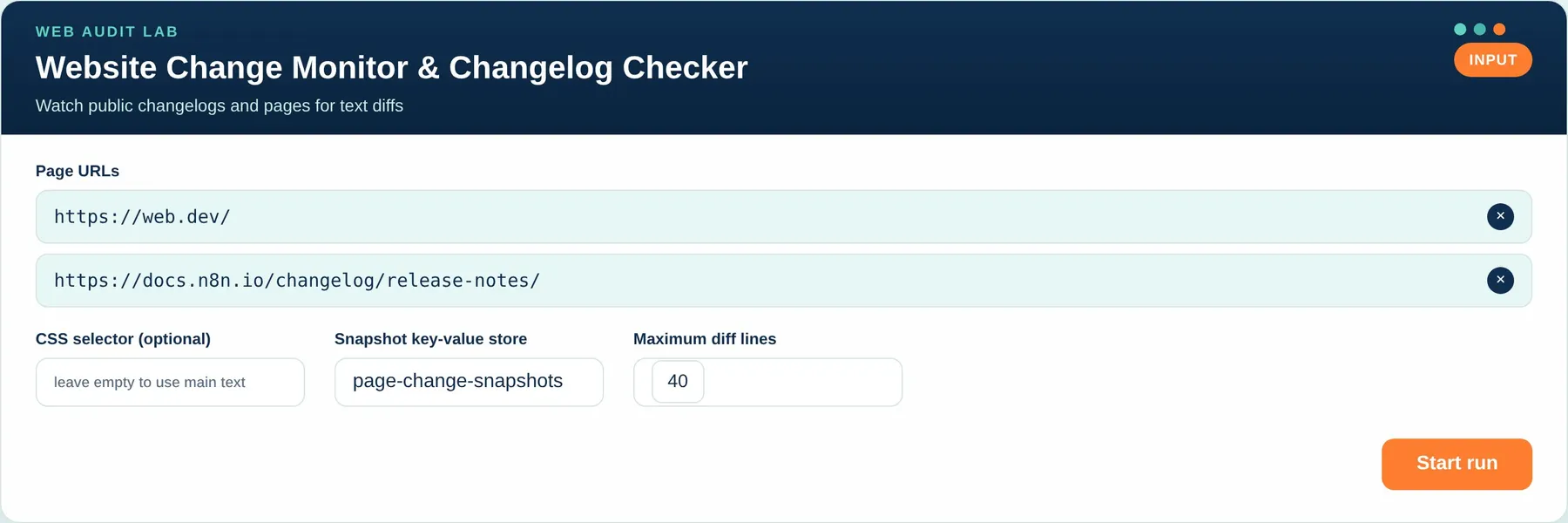
Input — a prefilled Try run, styled in the Web Audit Lab palette:
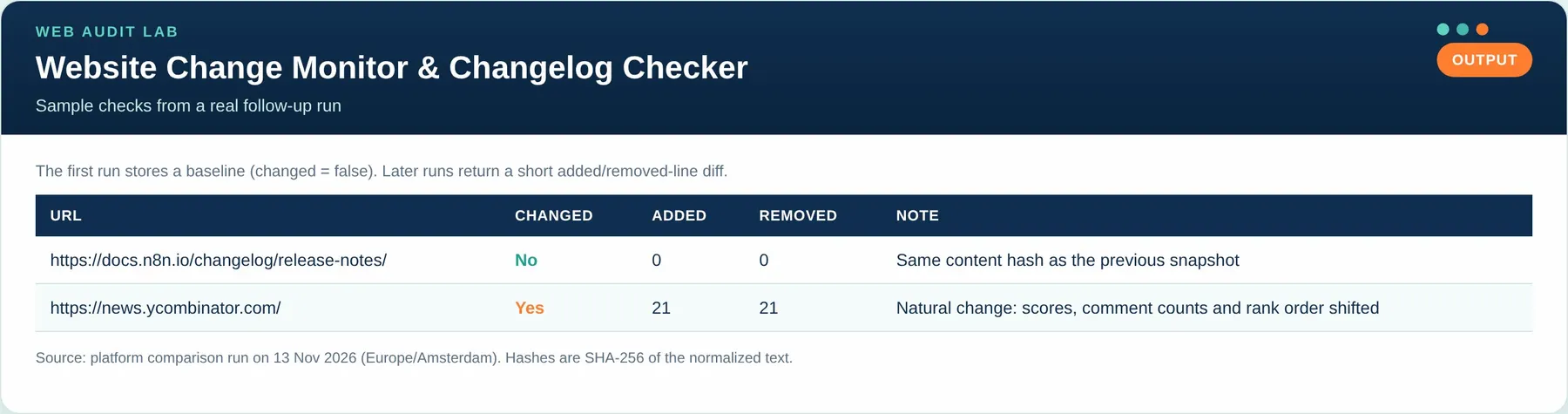
Output — sample dataset from a real platform run:
Input
| Field | Type | Default | Description |
|---|---|---|---|
startUrls | array of URLs | prefilled examples | Public http(s) pages to check. Each URL is fetched once per run. |
selector | string | empty | Optional CSS selector. If it matches nothing, the Actor falls back to the main page text and sets selectorMatched to false. |
snapshotStoreName | string | page-change-snapshots | Named key-value store for previous snapshots. Use the same name on later runs. |
maxDiffLines | integer | 40 | Maximum added lines and maximum removed lines kept in the short diff (5–200). |
Example input:
Output examples
Each dataset item is one URL. On the first run isInitialSnapshot is true and changed is false. On a later run, a real text change looks like this (illustrative shape; measured values come from the test runs recorded in store-draft/):
Unchanged pages return changed false, empty diff arrays, and the same hash as previousHash.
How snapshots work
The previous text is stored in a named key-value store in the account that runs the Actor. The store key is derived from the URL and the selector, so the same page can be tracked with or without a selector. After a successful check the current text becomes the next baseline. Failed or skipped URLs do not overwrite a snapshot.
Pricing
This Actor uses pay-per-event pricing. You pay for finished work, not for a vague compute bundle:
| Event | When it is charged | Price |
|---|---|---|
| URL checked (primary) | Each processed URL check, including initial snapshots and unchanged pages | $1.00 per 1,000 checks ($0.001 each) |
| Actor start | Automatically when the run starts (once at 512 MB or 1 GB) | $0.00005 (Apify default; the first 5 seconds of compute are covered) |
Failed and skipped (non-HTML) URLs are not charged. Ten successful checks cost $0.01 + $0.00005 = $0.01005 at these event prices.
Set a maximum cost per run in the Console or API if you want a hard spending cap. Schedule the same task for a recurring changelog or pricing-page check, or run it via the Apify API and export JSON, CSV or Excel.
Privacy and robots.txt
Public pages only. The Actor respects robots.txt, does not use a proxy, and does not collect personal data as a goal. It stores only the extracted public page text (and its hash) so the next run can compare.
Limitations
- Cheerio does not execute JavaScript. Pages that render all meaningful content only in the browser will look thin or empty.
- Non-HTML links and responses are skipped.
- Very large HTML is not fully kept in memory for analysis; extracted text is capped at 80,000 characters (
textTruncatedis then true). - Default memory is 512 MB.
- A CSS selector that matches a volatile block (ads, timestamps in a sidebar) can create false changes. Narrow the selector to the changelog or price block when you can.
Troubleshooting
- Non-HTML is skipped. URLs that look like
.md,.txt,.pdf, images or similar, and responses that are nottext/htmlorapplication/xhtml+xml, are not fetched as pages to compare. They appear asstatus: skippedand do not update the snapshot. - The page list is the cap. The Actor checks each input URL once. It does not crawl further links. Duplicates are ignored.
- Timeouts. If a slow site stops the run, raise the run timeout (
timeoutSecs) and keep the URL list modest. The default 512 MB is enough for typical documentation and changelog pages. - Blocked sites. There is no proxy. Sites that block datacenter IP addresses, or that disallow the Actor in robots.txt, are skipped or failed. Check the
errorfield and the run log. - No diff on the second run. If
changedis false, the normalized text is identical to the last snapshot (including whitespace normalization). If you expected a change, confirm you reused the samesnapshotStoreNameand selector, and that the change is in the extracted main text, not only in JavaScript-rendered content. - Costs. Each successfully checked URL is one event ($0.001). Set a maximum cost per run for a hard cap.
FAQ
Does the first run report a change?
No. The first successful fetch is the baseline (isInitialSnapshot true, changed false). Later runs compare against that snapshot.
Can I monitor more than one page in a run?
Yes. Add each URL to startUrls.
Will a scheduled run keep history?
It keeps the latest snapshot in the named key-value store and writes a new dataset item each run. Dataset history is the run history; the store is overwritten with the newest baseline after each successful check.
Can I watch a GitHub README or a Markdown changelog URL?
Only HTML pages are compared. Direct .md or .txt links are skipped. Use the HTML changelog or release-notes page instead.
Related Actors
Other tools from the same developer that fit the same workflows:
- SEO, GEO & AEO Audit: AI Search Readiness Checker — Website audit for AI search readiness: SEO, GEO, AEO, robots.txt and an llms.txt checker.
- On-Page SEO Audit & SEO Checker: Meta, Schema — Classic on-page SEO audit and SEO checker with a 0–100 score for titles, meta, headings and JSON-LD.
- Lighthouse PageSpeed Audit: Core Web Vitals — Lab Lighthouse PageSpeed audit in real Chrome for Core Web Vitals and category scores. Does not call the PageSpeed Insights API.
- Tech Stack Detector: Website Technology Lookup — BuiltWith and Wappalyzer alternative: detect CMS, JavaScript frameworks, analytics and CDN from public HTML.
- Greenhouse Scraper: Lever & Ashby Job Scraper — Greenhouse scraper and job scraper for official Lever and Ashby board APIs.
Changelog
- 2026-11-15 — Discoverability and visual update: sharper Store titles, README input and output screenshots, and clearer example inputs where needed.
- 2026-11-14 — First public release on Apify Store with pay-per-event pricing.
Development
Default platform configuration uses 512 MB and no proxy.


