
Reddit Competitor Intelligence
Pricing
from $4.00 / 1,000 qualified evidence items
Reddit Competitor Intelligence
Compare your brand against competitors on Reddit: brand-specific sentiment, head-to-head comparisons, recommendation and complaint share, a switching matrix, strengths, weaknesses and feature gaps from public posts and comments. Optional period monitoring. No Reddit login or API key.
Pricing
from $4.00 / 1,000 qualified evidence items
Rating
0.0
(0)
Developer

Delowar Munna
Maintained by CommunityActor stats
0
Bookmarked
3
Total users
2
Monthly active users
22 days ago
Last modified
Categories
Features
Share

Compare brands, complaints, switching, recommendations and market signals on Reddit.
Give it your brand and up to 20 competitors. It finds the Reddit posts and comments where people discuss them, reads every one per brand, and returns competitive intelligence rather than a pile of mentions:
- Competitor summaries: share of the sampled discussion, recommendation share, complaint share, purchase-consideration share, brand-specific sentiment, switching in and out, top strengths, top weaknesses, feature requests and the communities where each brand is discussed.
- Head-to-head rows for every pair you compare: direct comparisons, who people prefer, switching between the two, each side's advantages and the themes they are compared on.
- A switching matrix: from → to flows with how far along the writers are (switched, considering, asking, reported) and why.
- Feature gaps: features users ask for or miss in one brand while praising a competitor for them.
- Intelligence items: every qualified post or comment, with its type (switching signal, comparison, purchase intent, pain point, mention evidence), the brands it names, a sentiment per brand, the preferred and disfavored brand, recommendations, purchase intent and a link to the source.
- Recurring monitoring (optional): schedule it with a monitor key and each period is compared with the previous one of the same length — share, sentiment, recommendation and complaint deltas, momentum and alerts.
No Reddit login, cookies or API key. Built for product, marketing, founders, research and strategy teams.
Quick start
The smallest input — your brand and two competitors:
A small head-to-head with a category term (the input behind the sample output below, about 20 rows):
A SaaS comparison with aliases, category terms and chosen communities:
A weekly competitive monitor:
Run with no input at all and it compares the example brands Notion and Obsidian over the past 30 days with the default budget (12 queries, 20 posts per brand, 10 comments per thread): a small run that fills the evidence, summary, head-to-head and switching tables, so you can see the output shape first. Feature gaps need more evidence and may be empty on a run this small. Raise the three budgets for a fuller picture.
Input
| Field | Default | What it does |
|---|---|---|
primaryBrand | — | Your brand: { "name", "aliases": [], "domain" }. Empty runs the example comparison. |
competitors | [] | 1–20 competitors in the same shape. Only name is required. |
categoryTerms | [] | What the brands are ("note taking app"). Adds "best …" / "… recommendations" searches and confirms ambiguous names. |
subreddits | [] | Restrict to these communities. Empty searches all of Reddit. |
timeWindow | 30_DAYS | 24 hours, 7, 30, 90 or 180 days, a year, or all available. |
includePosts / includeComments | on / on | Comments are where most comparisons, switching stories and recommendations are. |
maxPostsPerBrand | 20 | Posts one brand's queries may bring in, across all its queries. |
maxCommentsPerPost | 10 | Comments read per thread of a brand post. 0 reads no threads (comment search still runs). |
maxDiscoveryQueries | 12 | The search budget. One query in one subreddit is one search. |
sort | RELEVANCE_NEW | Relevance plus a newest-first pass of each brand's name, or Newest, Top, Most comments. |
minimumScore / minimumComments | 0 / 0 | Ignore low-scoring items or thin threads. 0 means no minimum. |
monitorKey / onlyNewEvidence | — / off | Recurring monitoring; see below. |
excludeAuthors / excludeSubreddits / excludeDomains | [] | Leave out accounts, communities or link domains. |
excludePromotionalPosts | off | Leave out referral links, "I built…" launches and likely vendor accounts. |
excludeBots | on | Leave out AutoModerator, *bot accounts and "I am a bot" posts. |
proxyConfiguration | Apify Datacenter | See the proxy policy below. |
How the search budget is spent
Queries are planned in priority order and taken until maxDiscoveryQueries is used, so even a small
budget covers what matters most:
- each brand's name (by relevance and, with the default sort, newest first),
- your brand vs each competitor,
- a comment search for each brand's name, then for your brand together with each competitor,
- "brand alternative", "best category", "switch from brand", "brand vs", "category recommendations", "brand pricing / review / problem", "switch to brand", "your brand or competitor",
- competitor vs competitor, last.
Each brand's post budget is spread across its queries, so its name search cannot use it all and
leave the head-to-head queries nothing. RUN_SUMMARY and SOURCE_SUMMARY list every query, its
status and what it found, plus the queries held back by the budget.
Output
Five datasets, one per row type, each with its own table in the Console's Output tab:
| Dataset | Rows |
|---|---|
| default | competitor_intelligence: one per qualified post or comment (the billed item) |
summaries | competitor_summary: one per brand |
headToHead | head_to_head: one per compared pair |
switchingFlows | switching_flow: one per from → to flow |
featureGaps | feature_gap: one per gap |
The run page's Export button exports the default dataset; the other four are under the run's Storage
tab and the API. Every row keeps its rowType, so the datasets can be merged.
The samples below are real rows, trimmed, from the Notion vs Obsidian input above (30 days, run on 2026-11-02: 12 evidence items, 2 summaries, 1 head-to-head, 1 switching flow, no feature gaps). Usernames are anonymized.
Pain points & feature requests (a view of the default dataset):
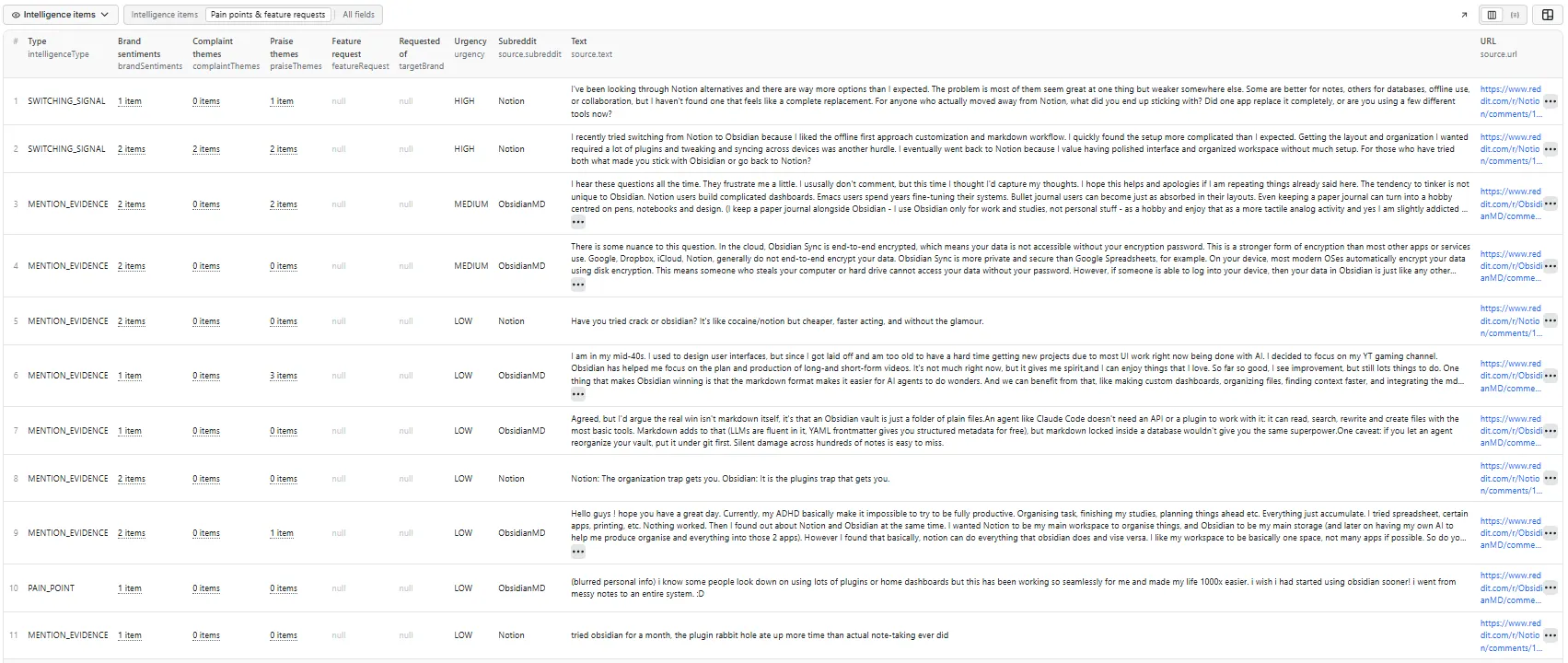
competitor_summary — one per brand
recommendationPct and complaintPct are each brand's share of all recommendations and complaints in
the sample. Both are null here because this small run found none to divide: a share is never shown
as 0 when there is nothing to divide, and it is also null when the brand has fewer than 5 evidence
items. The weaknesses come from the comparison post below, which Obsidian lost. With a monitor key
and a comparable previous period, comparisonToPrevious carries discussionShareDelta,
positiveShareDelta, negativeShareDelta, complaintShareDelta, recommendationShareDelta,
switchingInDelta, switchingOutDelta, discussionGrowthPct, momentum (RISING / STABLE /
FALLING), sentimentMomentum, recommendationMomentum and complaint-theme changes; each strength and
weakness gets a trend.
head_to_head — one per compared pair
Your brand is always brandA. Every pair with your brand gets a row, compared or not; competitor
pairs appear when they were compared. A pair compared in fewer than 5 sources reads
INSUFFICIENT_EVIDENCE, and leader needs at least 3 decided comparisons.
switching_flow — the switching matrix, one row per direction
feature_gap
This run found no feature gap: a gap needs requests or complaints about one brand and praise of the
same feature in a competitor, which a sample this small rarely holds. Each row carries brand,
gap (the feature), competitorAdvantage (the competitor praised for it), evidenceCount,
brandEvidence (requests and complaints about the brand), competitorEvidence (praise of the
competitor), confidence, examples (quoted explicit feature requests, empty when the gap comes
from complaints alone), evidenceIds { brand, competitor } and a note.
competitor_intelligence — one per qualified post or comment (the billed unit)
The writer tried Obsidian and went back, so the return is the switch and Notion the preferred brand; the trip out is not counted as a second flow.
All fields: intelligenceType, confidence, brands { primary, mentioned }, matchedBrands[] (brand,
matchedAs, matchType EXACT / ALIAS / DOMAIN, confidence), classification[], sentiment,
brandSentiments[] (sentiment, score and themes per brand), comparison (preferredBrand,
disfavoredBrand, comparisonReasons, basis), recommendedBrands[], alternativeTo[],
switching (from, to, stage, reasons), purchaseIntentScore (0–100), complaintThemes[],
praiseThemes[], featureRequest + targetBrand, commercialRelevanceScore (0–100), urgency,
evidenceWeight, sourceAffiliation, discoveredVia[], and source (sourceType, IDs,
subreddit, author, title / parent post title, text, URL, created date, score, upvote ratio,
comment count, flair, parent post, crosspostSubreddits). With a monitor key: isNew,
firstSeenAt, isBaseline.
Key-value store records
COMPETITIVE_INTELLIGENCE_SUMMARY— the run's report: brands compared, sample size, share of discussion, recommendation and complaint leaders, sentiment, the switching matrix, head-to-head results, top category pain points, the biggest feature gaps, rising and falling brands, alerts, the top evidence links, coverage and statuses.RUN_SUMMARY— discovery coverage (queries attempted and succeeded, posts and comments fetched, unique sources, qualified evidence, brands and subreddits found), intelligence counts, statuses, what was dropped and why, and cost accounting.SOURCE_SUMMARY— every search with its status.DEBUG_EVIDENCE— withdebugMode, every analyzed source, kept or dropped, with its readings.
FAQ
How is this different from the Reddit Brand Mention Monitor? The monitor answers "what new mentions of my brand appeared?" with one row per mention. This Actor answers "how do these brands compare, and why?": per-brand sentiment inside one source, comparison direction, a switching matrix, recommendation and complaint share across brands, head-to-head rows, strengths, weaknesses and feature gaps.
How is it different from the Reddit Keyword Monitor? The keyword monitor tells you whether a term appeared. This Actor analyzes multiple competing brands against each other.
How is it different from the Reddit Leads / Purchase Intent Finder? That Actor finds people to
contact. Here purchase intent is aggregated into which brand is winning consideration
(purchaseConsiderationPct), not a lead list.
What is share of discussion? A brand's qualified evidence divided by the qualified evidence of all the brands you monitor, in the sample this run collected. A source naming two brands counts for both, and the shares add up to 100 across your brands.
Is share of discussion market share? No. It is the share of the sampled, publicly accessible Reddit discussion about the brands you listed. Reddit users are not a representative sample of any market.
How are complaints classified? A source complains about a brand when what it says about that brand is negative or names a problem (bugs, support, billing). The words it uses set the theme: PRICING, PERFORMANCE, RELIABILITY, BUGS, UX, MISSING_FEATURE, SUPPORT, BILLING, INTEGRATIONS, MOBILE_APP, ONBOARDING, COMPLEXITY, PRIVACY, SECURITY, DATA_EXPORT, CUSTOMIZATION, SEARCH, COLLABORATION, or OTHER. Praise uses EASE_OF_USE, VALUE, PERFORMANCE, RELIABILITY, FEATURES, DESIGN, INTEGRATIONS, SUPPORT, CUSTOMIZATION, COLLABORATION, MOBILE, AUTOMATION, COMMUNITY, OTHER.
How is sentiment calculated? With rules: a weighted opinion-word lexicon with negation, intensifiers and question handling, read only on the sentences about each brand. It is POSITIVE, NEGATIVE, MIXED or NEUTRAL with a confidence, and a plain factual mention is NEUTRAL. No AI model is used, and there is no AI cost.
Can one source have different sentiment for two brands? Yes, and it is the point. "Notion is a mess these days. Obsidian just works" is NEGATIVE for Notion and POSITIVE for Obsidian. In "Obsidian is way faster than Notion", the comparison decides: Obsidian is the winner, Notion the loser.
How are direct comparisons detected? An explicit preference ("X is faster than Y", "I prefer X over Y", "I'd recommend X over Y"), a switch between the two, both brands in one sentence with comparison words ("Notion vs Obsidian?"), or two brands read with opposite sentiment in one source. Using two tools side by side ("I use Notion for work and Obsidian for notes") is not a comparison.
How is switching intent detected? From phrases like "switched from X to Y", "left X for Y",
"moved off X" and "thinking of leaving X", when the writer is doing it (COMPLETED), considering it
(CONSIDERING), asking about it (ASKING) or reporting others doing it (REPORTED). Advice ("you should
switch to Y") counts as a recommendation for Y, not as churn. When only one side is written ("I left
Notion last year") and the source names one other brand, that brand is taken as the other side and
the flow says so (sideInferred).
What is a switching matrix? The count of discussions per from → to direction across your brands,
as switching_flow rows and in the summary record. It is discussion-derived intent, not verified
customer churn.
How are recommendations counted? "I recommend X", "go with X", "try X", "X is the way to go", "X hands down", and the winner of an explicit preference. Negated ("I wouldn't recommend X") and question forms ("should I use X?") are not counted. Recommendation share is a brand's recommendations divided by all recommendations across your brands.
How are feature gaps found? A feature (offline mode, API, templates, two-way sync and about 30
more) that users ask for or say is missing in one brand, while praising a competitor for the same
feature. It needs at least three pieces of evidence between the two sides. Requests with no
competitor praised for them stay in that brand's topFeatureRequests.
Are comments included? Yes, by default, through two routes: Reddit's comment search for each brand (which finds comments under any post), and the first comments of threads whose post names a brand, most competitive threads first.
Can I restrict it to subreddits? Yes, with subreddits. Every query then runs in each one.
Can I run it on a schedule? Yes. Weekly suits most product categories, daily a fast-moving one, monthly strategic research. Use a monitor key and a window as long as the schedule interval.
How is persistent monitoring handled? Runs with the same monitorKey share a memory. The first
run is the baseline: its intelligence is returned with isBaseline: true. Later runs compare each
brand with the previous period of the same length and the same input, and only one that ended before
the current window began (current 7 days against the previous 7, never overlapping windows). A
changed input or overlapping windows give no deltas, and the reason is stated. With
onlyNewEvidence, evidence delivered by an earlier run is not delivered or billed again, but the
summaries still describe the whole window. Alerts: COMPLAINT_SPIKE, NEGATIVE_SENTIMENT_SPIKE,
SWITCHING_OUT_SPIKE, SWITCHING_IN_SPIKE, COMPETITOR_RECOMMENDATION_SURGE, PRICING_COMPLAINT_SURGE and
NEW_FEATURE_GAP. Each period is also written to the reddit-competitor-intelligence-history dataset,
one row per brand and period, for charts. Connect alerts to Slack, email, Make, Zapier or n8n with an
Apify webhook.
Does it need a Reddit login or API key? No. It reads public Reddit pages only.
What about brands with ordinary names, like Linear, Monday or Apple? A one-word name has to be
written as the brand ("Linear", not "linear algebra") or be clearly about the product. A same-named
thing in an unrelated community, such as the Coda weapon in r/Warframe, is left out unless something
places it in your category: another of your brands nearby, a subreddit named after a brand, a
subreddit you chose, a category term, or a community where your brands are discussed together. Add
categoryTerms to make the distinction sharper. Dropped items are counted in RUN_SUMMARY and never
billed.
How does pricing work? Pay per event: you pay for each qualified evidence item delivered,
that is a post or comment that names one of your brands, passed your filters, and arrives with its
brand-specific analysis. The competitor summaries, head-to-head rows, switching matrix, feature gaps
and reports built from that evidence are included. You are not charged for searches, for posts and
comments that name none of your brands, for namesakes, bots or filtered items, for duplicates and
crossposts, or for evidence your monitor already delivered when onlyNewEvidence is on. If you set
a spending limit, the run delivers the most commercially relevant evidence that fits, and the
summaries describe exactly that evidence. Live rates are on the Pricing tab; this README
deliberately quotes no figures.
What are the sampling limitations? The analysis covers the publicly accessible Reddit discussion
the run collects within its budget, and nothing more. Reddit's search returns a few hundred results
per query at most. A brand with fewer than 5 qualified items is INSUFFICIENT_EVIDENCE: its complaint
and recommendation shares are null, never 0. sampleConfidence is LOW below 25 items, MEDIUM from 25
and HIGH from 100. Watch authorConcentration when a few accounts write most of a brand's evidence.
Can I use it through the API or MCP? Yes. Call the Actor with the JSON input above through the
Apify API or any client, or from an AI agent through Apify's MCP server, then read the datasets (the
run's Output tab and output schema give each dataset's items URL) and the
COMPETITIVE_INTELLIGENCE_SUMMARY record, which holds the whole report in one JSON.
Interpretation
- Unofficial product, not affiliated with Reddit or with any brand analyzed.
- Outputs come from sampled, publicly accessible Reddit discussion, and Reddit users are not representative of a whole market.
- Share of discussion is not market share. Switching signals are discussion-derived intent, not verified churn. Sentiment and classifications are inferred by rules, not official brand sentiment. Feature gaps come from observed discussion.
- Low sample sizes reduce confidence. Read
statusandsampleConfidenceon every row. - Historical comparison starts after the baseline run of a monitor.
🚦 Proxy policy
Use Apify Datacenter proxy (the default) or no proxy. Both work for Reddit's public search and comment pages at this Actor's conservative concurrency.
Apify Residential proxy is not supported. If apifyProxyGroups
includes RESIDENTIAL, the run uses Apify Datacenter proxy instead and logs a warning. On pay-per-event Actors, residential bandwidth is billed to the developer,
not to your run, and Reddit comment pages are large. A single bandwidth-heavy run could cost more
than its results earn.
If you genuinely need residential routing, supply your own provider under Custom proxy URLs in the proxy editor. That traffic goes through your provider, not Apify, and is unaffected: