

Remote Jobs Scraper
Pricing
from $2.10 / 1,000 jobs
Remote Jobs Scraper
Remote job aggregator and remote job boards scraper: RemoteOK, WeWorkRemotely and more remote job websites, deduped, no API key. One remote job search across remote job sites for remote jobs worldwide, salary where listed. New remote jobs alerts to a remote jobs Slack digest. Remote jobs, one feed.
Pricing
from $2.10 / 1,000 jobs
Rating
0.0
(0)
Developer

Flash Scrape
Maintained by CommunityActor stats
0
Bookmarked
103
Total users
45
Monthly active users
3 hours ago
Last modified
Categories
Share
Remote Jobs Scraper & Aggregator: Remote Job Boards, One Feed
Remote Jobs Scraper & Aggregator sweeps 10 keyless remote job boards in one run — RemoteOK, We Work Remotely, Working Nomads, DevITjobs (US + UK), The Muse, Remotive, Jobicy, Himalayas and the Hacker News "Who is hiring?" thread — and returns one deduplicated feed with no API key, no proxy and no login, at $0.003 per deduplicated job ($3 per 1,000). Instead of checking each of those remote job sites by hand, you run one remote job search across them, filtered by keyword, salary floor, seniority and country.
Try it: Daily new remote data analyst jobs alert (only new postings)
Remote job aggregator — a remote job boards scraper that merges 10 keyless boards by default — plus one opt-in board: Arbeitnow — into remote jobs in one feed, deduplicated, with only-new-jobs monitoring.
✨ What you get
- 🏢 10 keyless remote boards in one run — RemoteOK, We Work Remotely, Working Nomads, DevITjobs US + UK, The Muse, Remotive, Jobicy, Himalayas and the Hacker News "Who is hiring?" thread, plus opt-in Arbeitnow.
- 🔁 One row per role across boards — merged by canonical job URL and by (title, company); the surviving row lists the other boards in
also_on_boardsand borrows salary, logo, date, location and tags from the dropped copy when its own board left them empty. - 💰 $0.003 per deduplicated job — $3 per 1,000 on the free plan; paid plans pay less (Pricing tab).
- 🔔 New-job alerts —
onlyNewJobson a schedule delivers only unseen postings, andwebhookUrlposts a digest to Slack, Discord or any webhook — Turn it into a job alert. - 🔌 Integrations — Apify Console schedules, n8n / Make / Zapier, MCP for AI agents; export JSON, CSV or XLSX.
A board that is down or blocked on a given run is named in that run's log, and its rows are never billed.
Every posting is normalized to the same schema (title, company, location, salary where the board publishes one, posting date, tags, description snippet, direct link), and the same role listed on two boards ships once: rows are merged across boards by canonical job URL and by (title, company). That cross-board deduplication is what a single-board scraper can't give you — you pay per unique job, not per feed it happened to appear in. Since 2026-09-07 the surviving row keeps the first board's title, company, link and description, lists the other boards in also_on_boards, and borrows the salary, logo, posting date, location, apply link and tags from the dropped copy wherever its own board published none — so a salary may come from another board's copy of the same posting (salary_source still says whether that figure was a structured field or parsed from text).
Three things no other multi-board remote actor offers:
onlyNewJobsmonitoring — run it on a schedule and every run delivers only postings you haven't seen before. A run where nothing is new delivers 0 rows, says so plainly, and bills no results. See Turn it into a job alert.- Annualized salaries — hourly/daily/weekly/fortnightly/monthly figures are converted to yearly (×2080 / ×260 / ×52 / ×26 / ×12) so
salary_min/salary_maxare comparable across boards, with a sanity guard against absurd conversions. - Descriptions — a 500-character
description_snippeton every row that has one (88% of rows on the 2026-08-15 default run), and the full HTML-stripped text viaincludeDescription.
One opt-in board, Arbeitnow (Germany-centric, remote rows only), joins the sweep only when you add it to boards. See Boards.
How much does it cost?
$0.003 per deduplicated job — $3 per 1,000 on Apify's free plan, less on paid plans (the actor's live pricing record, read 2026-10-10; the Pricing tab on this page is always authoritative). From 2026-10-14 18:10 UTC each run also bills a start fee of $0.00005 per GB of run memory, minimum one per run. A visitor on Apify's free plan can run it without a card — the plan's monthly usage credit ($5 at the time of writing) covers about 1,666 deduplicated jobs from this actor if spent on it alone. Duplicates merge before billing, filtered rows are never charged, and a nothing-new monitoring run or zero-match run bills no results.
The minimal input — copy, paste, run:
Completely empty input {} also works: up to 100 of the current remote jobs across every board.
How it compares
Read from Apify's public Store API on 2026-09-05. Seven other remote aggregators: benthepythondev (738 users, 5.0 from 1 review, 6 boards, $15/1,000 plus $10/1,000 for salary extraction), inlifeprojects/himalayas-jobs-scraper (608, no reviews, 1 board, $1/1,000), sync-network (282, 3.0 from 1, 4 boards, $3/1,000), memo23 (87, 5.0 from 2, 6 boards, $1.99/1,000, adds employer emails), get_anything (34, 5.0 from 2, 6 boards, $3/1,000), nivlekk (21, no reviews, 3 boards named in its title and 7 selectable in its input schema, $0.50/1,000) and delightful_unicorn (17, no reviews, 3 boards, $1/1,000).
This Actor (18 users, no reviews yet) sweeps the most boards, 10 keyless plus opt-in Arbeitnow, at $3 per 1,000 deduplicated jobs. No LinkedIn, Indeed or Glassdoor; salary on 35% of rows on the measured default run.
Use from an AI agent
- MCP: point Claude, ChatGPT, Cursor or any MCP client at
https://mcp.apify.com?tools=flash_scraper/remote-job-aggregator; the tool is named after the Store slug and takes this actor's input unchanged. Keywords for the server'ssearch-actorstool: remote jobs, job listings, job board, remote job scraper, job postings. Tool-name spellings, payment without an Apify token and measured timings: Use it from an AI agent (MCP). - Smallest useful call (Python
apify-client; the same JSON works in the Console, the REST API and n8n/Make/Zapier):
- Output contract: one row per remote job, the same columns on every row, salaries annualized where a board publishes one. The full field list with measured fill rates is under Output columns; every run also writes a machine-readable
RUN_SUMMARYrecord to its key-value store.
What you get
One row per remote job, the same columns on every row: title, company, location, salary where the board publishes one (annualized), posting date, tags, a 500-character description snippet and the direct link. On the 2026-08-15 default run, 100 deduplicated jobs came from 9 boards with 6 cross-board duplicates merged — 35% of rows carried a salary, 88% a description snippet and 100% a posting date.
One row per remote job:
(A real row from a live test run on 2026-08-15. That run delivered 100 deduplicated jobs from 9 boards with 6 cross-board duplicates merged — 35% of rows carrying a salary, 88% a description snippet and 100% a posting date, all measured on that run, not estimated.)
Input
| Field | Type | Default | What it does |
|---|---|---|---|
searchTerms | array of strings | [] (everything) | Keywords, case-insensitive. In the Console form matching starts wide — title + tags + the first 500 characters of the description (see matchDescriptions); an API or scheduled input that omits matchDescriptions matches titles only. A job matches if any term matches (OR). A multi-word term needs every word — "python developer" requires both, so prefer short terms like "python" for recall. Empty returns every remote job the boards offer. Capped at 10 terms per run — extras beyond the first 10 are ignored. |
matchDescriptions | boolean | form: true · API: false | The Console form starts in wide mode: terms match the title, the tags and the first 500 characters of the description (exactly what ships in tags and description_snippet, so you can always see why a row matched). Measured 2026-08-15 with ["python"]: 194 rows wide vs 28 title-only — ~7× the recall, at a precision cost: a marketing role whose blurb mentions "our Python stack" matches too. Untick it (or send false) for the title-only precision opt-out. The stored default is false, so an API or scheduled input that omits the field keeps title-only matching and its existing onlyNewJobs memory. |
boards | multi-select | the ten default boards | Which boards to sweep: remoteok, weworkremotely, working_nomads, devitjobs_us, devitjobs_uk, muse, remotive, jobicy, himalayas, hn_hiring (all on by default) — plus the opt-in arbeitnow, which joins only when you list it. See Boards. |
maxItems | integer (1–4000) | 100 | Maximum number of deduplicated jobs to return. Results are interleaved round-robin across boards, so a small cap still samples every board instead of just the biggest feed. |
includeDescription | boolean | false | true fills the description column with the job's full HTML-stripped text (avg ~4,300 chars measured). Off by default to keep rows light — the 500-char description_snippet is always on. |
onlyNewJobs | boolean | false | Deliver only postings this exact search has never delivered before. See Turn it into a job alert. |
postedWithinDays | integer (0–365) | 0 (off) | Drop postings whose posted_at is older than N days — before the cap and before billing. The console form starts at 90; 0 = no limit. As the only filter (with onlyNewJobs off), each board stops at about 3x maxItems matching rows (at most 4,000); Himalayas, whose feed holds only postings under 60 days old, stops at maxItems when N is 60 or more. Rows with no date are kept unless strictFilters is on. |
salaryMinAnnual | integer | 0 (off) | Drop postings whose annualized salary_max (salary_min when there is no max) is below N. Currency-agnostic — the figure is compared as the board published it (salary_currency tells you which). Rows with no salary are kept unless strictFilters is on. |
countries | array of strings | [] (off) | Keep postings open to any listed country or region — ISO-2 codes or names (US, United Kingdom, EU, Canada, Germany, India, LATAM, APAC, EMEA, Americas…). Regions match their member countries both ways; empty / worldwide / anywhere / remote locations match everything; a location the actor cannot read (a bare city, as RemoteOK publishes) is kept unless strictFilters is on. |
seniority | multi-select | [] (off) | Keep postings whose derived seniority column is one of entry, junior, mid, senior, lead, staff, principal, manager, director. Unknown seniority is kept unless strictFilters is on. |
excludeKeywords | array of strings | [] (off) | Drop postings whose title names any listed term (case-insensitive; a term of up to 4 letters must stand as a whole word, so go does not exclude "Django"; a multi-word term is one phrase). With matchDescriptions on, the tags and description_snippet are searched too — the same fields searchTerms reads. Runs before the cap and the charge, so an excluded row is never billed. |
excludeCompanies | array of strings | [] (off) | Drop postings whose company names any listed term (case-insensitive substring on the company column only; a term of up to 4 letters must stand as a whole word, so IBM does not exclude "IBMX"; a multi-word term is one phrase). Mute recruiting agencies or employers you have already applied to — no list ships with the actor, you name them. Runs before the cap and the charge, so an excluded row is never billed. Added 2026-09-07. |
strictFilters | boolean | false | Also drop rows that lack the data an active filter needs (no date / no salary / unreadable location / unknown seniority). See Filters for schedules. |
webhookUrl | string | (none) | Optional alert webhook: when rows are delivered, POST a digest to this URL — Slack incoming webhook or Discord webhook gets a message, any other URL (n8n / Make / Zapier catch hook) gets JSON with counts, console links and the first 20 rows. Quiet runs send nothing. See Alerts below. |
Running with completely empty input {} works and returns up to 100 jobs from all boards.
Output columns
| Column | Notes |
|---|---|
title, company, location | location is exactly what the board provides — often a country restriction like "USA Only" or "Anywhere in the World". |
remote | Always true — non-remote rows (DevITjobs office jobs, onsite HN posts) are filtered out before delivery. |
salary_min, salary_max, salary_currency, salary_interval | Only when the board publishes a figure — 35% of rows on the 2026-08-15 default run (DevITjobs ~100%, Himalayas/Remotive/WWR/HN partial, The Muse and Working Nomads none). Hourly/daily/weekly/fortnightly/monthly figures are annualized (×2080 / ×260 / ×52 / ×26 / ×12) so salary_interval normally reads yearly and figures are comparable across boards; a magnitude guard suppresses conversions that could only be wrong (an "hourly" $50,000 stays raw rather than shipping as $104M). salary_source says whether the figure was a structured field (direct_data) or parsed out of the posting text (description). Currency is left null when the board doesn't state it — no guessing. |
url | Direct link to the posting (for Remote OK rows this is the job's Remote OK page, as their API terms require). |
source_board | Which board this (first) copy of the job came from. |
posted_at | Posting date, YYYY-MM-DD, when the board provides one. |
tags | Skills/technologies/categories as the board tags them. Since 2026-09-07 We Work Remotely rows also carry the feed's <skills> list (28 of 91 items measured 2026-09-06) ahead of the category, and a cross-board duplicate's tags are unioned into the surviving row. |
description_snippet | Always on: the first 500 characters of the HTML-stripped description — filled on 88% of rows (measured; DevITjobs publishes no description text). Hacker News links ship as full URLs: HN ellipsizes link text after ~60 characters (27% of the September 2026 thread's 421 links), so since 2026-09-07 each link's href replaces its text before the tags are stripped. |
description | Full HTML-stripped description text when includeDescription: true, else null. |
seniority | Derived: entry, junior, mid, senior, lead, staff, principal, manager, director or unknown. Taken from the board's own level field where it publishes one (Jobicy jobLevel, Himalayas seniority, The Muse levels, DevITjobs expLevel, Arbeitnow's Entry / Student job types), otherwise from title keywords (Senior, Sr., Lead, Staff, Principal, Head of, VP…). director also covers VP / Head-of / C-level titles; a bare "Product Manager" is manager, a "Senior Product Manager" is senior. |
job_type | Derived: full-time, part-time, contract, internship, freelance or unknown — from the board's employment-type field (Jobicy, Himalayas, Remotive, DevITjobs, We Work Remotely, the HN first line, Arbeitnow's job types) or from the title. |
company_logo | The employer's logo URL when the board publishes one — Remotive, Jobicy and Himalayas do on most rows, DevITjobs on about a quarter of its remote rows (16 of 63 measured 2026-08-29); Remote OK's logo field was empty on every row measured that day, and the RSS/HTML boards (We Work Remotely, Working Nomads, The Muse, Hacker News, Arbeitnow) publish none, so those rows carry null. Fill rate varies by board (14 of 40 rows on the 2026-08-29 smoke run's default python sweep). Added 2026-08-29, appended after job_type. |
apply_url | Where to apply, when a board publishes a link that differs from url. Hacker News rows: the post's first careers / ATS link (careers, /jobs, apply, lever.co, greenhouse, ashby, workable, applytojob, rippling, bamboohr), else its first external link, else a mailto: built from an email in the text — 7 of the 7 remote posts in the September 2026 fixture; the live thread measured ~87% of remote posts with an apply-shaped link and ~7% more with an email (2026-09-06). Remote OK's apply_url and Himalayas' applicationLink equalled url on every measured row, so those rows carry null rather than a copy of url; the other boards publish no separate link. Added 2026-09-07 after company_logo. |
expires_at | The board's own expiry date, YYYY-MM-DD — We Work Remotely <expires_at> (91 of 91 items measured 2026-09-06) and Himalayas expiryDate (posting date + 60 days on its feed); null on the other boards. Added 2026-09-07. |
timezone_restrictions | Himalayas only: the UTC offsets in hours the posting accepts, exactly as the board publishes them (e.g. [-5, -4, -3], [1, 5.5]); null when the board lists none and on every other board. A column only — no filter reads it. Added 2026-09-07. |
also_on_boards | The other board ids this same posting was found on and merged away (["remotive"]; [] when none) — see the dedup note under What you get. Added 2026-09-07. |
job_id | 16-hex fingerprint of the job's canonical URL (tracking parameters stripped; title + company when a board publishes no URL). job_id is stable across runs and is the same identity onlyNewJobs bills on — use it as the upsert key in Google Sheets / Airtable / your CRM. Added 2026-08-29 after company_logo, so existing exports keep their column order; since 2026-09-07 the four columns above sit between them, and job_id and salary_text remain the last two columns. |
salary_text | Derived, always present: the salary as one readable string built from salary_min / salary_max / salary_currency / salary_interval — $90,000–$175,000 / year, €60,000 / year, $45 / hour; "" when the board published no figure. Nothing is guessed: a board that states no currency gives a bare 111,000–114,000 / year, an unknown currency code is shown as a prefix (CHF 120,000 / year). The numeric columns stay the source of truth. Added 2026-08-29 as the very last column. |
How to read the output
The run's Output tab opens on the Overview view; the other views are one click away in the same tab.
- Overview — the first look: logo, title, company, location, readable salary, posted date, source board, seniority, job type, link, apply link. 11 columns, in that order.
- Salary — for pay research:
salary_textnext to the annualizedsalary_min/salary_maxit was built from, the currency, the interval andsalary_source(structured field vs parsed from the posting text). - Monitoring — for
onlyNewJobsschedules and upserts:job_id, title, company,posted_at,scraped_at, source board, link. - All columns — every column of the row, in export order (the order a CSV/XLSX export uses).
Derived and appended columns (always present, never guessed): seniority, job_type, company_logo, apply_url, expires_at, timezone_restrictions, also_on_boards, job_id, salary_text — see the table above. posted_at is already a YYYY-MM-DD date, so no extra date column is added.
Export just one view: select it in the Output tab, then Export; or from the API, https://api.apify.com/v2/datasets/<datasetId>/items?view=salary&format=csv (the view parameter takes any of overview, salary, monitoring, all). Views only change which columns are shown — the underlying rows and their column names are identical in every export.
Boards
Ten boards are swept by default; one more is opt-in — add its id to boards to include them (that also starts a fresh onlyNewJobs baseline for that search, since the board list is part of the search signature).
| Board id | Default | Source | Depth per run | Notes |
|---|---|---|---|---|
remoteok | yes | remoteok.com/api | ~100 newest rows | Rows link back to the job's Remote OK page, as their API terms require. |
weworkremotely | yes | All-jobs RSS + 13 category RSS feeds | ~460 distinct jobs | No feed paginates; breadth across feeds is the only lever. The feed's <skills> join tags and <expires_at> ships as expires_at (since 2026-09-07); its <country> / <state> are not folded into location — on the measured items they read as the employer's headquarters, not a restriction. |
working_nomads | yes | workingnomads.com exposed_jobs API | ~50 curated rows | No salary data. |
devitjobs_us / devitjobs_uk | yes | devitjobs.us / .uk jobsLight API | whole live inventory, remote rows only (~8%) | Structured annual salaries on ~100% of rows; a logo on ~25% of them. devitjobs_uk is discontinued upstream as of 2026-08-29: devitjobs.uk (its front page and its API alike) now redirects to a third-party signup page instead of serving a feed, so the board contributes 0 rows until it answers again; devitjobs_us still serves (it moved to devitjobs.com, which the actor follows). |
muse | yes | themuse.com public jobs API, remote filter | up to ~1,980 rows | Fixed category taxonomy; keyword gate is client-side. |
remotive | yes | remotive.com remote-jobs API | one unparameterised GET per run = the whole active feed (~20 rows, measured 2026-08-29) | Not server-side search: your terms are matched client-side across the feed. Salary is free text, parsed conservatively. |
jobicy | yes | jobicy.com API v2 | 200 rows per call (the API's documented maximum), one call per distinct leading keyword of your terms (at most 10; python and python developer share one call); plus one ?geo= call per region (max 3) when countries is set | Structured salary + period when published. |
himalayas | yes | himalayas.app jobs API (cursor-paged) + its search API | cursor crawl of up to 750 pages × 20 rows within a crawl budget of at most 300 s (less on short runs); with searchTerms set, also page 1 of the search endpoint per term (~17-19 rows per search page, measured 2026-08-29; each still passes the same client-side keyword gate as the crawl, so matches per term vary) | Structured salary + currency + period; newest-first, so monitoring runs stop early. Only page 1 of the search is read per term — its robots.txt disallows deeper pages — so depth still comes from the crawl. |
hn_hiring | yes | Newest "Ask HN: Who is hiring?" thread, read whole in one Algolia items/{id} call (every top-level comment; the older per-term search paging is the fallback) | one thread (239 top-level posts on the September 2026 thread, measured 2026-09-06) | Only posts that say "remote" are kept. Your terms are matched client-side against every post, so a term no longer depends on Algolia's fuzzy search to surface it. |
arbeitnow | opt-in | arbeitnow.com job-board API (Germany-centric) | 4 pages × 175 rows, remote rows only (a few % of rows) | No salary field. Job data from Arbeitnow. |
- Not offered: Jobspresso (HTTP 403 to Apify IPs, measured 2026-08-27) — implemented and tested, but a board that fails on every platform run must not be selectable.
Data terms per board
What each board's own API terms ask of anyone re-using its listings. This actor keeps them (every row links to the board's own job page in url, and source_board names the source), and whatever you build on top of it should too:
| Board | Credit / link-back | Re-submission | In their own words (read 2026-08-29) |
|---|---|---|---|
| Remote OK | Link back to the job's Remote OK URL (the url column) and name Remote OK as the source | — | "Please link back (with follow, and without nofollow!) to the URL on Remote OK and mention Remote OK as a source, so we get traffic back from your site." (legal notice in the API feed) |
| Remotive | Link back to the Remotive URL and mention Remotive as the source | Do not resubmit to third-party job sites | "Please link back to the URL found on Remotive AND mention Remotive as a source" · "Please do not submit Remotive jobs to third Party websites, including but not limited to: Jooble, Neuvoo, Google Jobs, LinkedIn Jobs." · "we advise max. 4 times a day" (API README) · Note (read 2026-08-29): remotive.com/robots.txt also lists Disallow: /api/* for all user agents while the same API README explicitly grants /api/remote-jobs; this build treats the API README as the governing grant and makes exactly one unparameterised request to that path per run. |
| Jobicy | Keep Jobicy as the source and preserve the canonical Jobicy job URL | Do not present listings as your own postings | "Keep Jobicy as the original source and preserve the canonical Jobicy job URL when displaying a listing." · "Do not present Jobicy listings as your own original job postings or remove source attribution." · "do not run automated polling more frequently than once per hour" (Fair Use) |
| Himalayas | Link back to the job's himalayas.app URL (the url column) and credit Himalayas | Do not resubmit to third-party aggregators | "Link back to the job's URL on himalayas.app" · "Credit Himalayas as the source of the data wherever you display it." · "Do not resubmit Himalayas listings to third-party job aggregators, including but not limited to Jooble, Neuvoo, Google Jobs, and LinkedIn Jobs." (API README) |
Run it from your code
JavaScript (apify-client):
Python (apify-client):
curl (run synchronously and get the dataset back):
Remote jobs data and remote hiring data
One call returns remote jobs data from ten keyless boards in a single deduplicated feed, so you can track remote hiring data over time instead of checking ten sites. Filter by seniority, salary floor or keyword to pull just remote developer jobs, and schedule it with onlyNewJobs so each scheduled run skips the postings earlier onlyNewJobs runs of the same search delivered. Output is JSON or CSV with the board each role came from.
Use it from an AI agent (MCP)
The Apify MCP server at https://mcp.apify.com exposes Store actors to any MCP client as tools; an actor's tool is named after its slug with the / spelled -slash- (the docs' own example: apify/rag-web-browser becomes apify-slash-rag-web-browser), so this one is flash_scraper-slash-remote-job-aggregator. Load just this actor with https://mcp.apify.com?tools=flash_scraper/remote-job-aggregator, or let the agent find it through the server's search-actors and call-actor tools; full results come back through get-actor-output when the preview is cut.
A minimal input an agent can send — the four single-request boards only, so the sweep is seconds, not a crawl (20 rows in 2 s on a local run 2026-08-29; the same terms across all ten boards took 84 s that day, because Himalayas and The Muse are paginated feeds) — and its 20 rows bill at most $0.06 (20 × $0.003):
Per-result price, read from the actor's live pricing record on 2026-10-10: $0.003 per delivered job on Apify's free plan, less on paid plans (Store discounts; the Pricing tab is always authoritative). From 2026-10-14 18:10 UTC each run also bills a start fee of $0.00005 per GB of run memory, minimum one per run. An agent without an Apify account can still pay per call: Apify's experimental x402 agentic payments buy a prepaid API token with USDC on Base — "no Apify account needed", in the docs' words — and that token runs this actor through the same REST endpoints shown above.
Turn it into a job alert (onlyNewJobs)
Set onlyNewJobs: true and the actor becomes a monitor: every run delivers only postings this exact search (same searchTerms + boards + filters) has never delivered before.
How it behaves, run by run:
- First run = baseline. Delivers everything currently matching (up to
maxItems; anything beyond it stays eligible for the next runs, see the notes below). - Every later run delivers only postings no earlier
onlyNewJobsrun of this search delivered, including ones a capped run left behind if they are dated within the last 30 days (see the notes below). If nothing is new, the run finishes SUCCEEDED withNothing new since your last run (<time> UTC): … No results were billed.— zero rows delivered, zero rows billed. That message is the monitor working, not an error. - Memory lives in a named key-value store in your own Apify account (
remote-job-monitor), one record per search signature; entries are pruned after 90 days, so a job reposted after a long silence counts as new again.
Set up the alert in 2 minutes (Apify Console):
- Open this actor → Input: set your
searchTerms, tick Only new jobs, and setmaxItemsgenerously (e.g. 500–1000) — withonlyNewJobson, the sweep reads each board to full feed depth so nothing hides behind the cap, and a row is still billed only when it is delivered. - Run it once manually — that's your baseline.
- Schedules → Create new → pick this actor → cron like
0 8 * * *(daily 08:00). The schedule reuses your saved input. - Add a notification: Integrations on the actor → webhook on
Run succeededto Slack/email/n8n — or read the dataset from the run; on a nothing-new day the dataset is simply empty and no results were billed.
Two honest notes: if a run hits maxItems, the matching postings it could not deliver stay eligible — the memory records their identities and the date of the oldest one, and the next runs read the boards back to that day (at most 30 days back), delivering those postings alongside new ones, up to maxItems per run and never the same row twice within the 90-day memory. Only the postings that run matched and left behind are owed this way: a posting that only becomes reachable later with a date more than two days before the last onlyNewJobs run of this search that delivered rows (a board that failed a run, a feed that is not newest-first) is held back as back catalogue, not billed as new. While an overflow is owed, the newest-first boards (Himalayas, Hacker News) no longer stop paginating at your last run and are read back to that date, so those runs are slower — same price. If a board fails or is cut short on a later run, the owed postings it could not show that run stay owed (each until 30 days after its posting date) instead of dropping out of the record; when every board answers and a board no longer lists an owed posting, it is gone and the record shrinks to what is still listed. The run report says how many are still waiting (N matching posting(s) beyond maxItems stay eligible for your next run), so a generous maxItems on the first run (e.g. 500–1000) clears the backlog sooner. And changing searchTerms, boards or any filter below starts a fresh signature with its own baseline.
Filters for schedules
Six optional filters run after the boards answer and after onlyNewJobs, and before the cap and the charge — a row a filter removes is never billed. All are off by default, so they change nothing for an existing scheduled input.
Every run lists each board's title matches before its tag/description matches, newest first, among the rows that board returned (on the 2026-10-01 form run only 24% of delivered titles for python contained the word). To drop years-old postings, set postedWithinDays (measured 2026-10-01, The Muse returned postings up to 869 days old). The console form starts postedWithinDays at 90 days, while API calls, saved tasks and schedules that omit the key keep 0 (no limit); with it as the only filter and onlyNewJobs off, each board stops once it has about 3x maxItems matching rows (maxItems + 50 when that is larger, never above 4,000; from maxItems 1334 up this equals the full 4,000 depth) instead of collecting up to 4,000, and Himalayas, whose feed holds only postings under 60 days old, keeps maxItems depth when the floor is 60 days or more. A watch made from the form with 90 kept reads full depth like every onlyNewJobs run and has its own onlyNewJobs memory.
excludeKeywords: ["senior", "lead"]— drop postings whose title names any listed term; withmatchDescriptionson, tags and the description snippet count too. An excluded row is never memorised as delivered, so dropping the exclusion later (a new signature) makes it eligible again.excludeCompanies: ["Acme Recruiting", "Globex"]— drop postings whosecompanynames any listed term (case-insensitive substring; a term of up to 4 letters must stand as a whole word). Same billing and memory rules asexcludeKeywords: never billed and never memorised.postedWithinDays: 7— drop postings older than a week (byposted_at).salaryMinAnnual: 80000— drop postings whose annualizedsalary_max(orsalary_min) is below the floor; currency-agnostic, the number is compared as published.countries: ["US", "Europe"]— keep postings open to any listed country or region (ISO-2 codes or names;Worldwide/Anywhere/Remotelocations match everything).seniority: ["senior", "lead"]— keep postings whose derivedsenioritycolumn is in the list.strictFilters: true— also drop rows that lack the data a filter needs (no date, no salary, an unreadable location, unknown seniority); off, such rows are kept.excludeKeywordsandexcludeCompaniesnever lack data, so strict mode adds nothing to them.
Filters are part of the onlyNewJobs signature, so set them before a schedule's first (baseline) run. Filters apply after the boards answer, so with a salary floor, countries, seniority or an exclusion set the sweep reads each board to full feed depth (as onlyNewJobs does) rather than stopping at maxItems per board — a tight salary floor or country list does not under-fill your order while qualifying rows sit deeper in the feeds; a row is still billed only when it is delivered. postedWithinDays alone (with onlyNewJobs off) stops at about 3x maxItems matching rows per board instead (at most 4,000 per board; Himalayas keeps maxItems depth when the floor is 60 days or more); in the measured runs the rows a 90-day floor removed came from only a few boards, so a bounded margin refills the order.
Schedule it (n8n, Make, Zapier)
A remote job aggregator earns its keep on a schedule — a daily sweep feeding a Slack channel, an Airtable base, or a job-alert newsletter:
- n8n: use the Apify node (or an HTTP Request node hitting the
run-sync-get-dataset-itemsendpoint above) on a Cron trigger, then map the JSON rows to Slack/Notion/Google Sheets nodes. - Make (Integromat): the Apify app has a "Run an Actor" module — pair it with a scheduled scenario and an Iterator over the dataset items.
- Zapier: the Apify integration offers "Actor Run Finished" as a trigger — schedule runs natively in the Apify Console (Schedules → new schedule → pick this Actor) and let Zapier fan the fresh dataset out.
- Apify Console alone also works: Schedules can run this Actor daily and email you or push to a webhook when a run finishes.
Tip for monitoring pipelines: turn on onlyNewJobs (section above) so the scheduled runs deliver only the delta — no downstream dedup needed and quiet days bill no results.
Fair use the boards ask for — schedule accordingly. Jobicy asks for at most one automated poll an hour; Remotive advises at most 4 requests a day and blocks more than 2 a minute; Himalayas refreshes its data every 24 hours and answers 429 beyond an unpublished rate limit. Each run makes one Remotive request, one Jobicy request per distinct leading keyword of your terms (at most 10; one with no terms; plus at most 3 region calls when countries is set) and one Himalayas search page per term before its crawl — so run this actor at most hourly; daily is what the boards' own refresh cycles justify, and two overlapping schedules against the same boards count double.
Alerts: get a Slack / Discord / webhook message when new rows land
Set webhookUrl and every run that delivers at least one row POSTs a digest there — no n8n/Make scenario needed just to see the new jobs. Quiet runs send nothing, so pair it with onlyNewJobs on a schedule and the actor is a job alert on its own.
- Slack incoming webhook (
hooks.slack.com/…) or Discord webhook (discord.com/api/webhooks/…) → a message:Remote Jobs: N new row(s), one line per job (Title — Company (board) url, first 20) and the dataset link. - Anything else (n8n / Make / Zapier catch hook, your own endpoint) → JSON
{actor, delivered, run_url, dataset_url, rows[:20], text}. - Best-effort: a webhook that fails or answers non-2xx never fails the run — you still get your rows and the dataset.
The run report
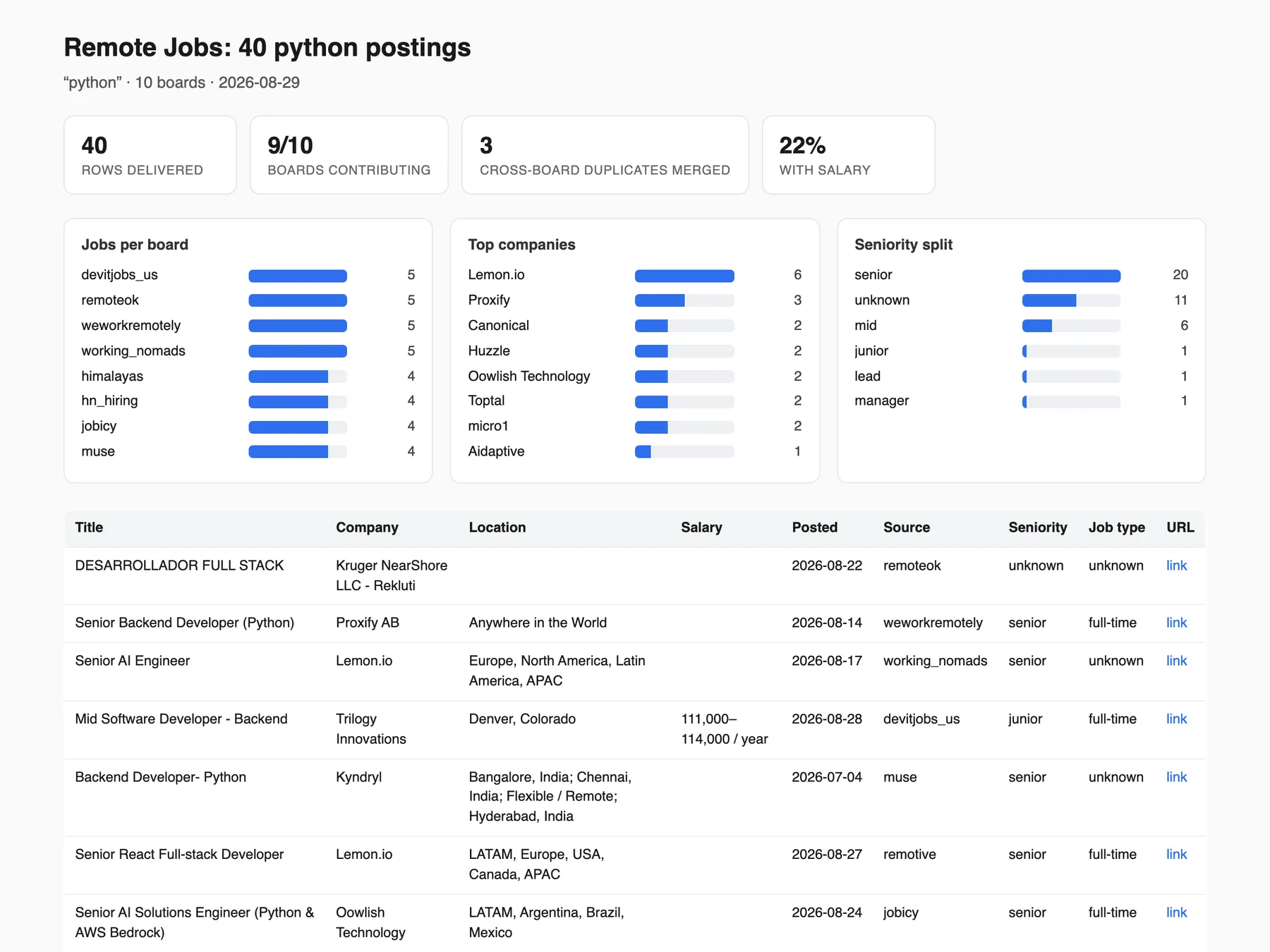
A run that delivers at least one row and reaches its normal end also writes a one-page HTML report to its key-value store under the key REPORT: the headline count, the search that produced it, stat tiles (rows delivered, boards contributing, cross-board duplicates merged, share with a salary), bar charts (jobs per board, top companies, seniority split), the first 100 rows and the run's notes on filters, onlyNewJobs counts and every board — including the ones the status message had no room for.
Find it in the run's Output tab under REPORT, or follow the Report: … link near the end of the run's status message. Only a webhook failure, the onlyNewJobs baseline line or a very long searchTerms list can crowd that link out. Its table shows the same columns as the Overview view (minus the logo), under the same headers.
It is a single self-contained HTML file (no scripts, no external assets) — safe to forward or screenshot as-is.
The dataset stays the source of truth: the report shows at most 100 rows and links back to the full dataset and the run.
Every run — including a zero-row one — also writes a machine-readable receipt under the key RUN_SUMMARY (JSON), for API and scheduled callers who never read a status line: status_message, search_terms, boards, max_items, only_new, offered (candidates after the cross-board merge), delivered and charged (always the same number), filters and filter_removed (rows your filters dropped before the cap and the charge, split per filter in filter_removed_by: exclude, posted, salary, country, seniority), filter_kept_missing_data, the onlyNewJobs counters (already_delivered_left_out, held_back_older_than_last_run, held_back_undated, owed_to_next_run), board_errors, boards_status (per board, in sweep order: status — ok, empty, skipped, failed or discontinued — with offered, delivered and error; the same delivered/offered funnel the run report prints, as data), report_url and webhook_note. Read it with GET https://api.apify.com/v2/key-value-stores/{defaultKeyValueStoreId}/records/RUN_SUMMARY.
Honest limits
- Feed-limited depth. These are public feeds, not archives: RemoteOK serves its ~100 newest rows, WeWorkRemotely ~100 per feed, Working Nomads ~50 curated rows, Jobicy 200 per call (plus a region call per
countriesentry, max 3). The Muse and Himalayas DO paginate deeply - measured 2026-08-19 at ~1,980 and ~2,000 rows respectively - so a large order draws mostly from those two. A run samples the current face of each board; it cannot paginate years back. - Keyword matching is client-side, on data you can see. The Console form starts wide (
matchDescriptions: true): a term needs to appear in the title, the tags or the first 500 chars of the description — ~7× the recall of title-only (measured), and every hit is explainable from the deliveredtags/description_snippet. Title-only is the precision opt-out (matchDescriptions: false, and what an API or scheduled input gets when it omits the field): a Python job titled "Backend Engineer" then won't match"python". Either way you are never charged for a fuzzy server-side match that isn't really your keyword. - Salary coverage varies by board — 35% of rows overall on the measured default run. DevITjobs publishes structured annual salaries on ~100% of its rows; Himalayas, Remotive, WWR and HN partially; RemoteOK ~3%; The Muse and Working Nomads none. Figures parsed out of free text (
salary_source: "description") are conservative best-effort, and annualization only multiplies figures whose interval the board or text actually states. - DevITjobs contributes remote rows only (~8% of its inventory, measured) — it's a city-based board, and shipping its office jobs with
remote: truewould be a lie. Its.ukfeed is currently gone: since at least 2026-08-29 devitjobs.uk redirects every request (front page and/api/jobsLight) to a third-party signup page, sodevitjobs_ukreadsdiscontinued upstreamon every run and delivers nothing — the other nine boards are unaffected, and a board that delivers nothing adds nothing to your bill. Failures — including a board answering with an error object or a redirect instead of its feed — are reported per board, never silently. - HN "Who is hiring?" rows are parsed from community-formatted posts (
Company | Role | Location | Salary). Parsing degrades gracefully, but expect the occasional imperfect company/title split (a post with no role segment ships its whole first line as the title). Only posts that explicitly say "remote" are included, and candidates' "want to be hired" templates (Location: … Remote: … Willing to relocate: …) posted into the thread are skipped — they are people, not jobs. - Boards change. Undocumented internal APIs (DevITjobs in particular) can change shape without notice. A board that fails is named in the run's log; its failure never poisons the other nine.
- The opt-in board is opt-in for a reason. Arbeitnow is a German city board: only the rows it flags remote are delivered (34 remote among its first 450 rows, measured 2026-08-25), so it adds a handful of mostly Germany / EU rows per run, and the actor reads at most 4 pages of its API per run, per its "please do not abuse" terms. It publishes no salary field, so its rows ship no salary.
- Attribution: job rows sourced from Remote OK link back to the job's Remote OK page in the
urlcolumn, as their API terms require. Rows from the opt-in Arbeitnow board come from the Arbeitnow job board API, whose terms ask for a link back. - The run report names every board, delivered/offered. It reads like
remoteok 12/100 · working_nomads 0/50 · devitjobs_uk discontinued upstream · muse failed: rows delivered from that board over the remote rows it offered before your keyword gate,skippedfor a board cut off by the run's time budget,discontinued upstreamfor a board whose site is gone (devitjobs.uk today),failedfor one that answered with an error (details in the log).0/50means the board answered and nothing matched — not that it was skipped. - Zero matches, zero rows billed. A run that delivers no rows tells you why (boards empty vs. your filters), and no results are billed.
FAQ
Is this a RemoteOK / Jobicy / Himalayas jobs API? Effectively, yes — it calls those boards' own public, keyless endpoints (plus seven more default sources and one opt-in) and normalizes everything into one schema, so instead of integrating a dozen feeds with a dozen shapes you integrate one. Remote OK rows keep their remoteok.com link in url, as its API terms require.
Can I use it instead of a remote-jobs RSS feed? That is exactly the shape it replaces. We Work Remotely arrives via its all-jobs and category RSS feeds; the other boards via their keyless JSON endpoints — all merged, deduplicated and salary-annualized into one JSON/CSV feed you can poll on a schedule.
How do I get alerts for new remote jobs only? Set onlyNewJobs: true and schedule the run — every run then delivers only postings this exact search has never delivered before; a nothing-new day bills no results. Full walkthrough in Turn it into a job alert.
What does it cost per 1,000 jobs? $3 on Apify's free plan — the rate is $0.003 per deduplicated row (less on paid plans), and the live price is always on this page's Pricing tab. From 2026-10-14 18:10 UTC each run also bills a start fee of $0.00005 per GB of run memory, minimum one per run. The free Apify plan's monthly credit is enough to try a real sweep.
How do I get only jobs with a published salary? Set salaryMinAnnual: 1 and strictFilters: true. The floor is then active, and strict mode also drops the rows that carry no usable annual figure — so only rows with an annualized salary_min / salary_max survive, and they are the only rows billed. (A raw hourly/monthly figure the sanity guard refused to annualize counts as no usable salary.)
Exclude senior roles? Set excludeKeywords: ["senior", "lead", "staff", "principal"] — any posting naming one of those in its title is dropped before the cap and before billing. Turn matchDescriptions on to exclude on tags and the description snippet as well. The opposite (keep only senior rows) is the seniority filter.
Do I need an API key, proxy or login? No. All eleven sources (ten by default + one opt-in) are public, keyless endpoints, and runs go direct with no proxy cost.
Does it cover LinkedIn, Indeed or Glassdoor? No — those aren't remote-only boards, and covering them well takes different machinery. That's the sibling actor below.
Is there a free way to scrape remote job boards?
Yes. Apify's free plan needs no card, and its monthly usage credit ($5 at the time of writing) covers about 1,666 deduplicated jobs from this actor. All ten default boards are public, keyless endpoints, so there is no extra API or proxy cost.
At the $0.003 rate read from the live pricing record on 2026-09-14, 1,666 jobs × $0.003 comes to $4.998 — just inside the free plan's $5 monthly credit (apify.com/pricing, read 2026-09-05) — and the completely empty input returns up to 100 of the current remote jobs across every board. The Pricing tab is authoritative.
How do I get remote job listings as a CSV or Excel file?
Run the actor, then click Export in the run's Output tab — CSV, XLSX and JSON are available. From the API, add format=csv to the dataset items endpoint; the view parameter (overview, salary, monitoring, all) selects which columns ship.
Column order is stable for exports: job_id, company_logo and salary_text were appended on 2026-08-29 after the existing columns so a CSV import keeps its positions, and job_id — a 16-hex fingerprint of the canonical URL — is the same identity onlyNewJobs bills on, so use it as the upsert key in Google Sheets, Airtable or your CRM. On 2026-09-07 apply_url, expires_at, timezone_restrictions and also_on_boards were appended after company_logo, ahead of job_id and salary_text, which stay the last two columns — an import keyed on column names is unaffected; one keyed on positions should re-map those two.
Can I get remote jobs worldwide, or only for one country?
Both. Leave countries empty and no country filter runs, so remote jobs worldwide come back alongside country-restricted ones. Fill it with ISO-2 codes, names or regions (US, United Kingdom, EU, LATAM, APAC…) to keep postings open to those places: postings marked worldwide or anywhere still match, and a location the actor cannot read (a bare city, as RemoteOK publishes) is kept unless strictFilters is on.
How many remote jobs can one run return?
Up to 4,000 deduplicated jobs per run (maxItems, default 100). Depth is feed-limited: The Muse and Himalayas paginate to roughly 2,000 rows each, while the smaller feeds serve their newest ~20–460 rows.
Those depths were measured 2026-08-19 (The Muse about 1,980 rows, Himalayas about 2,000); RemoteOK serves its ~100 newest rows, We Work Remotely ~460 distinct jobs across its 14 RSS feeds, Working Nomads ~50 and Jobicy 200 per call, so a large order draws mostly from The Muse and Himalayas.
Does it include salary data?
Yes, where a board publishes one — 35% of rows on the measured default run, and ~100% of DevITjobs rows. Hourly, daily, weekly, fortnightly and monthly figures are annualized (×2080 / ×260 / ×52 / ×26 / ×12) so salary_min/salary_max are comparable across boards.
That 35% is the 2026-08-15 default run of 100 deduplicated jobs; by board, DevITjobs publishes structured annual salaries on about 100% of rows, RemoteOK about 3%, The Muse and Working Nomads none, and salary_source says whether a figure was a structured field (direct_data) or parsed from the posting text (description).
How often should I schedule it?
At most hourly — daily is what the boards' own refresh cycles justify. Jobicy asks for at most one automated poll per hour and Remotive advises at most 4 requests a day; the actor keeps each board's fair-use terms within a run.
Those limits are the boards' own words, read 2026-08-29: Jobicy's fair-use terms say do not run automated polling more frequently than once per hour, Remotive advises at most 4 times a day, and Himalayas refreshes its data every 24 hours — so a daily cron such as 0 8 * * * is the cadence the sources justify.
Can an AI agent use it?
Yes. The Apify MCP server at https://mcp.apify.com exposes it as the tool flash_scraper-slash-remote-job-aggregator, and Apify's experimental x402 payments let an agent without an Apify account pay per call with USDC.
The agent-sized call — searchTerms python, maxItems 20 and the four single-request boards remoteok, jobicy, remotive and working_nomads — returned 20 rows in 2 seconds on a local run on 2026-08-29 (84 seconds across all ten boards that day, because Himalayas and The Muse are paginated feeds), and 20 rows bill at most $0.06.
Is there a remote jobs API that does not need an API key?
Yes. Remote Jobs Aggregator calls the public, keyless endpoints of 10 remote boards — RemoteOK, We Work Remotely, Working Nomads, DevITjobs US and UK, The Muse, Remotive, Jobicy, Himalayas and Hacker News — and returns one normalized, deduplicated JSON, CSV or XLSX feed through the run-sync-get-dataset-items endpoint, with no proxy and no login. The 2026-08-15 default run delivered 100 deduplicated jobs from 9 boards; the free-plan price read on 2026-09-14 is $0.003 per job — the Pricing tab is authoritative.
Does it cover LinkedIn, Indeed or Glassdoor remote jobs?
No. Those are not remote-only boards and covering them well takes different machinery; this Actor sweeps the ten keyless remote boards at $0.003 per deduplicated job (live pricing read 2026-09-14). The sibling Multi Job Board Scraper adds LinkedIn, Indeed and Glassdoor, merged and deduplicated across 12 selectable working boards — 11 of them delivering rows today — with the same only-new-jobs monitoring.
How do I get an alert for new remote jobs only?
Set onlyNewJobs true, tick a generous maxItems (500–1,000) for the baseline run, then schedule it daily and add a Slack, Discord or webhook URL in webhookUrl. Every later run delivers only postings this exact search has never delivered before; a nothing-new day delivers 0 rows and bills no results. Memory lives in your own account for 90 days, keyed on job_id — the same identity added to every row on 2026-08-29.
Which remote job boards can be scraped without an API key today?
Ten by default — RemoteOK (~100 newest rows), We Work Remotely (~460 distinct jobs across 14 RSS feeds), Working Nomads (~50), DevITjobs US, The Muse (up to ~1,980 rows), Remotive (~20 per feed read on 2026-08-29), Jobicy (200 per call), Himalayas (~2,000) and Hacker News — plus opt-in Arbeitnow. devitjobs.uk has been discontinued upstream since 2026-08-29, and Jobspresso is not offered because it answered HTTP 403 to Apify IPs on 2026-08-27.
Can I republish the remote jobs on my own job board?
Not from every board: the boards' own API terms, read 2026-08-29, pass through to you. Remotive says do not submit its jobs to third-party sites such as Jooble, Google Jobs or LinkedIn Jobs; Himalayas says the same for aggregators; Jobicy asks you to keep it as the source and preserve the canonical job URL; Remote OK asks for a dofollow link back naming Remote OK. Every row already links to the board's own posting in url.
Related actors
- LinkedIn Jobs Scraper — keyword + location search over LinkedIn's public job listings.
Need LinkedIn, Indeed and Glassdoor too - merged and deduplicated across 12 boards with only-new-jobs monitoring? -> Multi Job Board Scraper
Related Flash Scrape actors
- Multi Job Board Scraper — LinkedIn, Indeed, Glassdoor + 9 more boards, deduplicated, with only-new job alerts
- Local Business Leads Scraper — any category, any city, verified emails, lead scores
- Creator Leads Scraper — TikTok, Instagram and YouTube creator emails in one run
- LinkedIn Jobs Scraper — listings by title and location, no login, CSV/JSON
- Shopify Store Scraper — any store's full public catalog, every variant, SKU and price, plus a store-intelligence row
- All Flash Scrape actors — same house rules everywhere: pay per delivered row, honest status messages, only-new monitoring and webhook alerts.
If this run saved you time, a Store review helps others find it.


![🚀 Indeed jobs scraper [PPR] avatar](https://images.apifyusercontent.com/PEDOk9MmTf1yHtczA1A4wQEoGyAKCe5Aft1HzkhwROk/rs:fill:76:76/cb:1/aHR0cHM6Ly9hcGlmeS1pbWFnZS11cGxvYWRzLXByb2QuczMudXMtZWFzdC0xLmFtYXpvbmF3cy5jb20vTVhMcG5nbVZwRThXVEVTUXIvQjFrZ3BRS1p5dzJvVEpJUmctTG9nby1IZXJvLVN0YXRpYy1lemdpZi5jb20td2VicC10by1qcGctY29udmVydGVyLmpwZw.webp)


