
Attic Ventilation & Insulation Calculator (IRC, IECC)
Pricing
Pay per event
Attic Ventilation & Insulation Calculator (IRC, IECC)
How much attic ventilation and insulation a house needs, from plain text: the IRC net free vent area, how many ridge, box, turbine or soffit vents (or a power fan's cfm), and the R-value for the climate zone with the depth and bags of insulation to add.
Pricing
Pay per event
Rating
0.0
(0)
Developer

Jumble Mog
Maintained by CommunityActor stats
0
Bookmarked
2
Total users
1
Monthly active users
10 hours ago
Last modified
Categories
Features
Share
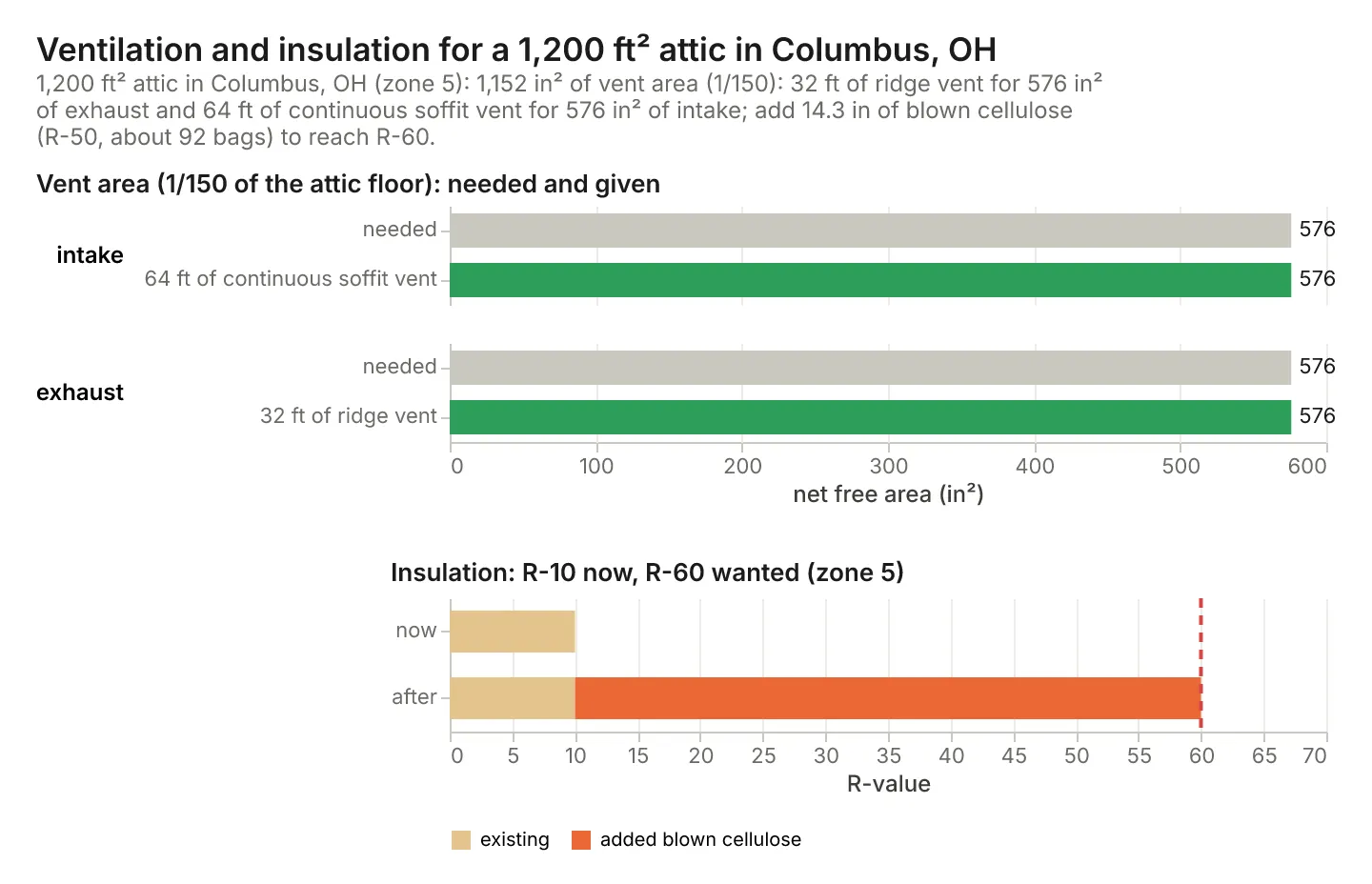
Work out how much attic ventilation and insulation a house needs, or check what's there, from one line of text. Ask attic 40 x 30 ft in Columbus, Ohio, ridge vent and soffit vents, 4 inches of old fiberglass and you get back:
- The vent area the International Residential Code asks for (1 ft² of net free area per 150 ft² of attic floor, or 1/300 with balanced high and low vents), split between intake and exhaust.
- How many vents that takes: feet of ridge vent or continuous soffit vent, or the number of box vents, turbines, gable vents or 16x8, 16x4 or round soffit vents, checked against the ridge and eave lengths; or a power fan's airflow and the intake it needs.
- A check of what you have: say
3 box ventsor40 ft of ridge ventand it tells you whether it's enough. - The insulation R-value for the attic floor in your IECC climate zone (from the zone or a US place), what your existing insulation gives, and the depth, pounds and bags of blown cellulose, fiberglass or rock wool, or the batts, to add.
- Charts (vent area needed and given, insulation now and after) and a Markdown report.
It's made for:
- Homeowners planning an attic upgrade or a reroof.
- Roofers, insulation contractors, home inspectors and energy auditors.
- AI agents, quoting tools and home-improvement apps that need attic numbers they can show their work for.
How to use it
- Write Requests, one per entry. The form has examples.
- Optionally set the vent ratio, the climate zone and the insulation to add.
- Click Start. Each request is a row in the results, with its summary, chart and report.
What you can write
| You write | It means |
|---|---|
1,500 sq ft attic, 40 x 30 ft, 110 m2, hip roof | The attic floor (and the roof shape for the ridge and eave lengths) |
1/150 (default), 1/300, vapor barrier | The vent rule |
ridge vent, box vents, turbines, 14 in turbine, gable vents, power fan, solar attic fan | The exhaust |
soffit vents, vented soffit, 16x8 soffit vents, round soffit vents, drip edge vents | The intake |
3 box vents, 40 ft of ridge vent, 12 16x8 soffit vents, 60 ft of soffit vent | What you have, to check |
ridge vent 12.5 sq in per ft, box vents 61 sq in | Your product's net free area |
zone 5, in Columbus, Ohio, lat 41.08 lon -81.52 | The climate zone for insulation |
4 inches of old fiberglass, 6 in of cellulose, R-19 batts now, no insulation | What's there |
blown cellulose (default), blown fiberglass, batts, to R-49, 25 lb bags | What to add |
The same as an object: {"length": 50, "width": 28, "exhaust": "ridge", "intake": "soffit", "zone": 4, "existingDepth": 6, "existingMaterial": "cellulose"}.
Examples
attic 40 x 30 ft in Columbus, Ohio, ridge vent and soffit vents, 4 inches of old fiberglass→ 1,152 in² of vent area: 32 ft of ridge vent and 64 ft of continuous soffit vent; zone 5 wants R-60, so add 14.3 in of blown cellulose (about 92 bags of 25 lb).attic ventilation for a 1,500 sq ft attic, 3 box vents, 6 16x8 soffit vents→ 1,440 in² needed: 15 box vents and 13 soffit vents; your 150 in² of exhaust and 336 in² of intake aren't enough.how much blown fiberglass for a 1,200 sq ft attic in zone 6, R-19 batts now→ add R-41: 16.4 in, about 36 bags.attic fan for a 2,000 sq ft attic, dark shingles→ a 1,610 cfm fan with 960 in² of intake.insulation for a 1,000 sq ft attic in Miami, no insulation, batts→ zone 1, R-30 batts.
How-to examples
These are examples from Examples above, written as complete inputs; the result lines are from their runs.
How to calculate attic vent area
Result: 1,152 in² of vent area: 32 ft of ridge vent and 64 ft of continuous soffit vent; zone 5 wants R-60, so add 14.3 in of blown cellulose (about 92 bags of 25 lb).
How to check whether existing attic vents are enough
Result: 1,440 in² needed: 15 box vents and 13 soffit vents; your 150 in² of exhaust and 336 in² of intake aren't enough.
How to calculate blown insulation for an attic
Result: Add R-41: 16.4 in, about 36 bags.
How to let an AI agent size attic vents and insulation
Add this Actor to the Apify MCP server with https://mcp.apify.com/?tools=jumblemog/attic-ventilation-calculator. The agent writes the attic and where it is ("40 x 30 ft in Columbus, Ohio, 4 inches of old fiberglass") and passes on the vent counts, target R-value and bags of insulation instead of guessing them.
FAQ
What does it calculate? Net free vent area split between intake and exhaust, vent counts, attic fan size, and the insulation to add for your climate zone.
Which ventilation ratio does it use? 1/150 by default; set ratio to 1/300 where your code allows it.
How does it know my climate zone? From the state or city in the request, or the zone field. Give your county's zone if it differs.
Can I mix a ridge vent with box vents? Don't: different exhaust types on one attic short-circuit each other.
How many can I run at once? Up to 200 attics per run, each as a line of text or an object. A request that can't be computed isn't billed.
Does it work with Zapier, Make or n8n? Yes. Call the Actor with its Apify app or an HTTP request and pass the results on.
Input
| Field | What it is |
|---|---|
requests | Attics as lines of text or objects (up to 200 per run) |
ratio | 1/150 or 1/300 when a request doesn't say (1/150 by default) |
zone | The IECC climate zone when a request gives no zone or place |
addMaterial | Insulation to add when a request doesn't say (blown cellulose by default) |
charts | Draw a chart for each request (default on) |
Output
One dataset item per request, also saved together in the run's OUTPUT record:
A request about only ventilation or only insulation leaves the other part null. Every item has place, warnings, notes (every assumption and default), a Markdown report and links to the chart and report. A request that can't be computed has "status": "failed" and the reason in error, and isn't billed.
How it works
- Vent area (IRC R806.2): attic floor ÷ 150 ft² of net free area, or ÷ 300 when 40-50% of it is high (within 3 ft of the ridge) and the rest at the eaves, or with a vapor retarder in climate zones 6-8. Half intake, half exhaust; intake should never be less than exhaust.
- Vents: area ÷ the product's net free area. Typical values: ridge vent 18 in²/ft, continuous soffit vent 9 in²/ft, vented soffit panel 6 in²/ft, box vent 50 in², 12 in turbine 112 in², 14 in turbine 154 in², gable vent 72 in², 16x8 soffit vent 56 in², 16x4 26 in², 4 in round 7 in². The ridge vent stops 6 in short of each end; a hip roof's ridge is its length less its width.
- Power fan: 0.7 cfm per ft² of attic floor, 15% more under a dark roof, with 1 ft² of intake per 300 cfm.
- Insulation: IECC 2021 Table R402.1.3 ceiling R-values (zone 1 R-30, zones 2-3 R-49, zones 4-8 R-60). Zones come from the dominant zone of the place's state. Existing insulation at R-2.5 per inch for loose fiberglass, 3.5 for cellulose, 3.2 for batts, 3.0 for rock wool. Blown insulation at its settled density (cellulose 1.6 lb/ft³, fiberglass 0.6, rock wool 1.7); batts in one or two standard layers.
Pricing
You pay one low price per attic, at the price shown on this page, whether it's ventilation, insulation or both. The charts and report are included. Requests that can't be computed are never charged. If you set a maximum cost per run, the Actor stops before a request that wouldn't fit.
Speed
A request takes milliseconds. A run through the API answers in about 10 seconds, including the cloud container starting.
Tips and limits
- Product ratings win: net free areas vary by brand; use the one printed on yours.
- Don't mix exhaust types (a ridge vent with box vents, gable vents or a power fan) on one attic: they short-circuit each other.
- Bag coverage charts are the final word on blown insulation; blow a little deeper for settling, and keep it off soffit vents with baffles.
- Vermiculite may contain asbestos: have it tested before disturbing it.
- Limits: 200 requests per run; zones by state, so give your county's zone if it differs.
For AI agents and developers
This Actor works with the Apify MCP server, so AI agents can call it as a tool. Pass requests as plain text and read summary, exhaust, intake, insulation and warnings. A direct API call that waits for the answer:
run-sync instead returns the run's OUTPUT: the status, the counts and every result as JSON.
In Python, with the apify-client package:
Credits
- Rules: the International Residential Code (R806.2) and International Energy Conservation Code 2021 (Table R402.1.3), as published by the ICC.
- Places: GeoNames (CC BY 4.0) through geonamescache.
- Charts: Vega-Lite and vl-convert (BSD-3-Clause), with the Inter font (SIL Open Font License).