

Lawn Calculator (Grass Seed, Sod, Fertilizer & Lime)
Pricing
Pay per event
Lawn Calculator (Grass Seed, Sod, Fertilizer & Lime)
Lawn materials from one line: grass seed for a new lawn or overseeding, sod pallets, fertilizer from the bag's N-P-K, lime or sulfur from a pH test, topsoil, compost and water, with cost.
Pricing
Pay per event
Rating
0.0
(0)
Developer

Jumble Mog
Maintained by CommunityActor stats
0
Bookmarked
2
Total users
1
Monthly active users
10 hours ago
Last modified
Categories
Features
Share
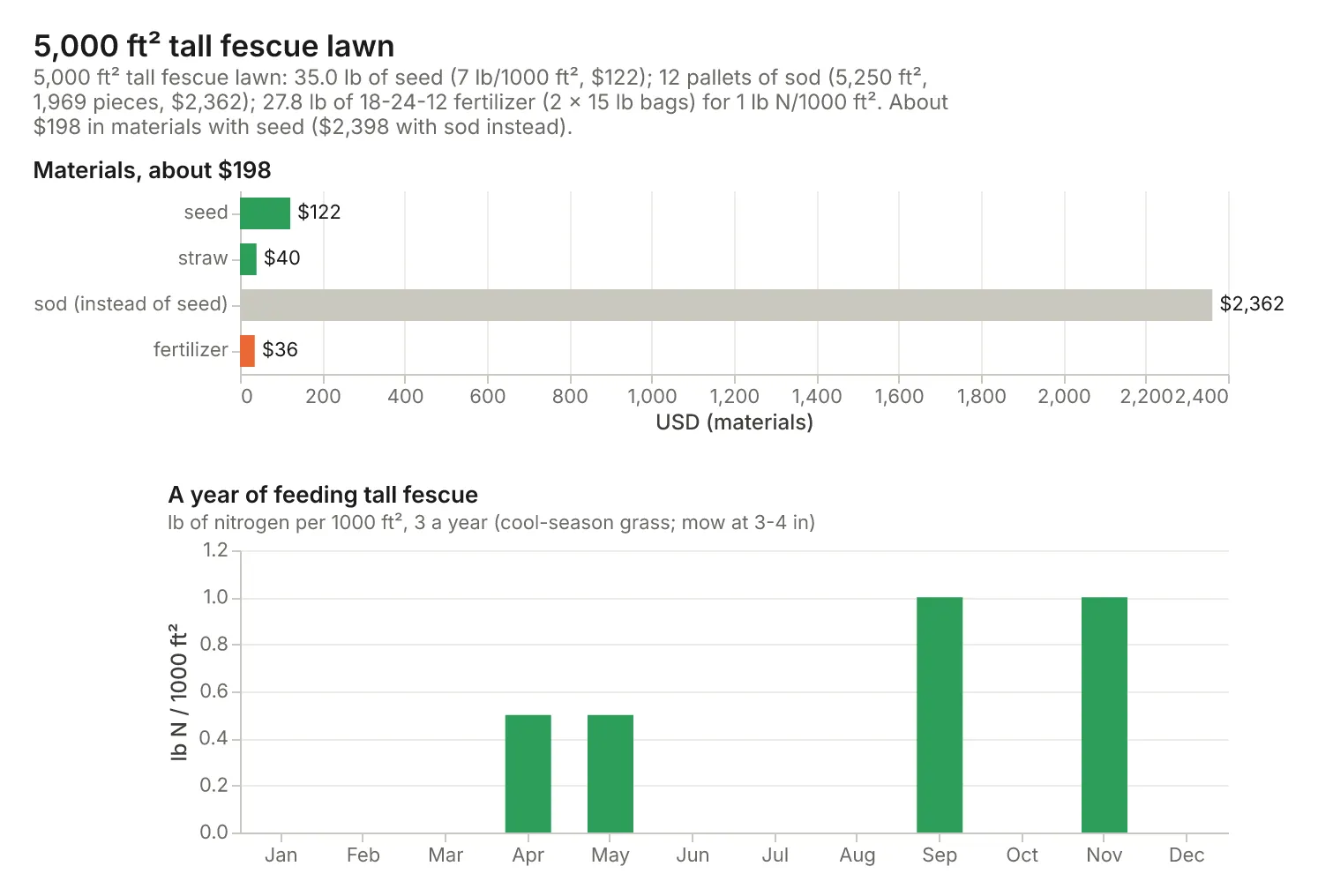
Work out what a lawn needs from one line of text. Ask new lawn 5,000 sq ft, tall fescue, seed or sod? and you get back:
- Grass seed by grass type for a new lawn or overseeding (extension-service rates), straw to cover it, when to plant and how long it takes to sprout.
- Sod: square feet with cuts, 16 × 24 in pieces, pallets, weight and the first weeks of watering.
- Fertilizer from the bag's N-P-K label: pounds per 1000 ft² for a nitrogen rate, total pounds and bags, what one bag covers, and a year of feedings for that grass.
- Lime or sulfur from a soil test pH, by soil texture, split into safe applications.
- Topsoil or compost in cubic yards and bags, and water in gallons a week.
- A materials cost, with seed against sod side by side.
- Charts (cost by item and a year of feeding by month) and a Markdown report.
It's made for:
- Homeowners starting, fixing or feeding a lawn.
- Lawn care and landscaping businesses quoting seed, sod and fertilizer jobs.
- AI agents, garden and home apps that need lawn numbers they can show their work for.
How to use it
- Write Requests, one per lawn. The form has examples.
- Optionally set the default grass.
- Click Start. Each request is a row in the results, with its summary, chart and report.
What you can write
| You write | It means |
|---|---|
5,000 sq ft, 1/4 acre, 50 x 80 ft, 200 m2, minus a 400 sq ft patio | The lawn's size |
tall fescue, kentucky bluegrass, perennial ryegrass, fine fescue, sun and shade mix, bermuda, zoysia, centipede, st augustine, bahia, buffalo grass | The grass |
new lawn, seed, overseed, sod, seed or sod? | Seed and sod |
32-0-4 fertilizer, 1 lb nitrogen, 15 lb bags | Fertilizer |
ph 5.6, target 6.5, clay, sandy | Lime or sulfur |
1/4 inch of compost, 4 in of topsoil, water | Topdressing and water |
$0.38/sq ft, $4/lb, $250 a pallet | Prices |
The same as an object: {"area": 10000, "grass": "zoysia", "jobs": ["sod", "fertilizer"], "npk": [16, 4, 8], "ph": 7.8, "soil": "sand"}.
Examples
new lawn 5,000 sq ft, tall fescue, seed or sod?→ 35 lb of seed, 5 straw bales and a starter fertilizer for about $198, or 12 pallets of sod for $2,362.overseed 1/4 acre of kentucky bluegrass→ 16.3 lb of seed.how much 32-0-4 fertilizer for 8,000 sq ft at 1 lb nitrogen, 15 lb bags→ 25 lb, 2 bags; one bag covers 4,800 ft².soil ph 5.6 on 6,000 sq ft clay lawn, target 6.5→ 378 lb of lime in 2 applications.sod for a 50 x 80 ft backyard minus a 400 sq ft patio, bermuda, $0.38/sq ft→ 9 pallets, $1,436.1/4 inch of compost topdressing on 3,000 sq ft and how much water a week→ 2.3 yd³ of compost, 1,869 gal a week.
How-to examples
These are examples from Examples above, written as complete inputs; the result lines are from their runs.
How to calculate grass seed or sod for a new lawn
Result: 35 lb of seed, 5 straw bales and a starter fertilizer for about $198, or 12 pallets of sod for $2,362.
How to calculate fertilizer for a lawn
Result: 25 lb, 2 bags; one bag covers 4,800 ft².
How to calculate lime to raise lawn soil pH
Result: 378 lb of lime in 2 applications.
How to let an AI agent work out lawn materials
Add this Actor to the Apify MCP server with https://mcp.apify.com/?tools=jumblemog/lawn-calculator. The agent writes the lawn and the job ("new lawn 5,000 sq ft, tall fescue") and passes on the seed, sod, fertilizer or lime to buy instead of guessing them.
FAQ
What can it calculate? Seed for new lawns and overseeding, sod pallets, fertilizer from any N-P-K analysis, lime, compost topdressing and weekly water.
Which grasses does it know? Common cool- and warm-season grasses such as tall fescue, Kentucky bluegrass and bermuda; a sun and shade mix by default.
Can it subtract a patio or driveway? Yes: 50 x 80 ft backyard minus a 400 sq ft patio works.
Should I follow the lime and fertilizer rates? They're typical rates. A soil test's recommendation wins, and many states limit phosphorus.
How many can I run at once? Up to 200 lawns per run, each as a line of text or an object. A request that can't be computed isn't billed.
Does it work with Zapier, Make or n8n? Yes. Call the Actor with its Apify app or an HTTP request and pass the results on.
Input
| Field | What it is |
|---|---|
requests | Lawns as lines of text or objects (up to 200 per run) |
grass | The grass when a request doesn't say (a sun and shade mix by default) |
charts | Draw a chart for each request (default on) |
Output
One dataset item per request, also saved together in the run's OUTPUT record:
Every item has warnings, notes (every assumption and default), a Markdown report and links to the chart and report. A request that can't be computed has "status": "failed" and the reason in error, and isn't billed.
How it works
- Seed: pounds per 1000 ft² by grass from US extension guides (tall fescue 7 new / 4 overseed, Kentucky bluegrass 2.5 / 1.5, perennial ryegrass 7 / 4, bermuda 1.5 / 1, centipede 0.25 ...); St. Augustine is sod or plugs only. Straw at about a bale per 1000 ft².
- Sod: area + 5%, in 16 × 24 in pieces (2.67 ft²) and pallets of about 450 ft², about 5 lb per ft².
- Fertilizer: product per 1000 ft² = nitrogen rate ÷ N%; a starter 18-24-12 for new lawns and a 29-0-4 lawn food otherwise when no label is given; at most 1 lb N at a time. Yearly nitrogen and feeding months by grass (tall fescue 3 lb, cool-season mostly in fall; bermuda 4 lb in summer).
- pH: about 25 / 50 / 70 lb of limestone per 1000 ft² per pH unit for sand / loam / clay, at most 50 lb at a time; elemental sulfur 10 / 15 / 20 lb per unit, at most 5 lb at a time.
- Topdressing: area × depth (1/4 in compost or 4 in topsoil for a new lawn by default). Water: 0.623 gal per ft² per inch, 1 in a week.
Pricing
You pay one low price per lawn, at the price shown on this page. The charts and report are included. Requests that can't be computed are never charged. If you set a maximum cost per run, the Actor stops before a request that wouldn't fit.
Speed
A request takes milliseconds. A run through the API answers in about 10 seconds, including the cloud container starting.
Tips and limits
- A soil test wins: lime, sulfur, phosphorus and potash should follow your test's recommendation; these are typical rates.
- Check local rules: many states limit phosphorus and fall nitrogen on lawns.
- Prices vary by region and season: give yours for seed, sod and pallets.
- Limits: 200 requests per run; US units with metric areas accepted.
For AI agents and developers
This Actor works with the Apify MCP server, so AI agents can call it as a tool. Pass requests as plain text and read summary, seed, sod, fertilizer, ph, cost and warnings. A direct API call that waits for the answer:
run-sync instead returns the run's OUTPUT: the status, the counts and every result as JSON.
In Python, with the apify-client package:
Credits
- Rates: typical US university extension-service recommendations for seeding, fertilizing and liming lawns.
- Charts: Vega-Lite and vl-convert (BSD-3-Clause), with the Inter font (SIL Open Font License).


