

Google Flights Scraper: Failed Runs Cost Nothing
Pricing
from $0.70 / 1,000 itinerary delivereds
Google Flights Scraper: Failed Runs Cost Nothing
Scrape live Google Flights fares for any route and date: price, airline, times, stops and layovers. A run that fails or finds nothing costs nothing. A free dry run shows the price first, and the run stops at a spend cap you set.
Pricing
from $0.70 / 1,000 itinerary delivereds
Rating
0.0
(0)
Developer

Monty Burrows
Maintained by CommunityActor stats
0
Bookmarked
2
Total users
0
Monthly active users
a month ago
Last modified
Categories
Share
Google Flights Scraper
Scrape live Google Flights fares as clean JSON, CSV or Excel. Each row has the price, airline, departure and arrival times, stop count, total duration and every layover.
Give it a list of origins, destinations and dates. Every combination is searched, so one run can build a whole fare calendar, such as LHR to JFK every day in September in business class.
One way, round trip and multi-city. Adults, children and infants. Alliance and stop filters. Over a hundred currencies.
Quick start
Press Start. The form is already filled in with a real search, LHR to JFK thirty days out, so the first run works without you typing anything. It returns roughly 25 to 30 itineraries in about ten seconds and costs around $0.03.
Then change three fields to your own search:
| Field | Example |
|---|---|
| From | LHR, or several codes to compare departure points |
| To | JFK, or several |
| Departure dates | +30, or 2026-11-10 |
To see the cost before you spend anything, tick Dry run. It reports how many results you would get and what they would cost, and it never charges you.
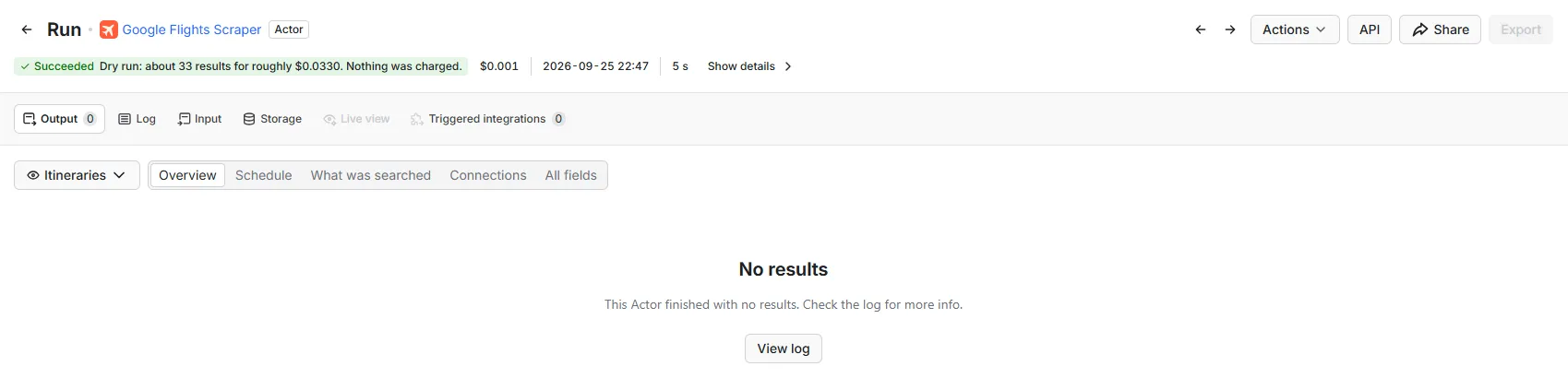
The status line is the estimate. A dry run writes no rows, so the results table stays empty, and the small figure beside the status is Apify's platform usage, which the developer pays under pay-per-event pricing, not you.
Dates that do not go stale
Every date field takes a calendar date such as 2026-11-10, or a number of days from today such
as +30.
Use the relative form on a schedule. A daily run pinned to a calendar date returns fares until that
date arrives and then returns nothing, with no error to tell you why. +30 still means thirty days
out a year later, so a scheduled run needs no maintenance.
What you get
One row per itinerary.
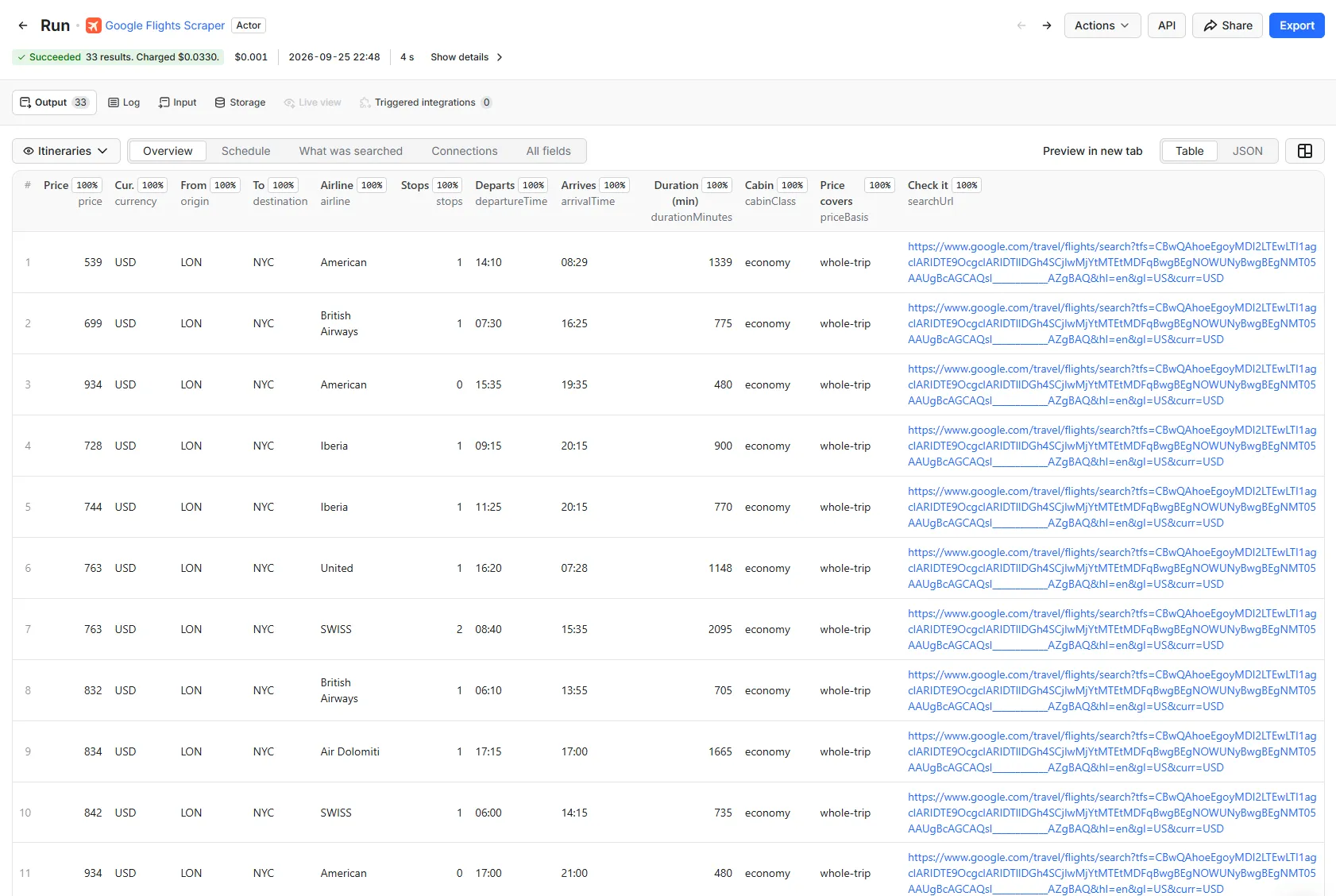
| Field | Description |
|---|---|
price | Lowest total fare for the whole party, in your chosen currency |
currency | ISO code, such as USD, GBP or EUR |
tripType | one-way, round-trip or multi-city |
priceBasis | How to read price: one-way, whole-trip or per-leg |
legIndex / legCount | Which leg this row prices, out of how many |
airline / airlines | Marketing airline, and every airline on the itinerary |
operatedBy | The carrier actually flying it, when it differs from the one selling |
stops | 0 for nonstop |
departureAirport / departureTime | Airport name and local 24-hour time |
departureDate / arrivalDate | Full ISO dates, so an overnight arrival is unambiguous |
arrivalAirport / arrivalTime | Airport name and local 24-hour time |
durationMinutes | Total journey time |
overnight | true when it lands on a later day than it left |
layovers[] | Each connection's airport, city and wait in minutes |
tripLegs[] | Every leg that was priced, so a round-trip row explains itself |
returnDate | The return that was searched, or null on a one-way |
searchUrl | The exact Google Flights search. Paste it into a browser and check |
origin / destination / searchDate | What was searched, so rows from a multi-route run stay self-describing |
adults / children / infantsInSeat / infantsOnLap | The party this fare was quoted for |
Example output
These are real rows, not a mock-up. LHR to JFK and LHR to BOS, round trip, economy, out on 10 November and back on 17 November 2026, scraped on 22 September 2026. The run returned 36 itineraries across 9 airlines, 28 of them nonstop, priced from $479 to $673, in 13 seconds.
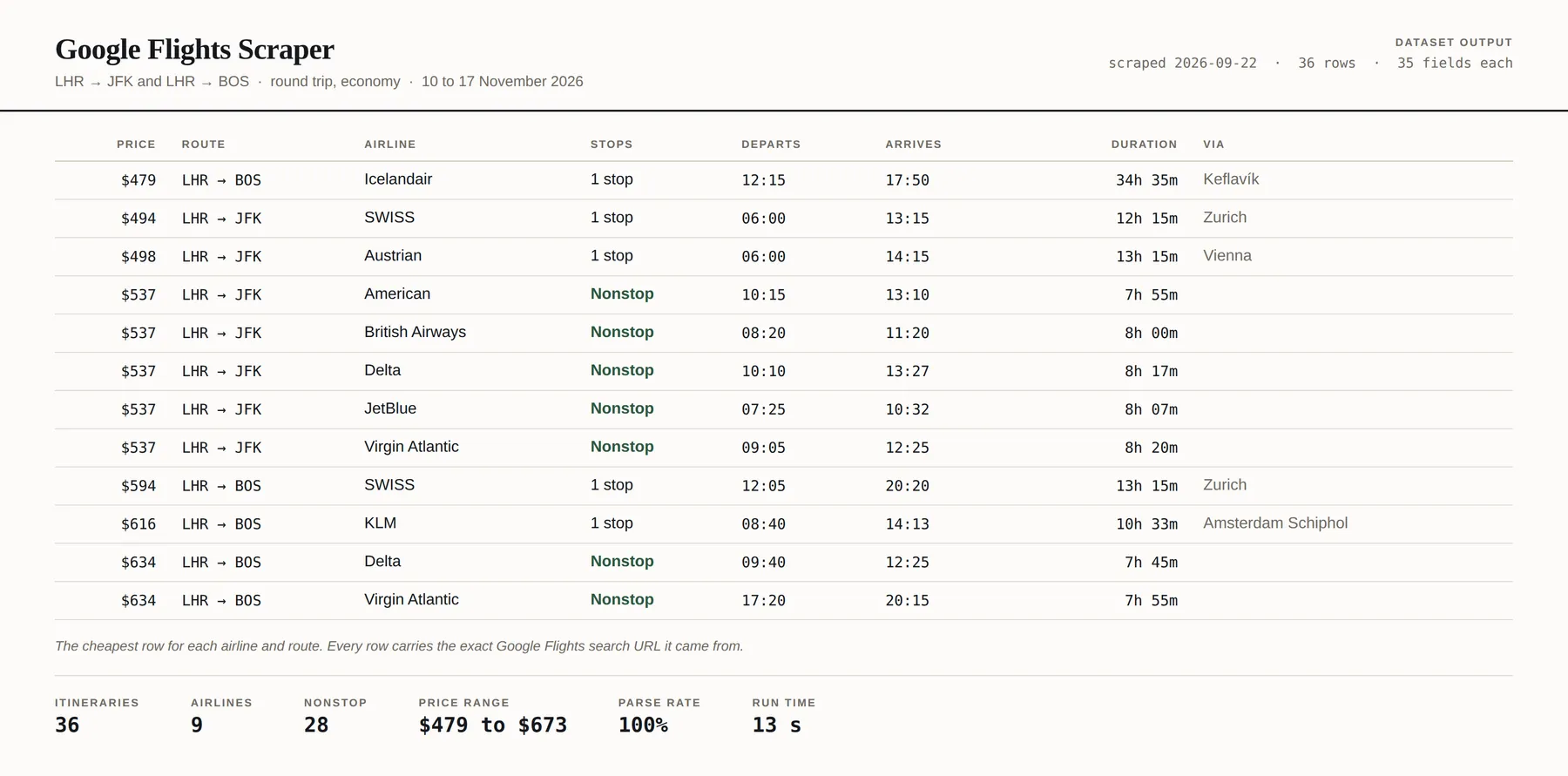
| Price | Route | Airline | Stops | Departs | Arrives | Duration |
|---|---|---|---|---|---|---|
| $479 | LHR to BOS | Icelandair | 1 stop | 12:15 | 17:50 | 34h 35m |
| $494 | LHR to JFK | SWISS | 1 stop | 06:00 | 13:15 | 12h 15m |
| $498 | LHR to JFK | Austrian | 1 stop | 06:00 | 14:15 | 13h 15m |
| $537 | LHR to JFK | JetBlue | Nonstop | 07:25 | 10:32 | 8h 07m |
| $537 | LHR to JFK | British Airways | Nonstop | 08:20 | 11:20 | 8h 00m |
| $537 | LHR to JFK | Virgin Atlantic | Nonstop | 09:05 | 12:25 | 8h 20m |
One row in full, exactly as it is written to your dataset, with nothing trimmed:
Paste a row's searchUrl into a browser and you land on the search it came from. That is how you
check any fare here against the source.
Input
| Setting | What it does |
|---|---|
| Trip type | One way, round trip or multi-city. |
| From / To | Pick from 1,149 major airports and 22 whole cities, or type any IATA code. |
| Departure dates | YYYY-MM-DD, or +30 for days from today. Add a range to find the cheapest day. |
| Return dates | Round trip only, same formats. Every departure is paired with every return. |
| Trip length in nights | Easier than listing returns: enter 7 and 14 to price both from every departure. |
| Multi-city legs | Multi-city only. One row per leg, each with a from, a to and a date. |
| Passengers | Adults, children aged 2 to 11, infants in seat, infants on lap. Up to 9 seated. |
| Cabin | Economy, premium economy, business or first. |
| Maximum stops | Any, nonstop only, 1 stop or fewer, 2 stops or fewer. Applied by Google itself. |
| Currency | Over a hundred, each verified end to end against the live page. |
| Dry run | Estimates the result count and cost, then stops. Costs nothing. |
| Maximum results | Hard cap on rows. The run stops the moment it is reached. |
| Maximum spend (USD) | Hard cap on cost. The run stops before exceeding it. |
A city in From or To, such as London, New York, Paris, Tokyo and eighteen more, searches every
airport in it at once. LON to NYC returns Heathrow, Gatwick and Stansted to JFK, Newark and LaGuardia in
one run, which is usually the search you actually want. Any code not in the list can still be typed.
There is no limit on how many origins, destinations or dates you provide. Cost is bounded by Maximum results and Maximum spend, and Dry run tells you the real number for free before you commit.
A single route on a single date returns roughly 25 to 30 itineraries, which is a useful number to size Maximum results against.
How prices are quoted
Every row carries a priceBasis field, so you never have to work out what a price covers by
checking which trip type produced it.
| Trip type | priceBasis | What price means |
|---|---|---|
| One way | one-way | That flight |
| Round trip | whole-trip | The entire return journey, all passengers |
| Multi-city | per-leg | That leg alone, priced as a one-way |
On a round trip, Google prices each outbound option at the whole-trip total, because you pick an outbound before it will show you returns. A round-trip row therefore describes the outbound flight and prices the whole journey.
On multi-city, each leg is searched and priced separately, so you get every option for every leg. That is more than Google's own multi-city view gives you, which lists first-leg choices only. A three-city trip returned 44 bookable itineraries in testing where Google's multi-city page showed 26 first-leg options.
The caveat, and the reason priceBasis exists: the sum of the legs is not a single multi-city
ticket, and a combined fare is often cheaper. If you need one ticket, use these prices to find the
right flights and then price that itinerary directly. Adding three one-ways together and calling it
a multi-city fare would be the wrong number.
Accuracy
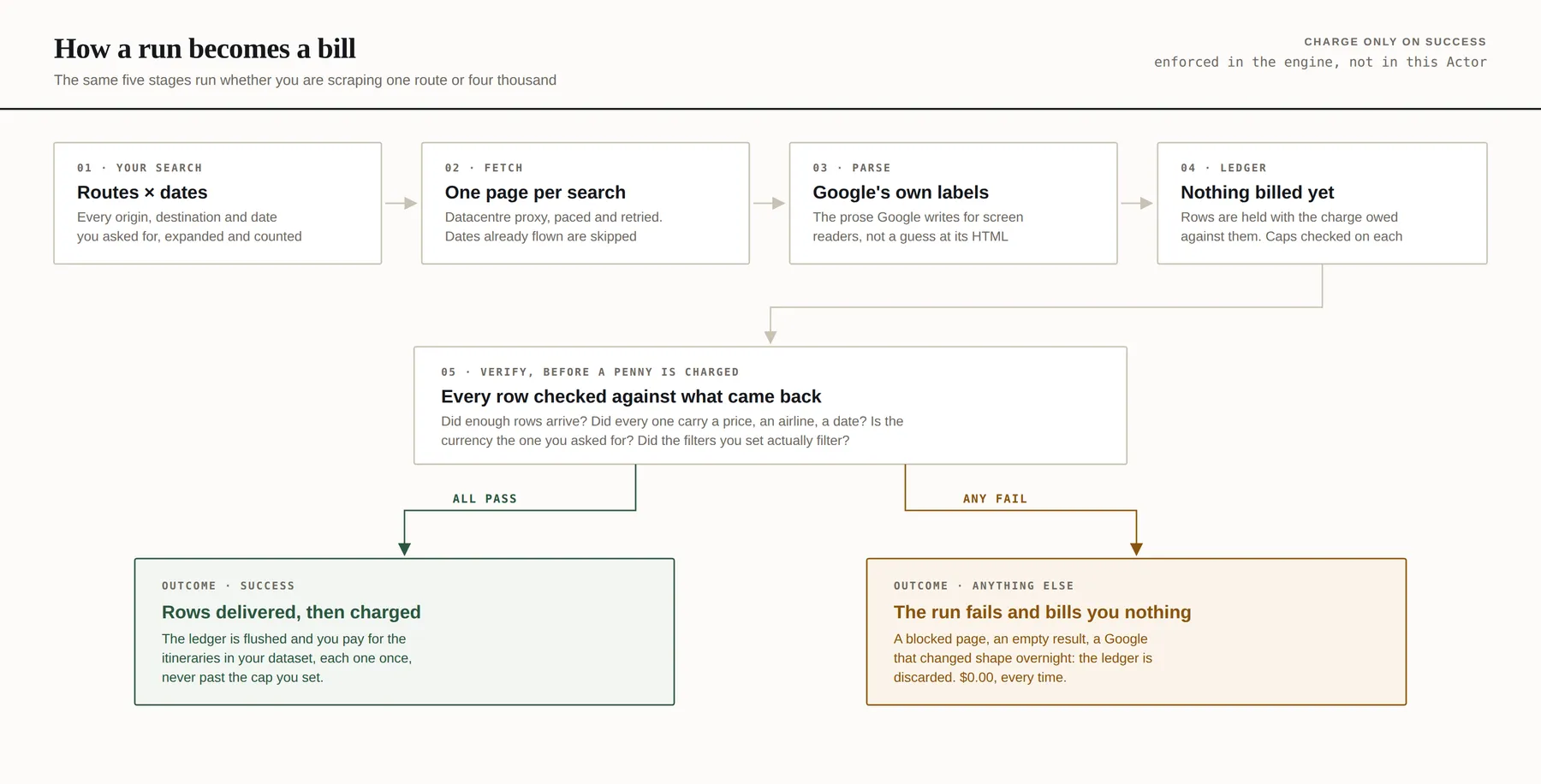
Fares are read from the itinerary descriptions Google writes into the page for screen-reader users. Those are sentences with named fields rather than an internal feed of unlabelled positional arrays.
That is the difference that matters. If a positional feed shifts by one element, every row still parses, the row count does not change, and the price column starts reporting a number that is not the price. A reworded sentence cannot fail that way. The parse rate collapses, this Actor's health checks fail, the run stops, and you are charged nothing.
Currency is read the same way. The Actor takes the currency from the page rather than trusting the one it asked for, because Google does not reject a currency it cannot serve. It prices in a different one instead. When that happens the run stops and names the currency it got, rather than billing you for prices in the wrong money.
Checked against the leading alternative in this category, this Actor found a real mispricing in it: two Zurich-connecting SWISS itineraries an hour apart, with the overnight departure's cheaper fare attached to the morning flight. That is the failure described above, in production. This Actor also returns layover airports and durations, operating carriers, and correct next-day arrival dates, which that Actor does not.
Limitations
Multi-city is priced leg by leg, not as one ticket. This is deliberate. Google's own multi-city cannot be read reliably without a browser. Asked one way it returns an empty page. Asked another it returns a healthy-looking page that has priced a plain round trip instead, at prices identical to the pound, for a search that never happened. Each leg is therefore searched on its own. If another scraper offers combined multi-city fares at HTTP speed, compare one of its open-jaw prices against the equivalent round trip before trusting it.
Nine seated passengers is the maximum. Above that Google returns one-passenger fares without saying so, so the search is refused rather than answered wrongly.
A route with no flights fails the run instead of returning an empty dataset. The page this Actor reads never says "no flights". A route with no service renders the same endless loading shell as a rate-limited request, so an empty answer cannot be told apart from a blocked one. Reporting "no flights exist" on evidence that might mean "we were throttled" would be a guess, so the run fails, says which it cannot rule out, and charges you nothing. If you think the route should have flights, run it again.
No flight numbers. Google does not put them in the data this Actor reads.
English only. Results are requested in English so the fields can be read reliably.
Pricing
Pay per result, and nothing else. No per-run fee, no charge for compute, no charge for retries.
| Plan | Per 1,000 results |
|---|---|
| Free | $1.00 |
| Bronze | $0.90 |
| Silver | $0.80 |
| Gold | $0.70 |
| Platinum | $0.70 |
| Diamond | $0.70 |
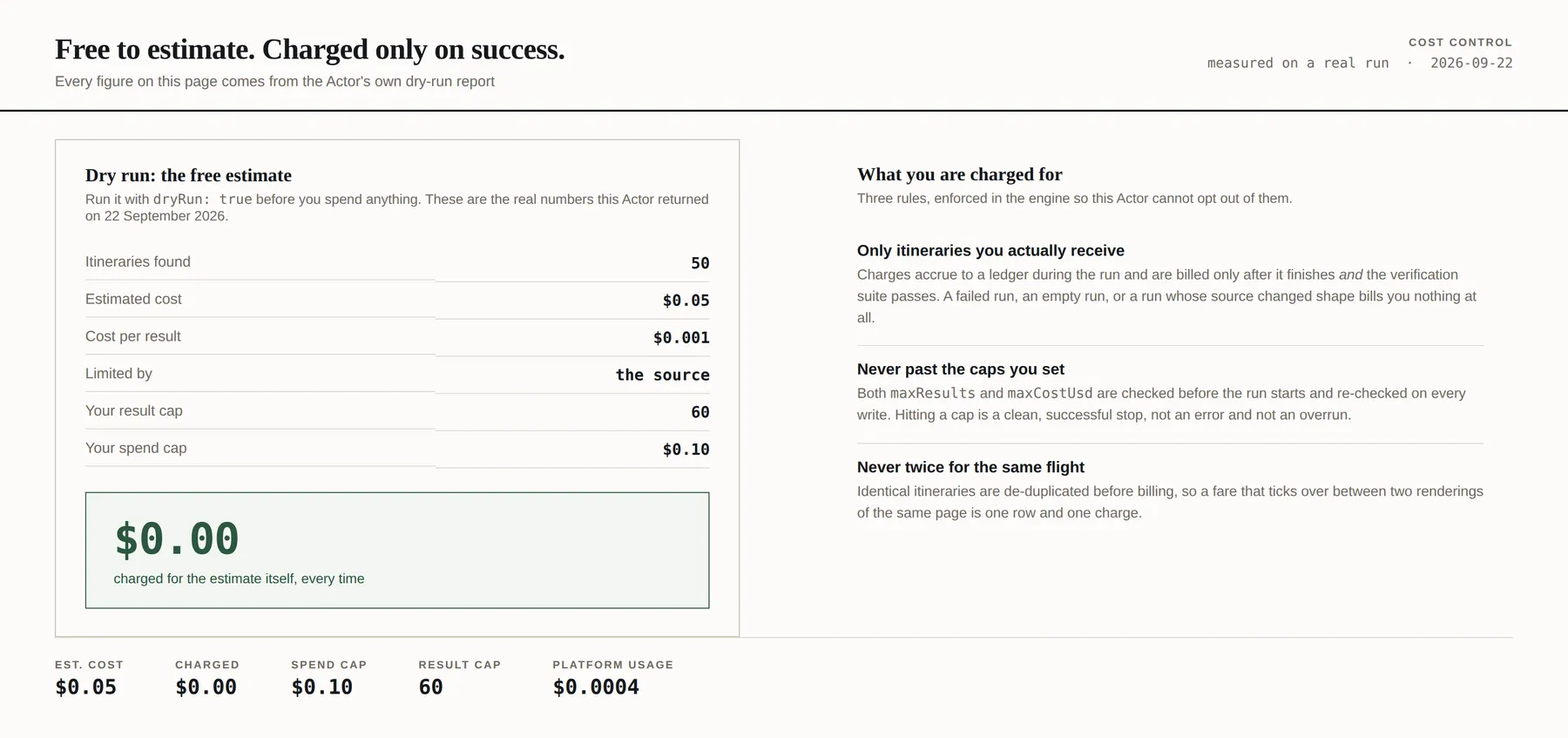
You pay only for results you actually receive. If the run fails, returns nothing, or Google changes the page and the health checks catch it, you are charged nothing. Duplicate itineraries are removed before billing, so the same flight is never sold to you twice.
Tick Dry run first to see the cost before you spend anything.
Run it on a schedule
Save your input as a task and add an Apify Schedule to run it daily, weekly or hourly. When a run finishes, Apify's integrations can pass its rows to Google Sheets, Zapier, Make or n8n, and a webhook can call your own endpoint. A run that fails costs nothing and does not fire an integration or webhook set to run on success.
Use relative dates in a scheduled task. +30 still means thirty days out a year from now, while a
calendar date returns fares until it arrives and then nothing (see Dates that do not go stale,
above).
Use it from an AI agent
Apify's MCP server loads this Actor as a single tool:
An agent with it can run a search with the same inputs as the form, dry run and spend cap included, and read the itineraries it returns, billed to your Apify account at the prices above.
FAQ
How much does it cost to scrape Google Flights?
$1.00 per 1,000 itineraries on Apify's free plan, and $0.70 per 1,000 on Gold and above, with no per-run fee. The prefilled search returns roughly 25 to 30 itineraries for around $0.03. Apify's free plan gives $5 of usage a month, which at $0.001 an itinerary is 5,000 itineraries. A failed run and an empty run cost nothing, duplicates are removed before billing, and the dry run, which estimates the count and the cost first, is free.
Is it legal to scrape Google Flights?
This Actor reads the public Google Flights results page, the same one anyone sees in a browser, with no login and no account. A row is a fare, not a person, so there is no personal data in it. Whether your use is acceptable depends on what you do with the data, where you are, and the terms of the sites involved, which are worth reading. Nothing here is legal advice.
Does a round-trip price cover both flights?
Yes. A round-trip row carries priceBasis: "whole-trip": the price is the whole return journey for
all passengers, and the row describes the outbound flight.
Can I price a multi-city trip as one ticket?
No. Multi-city is priced leg by leg, each leg as a one-way (priceBasis: "per-leg"), because
Google's own multi-city cannot be read reliably without a browser. A single multi-city ticket is
often cheaper than the sum of its legs.
Why did my route fail instead of returning nothing?
Google shows a route with no flights the same way it shows a throttled request, so this Actor cannot tell "no flights" from "blocked". It fails the run, says so, and charges nothing. If the route should have flights, run it again.
Does it return flight numbers?
No. Google does not put them in the data this Actor reads.
Other Actors from this developer
Every one has the same free dry run and spend cap, and none charges for a failed run.
- Shopify Product Scraper: every product and variant from a list of Shopify stores
- Shopify Price & Stock Tracker: price and stock on the Shopify product pages you choose
- Shopify Store Checker: which of a list of domains are readable Shopify stores
- RSS Feed Reader: RSS, Atom and RDF feeds in one table
- Domain Expiry, WHOIS & DNS Lookup: expiry dates, registrar and live DNS for a list of domains
Support and feature requests
Email actors@montyburrows.com if you find a bug, need an extra field, or want a filter that is not here yet. Feature requests are welcome and usually quick.


