

EU Geographical Indication Records — eAmbrosia
Pricing
from $33.50 / 1,000 gi records
EU Geographical Indication Records — eAmbrosia
Keyless pay-per-record EU eAmbrosia geographical indications — protected name, GI type, product, country, status, legal basis. Producer-group org only; no person data. CC BY 4.0. $0.05 per record on the Free plan, $0.0335 on Gold.
Pricing
from $33.50 / 1,000 gi records
Rating
0.0
(0)
Developer
NexGen Signal
Maintained by CommunityActor stats
0
Bookmarked
2
Total users
1
Monthly active users
8 days ago
Last modified
Categories
Share
Keyless. Pay per record. Every EU protected name — PDO, PGI, GI, TSG — as one clean register.
This actor turns the European Commission's eAmbrosia, the EU register of geographical indications, into clean, per-name records — the official register of every protected food, wine, spirit, and agricultural name in the EU. Each run reads the Commission's keyless eAmbrosia API and delivers one row per protected name: its identifier and file number, the protected name itself, the GI type and product type, the countries, the registration status and protection date, the legal instrument and publication reference, and the producer-group organisation's name, country, and website. Protected-name / product grain, structured for engineering use, under the Commission's CC BY 4.0 reuse policy, with no natural-person data of any kind.
What this is, in one paragraph
eAmbrosia is the Commission's authoritative register of the names protected across the EU as Protected Designations of Origin (PDO), Protected Geographical Indications (PGI), Geographical Indications for spirits and aromatised wines, and Traditional Specialities Guaranteed (TSG). This actor reads that register and flattens each entry into a single analysis-ready record: the GI identifier and file number, the protected name (or names), the GI type and product type, the product categories and CN classification, the countries, the registration status, the EU protection date, the last modification date, the legal instrument and its link, the publication reference, the third-country and amendment flags, and the producer-group organisation's name, country, and website. Values are carried verbatim as published. It is the protected-names layer of the EU single market. You are billed only for records actually delivered.
Who buys this and for what job
- Food, wine, and spirits producers, importers, and marketplaces checking whether a name is protected, of what type, and in which countries.
- IP, brand-protection, and compliance teams monitoring the register of protected designations for enforcement and labelling.
- Trade, provenance, and anti-counterfeit products mapping protected names to their product categories and CN codes.
- Data engineers who want the eAmbrosia register as clean rows without paging the Commission's API by hand.
Creative Commons Attribution 4.0 — free commercial reuse
One licence rider travels on every record. European Commission content in eAmbrosia is © European Union, and its reuse is authorised provided the source is acknowledged, under the Creative Commons Attribution 4.0 International (CC BY 4.0) licence per Commission Decision 2011/833/EU — free to reuse, including commercially, with attribution to the European Commission. That attribution travels on every record. One honest caveat rides too: these are register facts as published, not a legal determination of a name's protection status.
Protected-name grain — holder organisations only, no person data
The unit of every record is a protected name — a designation and its product, never a person. Where a record names a producer group, that group is an organisation (a consortium or association), and this actor carries only its organisation identity: name, country, and website. The producer-group contact fields — email, phone, and postal address — and every attachment, control-authority, and recognised-producer sub-record are structurally excluded and never read. A person-key guard runs on every record as a backstop, and the acceptance suite feeds a record whose producer-group email, phone, and address are all populated and asserts that none of those keys or values can ever appear in output, while the producer-group organisation name is preserved.
Sample output
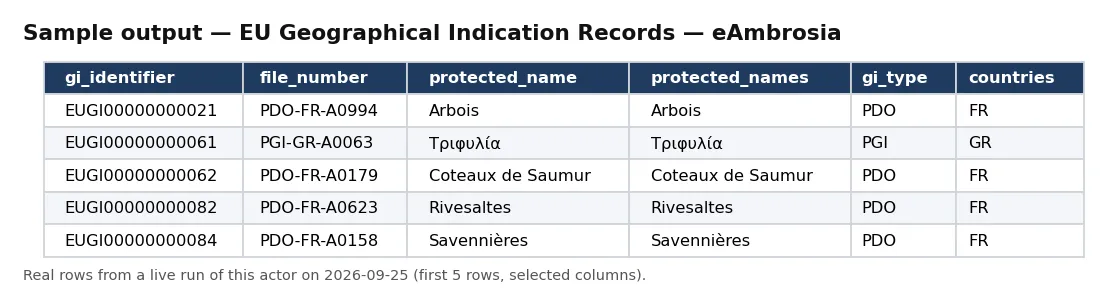
Real rows from a live run of this actor (first 5 rows, selected columns).
One full record from the same run, exactly as delivered:
Pricing
| Event | Free plan | Bronze | Silver | Gold / Platinum / Diamond |
|---|---|---|---|---|
gi_record | $0.05 | $0.045 | $0.04 | $0.0335 |
Delivered before charged. Blocked runs and empty results cost nothing.
Input
| Field | Type | Default | Description |
|---|---|---|---|
country | string | — | Optional 2-letter country code (e.g. FR, IT, ES). |
giType | string | — | Optional GI type (e.g. PDO, PGI, GI, TSG). |
productType | string | — | Optional product type (e.g. WINE, SPIRIT, FOODSTUFF, AGRICULTURAL). |
nameContains | string | — | Optional. Keep only records whose protected name contains this text. |
maxRecords | integer | 10 | Ceiling on records delivered and billed. |
Default changed on 30 Sep 2026: if you leave maxRecords out, a run now returns up to 10 records (it was 500). Set maxRecords yourself to get more — the maximum is unchanged.
Output
One JSON object per protected name. Real example (values as published):
An unbilled RUN_RECEIPT records the robots check, the filters, records matched and delivered, and whether charged equals delivered.
Field reference
Each record is one protected name. Identity: record_id / gi_identifier, file_number, protected_name, and protected_names (all names, joined). Classification: gi_type, product_type, product_categories, and cn_classification. Scope and status: countries, status, eu_protection_date, modification_date, third_country_flag, amendments_in_progress_flag, and removed_flag. Legal basis: legal_instrument, legal_instrument_uri, and publication_reference. Producer-group organisation: producer_group_name, producer_group_country, and producer_group_url (contact fields excluded). Provenance: source, source_url, licence, attribution, disclaimer, and observed_at.
How a run works
A run first re-reads the source host's robots posture from your runtime — the Commission's webgate host — and stops at the door if a Disallow ever covers the eAmbrosia API. It reads the full register once, selects only the protected-name, product, status, legal, and producer-group-organisation fields — never the producer-group contact fields or any attachment/authority sub-record — applies your optional country, type, product, and name filters, and flattens each entry to one record, delivered before it is charged, so a blocked or empty run costs you nothing. The actor stops at your maxRecords ceiling and records charge_equals_delivered in the receipt.
Coverage and scope
The register holds on the order of 4,000+ protected names across the EU and recognised third countries. Because each record carries the gi_type, product_type, and countries, segmenting by designation type, product, or country is straightforward. Pull one country, one product type, or the whole register to seed a protected-names table.
Working with the register
The register is a reference table that most consumers join against, and the identifiers make that clean. Every record carries the gi_identifier and file_number, so a downstream system can key protected names to its own catalogue and refresh on the modification_date. The gi_type distinguishes PDO from PGI from TSG in a single filter, while the product_type and cn_classification link each protected name to its commodity, so a marketplace can flag whether a listed product name is a protected designation and of what kind. Because the countries field carries every country a name is protected in, and the third_country_flag marks non-EU origins, a compliance team can scope enforcement geographically, and two pulls taken apart can be diffed on the status and removed_flag to see which names were newly registered, amended, or removed between reporting rounds.
Cost guidance
One gi_record per delivered name: cost = names delivered × your plan's per-record price. Scope with country, giType, productType, or nameContains to keep runs bounded. The whole register is ~4,000 names; 1,000 names is $50 (Free) / $33.50 (Gold).
Honest limitations
- Register facts, as published. These are the register's own fields carried verbatim; this actor reformats, it does not make a legal determination.
- Holder organisations only. Producer-group organisation identity is carried; contact details are never emitted.
- Acknowledge the Commission. The CC BY 4.0 attribution travels on every record.
- No person data of any kind.
Differentiation
It is distinct from any EU environmental, agricultural-subsidy, or company cell — its specific job is the eAmbrosia register of protected names (PDO / PGI / GI / TSG), name by name, with the producer-group contact fields removed.
The NexGen Signal family
Part of the NexGen Signal family of pay-per-record data products:
- EU EMAS Registration Records — EC
- EU Animal Research Project Records — ALURES
- EU Natura 2000 Site Records — EEA Protected Sites
- EU Regulatory Change Records — CELLAR
- EU Grassland Condition Records — Grassland Watch
Source: European Commission, eAmbrosia — the EU geographical indications register (webgate.ec.europa.eu / ec.europa.eu). © European Union; reuse authorised with acknowledgement of the source under CC BY 4.0 per Commission Decision 2011/833/EU — free to reuse, including commercially, with attribution to the European Commission. Protected-name / product grain; producer-group organisation identity only, contact fields structurally excluded; no natural-person data of any kind. Register facts as published, not a legal determination.


