

Recently Funded Startups — SEC Form D Filings + Funding News
Pricing
from $53.60 / 1,000 funding rounds
Recently Funded Startups — SEC Form D Filings + Funding News
Recently funded startups from SEC Form D filings (amount sold next to amount offered) and TechCrunch funding news (debt labelled). Funds and amendments filtered out. Watch mode returns only rounds new since your last run. Part of NexGen Signal — data tools and official-source data products
Pricing
from $53.60 / 1,000 funding rounds
Rating
0.0
(0)
Developer
NexGen Signal
Maintained by CommunityActor stats
0
Bookmarked
1
Total users
0
Monthly active users
7 days ago
Last modified
Categories
Share
A daily list of companies that just raised money, with every number labelled. Each run returns recently funded startups from two public places (PR Newswire releases as an option) — the SEC Form D notice a US company files when it sells securities, and TechCrunch funding headlines — as one clean record per financing. Switch on watch mode and a scheduled run returns only the rounds that are new since the last one.
Official source. No API key. Pay per record. A Form D's offering size is never passed off as money raised (amount sold sits next to amount offered), a debt deal is labelled debt, and investment funds and amendments are filtered out — so the list is companies, not noise.
- SEC Form D — company name, amount sold to date, total offering amount, amount remaining, date of first sale, industry group, entity type, state and year of incorporation, exemptions claimed, securities offered, minimum investment and number of investors so far, with a link to the filing.
- TechCrunch — funding-round headlines picked out of every story TechCrunch publishes: company, round size and currency, stage (seed, Series A–H, convertible…) and valuation when the headline gives them, with the date and a link back to the article.
- PR Newswire (optional) — funding announcements from PR Newswire's Venture Capital and Financing Agreements release lists, with the financing type (equity, debt, credit facility, convertible), the amount where the release states it, and the investor organisations the release explicitly ties to that financing, lead marked only when the release says so. Turn it on with
includePrNewswire, or usemode: "prnewswire"on its own.
On a 14-day read on 28 September 2026 the SEC search held 2,575 Form D filings; TechCrunch published 268 stories, of which 16 were funding rounds.
Ready-made searches
Open one, press Start, and change the inputs to your own:
- Biotech & Pharma Private Offerings — SEC Form D, Last 14 Days
- $5M+ Financings — Tech Form D + Funding News From Any Sector
Guide: build a funding-research list with investor organisations
A step-by-step guide with a real result: a week of financings from SEC Form D, TechCrunch and PR Newswire in one list, with what each amount means and, from PR Newswire releases, the investor organisations each release names and which of them led. It shows the ready-made searches, the exact input, the same call with curl, and a Python script that keeps one CSV row per financing. A Monday n8n workflow that writes to Google Sheets is included; its Google Sheets step has not yet been tested against a real Google Sheet. A financing found again by a later run is charged again (the CSV or sheet only avoids duplicate rows).
Read the guide · Python script, CSV output · n8n workflow (import from URL)
Investor organisations from PR Newswire (optional source)
A first example — the last week of PR Newswire funding announcements, five records:
To add PR Newswire to the existing two sources, keep your input and add "includePrNewswire": true. When TechCrunch and PR Newswire report the same financing, you get one record (one charge) that lists both links in source_references. This record came from a test run that read all three sources for "Outmarket" (two of its five investor organisations shown):
What the new fields mean:
investor_organizations— each firm, fund, bank or company the release names as investing in (or lending to) this financing, withrole(lead,participant,lead_lender,lender),organisation_evidence(how the release itself shows it is an organisation),evidence(a short excerpt of the release's wording: the financing, the phrase that ties the investor to it, and that organisation's name only) and the release link.leadis set only when the release says "led by", "co-led by", "leads" or "X led the round". Investors in earlier rounds, advisers and placement agents, organisations mentioned only in the company description, and investors in a different company or financing described in the same release are left out.investor_info_status—named_in_release(at least one organisation listed),names_not_shown_as_organisations(investor names were given, but the release does not show any of them is an organisation, so none is listed),individuals_only(only names that read as people),none_identified(no investor name was found; the release may still name one somewhere the rules don't read), ornot_extracted_for_this_sourceon SEC and TechCrunch records.excluded_individuals_countandunidentified_investor_count— how many investor names were left out because they read as people, and how many were left out because the release does not establish what they are (a bare name such as "Coatue" or a handle is withheld unless the release describes it as a firm, fund, bank or company, gives a legal form, or names a role at it). The two counts are kept apart: an unidentified name is not assumed to be a person.- How the listing rule works, and its limits: a name is listed only when the release itself shows it is an organisation — an organisation word in the name (Capital, Ventures, Partners, Bank, Fund, LLC…), a legal form elsewhere in the release, the release describing it as a firm, fund, bank or company, or a role named at it ("Partner at X"). Names that read as people are left out. This is a rule-based safeguard, not a guarantee: a person whose name the release dresses in organisation terms could still be listed, and real firms are left out when the release never says what they are.
financing_type,amount_type,round_stage—equity,debt,credit_facility,convertibleorunspecified; the amount is this financing's own figure, labelledround_size,debt_size,facility_size,offering_size(an offering being priced or launched, not money already raised),target_size,fund_sizeorinvestment_size(one named investor's stake, when the investor issued the release), always "(from release)". Totals raised to date, valuations and headlines that mix several amounts are never used as the amount; when the headline gives only a total but a later sentence states the round ("The $4.35 million Seed extension was led by…"), that round is used.round_stageis filled only when the release names a stage; a combined raise is written as it is stated ("Seed + Series A"), and "growth investment" is not treated as a stage.issuer,extraction_basis,source_references— who issued the release, whether the financing was read from the headline or the first sentence, and every selected source that reported this financing. For PR Newswire records, names withheld as above are also replaced in the headline ([individual]/[unidentified]).
Coverage depends entirely on what each release says. 54 fresh PR Newswire releases from July–August 2026 (two samples of 30 and 24) were checked by hand against their text and scored once on earlier frozen code, before any rule was changed because of them: 35 of the 45 real financings were found, 2 of the 9 non-financings (private-equity buyouts worded as investments) were wrongly delivered, and the company receiving the money was right on 30 of the 35 found (the 5 wrong ones were releases issued by the lender, adviser or investor). The errors found were then fixed. On the same 54 releases the current build finds 33 of the 45 financings (two investor-issued releases are now withheld rather than delivered with the wrong company), delivers none of the 9 non-financings, names the right receiving company on all 33 (one as "5C" for "5C Group"), gives the right amount on 32 and the right stage on 32, and lists 83 investor organisations, all correctly tied to that financing; no person's name appears in any field. Because those releases were used to make the fixes, the second set of figures is not an independent measure. These are small samples, not accuracy rates you should expect on every run: check company_name against the release, especially when a lender, adviser or investor issued it.
Who buys this and for what job
- Sales teams and service providers (legal, accounting, payroll, insurance) targeting companies that just raised money.
- Venture, private-equity and corporate-development teams watching a sector for new rounds.
- Market analysts and journalists tracking funding activity over time.
Buyers usually search for this as "startup funding data" or "SEC Form D filings".
Sample output
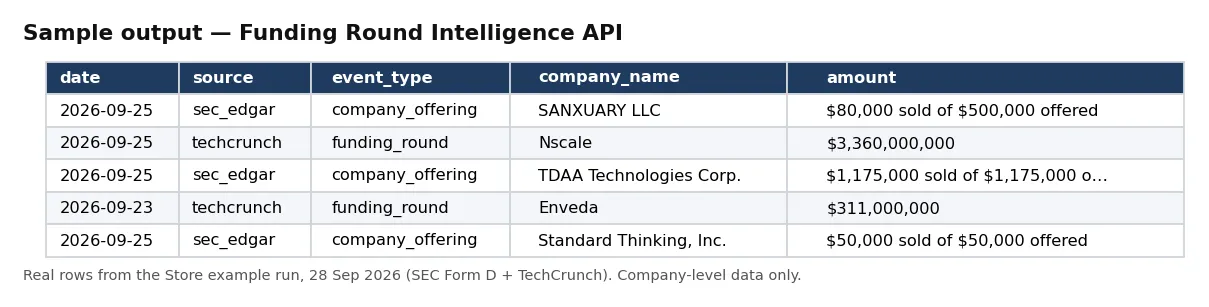
Real rows from the Store example run on 28 September 2026 (both sources, technology and health filings).
An SEC record from that run (the licence, attribution and disclaimer texts every record carries are left out here):
A TechCrunch record from the same run (empty fields left out):
Pricing
| Event | Free plan | Bronze | Silver | Gold / Platinum / Diamond |
|---|---|---|---|---|
apify-actor-start | $0.01 | $0.01 | $0.01 | $0.01 |
apify-default-dataset-item (one record) | $0.08 | $0.072 | $0.064 | $0.0536 |
watch-check (once per watch run) | $0.05 | $0.05 | $0.05 | $0.05 |
You pay per record delivered. The Actor start fee is $0.01 per GB of run memory: $0.02 at the default 2 GB, $0.01 if you run it with 1 GB (enough for this actor). It is charged even when no record matches. A watch run is charged one watch-check only when at least one source answered.
Input
| Field | What it does | Default |
|---|---|---|
mode | all_sources (SEC + TechCrunch), sec_edgar, techcrunch, or prnewswire (PR Newswire only) | all_sources |
includePrNewswire | Also read PR Newswire funding announcements, with investor organisations. Works with any mode | false |
searchQuery | SEC: full-text search of Form D filings (a company name works best). TechCrunch: headline contains this text. PR Newswire: only releases whose headline or list summary contains this text are opened, and the delivered record must show it in the headline, company, issuer or an investor organisation (an investor's name works when the summary names it) | none |
daysBack | How many days back to read (1–365) | 30 |
maxResults | Maximum records delivered and charged (1–500) | 25 |
industryGroups | Only SEC filings in these Form D industry groups, e.g. Other Technology, Computers, Biotechnology, Pharmaceuticals, Other Health Care | all |
minAmount | Only events with a known US-dollar amount at or above this | 0 |
includeInvestmentFunds | Also deliver pooled investment funds raising their own capital, and VC fund closes | false |
includeAmendments | Also deliver Form D/A amendments | false |
includeRealEstate | Also deliver real-estate Form D offerings (property syndications, REITs) | false |
newSinceLastRun, watchLabel | Watch mode: deliver only records not delivered on an earlier run with the same label | off |
Example — the Store example: ten recent technology and health financings from both sources ($0.80 in records on the Free plan):
(In testing it returned 5 SEC filings and 5 TechCrunch rounds in 22 seconds.)
Example — every Form D from one company over a year:
Example — a daily watch for technology raises of $5 million or more:
Output
| Field | Meaning |
|---|---|
record_id, source | sec:<accession> or techcrunch:<post id>; stable across runs |
event_type | company_offering (Form D), funding_round (news), or with includeInvestmentFunds on, investment_fund_offering / investment_fund_close |
raise_status | News: announced, reported (headline says "reportedly") or in_progress (in talks, raising, seeking). Form D: fully_sold, partly_sold or no_sale_yet |
company_name | The issuer on Form D; the company named in the headline (left empty when the headline's subject is a person) |
amount_usd, amount, currency, amount_type, amount_display | The event's amount and what it is: sold_to_date for Form D, round_size (from headline) for news, or debt_size (from headline) when the headline is a loan, credit line, credit facility or venture debt (borrowing, not equity raised; round_stage says which). amount_usd is set only for US-dollar amounts |
offering_amount_usd, amount_sold_usd, amount_remaining_usd, offering_indefinite | Form D offering figures as filed |
valuation, valuation_currency, round_stage | From the headline when it gives them |
date | Filing date (SEC) or publication date (news) |
industry, location, entity_type, jurisdiction_of_inc, year_of_inc, revenue_range | Form D issuer facts |
date_of_first_sale, exemptions, securities_offered, minimum_investment_usd, investors_so_far, is_amendment | Form D offering facts |
title, url, cik, source_url | Headline (news), link to the filing or article, SEC company ID |
is_new, licence, attribution, disclaimer, observed_at | Watch flag and provenance |
financing_type, investor_organizations, lead_investors, investor_info_status, excluded_individuals_count, unidentified_investor_count, issuer, extraction_basis, source_references | Added in October 2026 for the optional PR Newswire source (see above). On SEC and TechCrunch records they are empty, with investor_info_status = not_extracted_for_this_source and source_references holding the record's own link |
Cost guidance
The Store example costs $0.80 in records plus the start fee on the Free plan. A daily watch that delivers 20 new financings costs about $1.60 a day on Free or $1.07 on Gold, plus $0.05 for the watch check. Use industryGroups, minAmount and searchQuery to pay only for what you want; filings dropped by a filter are never charged.
How a run works
SEC: the actor queries EDGAR full-text search for Form D filings in your date window, 100 at a time, skipping investment funds and amendments from the search result itself, then opens each remaining filing's Form D XML for the company-level facts. The related-persons, sales-compensation and signature sections are cut out before the XML is read. TechCrunch: it reads TechCrunch's public RSS feed back to the start of your window and keeps headlines that describe a funding round. It does not use TechCrunch's /wp-json/ API or site search, which TechCrunch's robots.txt disallows.
PR Newswire (only when selected): it reads the Venture Capital and Financing Agreements release lists for your date window (up to six pages of 50 each, English releases only, under /news-releases/, which PR Newswire's robots.txt allows), opens the releases whose headline or summary mentions a financing (and your search text, if you gave one), and reads the financing and the investors from the headline, summary lines, opening paragraphs and up to 25 later lines that refer to this financing (paragraphs about advisers, earlier rounds or another company's financing, and the 'About' and legal sections, are skipped). Requests go to PR Newswire directly and fall back to Apify Proxy only if it refuses. A PR Newswire record and a TechCrunch record are treated as the same financing only when the company name matches, the dates are within seven days and both amounts are the same (within 2%), or, when an amount is missing, the same named stage within three days. Different rounds of the same company are kept apart. SEC filings are never merged with news, because a Form D reports an offering under securities law, not an announced round.
PR Newswire work limits and partial searches. Each run spends at most 150 seconds, 110 requests and 80 release pages on PR Newswire (each request times out after 20 seconds and is tried at most twice per route; if PR Newswire refuses direct and datacenter requests, at most 5 MB is read through residential proxies); it reads at most six list pages of 50 per list, so a long date window may reach further back than the lists it reads. When a limit stops the search before every candidate release is checked, the run says so: the status message starts with PARTIAL SEARCH (some records found) or INCOMPLETE SEARCH (none found — this is not a complete no-match), and RUN_RECEIPT.sources.prnewswire.search_status is partial with the reason and how many candidates were checked. complete means every candidate in the window was checked or enough records were found. If PR Newswire does not answer at all, it is reported as unavailable and SEC and TechCrunch results are still delivered. You are charged only for records delivered, plus the usual start fee.
With several sources, records alternate between them, newest first, so one source cannot crowd out the others. Records are pushed and charged as they are delivered. Every run saves a RUN_RECEIPT: each source's status, robots.txt decision, items read, dropped (and why) and delivered. If a source cannot be reached, the run says so and delivers the other; if none can, it ends with a clear message and nothing is charged. Watch mode remembers what it delivered in a key-value store named funding-round-watch-memory in your own Apify account, one entry per watchLabel. The old yc_startups mode is retired and returns guidance at no charge.
Honest limitations
- Form D is not a funding announcement. It is filed within 15 days of the first sale and reports amounts sold so far; many filers are small private companies, real-estate syndications and funds.
amount_sold_usdcan be $0 when no sale has happened yet. Filter byindustryGroupsandminAmount. - News coverage is TechCrunch's. Only rounds TechCrunch writes about, and only what the headline states; amounts in other currencies are kept in their currency. The feed reaches back about four months.
- Headline parsing is rule-based. It rejects revenue, valuation-only, IPO, acquisition, settlement, partnership and layoff headlines and separates VC fund closes. Measured against four hand-labelled months of TechCrunch headlines (28 May–27 September 2026, 418 headlines with money words): on the month the rules were never tuned on, it found 23 of 24 real raises, with every amount right and no wrong company name (one left blank); across all four months it missed 6 of 160 raises and mislabelled 3 of 258 non-raise headlines. An unusual headline can still be misread — check the
title. - No person data from SEC or TechCrunch; a rule-based safeguard on PR Newswire. Investors, executives, promoters and signers named in Form D are never read, and a headline whose subject is a person gets no
company_name. Investor organisations come only from PR Newswire releases, and only when the release shows they are organisations; names that read as people, and names the release does not establish, are counted and left out. The rules can still be wrong in unusual wording — checkorganisation_evidence. - PR Newswire extraction is rule-based and partial. It reads the headline, the summary lines, the opening paragraphs and up to 25 later lines that refer to this financing. Firms the release names without saying what they are (for example "Coatue", "GV", "Citi") are withheld, so investor lists are often shorter than the release's. Long lists broken up by descriptions can be cut short (a name is then missing, never invented). Releases outside the two lists, or in other languages, are not read. Check
evidence,organisation_evidenceand the release link. - Not investment advice. Point-in-time public data.
Licence and attribution
SEC EDGAR filings are US Government works in the public domain. PR Newswire releases are publicity material written and distributed by their issuers; each PR Newswire record carries the release link and only short evidence sentences, not the release text. TechCrunch's RSS Terms of Use say: "you are only permitted to display the content that is provided in the feed, with attribution to TechCrunch, and you must link to the full article on TechCrunch." Each TechCrunch record carries the headline as published, the credit and the article link; no article text is copied. Every record carries its sources in attribution. This actor is not affiliated with or endorsed by the SEC, TechCrunch or PR Newswire.
Differentiation
Funding actors on the Store — such as datahyena/company-funding-rounds, logiover/sec-edgar-form-d-scraper and pink_comic/sec-form-d-startup-funding-leads — scrape rounds or pull Form D filings, often with investor and executive names as leads. This actor combines Form D filings and news in one feed, labels what every amount means (sold, offered, round size, valuation), drops funds, amendments and non-financing headlines by default, and delivers company- and organisation-level data only: investor names are listed only when the release shows they are organisations.
The NexGen Signal family
Part of NexGen Signal — official-source data products, no API keys, pay per record. Related actors:


