
LLC & Corp Status Lookup — Official State Registries (7 + DC)
Pricing
from $33.50 / 1,000 entity status records
LLC & Corp Status Lookup — Official State Registries (7 + DC)
LLC and corporation status lookup in official state registries: NY, TX, PA, CO, CT and OR in one run, FL and DC on request. By company name or state entity ID: status, entity type, formation date, address. No person data. Part of NexGen Signal — data tools and official-source data products
Pricing
from $33.50 / 1,000 entity status records
Rating
0.0
(0)
Developer
NexGen Signal
Maintained by CommunityActor stats
0
Bookmarked
2
Total users
1
Monthly active users
6 days ago
Last modified
Categories
Share
Is this company registered, and is it active? Send company names or state entity IDs and get the answer from the states' own open-data registries — New York, Texas, Pennsylvania, Colorado, Connecticut and Oregon in one run, plus Florida (add FL; it reads the full state file, which takes several minutes) and the District of Columbia (add DC) — with the state's entity ID, registered name, status, entity type, formation date and business address, in one schema across all states.
Official source. No API key. Pay per record. No person data. Matching is exact, starts-with or contains, so one run can also list every similar name already registered. It reads the states' published registry datasets rather than scraping each state's search portal, so results are reproducible and no CAPTCHA stands in the way.
The registries it reads, and how many rows each held when tested on 26 September 2026:
| State | Registry dataset | Rows |
|---|---|---|
| New York | Department of State — Active Corporations: Beginning 1800 | 4,287,886 |
| Texas | Comptroller of Public Accounts — Active Franchise Taxpayers | 3,473,267 |
| Florida | Division of Corporations — quarterly corporate file + daily new filings | 12,808,196 (4,109,232 active) |
| Pennsylvania | Department of State — Registered Businesses in PA Current | 4,110,251 (one row per officer) |
| Colorado | Department of State — Business Entities in Colorado | 3,114,804 |
| Connecticut | Secretary of the State — Business Registry, Business Master | 1,299,623 |
| Oregon | Secretary of State — Active Businesses, ALL | 1,579,476 (one row per associated name) |
| District of Columbia (optional, added 1 Oct 2026) | Department of Licensing and Consumer Protection — Corporate Registration | 504,750 (all statuses) |
| New York, all statuses (optional, added 1 Oct 2026) | Department of State — All Filings: Entity Status History, read with the Active Corporations list | 20,976,639 status entries |
Ready-made searches
Open one, press Start, and change the inputs to your own:
- Check a Company's Status by State Registration Number
- Find a Company Across 7 State Business Registries
- Similar Business Names Already Registered — 7 States
Who buys this and for what job
- KYB and onboarding teams confirming that a customer, merchant or supplier is registered and in good standing before approving it.
- Lenders, factoring and insurance underwriters checking a business's registration status, age and type across the states where it operates.
- Procurement and vendor-risk teams screening vendor lists in bulk.
- Sales and data teams matching a CRM's company names to official state records and IDs.
- Due-diligence and legal researchers finding every registration of a company name across several states in one pass.
Sample output
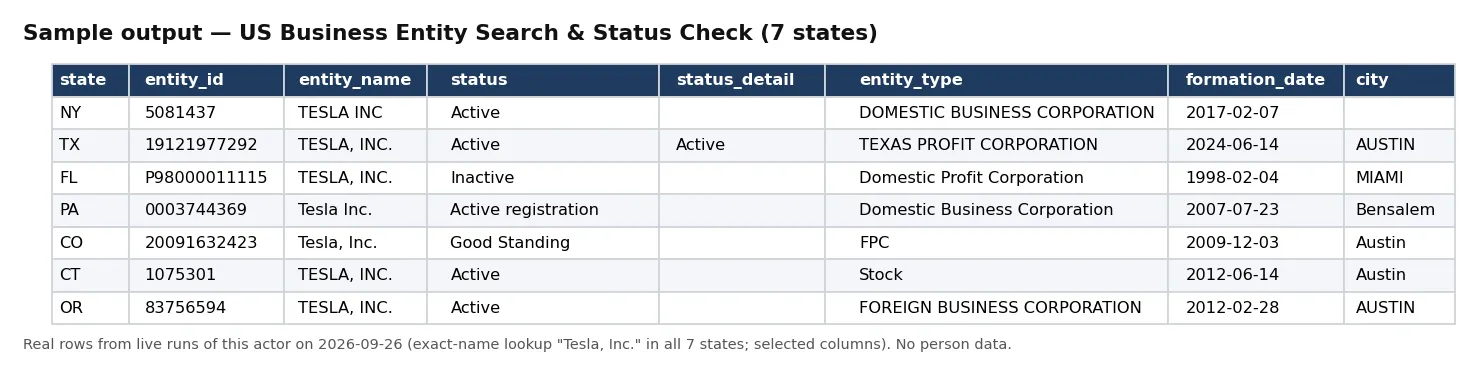
Real rows from live runs of this actor on 2026-09-26 (exact-name lookup "Tesla, Inc." in all 7 states; selected columns). No person data.
The record the Store example returns (live run on 2026-09-28; empty fields and the long status_basis, source and licence texts left out here):
Use it from your code or an AI agent
One API call that returns the rows (replace YOUR_APIFY_TOKEN; the body is the run input):
Python (pip install apify-client):
AI agents (MCP): add https://mcp.apify.com?tools=nexgensignal/us-business-entity-status-check as an MCP server in Claude, Cursor or any MCP client and sign in with your Apify account. The agent gets this search as a tool, runs it with the inputs above and reads the results. Billing is the same per-record price; set a maximum cost per run to cap spend.
Pricing
| Apify plan | Price per record |
|---|---|
| Free | $0.05 |
| Bronze | $0.045 |
| Silver | $0.04 |
| Gold and above | $0.0335 |
One record is one entity found in one state. Lookups that find nothing cost nothing. The maxRecords limit caps what a run can cost, and maxMatchesPerName caps how many entities one name can return in one state.
Input
| Field | What it does | Default |
|---|---|---|
names | Company names to check (up to 500) | none |
matchMode | exact — the words must match (case, commas, periods and apostrophes ignored); startsWith; or contains (4+ letters) | exact |
entityIds | State IDs as STATE:ID, e.g. NY:4424185, TX:32070357671 (taxpayer or SOS file number), FL:P26000046350, DC:L00008463852 (DC file number) | none |
states | Which registries to check for your names: NY, CO, CT, OR, PA, TX, FL, DC | all except Florida and DC |
nyIncludeInactive | New York: also return inactive and suspended entities (see below) | false |
maxMatchesPerName | Most entities one name may return in one state | 25 |
maxRecords | Maximum records delivered and billed | 10 |
Default changed on 30 Sep 2026: if you leave maxRecords out, a run now returns up to 10 records (it was 500). Set maxRecords yourself to get more — the maximum is unchanged.
Florida is off by default for name lookups because it is read from the State's full corporate file, which takes several minutes; add FL to states to include it. The District of Columbia is off by default too; add DC to include it. Florida and DC IDs in entityIds are always looked up. Leaving these options out keeps the earlier behaviour exactly (checked on 1 October 2026: the Store example returned the same six records on the old and new builds).
Example 1 — check one registration by its state ID (one record, $0.05 on the Free plan):
Example 2 — find one company's registrations across states by exact name (this is the Store example; on 30 September 2026 it returned 6 records, one per default state, $0.30 on the Free plan):
What "status" means in each state
States do not share one status standard, so the actor keeps each state's own wording and says which kind of list it came from:
| State | What status tells you |
|---|---|
| Colorado | The entity status the Department of State publishes (for example Good Standing, Delinquent, Dissolved) |
| Connecticut | Status and sub-status as published by the Secretary of the State (for example Active, Dissolved, Forfeited) |
| Texas | Right to transact business in Texas (Comptroller) plus the Secretary of State status in status_detail, both decoded from the published codes |
| Florida | Active or Inactive, as on the Division of Corporations' file |
| New York | "Active": the dataset holds active corporations only. With nyIncludeInactive, also "Inactive" or "Suspended" from the State's filing status history (see below) |
| District of Columbia | The status DLCP publishes: Active - In Good Standing, Active - Not in Good Standing, Revoked, Dissolved, Withdrawn, Merged, Inactive - Cancelled, Terminated, Converted, Domesticated or Consolidated |
| Oregon | "Active": the dataset holds active businesses only |
| Pennsylvania | "Active registration": the State's current-registrations list (it notes some businesses there no longer operate) |
A company missing from Oregon or Pennsylvania, or from New York without nyIncludeInactive, may be inactive or never registered there; those lists cannot tell the two apart.
New York: inactive and suspended entities (optional)
Set nyIncludeInactive to true and New York names and IDs are checked against two Department of State datasets instead of one: the Active Corporations list (monthly) and All Filings – Entity Status History (weekly), which records the entity's status after each filing. Names are searched in the State's name history (current and former names), and the datasets are joined by the DOS ID only, never by name.
The newest filing does not always tell you the current status. Checked on 1 October 2026: a conversion from a partnership to an LLC records "Inactive" and "Active" on the same day and can be followed by a cancellation of the old form while the LLC stays on the active list (DOS ID 1752062), and some merger and dissolution-by-proclamation entries say "Active" for entities that are no longer listed (3332805, 1691289). So a New York status is returned only when the two datasets agree:
| What the datasets show | What you get |
|---|---|
| On the Active Corporations list | Active, as before; the history's latest entry is shown in ny_history_latest |
| Not on the list, and the history's latest dated entry is Inactive or Suspended (one value on that date) | That status, with the filing number, code, document type and date as evidence (ny_status_*) |
| Not on the list, but the history's latest entry says Active; entries on the same date disagree; no entry has a status; the ID is an assumed-name (DBA) certificate; or a non-Active entry was filed within 45 days of the list's update | Not delivered and not charged. Listed in RUN_RECEIPT under not_delivered_status_not_established with the reason and the evidence |
| No entries at all | ID not found |
Missing or unclear data never becomes "Inactive". On a random sample of 1,200 DOS IDs (1 October 2026), 677 were returned Active from the list, 388 Inactive and 1 Suspended from the history, 5 were held back because the datasets disagreed, 19 were assumed-name certificates, and for 110 no status history was found.
Example (live run on 1 October 2026, $0.15 on the Free plan for three records):
It returned RMS PROGRAMS LLC as Inactive (certificate of dissolution-cancellation 260802000592, filed 2 August 2026), 28TH STREET HOTEL, LLC as Suspended (filing 140813000457, 13 August 2014) and GALLERIA ASSOCIATES, LLC as Active from the list, and held back 3332805 (datasets disagree) and 7445852 (an assumed-name certificate) without charging for them.
District of Columbia (optional)
Add DC to states (or use DC: IDs) to search the District's Corporate Registration table, published by the Department of Licensing and Consumer Protection on DC open data under CC BY 4.0. Unlike most state lists it holds every status, so revoked and dissolved entities are found too. Example (live run on 1 October 2026):
returned Spiritually Driven Services LLC (Revoked), DANAHER Corporation (Active - In Good Standing, a foreign corporation) and Wunderkammer LLC (Active - In Good Standing): three records, $0.15 on the Free plan.
formation_dateandjurisdictionare filled for DC-formed (domestic) entities only. For every entity the table's effective date is passed through asdc_effective_date; for a foreign entity it is not presented as a formation date.- Five file numbers appear twice in the District's table with different statuses or names (1 October 2026). They are never delivered or charged; they are listed in
RUN_RECEIPTwith what the table says. - Registered-agent columns are never requested, and the Beneficial Owners table in the same service is never read.
Reading a lookup result
Every record says how it was found:
match_result: "id"— you gave the state ID; this is that entity.match_result: "single"— the only entity in that state matching your name.match_result: "multiple"— your name matchedmatches_in_stateentities in that state. With exact matching this means the name is ambiguous there; checkentity_id,formation_dateand the address before relying on it.
The run receipt (RUN_RECEIPT) lists every name and state you asked about with one result: single, multiple, no_match, too_many_similar_names (use a longer name or exact matching), or state_unavailable (the state's portal did not answer; nothing was charged for it), plus the IDs not found, the IDs not checked because their registry did not answer (ids_not_checked_source_unavailable), the entities whose status the source does not establish (not_delivered_status_not_established), and whether maxMatchesPerName or maxRecords cut the output short. The status message repeats the counts.
Output
| Field | Meaning |
|---|---|
record_id, state, state_name, entity_id | Where the record comes from and the state's own ID |
entity_name | Name exactly as the state publishes it |
status, status_detail | The state's own status wording (see "What status means in each state") |
status_basis | One line saying what the status means for that state's dataset |
entity_type, formation_date, jurisdiction | Type, formation/charter/registration date, state of formation where published |
address_1, address_2, city, address_state, zip, county | The business address the state publishes |
naics_code, dissolution_date, registered_agent_company | Where published (Connecticut, Texas; Colorado and Florida agents only when a company) |
tx_*, fl_* | State-specific codes: Texas codes as published, Florida FEI number and last filing date |
dc_locale, dc_effective_date, dc_next_report_due, dc_last_report_filed | District of Columbia: Domestic/Foreign, effective date, next biennial report due, last report filed |
ny_status_source, ny_status_date, ny_status_filing_number, ny_status_filing_code, ny_status_document_type, ny_history_latest, ny_first_filing_date, ny_matched_name | New York with nyIncludeInactive: which dataset gave the status, its date, the filing that recorded it, the history's latest entry, the first filing date and the name your search matched (current or former) |
matched_query, match_mode | Which of your names (or id) found this record |
match_result, matches_in_state | id, single or multiple, and how many entities your name matched in that state |
registry, dataset_url, data_updated_at | The registry, its dataset page, and when the state last updated it |
source, licence, attribution, observed_at | Provenance on every record |
Cost guidance
An ID lookup is one record ($0.05 on the Free plan, $0.0335 on Gold). Exact-name checks return few records: in testing, four company names checked in six states returned 14 records ($0.70 on the Free plan). startsWith and contains can return many entities for common words — keep maxMatchesPerName low. In testing, a Tesla starts-with search in six states returned 133 records; a contains search for "ACME ROOFING" returned 11.
How a run works
For each state and name, the actor asks the state's open-data portal for candidate entities, then applies the matching rule itself, so punctuation differences do not hide a match; if nothing matches, it tries a looser pattern (so "Butchys" still finds "BUTCHY'S"). Florida is read from the Division of Corporations' bulk files over its public SFTP server. Queries run in parallel and retry on network errors. Records are pushed to your dataset first and charged only after delivery; a maximum charge stops the run cleanly. If a state's portal does not answer after retries, the run says which one and carries on; if none answer, it ends with a clear message and nothing is charged.
Timing in testing: portal-only runs finished in about 5–15 seconds (District of Columbia and New York all-status runs about 5 seconds on 1 October 2026); runs that include Florida names took about 7–8 minutes.
Honest limitations
- Seven states plus the District of Columbia, not fifty. These are the registries published as official open data this actor can read without a key. Other states are not covered.
- New York inactive statuses depend on two datasets agreeing. The active list is monthly, so a status change filed in the weeks before its update is held back rather than guessed, and entities whose datasets disagree are not returned (5 in a 1,200-ID sample). The State says its datasets are not an official record or a certification of legal status.
- District of Columbia statuses are as the District's table publishes them, refreshed with the table (1 October 2026 at the last check).
- Some lists hold active entities only — see the status table above. Texas lists active franchise taxpayers.
- Same name, different company. An exact name can match unrelated entities in different states — in the sample above, New York's "TESLA INC" (2017) and Florida's inactive "TESLA, INC." (1998) are not the car maker. Check the ID, formation date and address.
- Florida status is as of the State's quarterly file (10 July 2026 on 30 September 2026; the next is due in October), plus later daily files, which carry new formations and older entities that filed something that day.
- Freshness varies by state — each record carries
data_updated_at, and the status message lists every registry's data date. Re-checked 30 September 2026: New York, Colorado and Connecticut updated that day, Oregon on 29 September (weekly), Texas on 26 September and Pennsylvania on 2 September (monthly). Every run queries the live registries; nothing is cached. - No person data. Officer, director, organizer and individual agent names are never requested. Texas sole proprietors, estates and individual taxpayers are excluded, as are Oregon agent and representative rows, Pennsylvania officer names, and the District of Columbia's registered-agent columns and beneficial-owner table.
- Addresses are as published and can be a registered-office provider's address.
Licence and attribution
Each record carries its state's licence text. New York — OPEN-NY Terms of Use: "use our government information however you wish, in private sector projects or in government collaborations." Colorado and Connecticut — dataset licence: Public Domain. Pennsylvania — data.pa.gov Data Policy: "Data sets available through data.pa.gov are offered free and without restriction." Oregon — ORS 276A.368(3): "All publishable data is in the public domain for purposes of applicable copyright laws." Texas — the Texas Open Data Portal describes itself as "the official State repository for publicly accessible data"; no licence or reuse restriction is published with the dataset. Florida — Florida public record (Chapter 119, Florida Statutes), offered free by the Division of Corporations with no stated reuse restriction. District of Columbia — Creative Commons Attribution 4.0 International (CC BY 4.0); every DC record carries the attribution "Source: District of Columbia Department of Licensing and Consumer Protection, Corporate Registration (DC open data), CC BY 4.0", and says what was changed. This actor is not affiliated with or endorsed by any state.
Differentiation
This actor reads the states' official open-data registries and Florida's bulk files rather than searching websites: one call, one schema, the state's own IDs and status, bulk-friendly, with no person data to manage downstream.
The NexGen Signal family
Part of NexGen Signal — official-source data products, no API keys, pay per record. Related actors:


