
Funding Round Tracker — SEC Form D Evidence
Pricing
from $4.25 / 1,000 form d filings
Funding Round Tracker — SEC Form D Evidence
Search recent SEC EDGAR Form D notices by company or sector keyword. Get unique filing identity, filing date, direct SEC URL, evidence, freshness, confidence, coverage gaps, and a review action. A search hit is not proof of a completed round, amount raised, valuation, investor, or buying intent.
Pricing
from $4.25 / 1,000 form d filings
Rating
0.0
(0)
Developer

Tim Zinin
Maintained by CommunityActor stats
0
Bookmarked
3
Total users
2
Monthly active users
2 months ago
Last modified
Categories
Share
SEC Form D Search Evidence — deduplicated filing intelligence from EDGAR
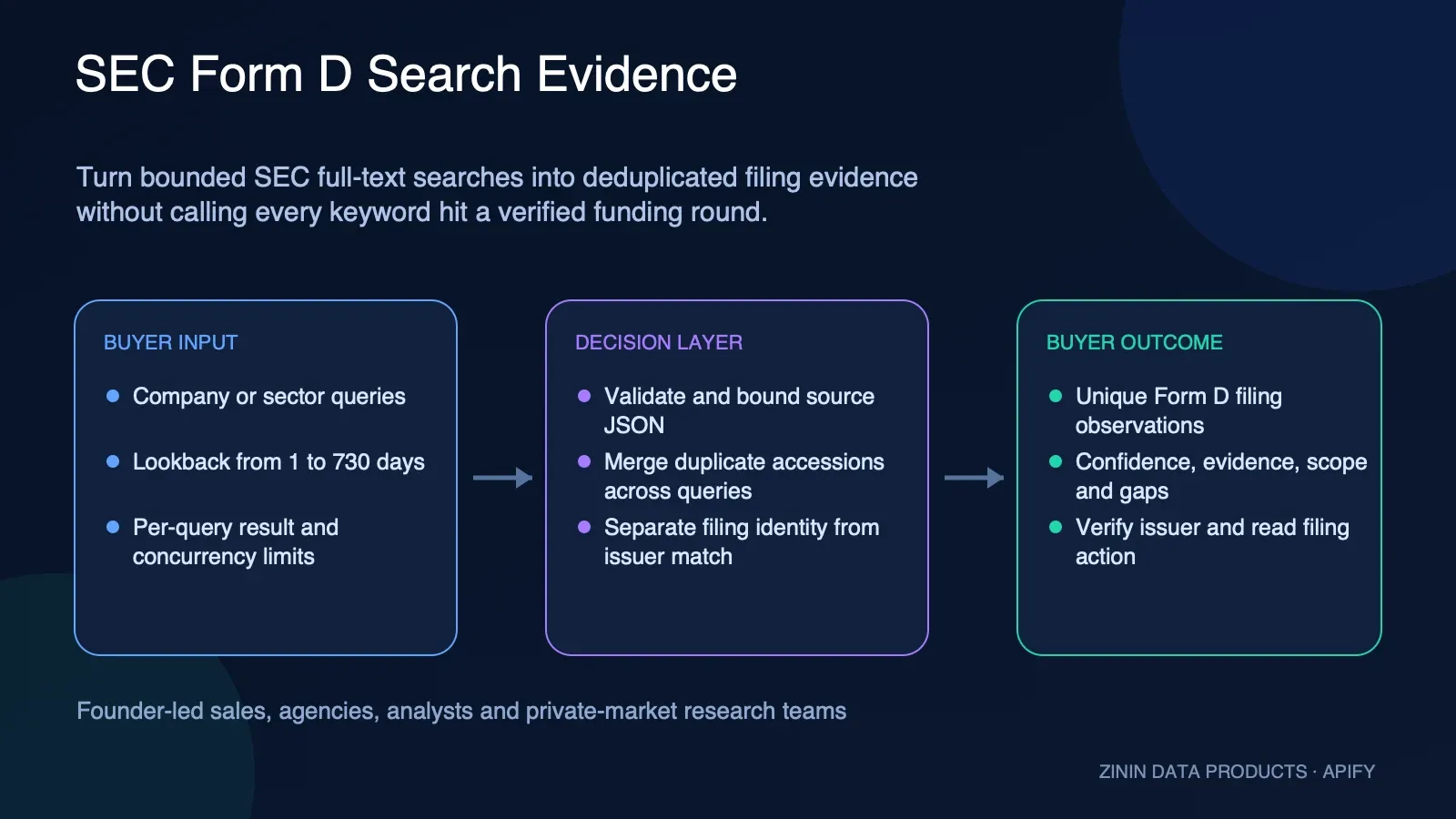
Search recent SEC Form D filing identities by company name or sector keyword and receive review-ready evidence rows: filer name, CIK, accession number, filing date, direct SEC link, query scope, confidence, gaps, stable IDs, billing semantics, and a recommended next action.
This Actor is deliberately narrower and more honest than a generic “funding round database.” It proves that a specific Form D filing identity appeared in a bounded SEC EDGAR full-text result. It does not prove a venture round label, final amount raised, valuation, investor participation, company-domain identity, commercial intent, or investment suitability.
Use it when official filing evidence is more valuable than an unsupported headline and when your workflow can include issuer verification and document review.
What you get
- One paid row per unique identified SEC accession number, even when several submitted queries return the same filing.
- Legacy-compatible fields such as
sourceQuery,found,matched,company,ciks,filedAt,form,accessionNumber,url,summary, andcheckedAt. - Additional
sourceQueriesandqueryMatchesfields explaining every submitted query merged into the filing observation. - A direct SEC filing index URL built only from a validated numeric CIK and validated accession number.
- Explicit scope fields:
retrievedCount,resultLimit,matchedIsLowerBound, andcoverageComplete. - Stable
entityId,observationId,eventId, and evidence IDs for deduplication and audit trails. - Separate filing-existence confidence and issuer-match confidence. A strong accession identity is not presented as strong buyer-intended-company attribution.
evidence,freshness,confidence,dataGaps,recommendedAction,failureDiagnostics, andsafeToAutomateon every row.- Free no-match, source-failure, incomplete-hit, and budget-notice rows. Only a unique identified filing row is eligible for
result-foundbilling. - A KVS
OUTPUTrecord reconciling query normalization, source success, candidate count, duplicate accessions, paid/free/local delivery, withheld rows, partial state, fatal errors, and replay safety.
What this Actor is — and is not
The SEC describes Form D as a notice of an exempt offering. In the usual Regulation D path it is due within 15 days after the first sale, but Form D notices can be amended, a full-text search can match text beyond the issuer name, and the lightweight search result does not contain every offering fact needed for a commercial or investment conclusion.
This Actor therefore makes only this positive claim:
At the recorded observation time, SEC EDGAR returned this stable Form D filing identity for the submitted full-text query and date window.
It never upgrades that observation into any of the following without evidence the Actor does not collect:
- “the company completed a funding round”;
- “the round was Seed, Series A, Series B, debt, or another inferred label”;
- “the company raised the total offering amount”;
- “the filing belongs to the domain or brand the buyer had in mind”;
- “the issuer is actively buying software, hiring vendors, or ready for outreach”;
- “the filing is new to the market” rather than merely present in the requested lookback;
- “the company is a good investment” or any investment recommendation;
- “contacting the issuer is lawful, wanted, or appropriate.”
That boundary is the product. It lets a CRM, research sheet, agent, or analyst keep filing evidence separate from attribution, interpretation, and action.
Who it is for
Founder-led sales and small B2B teams
Use a short list of exact company names or a narrow market phrase to build a primary-source research queue. Open the cited filing, confirm the issuer and domain, then decide whether the observation is relevant. A Form D hit may justify research; it does not create permission to contact or prove buying intent.
Agencies and lead-research services
Deliver an auditable enrichment column instead of a vague “recently funded” badge. Preserve accession, CIK, date, source link, query, confidence risks, and reviewer action in the client export. Bill your work for verification and context, not for an unsupported round claim.
Private-market and ecosystem researchers
Run repeatable keyword panels across sectors, geographies, technologies, or issuer names. Use matched, matchedIsLowerBound, and coverageComplete to understand the bounded search before comparing cohorts. Deduplicate downstream by entityId or accession number.
Analysts, journalists, and competitive-intelligence teams
Use the output as a discovery index into official filings. Cite the filing itself after reading it. Do not cite this Actor's summary as a substitute for the document or assume the first full-text match explains why the document matched.
Automation builders and AI-agent developers
Use the Dataset for evidence rows and KVS OUTPUT for run-level reconciliation. Branch on failureDiagnostics, coverageComplete, confidence.level, and safeToAutomate; require a human or an approved verification service before external action.
High-value use cases
1. Exact-name issuer discovery
Submit a legal company name or distinctive phrase. The output identifies SEC filing accessions returned by full-text search. Confirm the legal entity against the CIK and filing before associating it with a website, CRM account, or founder.
2. Sector and theme research
Search a narrow phrase such as artificial intelligence, industrial robotics, or rare disease. The result is a document-discovery cohort, not a canonical list of all companies in that sector. Broad phrases can have high totals, incomplete page coverage, and ambiguous reasons for matching.
3. CRM enrichment with source receipts
Map accession number, CIK, filed date, SEC URL, evidence confidence, and review status into staging fields. Promote a “verified funding event” field only after your own issuer and filing review. Keep the raw Actor observation unchanged for audit.
4. Agency research deliverables
Create three tabs: identified filings, query/source exceptions, and reviewed issuer matches. Include run URL, input scope, observed time, evidence link, gaps, and reviewer name. This avoids the common failure where a client receives a polished list but cannot trace any claim.
5. Scheduled filing panels
Schedule the same bounded input and compare stable entityId values in your destination. This Actor is stateless: it returns current matches in the requested window each run. If you want an Actor-managed named baseline that emits only newly observed filing identities, use Funding Alert.
6. Research-agent evidence retrieval
Let an agent retrieve rows, but force it to cite evidence[].sourceUrl, state confidence risks, and preserve dataGaps. The model may summarize the filing after fetching and reading it; it must not invent amount, round label, investor, domain identity, or intent.
How it works
- Runtime input validation requires a JSON object, 1–25 string queries, integer bounds, and no hidden numeric/string coercion.
- Queries are trimmed and deduplicated case-insensitively.
AcmeandACMEbecome one SEC request. - Each query is wrapped as an exact phrase for the SEC EDGAR full-text search endpoint and bounded by
sinceDays. - The source request uses a fixed SEC origin, a descriptive user agent, a 25-second timeout, no redirect following, JSON content-type validation, and a 4 MB streaming ceiling.
- Source hits are ordered by SEC file date and capped by the buyer's
limitfor that query. - CIK and accession syntax are validated before a direct filing URL or billable row can exist.
- All query results are collected before delivery. Identical accessions are merged across queries, so one filing identity is not delivered or charged twice.
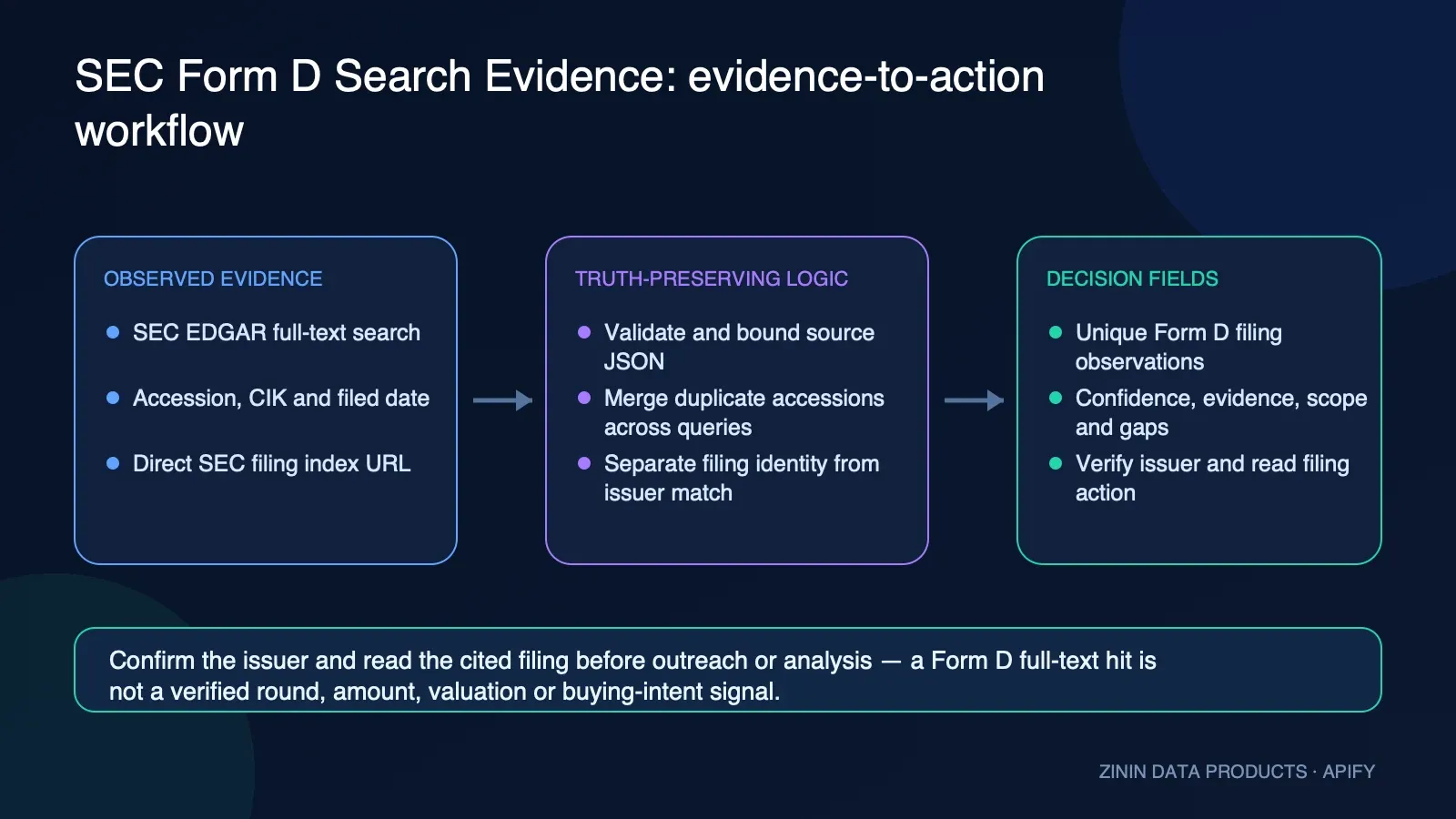
- The decision layer separates filing identity, query-to-issuer attribution, freshness, result coverage, confidence, gaps, and next action.
- Dataset delivery and
result-foundbilling occur in one linked SDK operation behind a process-wide mutex. The receipt must prove the expected linked operations exactly. - Free outcome rows use an unpriced Dataset channel only after runtime pricing is checked. Ambiguous delivery fails the run and marks
replaySafe=falsein KVSOUTPUT.
Source and methodology
Primary source
The Actor queries the public SEC EDGAR full-text search endpoint at efts.sec.gov. It does not use a funding-news scraper, social network, proprietary company database, LLM, proxy, or buyer-supplied API key.
Official SEC background:
What the search response supports
For an identified hit, the response supports the displayed SEC filer name, CIK list, SEC file date, form value, accession number, and document identity used to construct the SEC index URL. The Actor records these values as observed source data and exposes the exact search URL.
What it does not support
The search response alone does not establish the intended company-domain match, the reason the full text matched, first-sale date, offering amount, amount sold, investor count, security type, amendment history, round label, valuation, or transaction outcome. Those remain named gaps.
Coverage semantics
matchedis the count returned by SEC for that query window.matchedIsLowerBound=truemeans SEC marked the total asgte; do not present it as exact.retrievedCountis the number of hit objects present in the SEC response page before the buyer limit is applied.resultLimitis the configured maximum delivered from that query.coverageComplete=trueonly when the reported total is exact and fits inside the selected rows. Otherwise the row is still useful, but the bounded result is not the complete match universe.sourceQuerieslists the submitted queries that returned the same accession after cross-query deduplication.
Evidence, confidence, and decision contract
Filing existence versus issuer attribution
An identified row typically has filingExistenceConfidence=95 because accession, CIK, date, and direct SEC URL form a strong filing identity. It separately has issuerMatchConfidence=30 because a full-text keyword result does not independently prove that the filing belongs to the company or domain the buyer intended.
The overall confidence.score is evidence support for the Actor's narrow observation, not conversion probability, investment quality, round materiality, or source accuracy in every downstream interpretation.
Recommended actions
recommendedAction | Meaning |
|---|---|
VERIFY_ISSUER_AND_READ_FILING | Confirm legal issuer/domain identity and read the SEC document before using the observation. |
REFINE_QUERY_OR_SCHEDULE_RECHECK | The bounded search completed with no identified match; refine scope or repeat later without interpreting it as a universal negative. |
RETRY_SOURCE_CHECK | SEC request or response contract failed; retry later and do not treat the failure as no filing. |
INSPECT_SOURCE_SHAPE | A hit lacked a stable CIK/accession identity and was delivered free for investigation. |
RAISE_BUDGET_AND_RERUN_REVIEWED_SCOPE | The cap stopped delivery; review query breadth before increasing spend. |
Automation boundary
Every row has safeToAutomate=false. You may automate collection, storage, deduplication, routing, and creation of a manual review task. You should not automatically send outreach, overwrite a verified CRM funding field, make a legal conclusion, place a trade, or publish a funding claim from this row alone.
Input
| Field | Type | Required | Default | Bounds | Meaning |
|---|---|---|---|---|---|
queries | string array | yes | — | 1–25 items, 1–200 characters each | Company names or sector phrases. Trimmed and case-insensitively deduplicated. |
sinceDays | integer | no | 90 | 1–730 | UTC date lookback applied to every SEC query. |
limit | integer | no | 20 | 1–100 | Maximum hits selected per query from the returned SEC page. |
maxConcurrency | integer | no | 3 | 1–8 | Concurrent SEC queries. Delivery and billing remain serialized. |
The runtime rejects wrong types instead of silently coercing them. For example, "sinceDays":"30", a numeric query item, a fractional limit, or 26 queries fails before source work.
Narrow company-name search
Sector panel with duplicate normalization
The first two inputs become one request. The KVS output records requestedQueries:3, uniqueQueries:2, and duplicateQueries:1.
Output
Identified filing row
The example below is based on a bounded local live-source run on 11 August 2026. Filing values can change across future query windows; use the current run's Dataset as the source of truth.
Free no-match row
KVS OUTPUT
On Apify, an accepted paid canary should move eligible delivered rows from localNonMonetizedRows to paidRows and record exact linked receipt counts. Do not infer settled platform PPE from a local run; inspect the run's charged-event receipt.
Field dictionary
Compatibility fields
| Field | Meaning |
|---|---|
sourceQuery | First normalized query associated with the row. Preserved for existing integrations. |
found | true only for a hit with a valid accession and constructible SEC URL. |
matched | SEC-reported total for the first query; use queryMatches for merged-query details. |
company | Filer display name from the SEC hit, with the trailing CIK annotation removed. |
ciks | Valid numeric SEC CIK strings observed in the hit. |
filedAt | SEC file date from the search result. |
form | SEC form value, normally D; do not infer round type from it. |
accessionNumber | Stable SEC submission identifier and primary cross-query dedupe key. |
url | Constructed direct SEC index URL for the validated CIK/accession pair. |
summary | Human-readable description of the narrow observation or query failure. |
checkedAt | UTC time this run observed the source outcome. |
error | Source, shape, or run notice text for free outcome rows; otherwise null. |
Scope and provenance
| Field | Meaning |
|---|---|
sourceQueries | All normalized submitted queries merged into this accession row. |
queryMatches | Per-query SEC total and lower-bound flag. |
searchUrl | Exact bounded SEC full-text URL used for the first query. |
retrievedCount | Hit objects in the returned SEC page before the buyer limit. |
resultLimit | Buyer-selected maximum rows per query. |
coverageComplete | Whether the exact SEC total fits inside the selected hit set. |
matchedIsLowerBound | Whether SEC marked the total as gte. |
evidence | Machine-readable SEC source receipt with evidence ID and observation time. |
evidenceCoverage | Coverage of the row's narrow identity observation, not coverage of all possible offerings. |
Stable identity and time
| Field | Meaning |
|---|---|
entityId | Stable filing ID for identified rows: sec-filing:<accession>. |
observationId | Stable hash of entity plus observation time. |
eventId | Stable hash of observation semantics for event routing. |
observedAt | Run-level UTC observation time shared by source results. |
freshness.status | fresh, recent, older, or unknown from SEC file date. |
freshness.filingAgeDays | Whole UTC days between filing and observation when both parse. |
change | Explicit single-observation contract; this Actor does not pretend it has a previous baseline. |
Interpretation and action
| Field | Meaning |
|---|---|
filingExistenceConfidence | Confidence in the accession/CIK/date/URL filing identity. |
issuerMatchConfidence | Confidence that the full-text match is the company the buyer intended; intentionally much lower without independent attribution. |
matchBasis | sec_full_text_keyword_or_name_match, not a verified domain match. |
fundingClaimStatus | Explicit statement that the row is not a verified funding round. |
confidence | Evidence-support score, level, reasons, and risks. |
dataGaps | Material facts the source response and Actor do not establish. |
recommendedAction | Deterministic review route. |
actionPriority | Review urgency based on filing age or operational failure. |
actionReason | Plain-language explanation of the next step. |
safeToAutomate | Always false for external business, legal, financial, or outreach action. |
failureDiagnostics | Failure type, retryability, and partial-state flag. |
billing | Event eligibility, unit definition, and why the row is paid or free. |
observationSemantics | What the Actor observed and what it explicitly does not prove. |
Pricing and spend control
The current base tier charges:
$0.005for the Actor start event;$0.005for each unique identified filing row delivered asresult-found.
Current volume tiers reduce each event price to $0.00475 (Bronze), $0.00450 (Silver), $0.00425 (Gold), $0.00410 (Platinum), and $0.00400 (Diamond). Always check the Store pricing tab for the tier applied to your account.
At the base tier, 100 unique delivered filing rows in one run are approximately $0.505 including one minimum start event. No-match, source-failure, incomplete-identity, and budget-notice rows are not charged as result-found.
The runtime reads live pricing before source work. It refuses paid work when result-found is not priced, refuses all Dataset writes when free notice rows cannot be proven free, checks the buyer's maximum charge before each paid row, serializes the check-and-deliver critical section, and fails closed on an ambiguous linked receipt.
Set a small maxTotalChargeUsd during integration. A broad query can return many matches; limit and the charge cap control different risks and should both be bounded.
API and integration examples
Use environment variables or your platform secret store for tokens. Never paste an Apify token into a README, spreadsheet cell, webhook URL, or committed source file.
HTTP API
After the run finishes, retrieve Dataset items and KVS OUTPUT from the URLs in the Actor output schema. Treat a terminal FAILED or TIMED-OUT run as an operational event, not as evidence of no filing.
JavaScript client
Python client
Google Sheets
Export the Dataset directly or append rows through an automation. Keep entityId as the dedupe key, accessionNumber and url as evidence columns, confidence and gaps visible, and a separate reviewer/status column. Do not flatten away sourceQueries if overlapping query panels matter.
n8n
- Start the Actor with an HTTP Request or Apify node.
- Wait for a terminal run state.
- Fetch KVS
OUTPUT; stop the workflow iffatalErroris non-null orreplaySafe=false. - Fetch Dataset rows.
- Upsert by
entityId. - Route
failureDiagnostics.failureTypeto operations and filing rows to human verification. - Permit an external action only from your separately approved review state.
Make
Use an Apify module to run the Actor, retrieve Dataset items, and create a review record. Filter on found=true and keep the evidence URL, confidence risks, gaps, and run ID together. A Make scenario should not send outreach directly from found=true.
Apify schedules and webhooks
Schedules repeat the current bounded search. Webhooks should trigger on terminal Actor state, then fetch both Dataset and KVS OUTPUT. Store the run ID with downstream rows. Use destination-level idempotency because a stateless repeated run can observe the same filing again.
MCP and AI agents
An agent may call the Actor, but its system or workflow policy should require:
- citations to
evidence[].sourceUrl; - preservation of
fundingClaimStatusanddataGaps; - no invented funding amount, round label, investor, valuation, domain match, contact, or intent;
- explicit human review for
safeToAutomate=false; - run-level rejection when
OUTPUT.replaySafe=falseor a fatal error exists.
Operational checklist
Before the first production run
- Write the question in one sentence and decide whether a company-name or sector query actually answers it.
- Start with one or two distinctive queries, a short lookback, a low result limit, concurrency 1, and a small maximum charge.
- Decide which evidence will verify issuer-to-domain identity.
- Create staging fields rather than overwriting trusted CRM or research data.
- Define who reviews rows and what constitutes an approved funding claim.
During review
- Open the SEC filing URL.
- Confirm accession, CIK, legal issuer, form type, and date.
- Determine why the query matched.
- Check whether the filing is a new notice or amendment.
- Read offering details needed for your decision; do not infer them from the search card.
- Verify the company/domain relationship independently.
- Keep outreach legality, consent, suppression, and relevance as separate decisions.
In ongoing operation
- Monitor source failure rate, partial-hit rate, incomplete coverage, duplicate filing merge count, paid/free row count, and spend.
- Investigate sudden changes in SEC response shape or match volume.
- Preserve
OUTPUTwith the Dataset for reconciliation. - Re-expand manual sampling after source, schema, query panel, or destination changes.
- Never blindly retry an ambiguous run when
replaySafe=false; inspect the Dataset and charged-event receipt first.
Privacy, retention, and responsible use
The Actor sends submitted queries to the public SEC full-text search service and stores queries in the Actor Dataset/KVS output. Do not submit secrets, private notes, personal contact lists, health information, authentication material, or data you are not authorized to process.
Form D filings are public records, but public availability does not remove obligations around data minimization, lawful use, outreach rules, suppression lists, discrimination, financial promotions, or jurisdiction-specific privacy requirements. This Actor provides collection and decision-support evidence; it does not provide legal, compliance, tax, or investment advice.
Apify storage retention and access are controlled by your account and platform settings. Export only the fields needed by the destination, protect API tokens, restrict Dataset access, and remove stale exports according to your own retention policy.
Quality and troubleshooting
Source request fails
The row is free, failureType=SOURCE_UNAVAILABLE, retryable=true, and safeToAutomate=false. Retry later with the same bounded input. Do not convert a failed request into found=false business evidence.
A hit has no accession or valid CIK
The Actor does not sell it. It returns a free SOURCE_SHAPE_PARTIAL row with INSPECT_SOURCE_SHAPE. This is preferable to creating an unstable URL or billing for an unidentified document.
matched is larger than delivered rows
matched is the SEC total for the query, while limit caps selected hits and the source response itself is one page. Inspect matchedIsLowerBound, retrievedCount, resultLimit, and coverageComplete before describing coverage.
Two queries match the same accession
The Actor merges them before Dataset delivery and billing. sourceQuery keeps the first query for compatibility; sourceQueries and queryMatches preserve the combined explanation.
The budget stops the run
KVS OUTPUT records withheld rows and partial=true. A free run notice explains the stop when the Dataset channel is confirmed unpriced. Review the query breadth before raising the cap.
Delivery receipt is ambiguous
The run fails, fatalError is recorded, and replaySafe=false. The row may have reached the Dataset or billing service even though the SDK call did not return the exact receipt. Inspect the original run before any retry.
Funding Round Tracker versus Funding Alert
| Need | This Actor: SEC Form D Search Evidence | Funding Alert |
|---|---|---|
| Current bounded search window | yes | yes, as part of watch evaluation |
| Returns recent identified matches | yes | primarily new identities relative to baseline |
| Actor-managed named baseline | no | yes |
| Stateless repeatability | yes | no; watch state matters |
| Cross-query accession dedupe in one run | yes | watch-specific identity logic |
| Best use | discovery, enrichment, research panels | repeated alerting for newly observed filing identities |
Do not run both by default. Choose the stateless search product for current-window evidence and the stateful alert product when you explicitly need Actor-managed change detection.
Related tools
| Actor | When to use it |
|---|---|
| Funding Alert | Maintain a named baseline and emit newly observed Form D identities. |
| SEC Filing Watcher | Watch public-company ticker filings such as 10-K, 10-Q, 8-K, and S-1. |
| Insider Trading Tracker | Track Form 3/4/5 insider transaction filings by ticker. |
| 13F Portfolio Tracker | Research institutional manager holdings by CIK or manager identity. |
| Patent Filing Monitor | Monitor patent-grant keywords instead of securities filings. |
FAQ
Does a Form D prove a completed funding round?
No. It is an official notice of an exempt offering and is valuable primary evidence, but the search hit alone does not establish your preferred round definition, final amount, valuation, investor participation, close status, or commercial interpretation.
Is every Form D a venture-capital round?
No. Issuers and offerings vary, amendments exist, and the Actor does not classify security or financing type from the document body.
Does an exact quoted query guarantee issuer-name matching?
No. The phrase is sent to full-text search. It may appear outside the issuer display name. Confirm why the document matched.
Can I search a company domain?
You can submit a domain-like string, but this Actor does not resolve domains to legal issuers. Prefer a verified legal name or CIK-driven workflow and confirm identity manually.
Why is issuer-match confidence only 30?
Because the Actor has strong evidence for the SEC filing identity but only a full-text phrase relationship to the buyer's intended company. Keeping those confidences separate prevents a real filing from becoming a false company attribution.
Why is overall confidence medium on an identified filing?
The narrow filing observation is strong, while the commercial interpretation remains incomplete. Confidence measures support for the delivered claim, not the attractiveness or materiality of the issuer.
Can I treat matched=0 as proof that the company did not raise?
No. It means the bounded SEC full-text query returned no match in the configured window. Different names, spellings, CIKs, dates, exemptions, foreign transactions, or non-Form-D paths remain outside that negative result.
Does the Actor parse offering amount or amount sold?
No. It intentionally returns search-result filing identity and decision metadata. Read and parse the filing body in a separate reviewed enrichment step.
Are amendments included?
Do not assume complete amendment coverage. The current source request uses the SEC forms=D filter and preserves any form value the endpoint returns. If your workflow requires every amendment, validate that requirement against SEC filing history separately.
How fresh is the data?
observedAt records request time and filedAt comes from the SEC hit. freshness is derived from those two timestamps. It does not promise real-time completeness or publication latency.
Does it require an SEC API key?
No. The public EDGAR full-text endpoint is keyless. The Actor sends a descriptive user agent and bounded requests.
Does it use proxies or an LLM?
No. It uses direct public SEC JSON and deterministic transformation.
Can I schedule it?
Yes. Remember that it is stateless and can return the same accessions again. Upsert by entityId, or use Funding Alert when you need an Actor-managed baseline.
How should I deduplicate?
Within one run the Actor merges by accession number. Across runs, use entityId or accessionNumber. Do not use company display name as the only key.
Are no-match and source-error rows billed?
They are not billed as result-found. Runtime pricing checks must confirm the unnamed Dataset channel is free before those rows are written.
Can the same filing be billed twice in one run?
Not when it has the same valid accession number. Query results are aggregated and deduplicated before the serialized delivery/billing stage.
What if a filing appears under two different accession numbers?
They are different SEC submission identities and remain separate rows. Review whether one is an amendment or another filing; the Actor does not collapse distinct accessions by company name.
Is this investment advice?
No. It is public-filing search evidence and workflow metadata. Investment, legal, tax, and compliance decisions require appropriate primary evidence and qualified review.
Can I automatically contact every filer?
No. safeToAutomate=false. Verify identity, relevance, contact source, consent or lawful basis, jurisdiction, and suppression requirements first.
What should I include in a bug report?
Provide the Actor run ID, a redacted input, accession or affected field, expected behavior, KVS OUTPUT, and whether the SEC URL still reproduces. Never include API tokens, private customer data, or credentials.
Built by zinin for evidence-first research workflows. Review material facts at the cited primary source before acting.


