

Higher-Ed Institution Records — US IPEDS
Pricing
from $33.50 / 1,000 institution records
Higher-Ed Institution Records — US IPEDS
Keyless, pay-per-record NCES IPEDS register — one row per US college/university with control, level, and admissions decisions (applicants, admits, admit/yield rates, SAT/ACT). Public-domain; no person data.
Pricing
from $33.50 / 1,000 institution records
Rating
0.0
(0)
Developer
NexGen Signal
Maintained by CommunityActor stats
0
Bookmarked
2
Total users
1
Monthly active users
12 days ago
Last modified
Categories
Share
Keyless. Pay per record. Every US postsecondary institution — with admissions decisions.
This actor turns the US Department of Education's IPEDS (Integrated Postsecondary Education Data System) into clean, per-institution records — the official register of every college, university, and postsecondary school in the United States, joined to its admissions decisions. Each run reads IPEDS's keyless bulk data files for the year you choose and delivers one row per institution: its identity and characteristics, its control and level, and — for institutions that report admissions — its applicants, admits, enrollees, admit and yield rates, SAT/ACT score ranges, and the factors it weighs in admission. Institution grain, structured for engineering use, in the public domain, with no chief-administrator names, titles, or phone numbers ever emitted.
What this is, in one paragraph
IPEDS is the authoritative federal data system on US postsecondary education: reporting is mandatory for every institution that participates in Title IV federal student aid. This actor reads the IPEDS Directory (institutional characteristics) and Admissions files for a collection year, joins them by unit id, and flattens each institution into a single analysis-ready record: who they are and where, whether they are public or private, two-year or four-year, degree-granting, HBCU or tribal — and, where reported, the shape of their admissions funnel and the test-score profile of their class. Values are exactly as reported to and published by NCES. You are billed only for records actually delivered.
Who buys this and for what job
- EdTech, admissions, and enrollment-marketing products building an institution reference table keyed by unit id, enriched with selectivity and test-score ranges.
- Researchers and policy analysts studying access, selectivity, control, and outcomes across the postsecondary sector and over years.
- College-search, guidance, and financial-planning tools surfacing admit rates, yield, and SAT/ACT ranges by institution.
- Data engineers who want the IPEDS Directory + Admissions join as clean rows without downloading and merging the raw survey files.
Public-domain data — aggregate, not advice
Two honesty riders travel on every record. First, licensing: IPEDS is collected by NCES at the US Department of Education — a work of the US federal government, no copyright, public domain under 17 U.S.C. §105 — free to reuse with attribution to NCES/IPEDS. Second, fitness: these are aggregate, institution-level figures as reported for the year shown. Admission and enrollment counts are totals, not individual applicant records, and not admissions advice or a prediction of any applicant's outcome. IPEDS covers postsecondary institutions only — no K-12 data.
Institution grain — no person data
This actor works at institution grain: one record per postsecondary institution per year. The IPEDS Directory also carries the chief administrator's name and title and a general phone number — this actor never reads or emits any of them. Those fields are excluded structurally (they are not in the field selection at all), a person-key guard runs on every record as a backstop, and the acceptance suite feeds a directory row carrying a planted chief-administrator name and phone and asserts none of it can ever appear in output. What you get is the institution, not the person who leads it.
Sample output
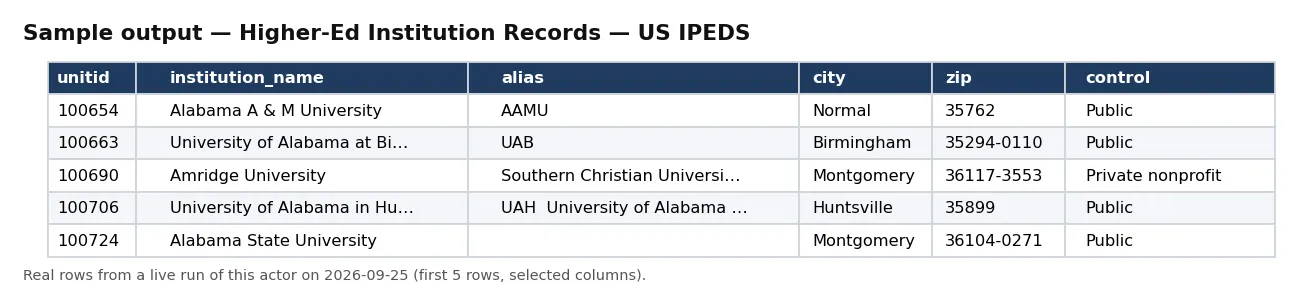
Real rows from a live run of this actor (first 5 rows, selected columns).
One full record from the same run, exactly as delivered:
Pricing
| Event | Free plan | Bronze | Silver | Gold / Platinum / Diamond |
|---|---|---|---|---|
institution_record | $0.05 | $0.045 | $0.04 | $0.0335 |
Delivered before charged. Blocked runs and empty results cost nothing.
Input
| Field | Type | Default | Description |
|---|---|---|---|
year | integer | 2023 | IPEDS data collection year (Directory + Admissions). |
state | string | — | Optional. Keep only institutions in this 2-letter state code (e.g. CA, TX). |
control | string | — | Optional. Public, Private nonprofit, or Private for-profit. |
admissionsOnly | boolean | false | If true, deliver only institutions that report admissions decisions. |
maxRecords | integer | 10 | Ceiling on records delivered and billed. |
Default changed on 30 Sep 2026: if you leave maxRecords out, a run now returns up to 10 records (it was 500). Set maxRecords yourself to get more — the maximum is unchanged.
Output
One JSON object per institution. Real example (values as published by NCES, MIT, 2023):
An unbilled RUN_RECEIPT records the robots check, the year and filters, institutions seen and delivered, whether charged equals delivered, and a note that chief-administrator person fields are never emitted.
Field reference
Each record is one institution for one year. Identity: record_id (unit id + year), unitid, institution_name, and alias. Location: city, state, zip, and fips_state. Classification: control, level, sector_code, degree_granting, highest_offering, undergrad_offering, graduate_offering, hbcu, tribal_college, medical_degree, has_hospital, locale_code, and open_to_public. Links: website, admissions_url, and net_price_url. Admissions decisions (where reported): reports_admissions, applicants_total, admitted_total, enrolled_total, admit_rate, yield_rate, sat_submit_pct, act_submit_pct, the SAT sat_reading_25/50/75 and sat_math_25/50/75, the act_composite_25/50/75, and the decoded admission_considerations map. Provenance and caveats: year, source, source_url, licence, attribution, disclaimer, and observed_at.
How a run works
A run first re-reads the source host's robots posture from your runtime — the IPEDS datacenter path on nces.ed.gov is not disallowed — and stops at the door if that ever changes. It then downloads the Directory (HD) and Admissions (ADM) complete-data files for your chosen year, joins each institution to its admissions record by unit id, and flattens the pair into a single record — reading only institution and admissions fields, never the chief-administrator name/title or phone. Each record is delivered before it is charged, so a blocked or empty run costs you nothing. Your optional state, control, and admissionsOnly filters bound the pull, and the actor stops at your maxRecords ceiling and records charge_equals_delivered in the receipt.
Coverage and scope
A single IPEDS year covers on the order of 6,000+ postsecondary institutions across all states and territories — public, private nonprofit, and private for-profit; four-year, two-year, and less-than-two-year. Roughly 2,000 of them report admissions decisions each year (the selective and semi-selective institutions); the rest — many open-admission and career institutions — appear with their directory characteristics and reports_admissions: false. Every record carries its collection year, so pulling two years and diffing by unitid gives you clean year-over-year change tracking of admit rates, yield, and score ranges. Pass a state, a control, or admissionsOnly to build a focused, bounded feed.
Cost guidance
One institution_record per delivered institution: cost = institutions delivered × your plan's per-record price. A full year is 6,000+ institutions, so scope with state, control, or admissionsOnly to keep runs bounded — one state's institutions is typically a few dozen to a few hundred, and admissionsOnly narrows a year to ~2,000 selective institutions. 1,000 institutions is $50 (Free) / $33.50 (Gold).
Honest limitations
- Aggregate, not individual, and not advice. Counts are institution totals as reported, not applicant-level records, and nothing here is admissions guidance or an outcome prediction.
- Admissions where reported. Institutions that do not report admissions (many open-admission and career schools) carry directory data with
reports_admissions: falseand null admissions fields. - Postsecondary only. IPEDS covers higher education — there is no K-12 data here.
- As published, per year. Values are exactly as NCES distributes them for the collection year; this actor reformats and derives admit/yield rates, but does not otherwise recompute.
- No person data — chief-administrator names, titles, and phone numbers are structurally excluded.
Differentiation
This actor's specific job is admissions decisions. It joins institution identity to the admissions funnel — applicants, admits, enrollees, admit and yield rates, SAT/ACT score ranges, and the factors weighed in admission. It carries the directory identity so each admissions record is self-describing; its distinct payload is the admissions-decision data. It is not a K-12 dataset, not a student-level dataset, and not a rankings product; it is the institution register with the admissions funnel attached.
The NexGen Signal family
Part of the NexGen Signal family of pay-per-record data products:
- Airport Facility Records — US FAA NASR
- Storm Event Records — US NOAA / NCEI
- Air Quality Monitor Records — US EPA AQS
- Federal Rulemaking Records — US Federal Register
- Grant Opportunity Records — US Grants.gov
Source: US NCES Integrated Postsecondary Education Data System (IPEDS), Directory (HD) and Admissions (ADM) complete data files. IPEDS is collected by the US Department of Education, a work of the US federal government, no copyright, public domain (17 U.S.C. §105); free to reuse with attribution to NCES/IPEDS. Figures are aggregate, as-reported, postsecondary only (no K-12), and not admissions advice. Reformatted to institution records; chief-administrator name/title and phone are structurally excluded and never emitted.


