

RSS Feed Finder and Reader – Blog and News Article API
Pricing
from $0.35 / 1,000 feed article delivereds
RSS Feed Finder and Reader – Blog and News Article API
Find the RSS, Atom and JSON feeds of any website and read their newest articles, from a domain name alone. Only new articles on every scheduled run, no author or other personal data, robots.txt obeyed, and you pay only per article delivered.

RSS Feed Finder and Reader: Blog and News Articles from Any Website
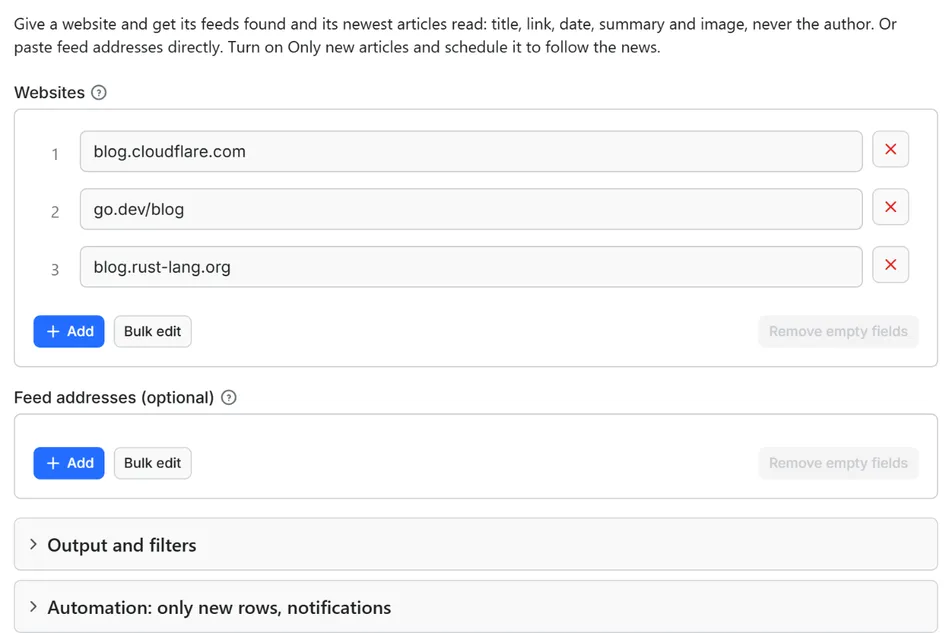
Give this actor a website and it finds the RSS, Atom or JSON feeds that the site publishes, then reads their newest articles into a clean table: title, link, publication time, a plain-text summary, categories and image, one row per article, as JSON, CSV or Excel. You do not need to know the feed address: a domain name such as example.com is enough, and feed addresses you already have work too. Follow the news without paying twice: turn on Only new articles, put the run on a schedule, and every run delivers, and charges, only the articles that were not in the feed the last time. No author names or other personal data are collected.
Key limits, up front: the default Maximum articles delivered is 1,000 (raise it, or use 0 for no limit); the newest 50 articles of each feed are read by default (up to 1,000), and up to 3 feeds per website (up to 20). A feed is read up to 5 MB and 2,000 articles. One request per second to the same host by default. robots.txt is obeyed on every host, including the host a feed address redirects to. A website with no feed, or behind an anti-bot page, is reported in COVERAGE and never charged.
What you get
One row per article, delivered once however many feeds carry it:
- The article:
title,link,summaryas plain text without HTML (at most 500 characters, cut at a word end),categoriesas one comma-separated text, andimageUrltaken from the feed itself (an image enclosure, a media tag, the image field of a JSON Feed, or the first image in the article text) - When it appeared:
publishedAtandupdatedAtas ISO 8601 times in UTC. Feeds write dates in many ways (RFC 822 with zone names such asESTor+0200, ISO 8601 with or without a time zone); they are converted, and a date that cannot be read becomesnull, never a guess - Where it came from:
siteUrl(the website you gave, or the home page named by a feed you gave directly),feedUrl(the feed after redirects),feedTitle,feedLanguageandfeedFormat(RSS 2.0,RSS 1.0,Atom,JSON Feed 1orJSON Feed 1.1) - Identity and attachments:
guidas the feed gives it,id(the guid, else the link, else the title with its date) as a stable key for your own database, andenclosureUrlwithenclosureTypefor an attached file such as a podcast episode, a PDF or an image - The run:
extractedAt
There is no author field. The actor never reads the author, dc:creator, itunes:author, editor or webmaster elements of a feed.
The run also writes a COVERAGE record with one entry per website or feed address you gave (ok, no_feed, blocked, robots_disallowed, not_found, error or not_checked) and, for each, the feeds that were found, how each was found (a link on the page, a standard path, or given by you), how many articles each held and how many were delivered; and a RUN_SUMMARY with the counts and the list of feeds read.
Why this actor
- Domain in, feeds and articles out. Most sites advertise their feeds in the head of their home page with
<link rel="alternate">; the actor reads those. When a site advertises none, it tries/feed,/rss,/rss.xml,/atom.xml,/feed.xmland/index.xml, in the folder of the page you gave first, and takes the ones that answer with a real feed (a page that only looks like one, such as a custom 404 page, is rejected). - Every common feed format. RSS 2.0 and the older 0.9x, RSS 1.0 (RDF), Atom and JSON Feed are read into the same columns. The reader copes with feeds as they are found in the wild: CDATA, HTML entities that XML does not define (
,é), namespace prefixes under any name, wrong or missing character sets, stray tags, and a feed cut at the size limit (the articles before the cut are kept). - Only new articles. The memory of Only new articles knows each article by its guid and by its link without tracking parameters, so a feed that changes its guids, or adds
utm_parameters to its links, does not make old articles come back as new. The second run on an unchanged feed delivers nothing and costs nothing. - A news monitor in one setting. Put a Slack, Discord, Make, n8n or Zapier webhook in Notify this URL when the run ends and the message lists the headlines of the new articles with their links.
- Filters before the charge. Published after (a day, or
7 days) and Keep only articles that mention drop articles before anything is charged. - Pay only for articles delivered. Duplicates, filtered articles, articles already delivered, websites without a feed and every request that fails cost nothing.
- Polite by design. robots.txt first on every host, one request per second per host, a Crawl-delay of up to 10 seconds honoured, a clear user agent, no proxies, no CAPTCHA solving.
How to use it
- Open the Actor and paste your websites into Websites, one per line.
example.com,blog.example.comor the address of a page such ashttps://example.com/news/all work. The three prefilled websites give a first result in a few seconds. - Optional: paste feed addresses you already know into Feed addresses (optional). They are read directly. You can fill one field or both.
- Optional: under Output and filters, keep only recent articles with Published after (for example
2026-10-01or7 days) or only articles that mention certain words with Keep only articles that mention. - Click Start. The status line shows the articles delivered and the feeds read.
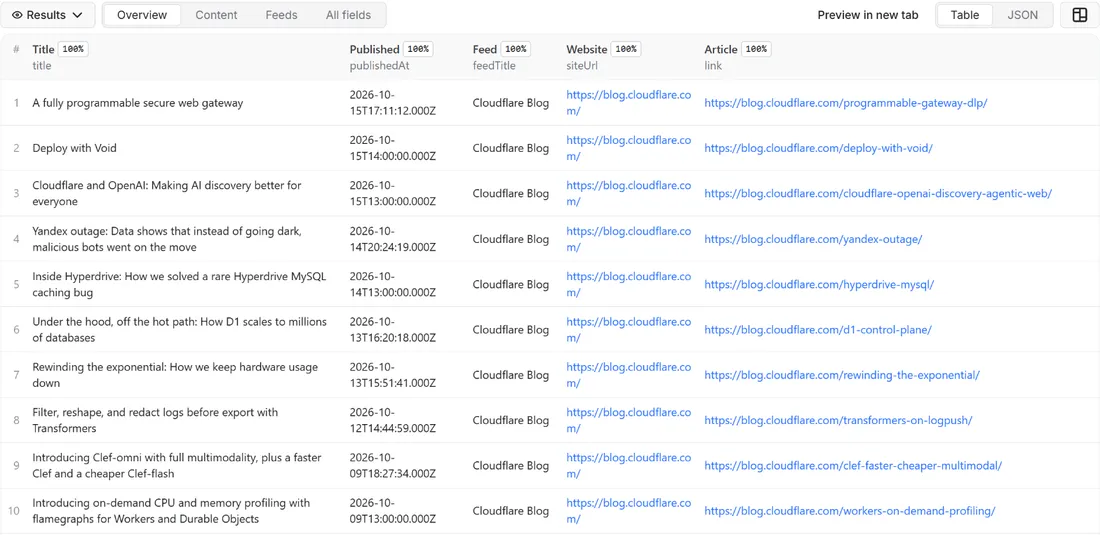
- Open the Dataset tab. The Overview view lists title, date, feed, website and link; Content shows summary, categories and image; Feeds shows the feed, its format and language and any attached file. Download JSON, CSV, Excel, XML or HTML, or send the rows to Google Sheets, Slack, Make, n8n or Zapier with the Integrations tab.
- Open the
COVERAGErecord in the key-value store to see, for each website, which feeds were found and how, and why a website gave nothing. - To follow a site, create a schedule with Only new rows since the last run turned on, give it a State name, and add a webhook in Notify this URL when the run ends.
Input
| Field | What it does |
|---|---|
websites | Domains (example.com) or page addresses (https://example.com/blog/), one per line. If the address you give is itself a feed, it is read as one. Up to 10,000 entries per run with feedUrls. |
feedUrls | Feed addresses to read directly: RSS, Atom or JSON Feed. |
maxItems | Stop after this many articles are delivered in the run. Default 1,000. 0 = no limit. |
maxArticlesPerFeed | The newest N articles of each feed are looked at. Default 50, up to 1,000. The filters and Only new articles apply to these. |
maxFeedsPerSite | Feeds read per website. Default 3, up to 20. Feeds that carry the same articles are read once. |
publishedAfter | Keep only articles published on or after this day: YYYY-MM-DD, or a relative value: 7 days, 2 weeks, 24 hours. Articles without a date are dropped when this is set. |
keywords | Words or phrases, one per line. An article is kept when its title or summary contains any of them. Upper and lower case and accents are ignored: cafe finds Café. A word of up to 3 letters, such as AI, must match a whole word, so it does not find said. |
onlyNew, stateName | Deliver only articles not delivered to you in an earlier run with the same state name. |
notifyUrl, notifyWhenEmpty | A webhook that receives one message when the run ends; see Automation below. |
requestIntervalMs | Pause between two requests to the same host, default 1000 ms, minimum 250 ms. |
The order matters for the filters: the newest maxArticlesPerFeed articles of each feed are taken first, then Published after and Keep only articles that mention are applied to them, then Only new articles. To search deeper into a long archive, raise maxArticlesPerFeed.
Example: the newest articles of three engineering blogs, read in a few seconds.
Example: a daily watch on two sites that delivers only security articles that appeared since the last run, with a Slack message.
Example: articles from feeds you already know, published in the last week.
Output
17 fields per row. Empty values are null, never missing, so CSV and Excel columns are stable.
| Field | Type | Example |
|---|---|---|
id | string | 01M5072CXFWQ88M9NCXZBSPAF2 |
title | string | A fully programmable secure web gateway |
link | string | https://blog.cloudflare.com/programmable-gateway-dlp/ |
publishedAt | string | 2026-10-15T17:11:12.000Z |
updatedAt | string | 2026-10-15T00:00:00.000Z |
summary | string | Cloudflare Gateway and Data Loss Prevention have inherited the flex… |
categories | string | Cloudflare Gateway, Cloudflare Workers, Data Loss Prevention, Devel… |
imageUrl | string | https://blog.cloudflare.com/_emdash/api/media/file/01M50725GWYBHA14… |
siteUrl | string | https://blog.cloudflare.com/ |
feedUrl | string | https://blog.cloudflare.com/rss/ |
feedTitle | string | Cloudflare Blog |
feedLanguage | string | en-us |
feedFormat | string | RSS 2.0 |
guid | string | 01M5072CXFWQ88M9NCXZBSPAF2 |
enclosureUrl | string | https://blog.cloudflare.com/_emdash/api/media/file/01M50725GWYBHA14… |
enclosureType | string | image/png |
extractedAt | string | 2026-10-15T20:43:44.939Z |
Example rows
Two real rows from a run (long texts shortened here, complete in the dataset):
Results can be downloaded as JSON, CSV, Excel, XML or HTML from the Dataset tab, or read through the Apify API.
Pricing
Pay per result. You pay for each article delivered to your dataset, nothing else: no subscription, no minimum, no charge for rows your filters drop or for the requests behind them.
| Your Apify plan | Price per 1,000 rows | Price per row |
|---|---|---|
| Free plan | $0.50 | $0.0005 |
| Starter plan | $0.45 | $0.00045 |
| Scale plan | $0.40 | $0.0004 |
| Business plan and above | $0.35 | $0.00035 |
Example: 1,000 articles cost $0.50 on the Free plan and $0.35 on the Business plan. The Apify platform usage of a run (compute, storage) is small for this actor — well under one cent per 1,000 rows — and is billed by Apify separately, as for every Actor.
A start event of $0.00005 is charged once per run (Apify default).
Cap your spend: set Maximum total charge in the run options. The actor stops cleanly when the cap is reached and you keep everything delivered until then. The run summary (RUN_SUMMARY in the key-value store) says why a run stopped.
An article is counted once per run, however many feeds carry it. What is not charged: duplicates (the same guid or the same link in two feeds), articles dropped by Published after or Keep only articles that mention, articles skipped by Only new articles, entries that are not valid websites or feed addresses, and every website or feed that could not be read (no feed found, anti-bot page, robots.txt, not found, errors).
Automation: only new articles, notifications, schedules
Only new articles. This is the main way to use the actor on a schedule. With onlyNew on, the actor remembers a short fingerprint of every article it delivered to you (in a key-value store named rowcraft-rss-feed-finder-reader-state in your Apify account, one memory per stateName, up to the latest 1,000,000 articles). An article is recognised by its guid or by its link without tracking parameters, whichever matches. The next run with the same state name delivers only the articles that were not there before, so an hourly schedule on a blog that publishes two posts a week costs two rows a week, not fifty rows an hour. The first run delivers the newest articles and builds the memory: treat it as the baseline, and use Published after when you want to look back in time. Articles outside the newest maxArticlesPerFeed of a feed are not looked at, so they are not remembered either; if a site can publish more than that between two runs, raise the number or run more often. Articles cut by Maximum articles delivered or by the charge limit are not remembered, so they come in the next run.
Notification when the run ends. Put a webhook address in notifyUrl and the actor sends one JSON POST with the number of delivered rows, links to the dataset (JSON and CSV) and the run, and the headlines and links of the first ten delivered articles (also as a list in the message text, so Slack and Discord show them). It works with Slack and Discord incoming webhooks, with Make, n8n and Zapier catch hooks, and with your own endpoint. By default it is sent only when at least one article was delivered; notifyWhenEmpty sends it every time.
Schedules. Create a schedule in Apify Console (hourly, daily, weekly or cron) with onlyNew on. Use one state name per list, so lists that differ keep separate memories. A change to the list of websites does not reset the memory: a site you add delivers its newest articles once, and a site you remove is simply no longer read.
Integrations. Send the results to Make, n8n, Zapier, Google Sheets, Slack, Google Drive, Airtable or any webhook from the Integrations tab of the Actor, with no code. A common pattern is a schedule with Only new articles, a Slack webhook for the headlines and a Google Sheets integration that appends the rows.
API, SDKs and AI agents. Every run is available through the Apify API and the official JavaScript and Python clients; the Actor can also be called by AI agents through the Apify MCP server, for example to give an agent the latest headlines of a list of sites. The example input in the API tab is a working call.
Use cases
- News and industry monitoring: follow a list of publications and get the new headlines, links and summaries in a spreadsheet or a Slack channel as they appear.
- Competitor and partner blogs: schedule a daily run with Only new articles on the blogs of competitors, suppliers or customers and see what they publish the day it is published.
- Brand and topic alerts: add Keep only articles that mention with your brand, product or topic words and read only the matching articles from the sites you follow.
- Release notes and security advisories: many software projects publish releases and advisories as feeds; a keyword filter such as
securityturns them into an alert. - Content curation and newsletters: collect the newest articles of a hand-picked list of sources, with title, summary and image, as the raw material of a weekly digest.
- Research datasets and AI pipelines: build a dated corpus of headlines and summaries from many sources, or feed an agent the latest articles of the sites it should know.
- Publishing rhythm and SEO research: count how often a site publishes and in which categories, from the dates and categories in its feed.
Ready-made examples, each with the input filled in (open one and press Start, or save it as your own task):
- Follow the engineering blogs of software companies
- Security and privacy stories from technology news sites
What this actor does not do
- Read the full text of articles: the row holds the summary the feed gives, up to 500 characters. The actor never opens the article pages. Use a page scraper on the
linkfor the full text. - Collect authors or people: no author, editor, e-mail address, phone number or social profile;
mailto:,tel:andsms:addresses are ignored. - Create feeds for sites that have none: a website without a feed is reported as
no_feed. It does not read news sitemaps either; to list the pages of such a site use a sitemap reader. - Read comment feeds: feeds that a page advertises for comments are left out.
- Download the attachments:
enclosureUrlis the address of an audio file, a PDF or an image, never the file. - Log in, run JavaScript, use proxies or solve CAPTCHAs: a feed behind a bot challenge or a paywall is reported as blocked and not charged.
- Run continuously: it reads feeds when a run starts. For a live monitor, use a schedule.
Limits and fair use
- One request per second to the same host by default (minimum 250 ms). A website takes its robots.txt, one request for its page and one request per feed; a standard path that does not exist is one more request. Several websites in one list are read one after the other, so a list of 100 websites takes a few minutes.
- Feeds are read up to 5 MB and 2,000 articles. A longer feed is cut there, the articles before the cut are used and the feed is flagged in
COVERAGEand in the summary; for the newest articles this is almost never a problem, because feeds list the newest first. A web page is read up to 600 KB to find the feed links. - The newest 50 articles of each feed by default (
maxArticlesPerFeed, up to 1,000), and 3 feeds per website (maxFeedsPerSite, up to 20).COVERAGEsays how many more feeds a website advertises than were read. - Maximum articles delivered defaults to 1,000. The status line and the run summary say when the maximum stopped the run. Set it to 0 to get everything, and set a Maximum total charge in the run options if you want a hard cost cap.
- robots.txt is obeyed for every host that is read, including the host a feed address redirects to. If robots.txt disallows the feed path, the feed is
robots_disallowed; a Crawl-delay of up to 10 seconds is waited out between requests to that host; if robots.txt answers with a server error the site is not read, as the robots.txt standard (RFC 9309) requires. - Anti-bot pages. A site that answers with a bot challenge, an access-denied page, a 403 or a 429 is reported as
blocked, not retried and not charged. After 10 blocked entries in a row the run stops and says why in the run summary. - Dates need to be readable. With Published after on, articles without a date are dropped, and counted in the summary, because their age cannot be known.
- The run stops 90 seconds before its timeout with the summary, the coverage and the Only new articles memory saved; for long lists raise the timeout or split the list.
Data source and licence
The data is what websites publish for feed readers: RSS (rssboard.org publishes the RSS 2.0 specification, https://www.rssboard.org/rss-specification), Atom (RFC 4287, https://www.rfc-editor.org/rfc/rfc4287), and JSON Feed (https://www.jsonfeed.org/version/1.1/), plus the older RSS 1.0 format. The actor reads those files once per run, as a feed reader would, after checking robots.txt, and keeps the title, link, dates, a short summary, the categories, the image address, the attachment address, the guid and the name and language of the feed.
Feeds are published so that readers and other tools can follow a site. The articles and their summaries belong to their publishers. How you may use a given site's feed, for example whether you may republish its summaries, is your responsibility under that site's terms and the law that applies to you; the actor reads the feeds as they are served to every visitor and does not bypass any protection.
Rowcraft is independent and not affiliated with or endorsed by the websites it reads. Site names and trademarks belong to their owners and are used only to say which site an article comes from.
Privacy: no personal data
Rowcraft actors are built not to collect personal data:
- The row holds article titles and links, dates, summaries, categories, image addresses and feed details. There is no author field, and
author,dc:creator,itunes:author,managingEditorandwebMasterelements are never read. mailto:,tel:andsms:addresses are skipped. E-mail addresses and phone numbers in titles, summaries and links are replaced by[email removed]and[phone removed], and a name that follows a contact cue such asContact:orMedia contact:in a summary is replaced by[name removed].- Identifiers that look like phone numbers but are not, such as a DOI or a publisher's article number, are kept as they are.
- Titles and summaries are delivered as the publisher wrote them. They can mention people, for example in a headline about a public figure, and some aggregator feeds put an author's name at the start of the title. The actor adds no information about anyone; if a source puts author names in its titles, leave that feed out of your list or drop its rows by
feedUrlin your own tool. - The actor sends no cookies, fills no forms and never logs in.
You are responsible for using the data in line with the law that applies to you.
Other Rowcraft actors
All Rowcraft actors read official or public sources, deliver flat rows without personal data and support only-new runs and notifications:
- Ashby Jobs Scraper – Job Postings with Salary Ranges — Job postings from Ashby job boards (jobs.ashbyhq.com) by company: title, department, team, locations with country, employment and workplace type, published salary range, full text.
- Broken Link Checker – Find 404s and Dead Links API — Pay per crawled page, not per link: crawl a site within robots.txt and check every link on each page for 404s, 5xx errors, DNS and TLS failures and redirects.
- Career Site Jobs Scraper: Greenhouse, Lever, Ashby, Workday — Job listings from the career pages of the companies you choose on Greenhouse, Lever, Ashby, Workday, Workable, Personio, Recruitee, Teamtailor and Gem, in one run and one format: title, locations, department, salary when published, full text.
- Chrome Web Store Scraper: Users, Ratings & Versions — Reads public Chrome Web Store listing pages with no login, no proxy and no personal data: users, rating, category, version, update date, permissions and company developers.
- Domain Email and DNS Checker API: MX, SPF, DMARC, Providers — Find which email provider, sending services and DNS host each domain uses, from public DNS records only.
- SIRENE France Company Scraper: SIREN, NAF, Revenue, Status — French companies from the official Recherche d'entreprises API (INSEE SIRENE + INPI): SIREN and SIRET, legal form, NAF activity, head-office address, employee band, revenue and net income, labels, creation date and VAT number.
- Gem Jobs Scraper – Job Board Listings from jobs.gem.com — Job listings from Gem job boards (jobs.gem.com) by company: title, department, offices with country, employment type, remote, hybrid or on-site, requisition ID, publication date and full ad text, from the public Gem Job Board API.
- Google Play Apps Scraper: App Details, Installs, Ratings — Public Google Play app details as flat rows: installs, rating, number of ratings, price, version, last update, minimum Android, ads and in-app purchases.
- Greenhouse Jobs Scraper – Job Listings by Company Board — Job listings from Greenhouse job boards by company: title, departments, offices, publication date, full ad text, published pay ranges.
- Himalayas Jobs Scraper: Remote Jobs API with Salaries — Remote jobs from Himalayas through its public jobs API: title, company, salary range, seniority, categories, the countries and time zones open to candidates, full description and job link.
- KRS Poland Companies Scraper: Register Data, PKD, Status — Polish companies from the official KRS register API of the Ministry of Justice: name, KRS, NIP and REGON numbers, legal form, status, address, PKD activity codes, share capital, branches and registration dates.
- LEI Records Scraper: Legal Entity Identifier Lookup API — Legal Entity Identifier (LEI) records from the Global LEI Index, read through the public GLEIF API: legal name, legal form, register number, addresses, status, renewal date and parent companies.
- Lever Jobs Scraper – Job Postings from jobs.lever.co — Job postings from Lever career pages (jobs.lever.co) by company: title, team, department, location, commitment, workplace type, salary range when published, description, requirements and benefits.
- Norway Company Register Scraper: Brønnøysund Business Data — Norwegian companies from the Central Coordinating Register for Legal Entities (Brønnøysund, NLOD open data): organisation number, legal form, industry, employees, share capital, addresses, website, VAT and bankruptcy status.
- Personio Jobs Scraper: Job Listings, Salaries, Departments — Job ads from any company's Personio careers feed: title, department, office, employment type, schedule, seniority, salary when published, keywords and the full description in the language you choose.
- Platsbanken Scraper: Sweden Jobs, Employers, Org Numbers — Every job ad on Platsbanken (Arbetsförmedlingen) from the official JobTech API: headline, employer and organisation number, occupation codes, municipality, coordinates, salary type, deadline and full text.
- Recruitee Jobs Scraper – Job Listings by Company Career Site — Job listings from Recruitee career sites by company: title, department, locations with country, employment type, remote flag, published salary and full text, one request per company.
- Robots.txt and AI Crawler Access Checker API — Check which AI and search crawlers a website lets in: GPTBot, ClaudeBot, PerplexityBot, Google-Extended and more, read from robots.txt by the RFC 9309 rules.
- SEO Audit Tool: Titles, Meta Tags, Headings and Links API — Audit the on-page SEO of any list of pages or websites: titles, meta descriptions, headings, canonicals, indexing, links, images and structured data, with a score and the issues found per page.
- Shopify Products Scraper: Store Catalog Export to JSON, CSV — Products from any Shopify store's public catalog: title, vendor, type, tags, description, variants with price, compare-at price, SKU and stock, images, options, store currency.
- Sitemap URL Extractor: Every Page with Last-Modified Dates — Get every page a site lists in its sitemaps, with last-modified dates, from robots.txt through sitemap indexes and .gz files.
- SSL Certificate and Security Headers Checker API — Check the TLS certificate and the HTTP security headers of every domain in one run, with an A+ to F grade and the exact issues to fix.
- Store Products Scraper – Shopify, WooCommerce, VTEX — Export the product catalogue of any Shopify, WooCommerce or VTEX store from its public catalogue endpoint: title, brand, prices, discounts, stock, categories, images and links, one row per product, the same columns on every platform.
- Structured Data Extractor: JSON-LD, Schema.org, Open Graph — Pull the schema.org JSON-LD, Microdata, RDFa and Open Graph of any page list into flat rows: types, product price, availability, ratings, organization, breadcrumbs, with validation issues.
- Teamtailor Jobs Scraper – Career Site Jobs by Company — Job listings from Teamtailor career sites by company: title, department, role, locations with city and country, remote or hybrid status, publication date and full ad text, from the official job feed.
- TED Tenders Scraper: EU Public Procurement Notices API — EU public procurement notices from TED (Tenders Electronic Daily), the official EU tenders portal, through its public Search API: title, buyer, country, CPV codes, values, deadlines, lots and document links.
- UK Companies House Scraper: Company Search & Profiles API — UK companies from the official Companies House API with your free key: search by name, status, type, SIC code, date or location, or look up company numbers.
- UK Tenders Scraper: Find a Tender + Contracts Finder API — UK public procurement notices from Find a Tender and Contracts Finder, the official UK government portals, through their open OCDS APIs: title, buyer, region, CPV codes, values, deadlines, notice type and links.
- Bulk URL Status and Redirect Chain Checker API — Check the status code, redirect chain, canonical and indexing signals of every URL in a list, with the final destination and a loop flag.
- VTEX Products Scraper – Public Catalog Export — Export the catalogue of any VTEX store (Auchan, Chedraui and thousands of retailers in Europe and Latin America) from its public search endpoint: title, brand, EAN, prices, list prices, stock, categories, specifications and images, one row per product.
- Website Tech Stack Detector – Technology Lookup API — Find the technologies behind a list of websites: CMS, e-commerce platform, analytics, tag managers, ad pixels, consent tools, chat, CDN and payments, from one polite home-page request per domain.
- WooCommerce Products Scraper – Store API Export — Export every product of a WooCommerce store through its public Store API: title, SKU, prices and sale prices, stock, categories, tags, attributes, ratings, images and links, one row per product.
- Workable Jobs Scraper: Job Listings from Career Pages — Job listings from any company's Workable career page: title, department, location, remote or on-site, employment type, description, requirements, benefits and salary when published.
- Workday Jobs Scraper – Jobs from myworkdayjobs.com Sites — Job listings from Workday career sites (myworkdayjobs.com) by company: title, locations, country, posting date, time type, requisition ID and the full description.
FAQ
How do I get only the new articles of a blog or news site? Run the actor on its domain with Only new articles on. The first run delivers the newest articles and remembers them. Put the same input on a schedule with the same state name: each later run delivers only the articles that were not in the feed before, and you pay only for those.
What happens when I give only a domain? The actor reads robots.txt of that domain, then its home page, and uses the feeds the page advertises with <link rel="alternate">. When the page advertises none, it tries /feed, /rss, /rss.xml, /atom.xml, /feed.xml and /index.xml and uses the ones that answer with a real feed. When none exists the website is reported as no_feed in COVERAGE, with the addresses that were tried, and nothing is charged.
Why is the result empty? Look at COVERAGE and RUN_SUMMARY. The usual reasons: the site has no feed (no_feed), its feed is behind an anti-bot page (blocked) or disallowed by robots.txt (robots_disallowed), the address does not exist (not_found), or your filters dropped everything (filteredSkipped in the summary shows how many articles each filter removed; with Published after on, articles without a date are dropped too). With Only new articles on, articles delivered in an earlier run are skipped as well, and skippedAlreadySeen in the summary counts them. Nothing is charged for any of this, apart from the start event.
Is it legal? The actor reads feeds, which sites publish for anyone to read, obeys robots.txt on every host and collects titles, links, dates and short summaries, not personal data. Whether and how you may use the results, for example for republishing or marketing, depends on the site's terms and the law that applies to you.
Does it collect personal data? No personal data: there is no author field, no e-mail address or phone number is delivered, and contact details found in texts are masked. See the Privacy section for what can remain in a headline.
Do I pay for feeds that cannot be read? No. Websites without a feed, blocked and robots-disallowed feeds, addresses that do not exist, invalid entries and duplicates are never charged. You pay for the articles delivered to your dataset.
Why do some rows have no summary, image or date? The feed does not give one for that article, or gives something that cannot be read (a date such as 2026-02-31, or a text that is only HTML tags). The value is null, never a guess. Many feeds carry no image, and some carry no dates; the columns are only as good as the feed.
Does it find feeds on sites that do not advertise them? It tries the six standard paths. If a site keeps its feed at an unusual address, copy that address into Feed addresses (optional) and it is read directly.
Which feed formats are supported? RSS 2.0 and 0.9x, RSS 1.0 (RDF), Atom 1.0 and 0.3, and JSON Feed 1 and 1.1, including feeds with content:encoded, media:content, enclosures and Dublin Core dates.
What is the difference between Only new articles and Published after? Published after keeps articles by the date the feed gives them. Only new articles keeps articles by what you have already received, so it finds articles that appeared since your last run even when the feed gives no dates. To follow a site use Only new articles; to look back at the last weeks use Published after.
Can I get the full text of the articles? No. The row holds the summary that the feed provides, up to 500 characters, and the link. The actor never opens the article pages; a page scraper can read the full text from the links.
Why are there fewer articles than the feed shows in my browser? The actor reads the newest maxArticlesPerFeed articles of each feed (50 by default). Raise the number to read more, up to 1,000. A feed itself usually holds only the latest 10 to 100 articles.
Can I read a site that needs a login or a paywall? No. The actor reads what the site serves to every visitor. Private feeds with a secret address in the link work when you paste that address into Feed addresses (optional), but the address then appears in your run's input and in feedUrl, so use it only in your own account.
Support and reviews
Problems, missing fields, questions: open an issue on the Issues tab of this Actor. We answer within one working day and fix confirmed bugs in the next release; the changelog lists every change.
If this Actor saved you time, a short review on its page helps other users find it and helps us keep improving it.


