

WARN Layoff Notices Scraper: 8 States + New-Only Alerts
Pricing
from $0.56 / 1,000 warn notice returneds
WARN Layoff Notices Scraper: 8 States + New-Only Alerts
WARN layoff notices scraper for WARN Act layoffs and plant closures from 8 official state sources (TX, CA, WA, OR, MD, VA, NC, MI) in one schema. Filter by notice date, workers affected, closures only. Employer, headcount, city, county, dates, closure flag, source link. New-only mode for alerts.
Pricing
from $0.56 / 1,000 warn notice returneds
Rating
0.0
(0)
Developer

Detroit Web Agent - Open Data
Maintained by CommunityActor stats
0
Bookmarked
2
Total users
0
Monthly active users
3 days ago
Last modified
Categories
Features
Share

WARN Layoff Notices Scraper: 8 States + New-Only Alerts
WARN Act layoff notices and plant closures from 8 US states (TX, CA, WA, OR, MD, VA, NC and MI) in one clean table, with a new-only alert mode for scheduled runs.
Free sample: download a CSV of real rows from recent runs of this Actor (up to 50 rows, refreshed weekly, no account needed).
Video walkthrough: Watch the 1-minute demo on YouTube
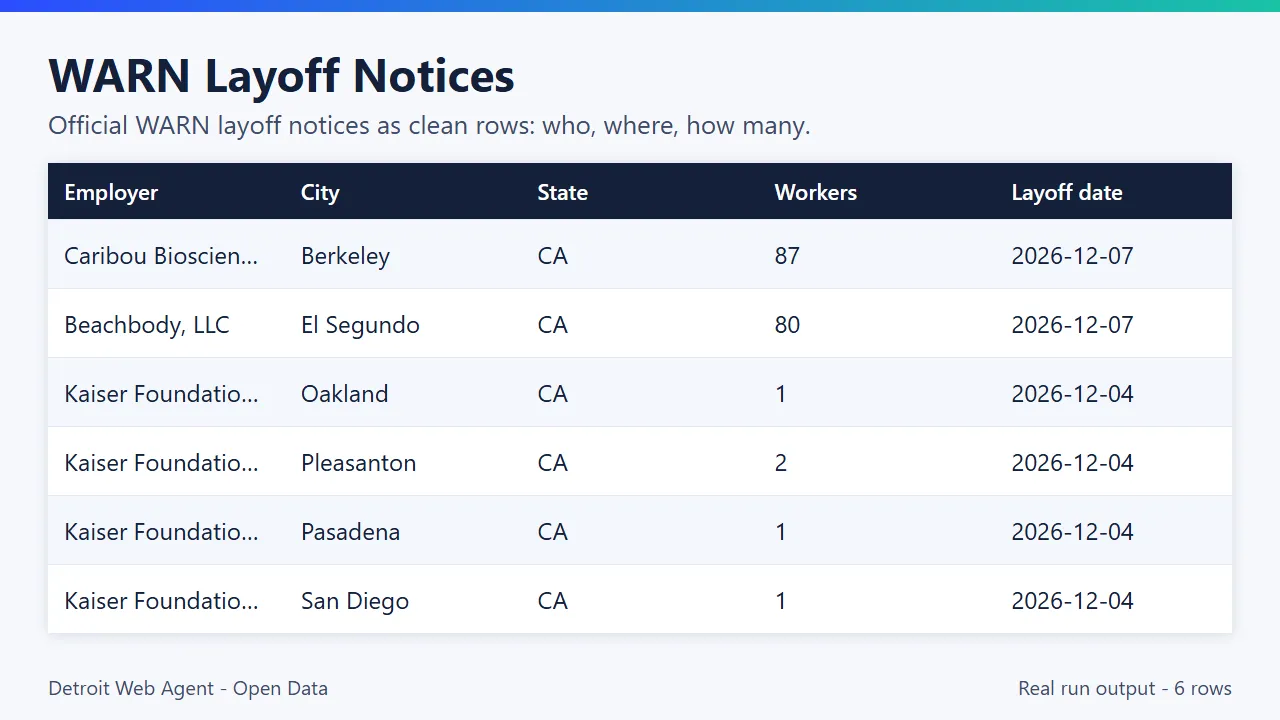
One clean table of WARN Act layoff and closure notices from Texas, California, Washington, Oregon, Maryland, Virginia, North Carolina and Michigan: employer, workers affected, city, county, notice date, layoff date, closure flag and a link back to the state source. Schedule it and each run returns only the notices you have not seen yet.
- What you get: one row per WARN notice, read from the official state publication, in a single schema across all 8 states.
- Who it is for: recruiters and staffing firms, outplacement and benefits providers, B2B sales teams, journalists, investors and labor-market researchers.
- What it costs: $0.00093 per notice delivered on the Apify free plan, which is $0.93 per 1,000 notices ($0.56 to $0.74 per 1,000 on paid Apify plans). No monthly fee, no run fee. Optional employer domain and phone enrichment (with your own Apollo key) is a separate $0.05 per enriched employer on the free and Bronze plans ($0.035 to $0.0425 on higher plans).
- What you need: an Apify account. No state login, no API key.
One real row, from our run on Oct 16, 2026 (Michigan):
| Employer | City | County | State | Workers | Notice date | Layoff date | Type | Closure |
|---|---|---|---|---|---|---|---|---|
| Lear Corporation | Sterling Heights | Macomb | MI | 67 | 2026-10-08 | 2026-11-09 | Facility closure - Not reported | true |
- In short: WARN Layoff Notices (Apify actor
transparent_meteorite/warn-layoff-alerts) returns WARN Act layoff and plant-closure notices from official state sources (Texas, California, Washington, Oregon, Maryland, Virginia, North Carolina, Michigan) as clean, deduplicated rows. - Who it is for: recruiters and staffing firms, outplacement and benefits vendors, B2B sales teams, journalists, investors and labor researchers.
- Input: states (TX, CA, WA, OR, MD, VA, NC, MI), days back or an exact notice-date window, minimum affected workers, closures-only filter, only-new-since-last-run mode and webhook.
- Output: employer, clean employer name, workers affected, size bucket, closure flag, layoff type, city, county, state, notice date, layoff date, days from notice to layoff, notice link, source state and source link.
- Price: $0.00093 per notice ($0.93 per 1,000) on the Apify free plan, $0.00056 to $0.00074 on paid plans; optional employer enrichment with your own Apollo key at $0.05 per enriched employer ($0.035 to $0.0425 on Silver and higher plans). Pay per result, no subscription.
- Limits: eight states today (other codes are skipped with a log note); data is only as fresh as each state publishes it.
Key facts
- Actor name: WARN Layoff Notices
- Actor ID:
transparent_meteorite/warn-layoff-alerts - Store page: https://apify.com/transparent_meteorite/warn-layoff-alerts
- Data source: official state WARN publications: data.texas.gov, California EDD, Washington ESD, Oregon HECC, Maryland Department of Labor, Virginia VEC (VirginiaWorks), North Carolina Commerce, Michigan LEO
- Pricing model: pay per event (
warn-notice$0.00056 to $0.00093,enriched-contact$0.035 to $0.05, by Apify plan) - Output formats: JSON, CSV, Excel, XML, HTML table, RSS (Apify dataset)
- Access: Apify Console, REST API, JavaScript/Python clients, schedules, webhooks, Apify MCP server
- Login or third-party API key needed: no, only an Apify account
- Also known as: WARN notices scraper, WARN Act tracker, layoff data API, layoff alerts, mass layoff notices, plant closure notices
- Maintainer: transparent_meteorite (independent developer)
- Last updated: 2026-10-19
What is a WARN notice, and why the data is hard to use
The federal Worker Adjustment and Retraining Notification (WARN) Act requires most employers with 100 or more employees to give 60 days' written notice before a plant closing or a mass layoff. The notice goes to the state's dislocated-worker unit, and many states then publish those notices.
The catch is that every state publishes them differently. Texas uses an open-data portal. California posts a spreadsheet for the current quarter. Washington runs a searchable database. Oregon keeps a tracker. Maryland, Virginia and North Carolina publish web tables, and Michigan posts notices on a search page with a PDF per filing. Column names, date formats and layoff-type wording all differ, and none of them tells you which notices are new since you last looked.
This actor reads each official source, maps every notice to one schema, removes duplicates, and remembers what it already delivered to you. You get a table you can filter, schedule, export or push to a webhook, instead of eight browser tabs and a copy-paste routine.
Run in 30 seconds
- Open the prefilled run (free Apify account; it creates a saved task with a working input).
- Press Start. The input is small on purpose, so the first run is quick and costs a few cents at most.
- Open the Output tab, switch to Table view, download as CSV, Excel or JSON.
Prefilled input:
Ready-made presets by use case (each opens as a saved task you can edit):
Output fields
One row per notice. Fields a state does not publish come through as null, never as a guess.
| Field | What it holds | Example |
|---|---|---|
company | Employer name exactly as filed | Lear Corporation |
employer_clean | Employer name without legal suffix, site names or dates | Lear |
layoff_count | Workers affected, as filed | 67 |
size_bucket | 1-49, 50-99, 100-499 or 500+ | 50-99 |
city, county, state | Location of the layoff | Sterling Heights, Macomb, MI |
notice_date | Date of the notice | 2026-10-08 |
layoff_date | First layoff or effective date | 2026-11-09 |
received_date | Date the state received it (where published) | 2026-10-08 |
notice_to_layoff_days | Lead time between notice and layoff | 32 |
days_since_notice | Age of the notice when the run happened | 8 |
layoff_type | The state's own type wording | Facility closure - Not reported |
is_closure | true for closure, shutdown or relocation; null where the state publishes no type (TX) | true |
notice_url | Link to the filed notice where the state publishes one (MI, VA, WA, OR) | michigan.gov PDF |
wda | Local workforce development area (TX) | North Central Texas WDA |
source_state, source_url | Which official source the row came from | MI, michigan.gov WARN notices page |
scraped_at | ISO timestamp of the run | 2026-10-16T04:31:38.524Z |
company_domain, company_phone, company_industry, enriched | Filled only when you add your own Apollo key | null unless enriched |
Export as CSV, Excel, JSON, XML or an HTML table from the Output tab, read it from the API, or have each batch POSTed to a webhook.
Example output
These are real rows from this actor's own scheduled runs. Nothing below is edited except for column selection.
| Employer | City | County | State | Workers | Notice date | Layoff date | Layoff type | Run date |
|---|---|---|---|---|---|---|---|---|
| The Neil Jones Food Company dba Tomatek | Firebaugh | Fresno | CA | 116 | 2026-10-14 | 2026-12-14 | Layoff Temporary | 2026-10-19 |
| ServiceNow, Inc. | Santa Clara | Santa Clara | CA | 2 | 2026-10-13 | 2026-12-14 | Layoff Permanent | 2026-10-19 |
| HealthEdge, d/b/a as UST HealthProof | Detroit | Wayne | MI | 53 | 2026-10-08 | 2026-12-01 | Permanent layoff - Operations transferred | 2026-10-16 |
| Lear Corporation | Sterling Heights | Macomb | MI | 67 | 2026-10-08 | 2026-11-09 | Facility closure - Not reported | 2026-10-16 |
| Dakkota Integrated Systems, LLC | Lansing | Clinton | MI | 67 | 2026-09-09 | 2026-12-31 | Closure - Not available | 2026-10-16 |
One complete row as JSON (run of Oct 19, 2026):
Notice how the same row tells you three things at a glance: the layoff is 61 days after the notice (the WARN minimum is 60), it is a temporary layoff rather than a closure, and the employer's clean name is ready for a CRM lookup.
Example inputs from real runs
Each input below was used in a real run of this Actor in October 2026. Paste one into the Input tab (JSON view) to start from it.
1. WARN notices in 7 states, last 120 days (that run returned 60 rows)
2. Michigan WARN notices, new since last run (that run returned 10 rows)
3. Washington plant closures with 20+ workers (that run returned 3 rows)
4. Texas WARN notices, last year (that run returned 5 rows)
5. California WARN notices, last 60 days (that run returned 5 rows)
Input
| Input | What it does | Default |
|---|---|---|
states | 2-letter codes: TX, CA, WA, OR, MD, VA, NC, MI. Other codes are skipped with a log note | ["TX"] |
daysBack | Notices with a notice date in the last N days (1-365) | 365 |
noticeDateFrom, noticeDateTo | Exact notice-date window, YYYY-MM-DD; overrides daysBack | empty |
minAffectedWorkers | Only notices affecting at least N workers (minLayoffCount is the same filter, kept for older tasks; the larger applies) | 0 |
onlyClosures | Only closure, shutdown or relocation notices (needs a state that publishes a type, so TX rows are skipped) | off |
onlyNewSinceLastRun | Skip notices already delivered in earlier runs, matched by employer + notice date + city | on |
maxResults | Hard cap on notices returned and charged in this run | 100 |
apolloApiKey | Your own Apollo.io key: adds employer domain, main phone and industry (company level only) | empty |
socrataAppToken | Free data.texas.gov app token, only for very frequent Texas pulls | empty |
webhookUrl, webhookBatchSize | POST delivered notices as JSON batches { source, count, records } | empty / 100 |
Nothing is required: an empty input runs Texas for the last year with the defaults above.
Input recipes
Large layoffs only, Texas, last year:
Exact date window, closures only, at least 50 workers:
Weekly alert feed for all eight states into a webhook (schedule it weekly):
With employer domain and phone (uses your own Apollo key):
Example
Input example
Sample output
Three real rows from a recent run of this Actor. Personal data is masked, some fields are left out and long values are shortened for readability.
Pricing
Pay per event. You pay only for notices delivered to your dataset.
| Event | Price |
|---|---|
| WARN notice delivered | $0.00093 (free plan); $0.00056 to $0.00074 on paid plans |
| Employer contact enriched (only with your Apollo key, and only when a domain or phone is found) | $0.05 |
| You pull | You pay |
|---|---|
| 50 notices | $0.15 |
| 1,000 notices | $0.93 (free plan); $0.56 to $0.74 on paid plans |
| Every Texas notice of the past year (115 on Oct 5, 2026) | $0.35 |
| 100 notices with enrichment found for all of them | $5.30 |
Scheduled change: from Oct 30, 2026 the notice price is set to drop to $0.00093 per notice on the Apify free plan and $0.00056 to $0.00074 on paid Apify plans; enrichment stays $0.05 on the free and Bronze plans and drops to $0.035 to $0.0425 on higher plans. The Store page always shows the price in force.
With onlyNewSinceLastRun on (the default), a notice you already received is skipped and never charged again, so a weekly schedule only bills new filings. Use maxResults and the run's Maximum cost setting to cap any single run.
Apify's free plan includes $5 of monthly platform credit, which covers about 5,000 layoff notices with this actor (at $0.00093 per result, plus small platform usage). Paid Apify plans get the same data with no monthly cap; scheduled daily runs stay cheap because each run only returns new records.
What this actor does for you
- Eight official state sources, one schema. TX, CA, WA, OR, MD, VA, NC and MI notices all come out with the same field names, so one spreadsheet, one CRM import or one dashboard works for every state.
- Only-new mode for alerts. With
onlyNewSinceLastRunon, a notice you already received is skipped and never charged again. A daily or weekly schedule becomes a true alert feed. - Filters that match how people search layoffs: a rolling window (
daysBack) or an exact notice-date range, a minimum number of affected workers, and a closures-only switch. - Fields you would otherwise compute yourself:
employer_clean(legal suffixes and dates stripped from the filed name),size_bucket(1-49, 50-99, 100-499, 500+),is_closure,notice_to_layoff_daysanddays_since_notice. - A link back to the source on every row (
source_url), plus the filed notice itself (notice_url) where the state publishes one, so every number can be checked. - Webhook delivery in batches to n8n, Make, Zapier, Slack bridges or your own endpoint.
- Clear run messages. When a run finds nothing new, or reaches your maximum cost, the log and run status say so instead of ending silently.
| Check | This actor |
|---|---|
| States covered | 8 (TX, CA, WA, OR, MD, VA, NC, MI) |
| Rows returned in a live test run (Oct 9, 2026) | OR 188, CA 356, WA 150, MD 108, VA 1,132, NC 63 |
| Michigan rows in a scheduled run (Oct 16, 2026) | 3 notices dated Sep 9 to Oct 8, 2026, with PDF links |
Measured from this actor's own runs.
Use cases
- Recruiting and staffing. A notice tells you which employer is releasing how many people, where, and on what date, about two months ahead. Filter by your metro's counties and by
minAffectedWorkers, then plan outreach and job fairs before the layoff date. - Outplacement, benefits and career-transition services. Employers that file WARN notices have to plan for affected staff. A weekly only-new feed of employers above 50 workers is a ready prospect list, and
notice_to_layoff_daysshows how much time is left. - B2B sales and account monitoring. Watch your customer and pipeline accounts for closures and relocations. Match on
employer_cleanand push hits to Slack or your CRM with the webhook. - Commercial real estate and local economic development.
is_closureplus city and county shows where facilities are closing and space may come to market. - Journalism. A clean, multi-state table makes it easy to answer "who is cutting jobs in our area this month" and to link back to the filed notice.
- Investing and research. Track layoff counts by state, county, employer or size bucket over time. The schema is stable, so a monthly export lines up with the last one.
- Workforce boards and nonprofits. Get every notice in your area the week it is published and route it to the rapid-response team.
State coverage
| State | Official source | Update cadence | Fields |
|---|---|---|---|
| TX | data.texas.gov open dataset | Irregular (state feed) | employer, city, county, layoff count, notice date, layoff date, received date, workforce area |
| CA | EDD current-quarter WARN report (xlsx) | Weekly | employer, city, county, layoff count, notice date, layoff date, received date, type |
| WA | Employment Security Department WARN database | Rolling | employer, city, layoff count, notice (received) date, layoff start, type, notice link |
| OR | HECC rapid response tracker | Rolling | employer, city, layoff count, notice date, type, notice link |
| MD | Maryland DLLR WARN page (current and prior year) | Rolling, same week as filing | employer, city, county, layoff count, notice date, effective date, type |
| VA | VirginiaWorks (VEC) WARN notices table | Rolling, same week as filing | employer, city, layoff count, notice date, impact date, type, notice PDF link |
| NC | NC Commerce Workforce WARN Summary List | Updated every few days | employer, city, county, layoff count, notice date, received date, effective date, type |
| MI | Michigan LEO WARN notices page | As LEO posts each notice | employer, city, county, layoff count, notice date, layoff date, type, notice PDF link |
Row counts depend on each state's own publication. Some state rows (for example Maryland) have a blank employee count at the source; those come through as null. Oregon's tracker also lists notices for multi-state employers, so some OR-sourced rows have a state outside Oregon; source_state always names the source.
Use it from code
Small real input: it returns only a couple of rows, so a test run costs very little (see Pricing). Set the APIFY_TOKEN environment variable to your token from Apify Console > Settings > API & Integrations.
Python (pip install apify-client)
JavaScript / Node.js (npm install apify-client)
curl (runs the actor and returns the dataset items in one call)
Use from AI agents (MCP)
WARN Layoff Notices works as a tool for AI assistants through the official Apify MCP server. Add this server URL to any MCP client (Claude Desktop, Claude Code, Cursor, ChatGPT connectors, VS Code):
Claude Desktop / Cursor config:
Then ask in plain language, for example: "List WARN notices in Michigan from the last 30 days with at least 50 workers."
Send results to Google Sheets, Slack, Zapier, Make or n8n
- Google Sheets: every run's dataset has a CSV export link:
https://api.apify.com/v2/datasets/<DATASET_ID>/items?format=csv&clean=true(the dataset ID is on the run's Storage tab). In Sheets,=IMPORTDATA("<that link>")loads it. Anyone with the link can read that dataset, so share it carefully. To export to Google Drive automatically, use the Google Drive integration on the actor's Integrations tab. - Zapier: in the Apify app, use the trigger Finished Actor run (or Run Actor as an action) with
transparent_meteorite/warn-layoff-alerts, then Fetch dataset items and pass the rows to Google Sheets, a CRM or Slack. - Make: the Apify app has Watch Actor Runs, Run an Actor and Get Dataset Items modules; connect them to any Make app.
- n8n: install the Apify node (
@apify/n8n-nodes-apify) and use Run an Actor and get dataset, or the On new Apify event trigger. - Clay: add an HTTP API column that calls the run-sync endpoint above.
- Schedule and webhooks: create a Task with your input, add a Schedule in Apify Console, and either set
webhookUrlin the input or add an Apify webhook for when a run finishes.
See the Apify integrations docs for setup steps.
Limitations
- Eight states today (TX, CA, WA, OR, MD, VA, NC, MI). Other states are added as they publish usable public data.
- Freshness is set by each state. We cannot deliver notices a state has not released; Texas in particular publishes irregularly.
- California's public report covers the current quarter only, so older California notices are not in the feed.
- Company names are as filed. They can include site names or dates; use
employer_cleanfor matching. - Some fields are blank at the source, for example employee counts on some Maryland rows, or a layoff type in Texas. Those stay
null. - Enrichment is company-level and needs your Apollo key. Large or oddly named employers do not always match.
Reliability
Last 30 days, measured from Apify run records (all runs, including our own daily health checks): 30 of 30 finished runs succeeded (100.0%), median run time 2.4 s (90th percentile 6.7 s). Aborted runs (0) are not counted.
Updated 2026-10-11 automatically every week from the run history. Report any failure on the Issues tab with the run URL.
More resources
- Guide & examples: mamoo85.github.io/open-data-actors/warn-layoff-alerts.html
- Sample output and example input on GitHub (masked sample CSV): github.com/Mamoo85/apify-actor-samples/warn-layoff-alerts
- Workflow templates: n8n, Make, Zapier recipe
Works well with
Other actors from Detroit Web Agent - Open Data that pair with this one:
- Company News Monitor: follow the news coverage around the employers that file WARN notices.
- Company Enrichment by Domain: turn affected employers' domains into company rows with socials and public contact routes.
- Career Site Jobs API (Greenhouse, Lever, Ashby and more): see whether an employer that is laying off people is still hiring elsewhere.
- Workday Jobs Scraper: see which of the same employers are still hiring on Workday career sites.
- FMCSA New Carrier Leads: new US trucking companies from the official FMCSA census.
FAQ
Quick answers about coverage, freshness, filtering and cost.
How do I get WARN layoff notices automatically?
Save your input as a Task, add a daily or weekly Schedule, and keep onlyNewSinceLastRun on. Each run returns only notices you have not received before, so the dataset (or your webhook) works as an alert feed with no repeats and no double charges.
Which states are covered?
Texas (TX), California (CA), Washington (WA), Oregon (OR), Maryland (MD), Virginia (VA), North Carolina (NC) and Michigan (MI). Pass any combination in states. There is no national WARN API: each state publishes its own way, often as PDFs or web tables, and each needs its own adapter. If you need another state, open an issue and tell us which.
Is there a WARN notice API?
This actor works as one. Call it from the Apify API (examples above) and get WARN notices from the official state sources as JSON, CSV or Excel, or connect it to an AI assistant through the Apify MCP server.
How current is the data?
Exactly as current as each state's publication. Maryland and Virginia usually post notices the same week they are filed; California's report covers the current quarter and is refreshed weekly. Texas is irregular: on Oct 5, 2026 the newest notice in the Texas feed was dated June 23, 2026, which is why the default window is 365 days. Your next run picks up new filings as soon as a state publishes them.
Can I see only plant closures?
Yes. Set onlyClosures to true. It keeps notices whose filed type says closure, shutdown or relocation. Texas publishes no type, so Texas rows are left out when this filter is on; every other covered state publishes one.
Can I filter out small layoffs?
Yes. Set minAffectedWorkers (for example 100). The older minLayoffCount input does the same thing; when both are set, the larger applies. size_bucket lets you group results afterwards.
Can I get employer contact info from a WARN notice?
Yes, with your own Apollo.io key in apolloApiKey. Each notice then gets the employer's website domain, main phone and industry from a company-level Apollo search. Messy filing names are cleaned first (for example a name with a site or a date in it is reduced to the employer). No personal emails are added. It uses your Apollo credits, and the $0.05 enrichment charge applies only when a domain or phone is actually found.
Is WARN data public?
Yes. WARN notices are public records published by the states. The actor reads the official state sources with no login. The data can still name employers and places, so use it in line with your own legal and privacy obligations.
What happens if a state site is down?
That state is skipped for the run with a clear log line, and the other states still deliver. You are charged only for notices that reach your dataset.
How do I avoid surprise costs?
Set maxResults (a hard cap on notices returned and charged) and the run's Maximum cost. When the cap is reached, the run keeps the rows it already has and the log says the limit was reached.
This Actor vs jungle_synthesizer/warn-layoffs-aggregator: this one adds a new-only alert mode plus notice-date, workers-affected and closures-only filters.
What the free plan gets you
Free plan: about 5,300 WARN layoff notices from your $5 monthly Apify credit (at $0.00093 each, today's price); default settings return about 5 rows. Employer contact enrichment is a separate opt-in charge ($0.05 each on the free plan). Need more? Upgrade your Apify plan or set a higher result limit in the input.
Built and maintained by Detroit Web Agent - Open Data (Detroit, Michigan). Questions, bugs or a field you need: open an issue on this Actor's Issues tab and we will reply there.
Feedback: if this Actor was useful, or if it fell short, an honest review on the Reviews tab helps other users decide. Problems or feature requests: please open an Issue and we usually reply within one business day.
Changelog
- 2026-10-05: Listing rewrite, Texas source, real example input.
- 2026-10-06: Added California, Washington and Oregon; new
layoff_typeandnotice_urlfields. - 2026-10-09: Console example switched to California, last 60 days; Output tab table view; video walkthrough.
- 2026-10-09: Input sections, status messages, examples.
- 2026-10-09: Branding: maintained by Detroit Web Agent - Open Data.
- 2026-10-09: README free-credit note; clear log line and status when your Maximum cost per run is reached.
- 2026-10-11: Closing log line points to the Issues tab; Reliability section added to this README.
- 2026-10-13: Added
noticeDateFrom/noticeDateTo,minAffectedWorkers,onlyClosures; new fieldsis_closure,employer_clean,size_bucket,notice_to_layoff_days,days_since_notice,scraped_at; clear message when a run finds no new notices. - 2026-10-13: Added a Run in 30 seconds section with a one-click prefilled run link, saved use-case presets and cross-links to pairing actors.
- 2026-10-19: README rewritten: all eight states (including Michigan) listed consistently, real example rows from October 2026 runs, output field reference, FAQ and limits.
- 2026-10-25: Listing refresh: new Store icon, README reorganised (overview, data fields, pricing, FAQ) and changelog tab added. No code change.
Volume tier pricing
Price per 1,000 events by Apify plan (paid plans get the lower rate automatically):
| Event | Free | Bronze | Silver | Gold+ |
|---|---|---|---|---|
warn-notice | $0.93 | $0.74 | $0.65 | $0.56 |
enriched-contact | $50 | $50 | $42.5 | $35 |


