
Media Transcriber: Video, Audio & Podcast Links to Text
Pricing
from $1.99 / 1,000 transcripts
Media Transcriber: Video, Audio & Podcast Links to Text
Turn any video, audio or podcast link into a transcript with timestamps: YouTube, TikTok, Instagram, X, Vimeo, Loom, Spotify, Apple Podcasts and files. Captions first, speech to text in 99+ languages otherwise. SRT/VTT subtitles, speaker labels and summaries. Channels, feeds or one link per request.
Pricing
from $1.99 / 1,000 transcripts
Rating
0.0
(0)
Developer

Zen Studio
Maintained by CommunityActor stats
0
Bookmarked
1
Total users
0
Monthly active users
14 hours ago
Last modified
Categories
Features
Share
From Zen Studio, makers of the X, TikTok and Douyin transcript scrapers.
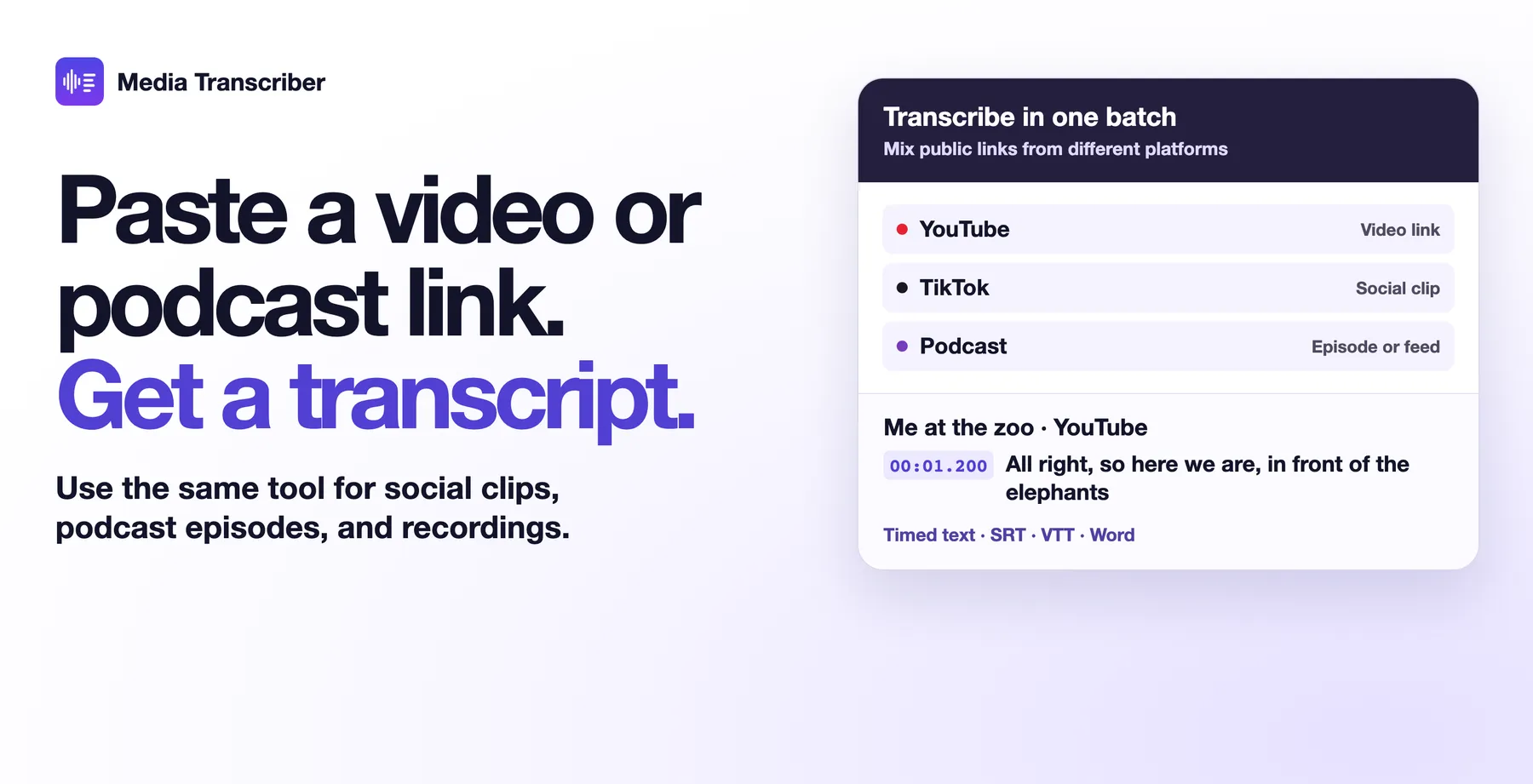
Transcribe videos, podcasts and files in one batch
- Mix links from different platforms. Paste YouTube, TikTok, Instagram, Loom or podcast links together. You can also include direct links to audio or video files.
- Get text you can edit and subtitles you can use. Export the transcript in Word or plain text, with timed segments and SRT or VTT subtitles where available. Turn on speaker labels or summaries as needed.
- Pay for audio transcription only when it runs. Existing captions and published podcast transcripts incur the transcript charge. Audio transcription and optional speaker labels carry separate per-minute charges.
Use supported public links, including videos, playlists, channels, podcast episodes and audio files.

Try a video, a social clip and a podcast
Open the actor input, switch to JSON and paste this example.
The example takes one episode from the podcast feed and limits audio transcription to five minutes per item.
| Zen Studio Video Transcripts • Every video and podcast to text |
 Media Transcriber ➤ You are here  X Transcripts X videos to text  TikTok Transcripts TikTok videos to text Douyin TranscriptsDouyin videos to text |
Copy to your AI assistant
How to transcribe a video or podcast link to text
- Paste your links into Audio and video links, one per line, or upload files under Upload files.
- Optionally pick the Transcript source, a Language, Label speakers, Summary, chapters and keywords or Translate to English.
- Start the run. Each video, episode or file becomes one row. A channel, playlist, podcast feed or show becomes its newest items.
- Export the dataset as JSON, CSV or Excel, or open the .txt, .md, .docx, .srt and .vtt files linked on each row.
Which links work?
| Source | What to paste | What you get |
|---|---|---|
| YouTube | Video, Shorts or live replay links, or a bare video ID; a channel (@handle, /channel/, /c/, /user/) or playlist link | Creator captions, or automatic captions with word timings, when the video has them; otherwise speech-to-text. Every row lists the caption languages the video offers. |
| TikTok, Instagram, Facebook, X | Video, reel or post link | Speech-to-text of the post's audio |
| Vimeo, Loom, Dailymotion, Rumble, Bilibili, SoundCloud | Video or track link | The site's own subtitles when it has them, otherwise speech-to-text |
Post links (reddit.com, redd.it) and v.redd.it video links; a post that links a YouTube or other video gives that video's transcript | Speech-to-text, or the linked video's captions | |
| Podcasts | RSS feed, Apple Podcasts show or episode link (?i=), Spotify episode or show link | The publisher's own transcript when the feed lists one, otherwise speech-to-text. Spotify links are matched to the same show's public feed. |
| Files | Direct links (mp3, m4a, wav, flac, ogg, mp4, webm, mov and more), Google Drive, Dropbox and OneDrive share links, files uploaded in the input form | Speech-to-text |
| Another run | datasetId or pasted datasetItems | One media link per row: the audio file first, then the video file, then the page |
Other public video pages are worth a try: if a link cannot be read, its row says why and is free.
Where does the transcript come from?
With Captions first (mode: "auto", the default), each item is answered by the best transcript that already exists, and audio is transcribed only when none does:
transcriptSource | Meaning | Audio minutes charged |
|---|---|---|
native_captions | Captions the creator or site published | No |
auto_captions | The platform's automatic captions (YouTube) | No |
publisher_transcript | The podcast publisher's transcript file, linked in transcriptFileUrl | No |
speech_recognition | Speech-to-text of the audio, with segment and word timings | Yes |
Always transcribe audio (mode: "transcribe") ignores captions and gives you speech-to-text with word timings for every item. Captions only (mode: "captionsOnly") never transcribes audio: items without captions return a free no_captions row.
Speech-to-text detects the spoken language (99+ languages), splits long recordings at pauses and stitches them back with continuous timestamps: a 31-minute podcast came back as 337 timed segments. Music-only or silent audio returns a free no_speech row instead of invented filler words. Sung audio returns the lyrics that were heard, with a note when fine timings are unavailable.
Input options
| Parameter | Type | Default | Meaning |
|---|---|---|---|
urls | array | Audio and video links, one per item, plus channel, playlist, feed and show links | |
audioFiles | array | Files uploaded in the input form | |
maxItemsPerSource | integer | 10 | Newest items taken from each channel, playlist, feed or show (1 to 500). A single video, episode or file is always one item. |
mode | string | auto | auto (captions first), transcribe (always speech-to-text) or captionsOnly |
language | string | Language code such as en, de or pt. Picks the caption track in that language, or the platform's translation into it, and tells speech-to-text what is spoken. Empty: detected. | |
translateToEnglish | boolean | false | English transcript and subtitles from any spoken language |
includeWordTimestamps | boolean | true | Every word with its start and end time (speech-to-text and automatic-caption rows) |
includeSubtitles | boolean | true | SRT, VTT and timestamped text on each row |
saveFiles | boolean | true | Store .txt, .md, .docx, .srt and .vtt files in the run's storage and link them on the row |
speakerLabels | boolean | false | Label who speaks when (S1, S2, ...) and count the speakers. Adds a charge per started minute and takes extra time. |
speakerCount | integer | Number of speakers, if you know it (1 to 12) | |
summarize | boolean | false | Short summary, chapters with start times and up to 15 keywords, written in the recording's language |
vocabulary | string | Names and terms the audio contains, comma-separated, so speech-to-text spells them right | |
maxMinutesPerItem | integer | 180 | Longer media is transcribed up to this length and the row says so. 0 means up to 600 minutes. Captions and publisher transcripts are always complete. |
publishedAfter | string | Channel, playlist and feed items published after a date (2026-09-01) or within a window (30 days) | |
titleContains | string | Channel, playlist and feed items whose title contains one of these words, separated by ` | |
watchlistId | string | A name for scheduled runs; items delivered under it are remembered | |
newItemsOnly | boolean | false | With a watchlist name, leave out items an earlier run delivered: no row, no charge |
datasetId | string | Transcribe the media of another run's dataset | |
datasetItems | array | The same, with rows pasted in |
Full descriptions are on the Input tab.
What data do you get from each video or podcast?
One row per media item, with these groups of fields:
- Media:
url,inputUrl,mediaUrl,platform,siteName,sourceType,discoveredVia,id,title,description,uploader,uploaderId,uploaderUrl,uploaderFollowers,publishedAt,thumbnailUrl,durationSeconds,viewCount,likeCount,commentCount,repostCount,tags,categories,creatorChapters,fileSizeBytes, and apodcastobject (show, author, feed, episode GUID, episode and season number, type, explicit flag, file type and size, language) for podcast episodes. - Transcript:
text,wordCount,language,languageProbability,languageSource,task,transcriptSource,captionTrack,availableCaptions,transcriptFileUrl,confidence,audioType,hasTimestamps. - Timing:
segments(start, end, text, and for speech-to-text, where available, the quality scoresavgLogprob,noSpeechProbandcompressionRatio),words(word, start, end),paragraphs,hook3s(the first three seconds of speech) andhookStartSeconds. - Ready to use:
srt,vtt,timestampedText,markdown(title, facts, summary, chapters and timestamped paragraphs for an LLM or a note), and file linkstxtFileUrl,markdownFileUrl,docxFileUrl,srtFileUrl,vttFileUrl. - Speakers and summary (optional):
speakers,speakerMinutes, aspeakerlabel on segments, words and paragraphs,summary,chapters,keywords,summaryNote. - Run and billing:
status,transcribedSeconds,chargedAudioMinutes,chargedEvents,charged,fromCache,cachedAt,isNew,repeat,firstSeenAt,firstSeenRunId,warnings,error,retryable,stopReason,processedAt.
Complete example row
A real row for a YouTube video with creator captions, with every field. It was delivered through the Standby URL, which leaves the five file links empty by default; batch runs fill them.
Speech-to-text fields
An excerpt of a real Loom row (selected fields; segments and words shortened to their first entries). confidence is the average certainty of the recognized text, from 0 to 1. On each segment, a low avgLogprob, a high noSpeechProb or a high compressionRatio (repetitive text) marks a passage worth checking.
Speaker labels, summary and chapters
An excerpt of a real podcast row with speakerLabels and summarize on and maxMinutesPerItem set to 3 (selected fields; arrays shortened, and the summary and paragraph texts cut after their first sentence). The SRT and VTT cues and the Markdown carry the same speaker labels.
Row status
status | Meaning | Charged |
|---|---|---|
transcript | A transcript was delivered | Yes |
no_speech | Music only, silence or no sound track | No |
no_captions | Captions only mode, and the item has none | No |
unavailable | Removed, private, needs a login, a live broadcast in progress, or only playable inside its own app | No |
skipped | Duplicate of another input, filtered out, or not reached within the run's cost or time limit | No |
error | Not a usable link, or the item could not be completed; retryable says whether trying again can help | No |
Every row that is not a transcript carries error.code and a plain-language error.message.
Dataset views and run records
The dataset has five views: Overview, Transcripts, Media details, Files and subtitles and Not delivered. Each run also writes two records to its key-value store: SUMMARY (delivered transcripts, charged events, why the run stopped and how many items each transcript source answered) and ERRORS (every undelivered item with its reason, detail and whether a retry can help).
Transcribe channels, playlists and podcasts on a schedule
Follow a YouTube channel, a playlist or a podcast and transcribe only what is new:
- Save this input as a task and add an Apify schedule, for example daily.
- Every item delivered under
watchlistIdis remembered in your own Apify storage. WithnewItemsOnly, later runs leave out items already delivered: no row and no charge. - Without
newItemsOnly, repeats are still delivered and marked:isNew,repeat,firstSeenAtandfirstSeenRunIdtell you when the item first appeared. - Connect the run to Make, Zapier, n8n, Google Drive or a webhook to receive each new transcript.
Watch Apify's short guide: Schedule your Actor.
Transcribe another actor's results
Put another run's dataset ID in datasetId, or paste rows into datasetItems. Each row gives one media link: an audio file first, then a video file, then the item's page. Images, avatars and profile links are never picked. Use it after a TikTok, Instagram, YouTube or podcast scraper to turn its results into transcripts.
Get one transcript per request (Standby)
The actor also answers HTTP requests directly: send one link, get its transcript in the same response. Use your Apify token as a Bearer header.
| Method | Path | Body or query | Returns |
|---|---|---|---|
| GET | / | url plus any option below | One transcript row and a short receipt |
| POST | / | JSON {"url": "..."} plus any option below (or the same object under "input") | The same |
Options: mode, language, translateToEnglish, speakerLabels, speakerCount, summarize, vocabulary, includeWordTimestamps, includeSubtitles, maxMinutesPerItem. A GET without parameters returns a short usage note.
The response, with the row shortened to a few fields here (it carries every field of the complete example above):
transcripts: the delivered row (one link per request).deliveredandchargedsummarize the request, andchargedEventslists what was charged.notes: plain-language messages, for example why a link could not be transcribed. Such requests return HTTP 200 withdelivered: 0, the explanatory row inrows, and no charge.- HTTP 400 means the request itself needs fixing: no
url, invalid JSON, or more than 120 minutes requested. - One link per request, up to 120 minutes of audio; start a batch run for longer media, channels or feeds. File links are not saved by default.
- Measured on a captioned YouTube video: about 2.4 seconds when the service is warm and about 8.7 seconds from a cold start. Speech-to-text takes longer, depending on the length of the audio.
Each delivered transcript is charged with the same transcript, audio-minute and speaker-labelled-minute events as in a batch run. See the Standby documentation.
Use it from code and AI agents
Run it with the Apify API and get the rows back in one call:
Or with the Python client:
AI agents can call it through Apify's MCP server and read the markdown field, which holds the title, key facts, summary, chapters and timestamped paragraphs in one block. The "Copy to your AI assistant" block above points an assistant to the full documentation.
How does it compare?
Measured by running the three most-used multi-site transcribers on the Apify Store with the same 10 links (YouTube, TikTok, Instagram, X, Loom, Vimeo, Facebook, a FLAC file, SoundCloud and Dailymotion; about 11 minutes of media), each with a $0.25 cost limit.
| This actor | The three most-used alternatives | |
|---|---|---|
| Transcripts delivered from the 10 links | 10 | 7, 6 and 4 |
| Links not transcribed | None | Two stopped at the cost limit before reaching some links; one refused the YouTube, Instagram, Vimeo and Dailymotion links |
| Output fields on a delivered row | 75 | 41, 34 and 6 |
| Same 10 links again | 14 seconds, 9 of 10 returned right away (the direct file is transcribed again) | Not measured |
How much does it cost to transcribe video and audio?
Pay per event, no subscription. These are the planned launch prices; the actor's Pricing tab shows the prices that apply to your run.
| Event | When it is charged | Free plan price |
|---|---|---|
| Actor start | Once per run, per GB of run memory | $0.002 per GB ($0.004 at the default 2 GB) |
| Transcript | Each delivered transcript row, from any source | $1.99 per 1,000 |
| Audio minute | Each started minute of speech-to-text | $7.99 per 1,000 |
| Speaker-labelled minute | Each started minute labelled, only with speakerLabels on | $9.99 per 1,000 |
Paid Apify plans pay less for audio and speaker-labelled minutes:
| Event, per 1,000 | Free | Bronze | Silver | Gold |
|---|---|---|---|---|
| Transcript | $1.99 | $1.99 | $1.99 | $1.99 |
| Audio minute | $7.99 | $6.99 | $6.99 | $6.99 |
| Speaker-labelled minute | $9.99 | $8.99 | $8.99 | $7.99 |
Examples on the Free plan, per item and before the run's start charge:
| Item | Charges | Cost |
|---|---|---|
| YouTube video with captions, any length | 1 transcript | $0.002 |
| 1-minute TikTok clip | 1 transcript + 1 audio minute | $0.010 |
| 30-minute podcast episode, speech-to-text | 1 transcript + 30 audio minutes | $0.242 |
| The same episode with speaker labels | 1 transcript + 30 audio minutes + 30 speaker-labelled minutes | $0.541 |
| Podcast episode with a publisher transcript | 1 transcript | $0.002 |
Captions, publisher transcripts and items returned from an earlier transcription never add audio minutes. no_speech, no_captions, unavailable, skipped and error rows are free. Set a Maximum cost per run on the run options to cap spending: items the limit does not cover come back as free skipped rows.
FAQ
Do I need an account, cookies or my own key for the sites? No. You paste public links; the actor does the rest.
What if the video has no captions? In the default mode the audio is transcribed instead. Use mode: "captionsOnly" if you only want existing captions; items without them are free.
Can I get a transcript of a Spotify podcast? Yes, when the show also publishes a public podcast feed, which most shows do. The Spotify episode is matched to the same episode in that feed by title and date. A show that exists only on Spotify returns a free unavailable row saying so.
Can I transcribe a whole YouTube channel or playlist? Yes. Paste the channel or playlist link and set maxItemsPerSource (up to 500 newest items per link). Narrow it with publishedAfter and titleContains.
How do I transcribe only new episodes or videos? Schedule the run with a watchlistId and newItemsOnly: true. See Transcribe channels, playlists and podcasts on a schedule.
Which languages are supported? Speech-to-text detects 99+ languages automatically. Set language when you know it; with captions it also picks the track in that language. translateToEnglish returns an English transcript and subtitles from any language.
How do speaker labels work? Turn on speakerLabels. Segments, words, paragraphs and subtitle cues get labels such as S1 and S2, and speakers counts them. Labels do not identify who a speaker is. Labelling adds time and a per-minute charge; for long recordings, give the run 4 GB of memory.
Can it summarize a video or podcast? Turn on summarize for a short summary, chapters with start times and up to 15 keywords, written in the recording's language. They are machine-written from the transcript, so check them before publishing. If a summary cannot be made, the transcript is still delivered and summaryNote says so.
How long can a recording be? Up to 600 minutes per item in batch runs (maxMinutesPerItem: 0), 180 by default, and 120 minutes per Standby request. Longer media is transcribed up to the limit and the row says so.
Which formats do I get? JSON, CSV or Excel exports of the dataset, plus .txt, .md, .docx, .srt and .vtt files per transcript, linked on the row. JSON keeps the nested segments, words and chapters intact.
Why is a row marked fromCache? The same public video or podcast episode was transcribed before with the same settings, so the stored transcript was returned right away, with no audio minutes charged. Only the transcript text and timings are kept, never who asked for it or the links they used. Direct files, cloud share links, uploads and private podcast feeds are always transcribed fresh.
What happens with music-only or silent media? You get a free no_speech row with no invented text.
Can I upload my own recordings? Yes, under Upload files, or paste a Google Drive, Dropbox or OneDrive share link or a direct file link.
Is it legal? It reads publicly available media. You are responsible for how you use the transcripts, including copyright and privacy rules that apply to you.
Limits
- Public media only. Private, members-only, login or age-check, paywalled and DRM-protected media cannot be transcribed, and neither can live broadcasts still in progress.
- Spotify shows without a public feed, and media that only plays inside its own app, return a free
unavailablerow. - Local file paths and private network addresses are not accepted as links.
- Very large files beyond the supported download size return a free error row.
Support
Found a problem or need a field or a site? Open an issue on the Issues tab.


