
13F Portfolio Tracker
Pricing
from $4.25 / 1,000 delivered 13f manager filing reports
13F Portfolio Tracker
Check up to 100 institutional managers for bounded 13F-HR filing activity from official SEC EDGAR data. Get resolved identity, filing metadata, primary links, observation time, confidence, gaps, and billing. Unknown managers are free. Filing events are not current holdings or investment advice.
Pricing
from $4.25 / 1,000 delivered 13f manager filing reports
Rating
0.0
(0)
Developer

Tim Zinin
Maintained by CommunityActor stats
0
Bookmarked
2
Total users
1
Monthly active users
a month ago
Last modified
Categories
Share
13F Portfolio Tracker — New Filings by Institutional Manager
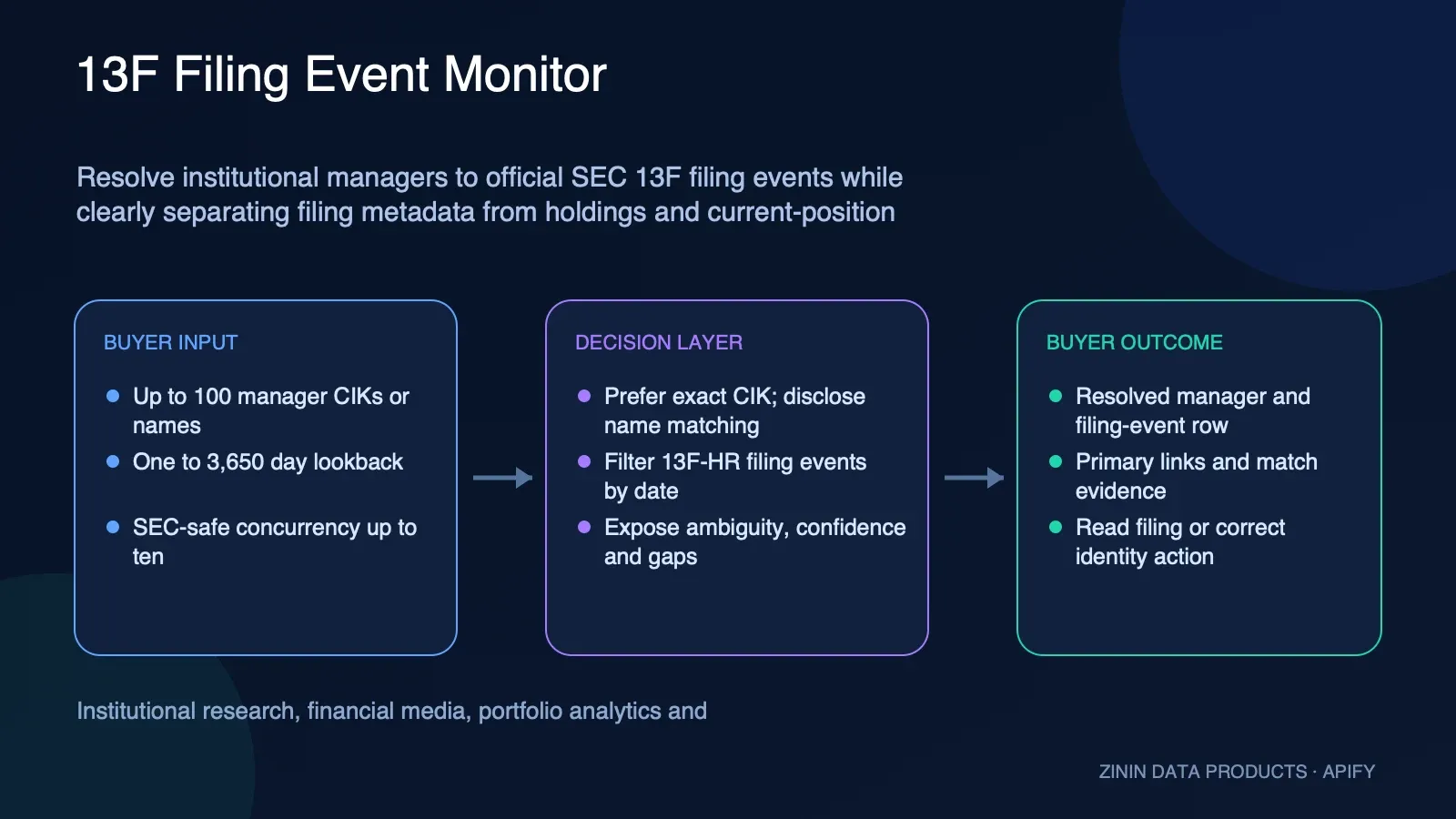
Did a hedge fund or family office just file their quarterly 13F? Point this Actor at a list of institutional managers — by SEC CIK or by name — and get back every 13F-HR filing that landed in your lookback window, straight from official SEC EDGAR data. No API key, no browser, no login.
Who is this for
- Investors & analysts — an alert-ready feed of 13F-HR filings for a watchlist of managers, without babysitting the EDGAR full-text search UI.
- Journalists & researchers — track when a specific fund last disclosed its quarterly holdings.
- Fintech builders — a clean, structured 13F filings feed to wire into a bot, dashboard or n8n workflow.
- Allocators & LPs — monitor filing cadence for managers you track or invest alongside.
What you get
- A structured filings feed — resolved company name, filing count in your window, and the filings themselves (form, filing date, accession number, EDGAR link) — no scraping, no rendering.
- A confident name→CIK match, not a guess. A manager name only resolves to a filer when the name similarity clears a 0.85 bar; below that, you get a short list of the closest candidates with their scores instead of a silently wrong company's holdings.
- CIK input skips resolution entirely — a 10-digit CIK is unambiguous and goes straight to the filing history.
- Match evidence on every resolved row —
matchConfidenceandmatchBasistell you whether the row came from an exact CIK or a scored name match, and how confident that match was. - Runs on Apify: schedule it, monitor it, call it from the API or the MCP server, export to JSON/CSV/Excel, or push straight into your own pipeline.
Why it matters
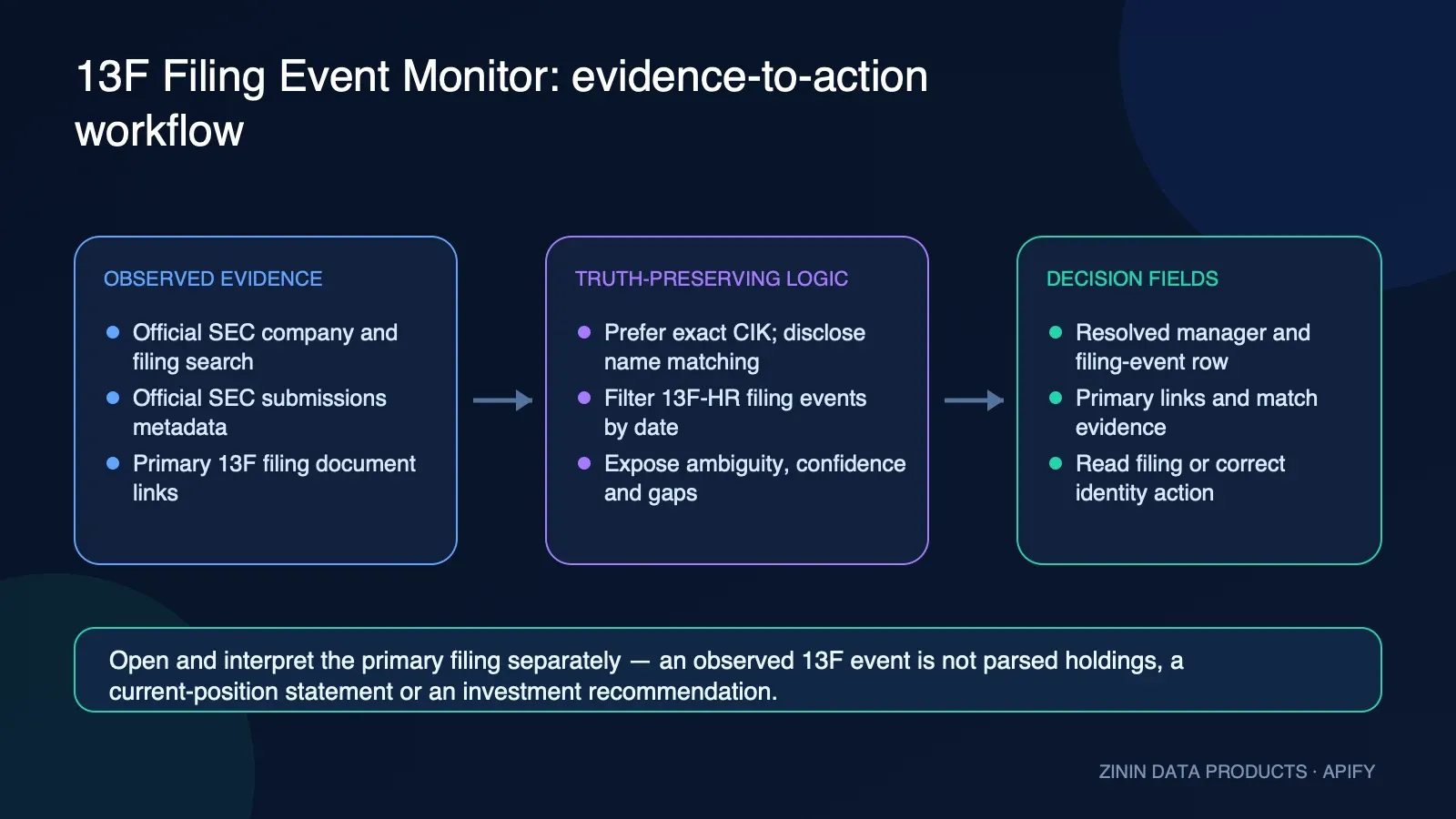
13F-HR is an SEC filing type used by qualifying institutional investment managers. This Actor monitors filing events and links primary records; it does not parse the information table or infer what a manager bought, sold or currently holds. It resolves each requested manager once per run and emits a reviewable event row.
How to run it
- Click Try for free — no card needed on the free plan.
- Paste managers into Managers, one per row — a 10-digit SEC CIK (most reliable) or a manager name.
- Press Start and read the results from the dataset — UI, API or webhook.
Pricing
Pay-per-event: $0.005 per run start + $0.005 per result. 100 managers cost about $0.51; 1,000 managers about $5.01.
A manager that could not be resolved to a single filer — a bad CIK, no name match, or a name that matches several filers too closely to call — is still returned so you can see why, and it is not charged for. You pay for an identified filer's filings, not for an attempt.
简体中文说明
输入一批机构投资者(10 位 SEC CIK 编号,或机构名称),此 Actor 会直接读取官方 SEC EDGAR 数据,返回该机构在你设定窗口内提交的每一份 13F-HR 季度持仓披露:表格类型、提交日期、accessionNumber 和 EDGAR 链接。13F-HR 是机构投资管理人按季度披露其美股持仓的 SEC 表格,是了解"这只基金买了/卖了什么"最主要的公开信息来源。
用机构名称查询时,只有名称相似度达到 0.85 以上才会被判定为匹配成功(matchConfidence/matchBasis);相似度不够时不会强行返回一个可能是错误机构的结果,而是给出候选机构列表(candidates),附带各自的相似度分数——直接用 CIK 编号可以完全跳过名称匹配这一步。
当前版本(v0.1)不解析每份 13F-HR 内部的具体持仓明细(股票、股数),只列出备案本身;url 指向该机构在 EDGAR 上的备案列表,需要具体持仓明细的话,点进去查看对应备案的信息表。
计费为按事件付费:每次运行 $0.005,每条成功解析的结果 $0.005。无法解析为唯一机构的输入(CIK 有误、名称无匹配、或名称同时匹配多个机构)仍会返回原因说明,不计费。100 个机构约 $0.51,1000 个约 $5.01。本 Actor 不构成投资建议,v0.1 也不解析基金的实际持仓明细——它只告诉你某份 13F-HR 何时由谁提交,并给出链接。
Input
| Field | Type | Description |
|---|---|---|
managers | array of strings | Institutional managers to watch — a 10-digit SEC CIK (e.g. 0001067983, used as-is) or a manager name resolved against EDGAR's filer index (e.g. Bridgewater Associates). A name that matches several filers too closely to call returns the shortlist with similarity scores instead of picking one — use the CIK, or the filer's full name, for anything generic like Capital Management. Required. |
sinceDays | integer | Only include 13F filings from the last N days. Default 365, max 3650 (10 years). |
maxConcurrency | integer | Parallelism (1–10, default 5). SEC EDGAR's documented rate limit is 10 requests/second. |
Output
One row is emitted per unique manager input. Manager identity, filing counts and dates are not embedded as evergreen facts; the exact-build canary receipt supplies the release's bounded live example and KVS OUTPUT reconciliation.
| Field | Description |
|---|---|
manager | The CIK or name you passed |
cik / companyName | The resolved filer's CIK and name on EDGAR |
found | Whether this manager resolved to exactly one filer |
matchConfidence | 1 for a CIK given outright; the name-similarity score (0–1) for a name match |
matchBasis | cik, name, or ambiguous (see below) |
candidates | Empty on a confident match. On an ambiguous name, the shortlist of closest filers instead — cik, name, score for each |
filingsCount / recentFilings | How many 13F-HR filings landed in sinceDays, and the filings themselves |
summary | Human-readable recap, including how the manager was matched |
error | Present only when found: false — why (bad CIK, no name match, or ambiguous — see FAQ) |
An unresolvable manager (bad CIK, no name match, or a name matching several filers below the 0.85 confidence bar) returns found: false with an error explaining why — never a guessed or partial row.
API
Start a run with a bearer token and explicit JSON input:
Read Dataset rows using the returned defaultDatasetId:
MCP
For an Apify MCP client exposing the standard call-actor tool, send this exact payload:
Related tools
Related tools for adjacent workflows in financial signals and markets.
| Actor | What it does |
|---|---|
| Funding Round Tracker | Pair it in the financial signals and markets workflow: Track recent SEC Form D filings by company name or sector keyword — the notice a company files when it... |
| Insider Trading Tracker | Pair it in the financial signals and markets workflow: Track insider stock trades — SEC Form 3/4/5 filings — for any list of tickers |
| SEC Filing Watcher | Pair it in the financial signals and markets workflow: Watch stock tickers for new SEC filings — 10-K, 10-Q, 8-K, S-1 and more |
| Patent Filing Monitor | Pair it in the financial signals and markets workflow: Watch keywords or technologies for newly granted US patents |
| Clinical Trials Monitor | Pair it in the financial signals and markets workflow: Watch conditions, drugs or sponsors for new and updated clinical trials |
FAQ / Limitations
Does it need an API key or login? No — EDGAR full-text search and submissions/CIK*.json are public SEC EDGAR endpoints.
Does this parse the actual holdings (stocks, share counts)? Not in v0.1 — this Actor lists the 13F-HR filings themselves (form, date, accession number, EDGAR link), not the parsed information-table holdings inside each filing. Use the url to open the manager's filing list on EDGAR and drill into a specific filing's information table.
Why is the url the same for every filing of a manager? A 13F-HR's payload is an XML information table, not a single readable primary document — so v0.1 links to the manager's own filing list on EDGAR (browse-edgar?...&type=13F) rather than guessing at a per-filing document path.
Can I look up a manager by name instead of CIK? Yes — a name resolves to a filer only when EDGAR's own similarity score against that filer's name clears 0.85. Below that bar, you get found: false with a candidates shortlist of the closest filers and their scores, instead of a confident-looking row for the wrong fund. A generic name like "Capital Management" is exactly the case this guards against — for an unambiguous result, give the CIK, or the filer's full legal name.
What happens when a name is ambiguous? The row returns found: false, matchBasis: "ambiguous", and candidates — each with cik, name and its similarity score — so you can re-run with whichever CIK is the right one, or with the filer's full name.
How fresh is the data? Every row records when EDGAR was queried. SEC publication timing and availability remain upstream conditions; read the cited filing for authoritative status.
Can I call it from an AI agent? Yes — it's a standard Apify Actor, callable via the Apify API or the Apify MCP server.
What this is NOT. Not investment advice, and not a parser of a fund's actual stock positions in v0.1 — it tells you a 13F-HR was filed, when, and by whom, and links you to it.
Found a wrong result, or need a doubtful match resolved differently? Open an issue on this Actor's page.
Built by zinin. Questions? Telegram @timzinin.
What this Actor is — and is not
13F Portfolio Tracker is a filing-event monitor for institutional managers. It accepts exact SEC CIKs or manager names, resolves identity conservatively, checks official submissions data for recent 13F-HR/13F-HR-A filings, and returns evidence-linked review rows with confidence, gaps and a manual action.
It is not a portfolio or holdings parser. It does not read the information table, calculate position
changes, infer buys or sells, identify beneficial ownership, account for confidential treatment,
merge affiliated managers, or establish a current position. A 13F event is historical regulatory
metadata, not a legal conclusion or investment recommendation. Every row therefore keeps
safeToAutomate:false.
Identity first: CIK versus name
An exact CIK is the strongest supported input. The Actor pads it to ten digits and uses it directly against SEC submissions data. A manager name is not a unique identifier. The Actor searches EDGAR, normalizes legal-name noise, scores similarity and accepts only a sufficiently strong unambiguous match. If several filers could fit, it returns a free candidate shortlist rather than selecting a fund silently.
For name-resolved rows, review companyName, cik, matchBasis, matchConfidence and
candidates. Use the resulting CIK as the canonical identity in later runs. Parent companies,
advisers, funds and similarly named entities can be different filers; matching a familiar name is
not enough.
Evidence and interpretation contract
The decision layer adds recordType, schemaVersion, entityId, observedAt,
confidenceScore, confidenceBand, confidenceReasons, confidenceRisks, sourceEvidence,
dataGaps, negativeSignals, recommendedAction, actionPriority, actionReason,
interpretationBoundary, failureType, retryable, partial, failureDiagnostics, billing
and safeToAutomate without removing the existing filing fields.
Confidence measures identity/source strength. An exact-CIK row can be high confidence even when no filing appears in the selected window. It does not measure the manager's performance, filing accuracy, timeliness relative to current positions or relevance to a specific strategy.
sourceEvidence retains SEC links. The filing list URL is intentionally conservative: it points to
the filer's own 13F history rather than inventing a readable document path. Accession numbers and
filing dates remain the structured evidence needed for a downstream parser.
What the row proves
A successful row proves that the supplied or resolved CIK was observed in SEC submissions data and that the listed filing events passed the chosen lookback/form logic at run time. It does not prove what securities were reported, whether an amendment superseded a row, whether confidential data was omitted, or whether the manager still holds any reported asset.
A zero-filing row proves only that this bounded query did not observe a matching 13F event inside the selected window. It is not proof that the filer has never filed 13F, is exempt, has no assets, or is no longer active.
An ambiguous-name advisory proves that the Actor refused to guess. Resolve it with an exact CIK or the complete legal filer name. Do not treat the candidate with the highest score as accepted unless your own evidence confirms it.
Review playbooks
Manager filing watch
Maintain a verified CIK watchlist, run it on a schedule, and route new accession numbers to a review queue. Open the SEC record and determine whether it is an original filing or amendment. Persist the exact lookback and observation time so an absence has a defined meaning.
Holdings-analysis handoff
Use this Actor only to discover filing events. Pass accession numbers into a separately validated information-table parser. That downstream step must preserve filing version, amendment status, reported quarter, units and confidential-treatment limitations. Do not label event discovery as a parsed portfolio.
Research or media monitoring
Use READ_PRIMARY_SEC_FILINGS as a task-creation instruction. A headline or external statement
should cite the filing, not this Actor's summary alone. Avoid “manager bought/sold” language until
the relevant information table and comparison method have been verified.
Agent workflow
An agent may schedule checks, deduplicate accession numbers and open review tasks. It must branch
on matchBasis, confidence, failureType, retryable, partial and safeToAutomate. It must not
publish a current-position assertion, investment action or legal conclusion automatically.
Happy, empty, ambiguous, and failed examples
Happy exact-CIK path: found:true, matchBasis:"cik", matchConfidence:1, a verified CIK and one
or more recent filings. Confidence is high and the recommended action is to read the primary SEC
filings. Billing represents one delivered manager evidence row, not one charge per nested filing.
Happy name path: found:true, matchBasis:"name", a disclosed matched filer and similarity score.
The row remains manually reviewable because name resolution is weaker than an exact CIK.
Valid empty path: found:true, filingsCount:0, empty recentFilings, and a schedule-recheck
action. It is a complete bounded observation when the source and identity succeeded.
Ambiguous path: found:false, matchBasis:"ambiguous", candidate CIK/name/score entries,
failureType:"invalid_or_ambiguous_input", retryable:false, and no result charge. Supply an exact
CIK rather than retrying the same name.
Transient failure: found:false, failureType:"source_unavailable", retryable:true, a source
gap and free billing. Retry with backoff; never convert this state into “no filing.”
Run-level OUTPUT
The default Dataset contains manager rows. KVS OUTPUT reconciles the run: requested, unique,
duplicate, attempted, delivered, paid, local-non-monetized, free, source-failure and withheld
counts, plus status, partial, budgetStopped, fatalError, replaySafe, completedAt and
resultsUrl.
COMPLETE means every unique manager reached a terminal delivered state without a recorded source
or budget gap. PARTIAL means at least one manager produced an advisory or was withheld. FAILED
means the linked delivery/money state became unsafe or unknown. If replaySafe:false, inspect the
prior Dataset and charged-event receipt before any rerun.
Concurrent manager checks share one serialized billing critical section. The remaining budget is
read directly before linked pushData(row, "result-found"); workers cannot all spend the same
allowance. An ambiguous or failed identity row remains free.
Field dictionary
manager echoes the input. cik is the normalized SEC filer identifier. companyName is the name
from submissions data. matchBasis is cik, name or ambiguous. matchConfidence is identity
similarity, not data or investment confidence. candidates appears when the Actor refuses an
ambiguous name. filingsCount counts only recent supported forms in the selected window.
recentFilings retains form, date, accession number and SEC URL.
checkedAt is the original observation timestamp. observedAt is the normalized decision-layer
timestamp. confidenceScore and confidenceBand summarize evidence strength. dataGaps and
interpretationBoundary must travel with any downstream copy of the row.
API and warehouse integration
Start a run with managers, sinceDays and bounded concurrency. After completion, fetch Dataset
items and the OUTPUT KVS record. Reject “complete” status when OUTPUT says partial or failed.
For a warehouse, use CIK plus accession number as the event key. Keep manager input and match basis for auditability. For alerts, compare accession numbers across successful runs and suppress repeats. Do not infer a deletion when an older filing leaves the lookback window.
For a holdings parser, treat recentFilings as discovery input. Validate document selection and
amendment handling in that separate product. This Actor intentionally does not claim those results.
Source, privacy, and retention
The Actor reads official public SEC filer search and submissions endpoints with a descriptive User-Agent, bounded concurrency, timeouts and response-size caps. It does not log into accounts, bypass rate limits, buy private datasets or extract contact details.
Public regulatory metadata can be joined with sensitive internal research. Apply access controls, retention rules and a documented purpose to the combined dataset. Keep SEC attribution and primary links. Review current SEC fair-access guidance and any downstream redistribution obligations.
Operational acceptance checklist
- Prefer exact CIKs for production watchlists.
- Resolve ambiguous names manually and then persist the chosen CIK.
- Keep source links, accession numbers and observation timestamps.
- Read Dataset and OUTPUT together.
- Separate filing-event discovery from holdings parsing.
- Treat zero filings, ambiguous identity and source failure as different states.
- Require human review before external, legal or investment interpretation.
Release evidence contract
One bounded no-retry canary must tie the exact production candidate to its Dataset, KVS OUTPUT, charged events, usage and cheapest-tier coverage. The run receipt reconciles requested, unique, duplicate, successful, failed, delivered, paid, free and withheld outcomes. It proves whether the run is complete, partial, failed and safe to replay. This delivery evidence does not turn a filing event into parsed holdings or a current-position claim.


