

Google Trends Scraper: Interest, Related and Trending Now
Pricing
from $1.20 / 1,000 query with data
Google Trends Scraper: Interest, Related and Trending Now
Google Trends scraper for search terms and comparisons: interest over time, interest by region, related queries, plus the full Trending now list per country. Batch up to 2,000 queries, no charge for empty results.
Pricing
from $1.20 / 1,000 query with data
Rating
0.0
(0)
Developer

AgentToolWorks
Maintained by CommunityActor stats
0
Bookmarked
2
Total users
1
Monthly active users
4 hours ago
Last modified
Categories
Share
What is this Google Trends scraper?
This Actor is a Google Trends scraper, and a practical Google Trends API: give it search terms (matcha, cold brew) or comparisons of up to five terms (coffee, tea), and get one row per query with interest over time, interest by region (country, region, US metro or city) and related queries (top and rising), exactly as the Google Trends explore page shows them. Or read the full Trending now list of a country, one row per trending search, with its start time, search volume, categories and trend breakdown.
In short
- What you get: interest over time, interest by region and related queries (top and rising) for up to 2,000 terms or comparisons per run, one row per query; or the whole Trending now list of a country, one row per search.
- What it costs: $1.50 per 1,000 queries with data ($1.20 on Apify Business plans) plus $0.003 per run, platform usage included. A query Google has no data for is returned with the reason and never charged.
- Why this one (Store data read 2026-10-05, prices read again 2026-10-13): on Apify's free plan, $1.50 where apify/google-trends-scraper charges $3.00 plus platform usage and data_xplorer $2.00 plus $0.025 per run; comparisons of up to 5 terms with related queries and regions, which data_xplorer does not offer; and 109 of our 110 runs succeeded on 2026-10-05 (the one failure was an empty input, refused by design), where the leader's 30-day success rate was 59.3%.
Batch up to 2,000 queries per run. Duplicates are dropped before any request, and a query Google has no data for is returned with the reason and never charged.
No Google account, no API key, no cookies from a signed-in browser: the Actor reads what Google Trends shows any logged-out visitor.
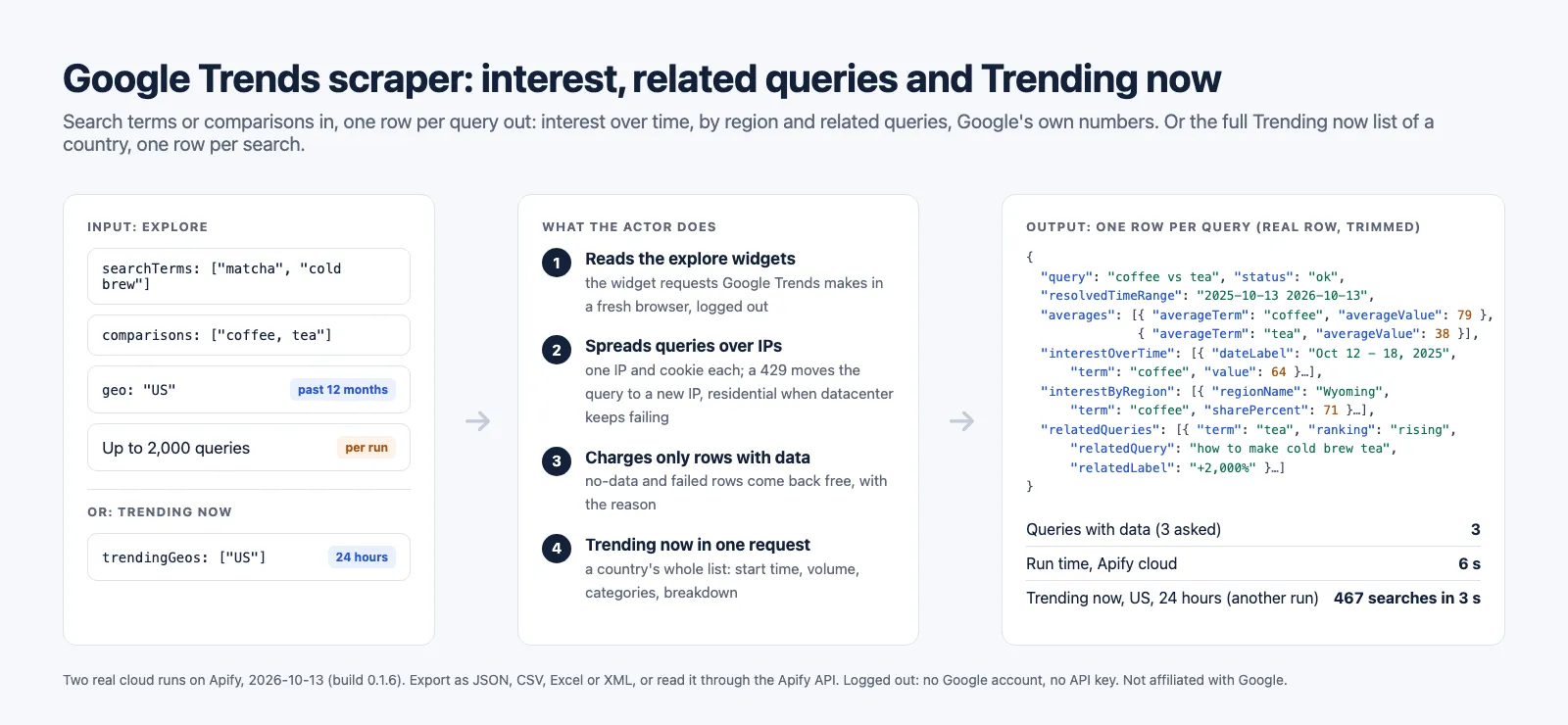
What data can you extract from Google Trends?
Two modes, one row type each.
Explore (one row per search term or comparison):
| Section | What you get |
|---|---|
| Interest over time | One point per date (or hour, or minute) and term, 0 to 100 relative to the chart's highest point, with Google's own date label and a flag on the last, still partial, point |
| Averages | Google's average per term over the period, for comparisons |
| Interest by region | One point per region and term: countries, regions or states, US metro areas (DMA) or cities with coordinates, plus each term's share in a comparison |
| Related queries | Top (0 to 100) and rising (+2,000% or Breakout) for each term, with a link to each one on Google Trends |
| Related topics | Opt-in, see the limits: Google sends logged-out visitors an empty list for most queries |
| Context | The time range Google resolved (2025-10-13 2026-10-13), the bucket it chose (WEEK), category, search type, a link to the same chart on trends.google.com, and a status (ok, partial, no_data, failed) with notes |
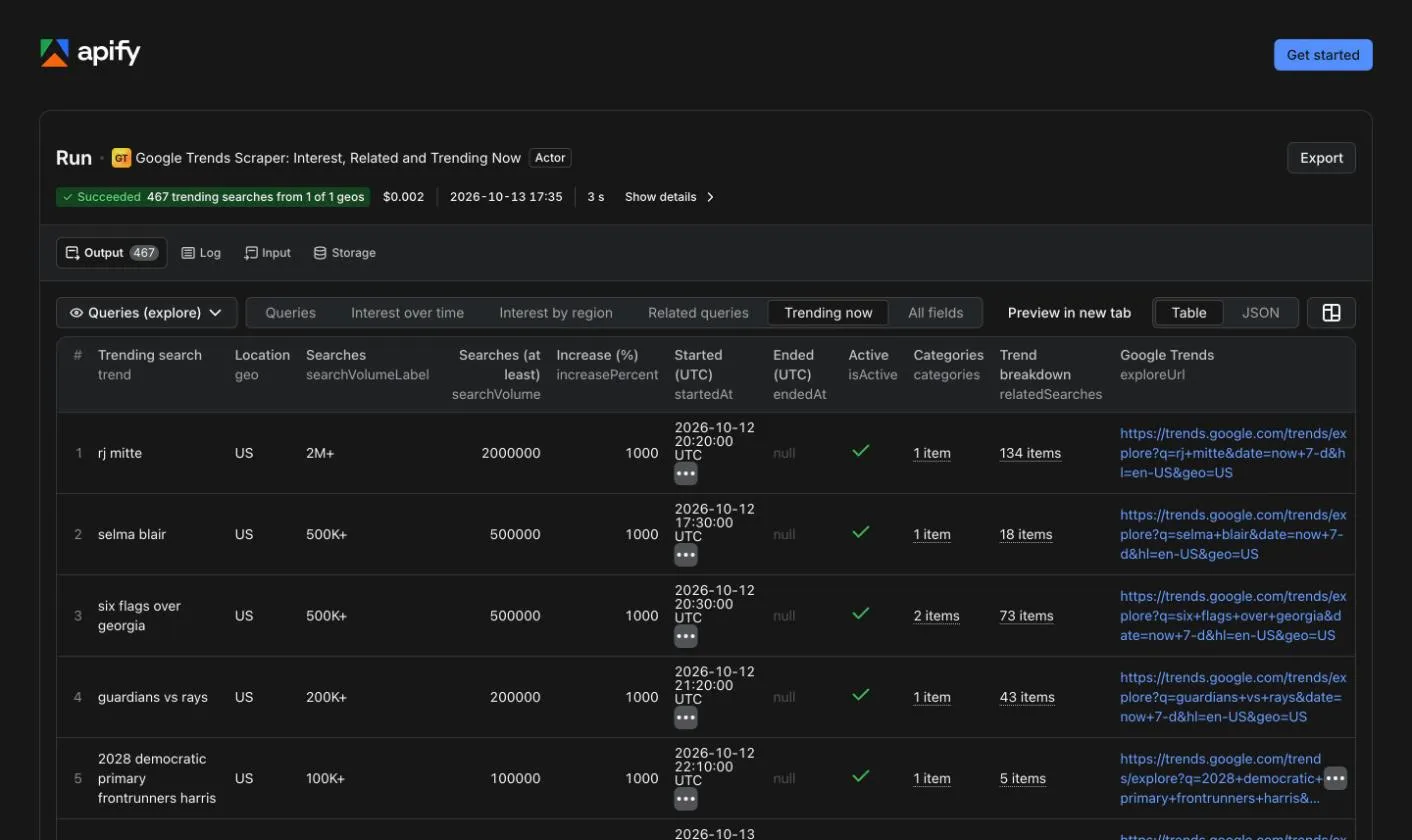
Trending now (one row per trending search): the search, country or region, Google's volume bucket (2M+) and its lower bound as a number, increase in percent, when it started trending and when it stopped (or null while active), active flag, categories, the searches Google groups under it (its trend breakdown), and a link to it on Google Trends.
Every key is on every row, null or an empty list when Google gives nothing, so a CSV export always has the same columns.
What can you use Google Trends data for?
- Keyword and content research: rising queries around a topic, before they show up in keyword tools.
- Product and market research: compare brands, products or categories on one 0 to 100 scale, by state or metro.
- Seasonality: five years of weekly interest, or every month since 2004, for each term of a list.
- News and social monitoring: what is trending in a country right now, refreshed on a schedule.
- Data for AI agents and pipelines: one predictable JSON row per query, in long format (one element per date and term), the same shape for one term or five.
How to scrape Google Trends
- Click Try for free (or Start) on this page and sign in to Apify.
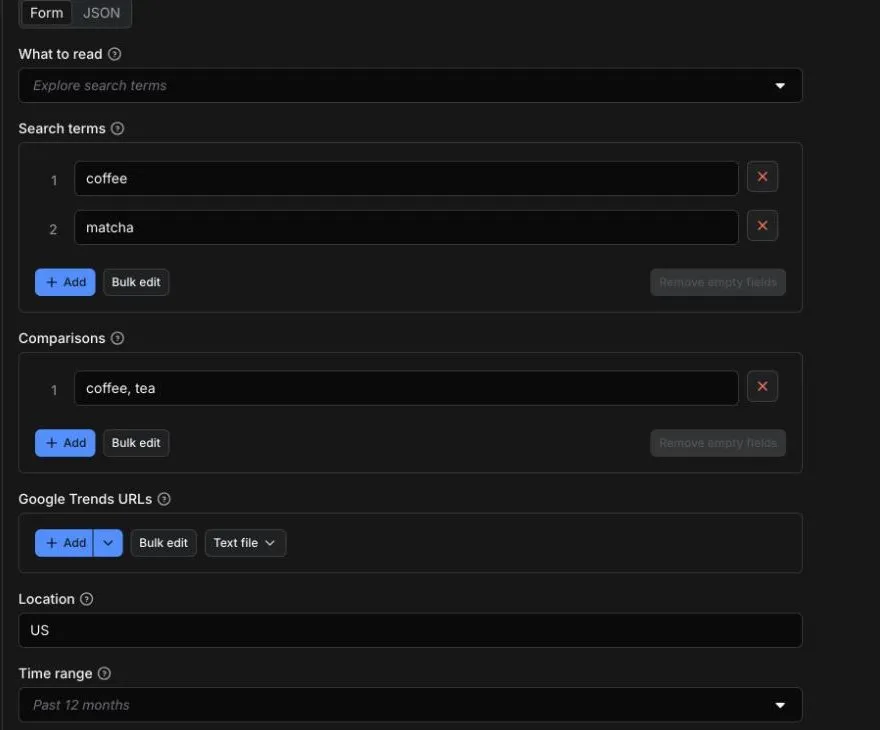
- Keep What to read on Explore search terms. Type one search term per line, or a comparison of 2 to 5 terms separated by commas.
- Pick the Location (empty for worldwide,
US,US-CA), the Time range and, if you want, a category or a search type (web, images, news, YouTube, Shopping). - Click Start. When the run finishes, open the Output tab and pick the Queries, Interest over time, Interest by region or Related queries view, then export as JSON, CSV, Excel or XML, or read it through the API.
- For Trending now, set What to read to Trending now, list the countries, and open the Trending now view.
Input
| Field | What it does |
|---|---|
mode | explore (default) or trendingNow. |
searchTerms | One term per line, each read on its own. A topic ID such as /m/02vqfm works too. |
comparisons | 2 to 5 terms per line, separated by commas, compared on one scale as on the Google Trends page. |
startUrls | Google Trends explore URLs (https://trends.google.com/trends/explore?q=...). Each keeps its own terms, location, dates, category and search type. |
geo | Empty for worldwide, a country (US, FR), a region (US-CA) or a US metro (US-CA-807). |
timeRange, customTimeRange | Past hour to "2004 to present", as on the page, or exact dates (2024-01-01 2024-12-31). |
category, property | A Google Trends category ID (71 is Food & Drink) and the search type: web, images, news, YouTube or Shopping. |
sections | Interest over time, interest by region and related queries by default; related topics opt-in. Same price whatever you pick. |
regionResolution, includeLowVolumeRegions | Countries, regions, US metros or cities, and Google's own low-volume checkbox. |
language, timezoneOffsetMinutes | Language of Google's labels, and the time zone of hourly and daily buckets. |
trendingGeos, trendingHours, trendingCategories, trendingActiveOnly, maxTrendingPerGeo | Trending now mode: countries or regions, past 4, 24 or 48 hours or 7 days, Google's 19 categories, the "Active" filter, and an optional cap per country. |
proxy | auto (default): Apify datacenter IPs, one per parallel session, with residential IPs taking over a session that keeps failing. none is one IP, paced, and suited to a few queries only. |
Up to 2,000 explore queries per run.
Example: two terms and a comparison in the United States, past 12 months (the run on this page).
Example: five years of weekly interest for a list of products, worldwide, YouTube search.
Example: interest by US metro area for one term.
Example: Trending now in three countries over the past 24 hours, sports only.
Output
The dataset holds one row per query (explore) or one row per trending search (Trending now), with five ready-made views in Apify Console and in the API:
- Queries: query, status, location, time range, the period and bucket Google resolved, averages and notes.
- Interest over time: one row per date and term, ready for a chart or a spreadsheet.
- Interest by region: one row per region and term, with the share of each term in a comparison.
- Related queries: one row per related query, top and rising.
- Trending now: one row per trending search (Trending now runs).
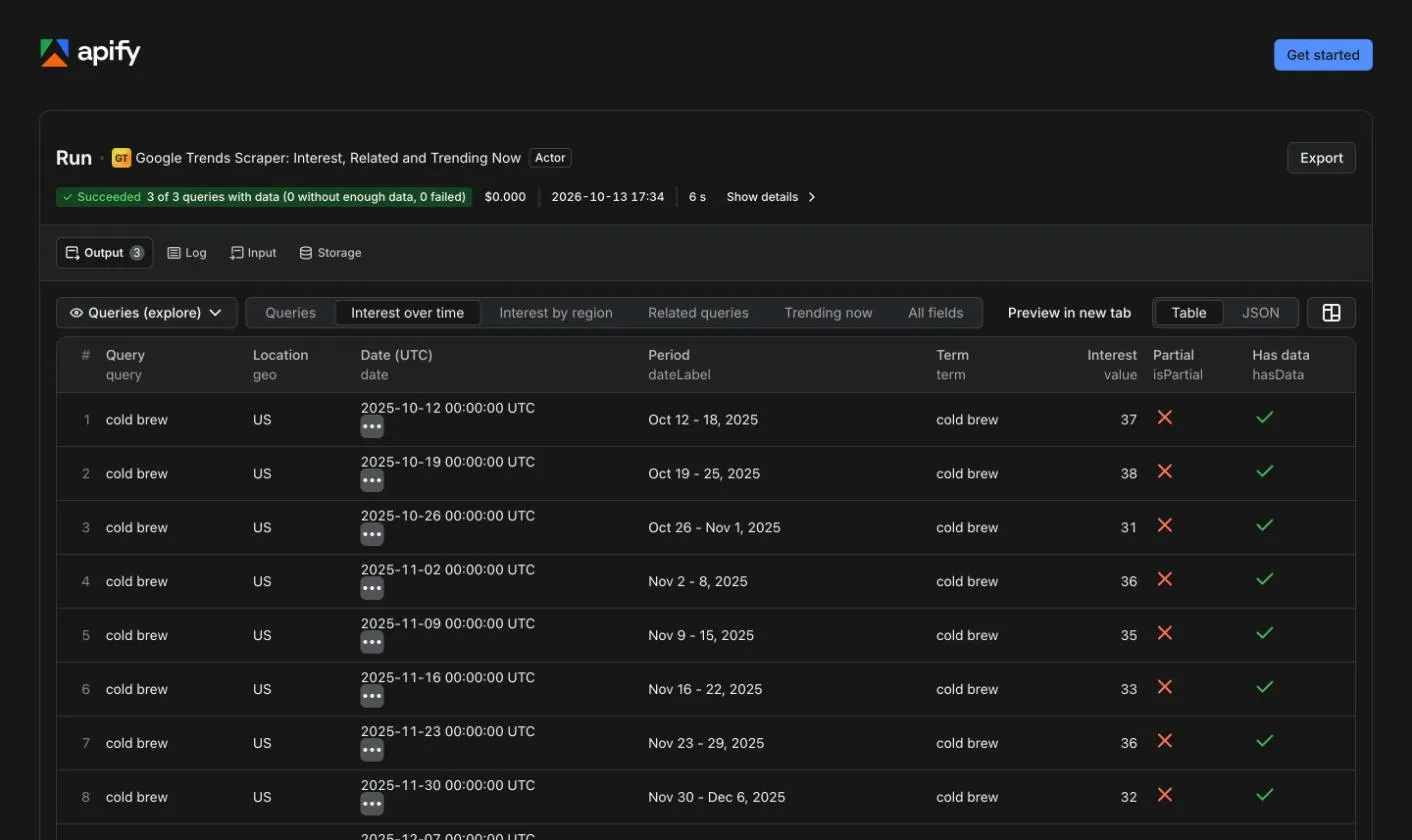
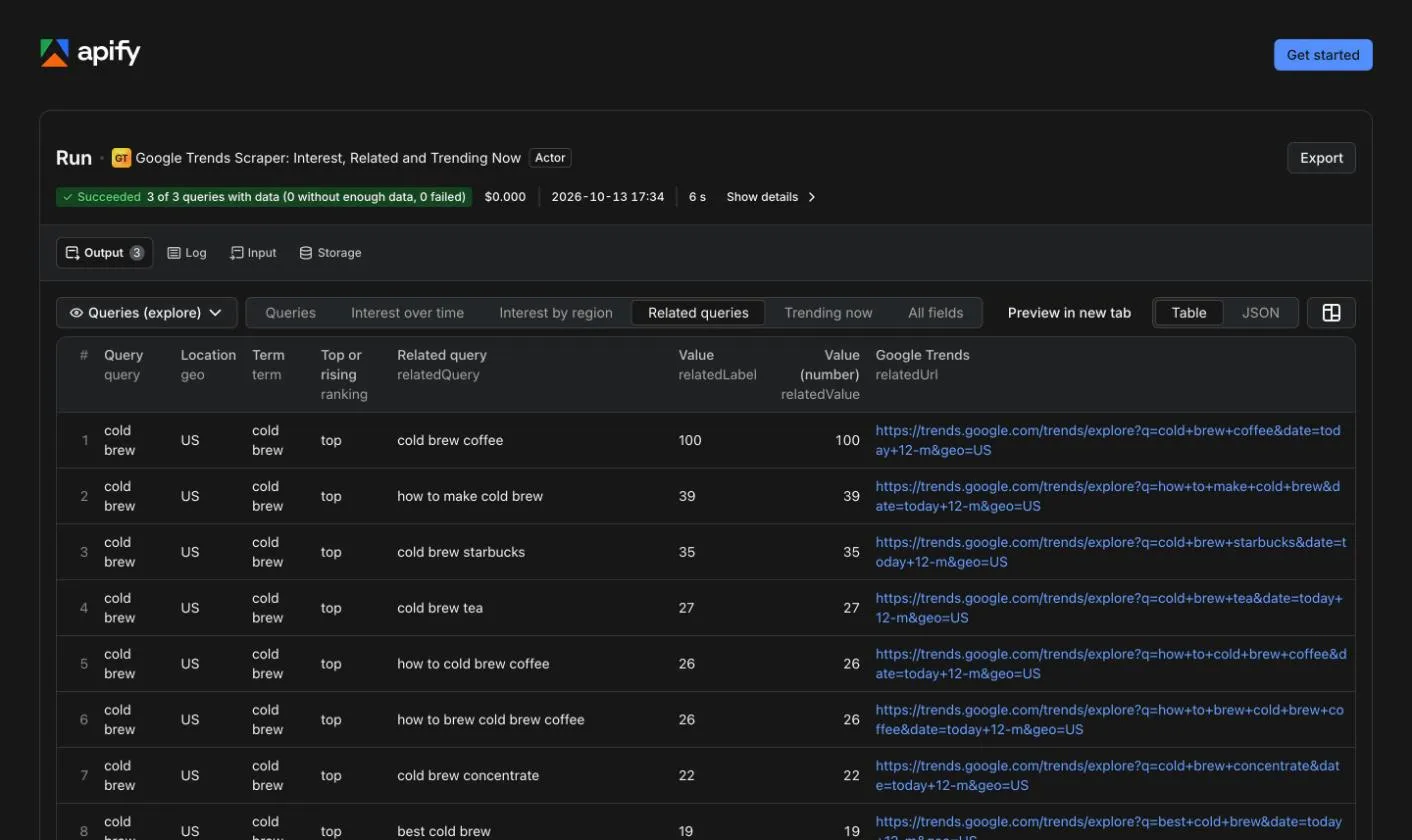
A row from the cloud run on this page (coffee, tea, United States, past 12 months, 2026-10-13; series shortened to their first and last points):
A Trending now row from the other run on this page (United States, past 24 hours, 467 searches; breakdown shortened):
Run summary
The run's key-value store holds a SUMMARY record: one report per query (status, reason, requests, HTTP 429 answers, seconds), the counts of ok, partial, no_data and failed, how many rows were charged and how many were free, duplicates skipped, requests sent through residential IPs, and bytes read. A missing result is never silent.
Limits worth knowing before you run it
- Related topics are empty for logged-out visitors. Google sent an empty related-topics list to every logged-out client we tried (plain HTTP, headless and headful Chrome, Apify datacenter and residential IPs), while a signed-in browser showed topics for the same query. The Actor never signs in, so related topics are off by default; turned on, they are returned only when Google sends them, and a note says so. Related queries, interest over time and by region matched what a signed-in browser showed.
- City-level regions can be thinner than a signed-in browser sees. When Google has too little data, the row says so.
- Google Trends numbers are samples. The same query read twice can move by a point:
coffee, teagave averages of 78 and 37 at 14:15 UTC and 79 and 38 at 14:34 on 2026-10-13 (a signed-in browser showed 78 and 37), and the order of rising queries changed between two loads in the same signed-in browser. Values are relative (0 to 100), never search volumes. - Rising queries are Google's, noise included. For
coffeein the US over 12 months, Google listedhome workout routinesandsports scores todayamong the top rising queries, in our logged-out answers and in a signed-in browser alike. The Actor returns what Google lists. - Speed depends on Google's rate limit. Google answers HTTP 429 per IP. The same three queries took 126 s (27 of 79 requests answered 429, residential fallback used) and then 6 s (no 429) nineteen minutes apart on 2026-10-13. Every query still ends with a row and a status.
- No proxy means one IP, paced at one request per second: Google refuses a single IP for over an hour after about 140 quick requests. Keep
autofor more than a few queries. - Trending now needs a country: Google offers no worldwide list.
- Five terms per comparison, as on Google Trends.
How it compares with the most used Google Trends scrapers
Read on 2026-10-05 from the public Store data of both Actors (their pricing, run statistics, input schemas, READMEs, reviews and issues). We did not run either of them. Our figures are our own Apify cloud runs.
| apify/google-trends-scraper | data_xplorer/google-trends-fast-scraper | This Actor | |
|---|---|---|---|
| Price per 1,000 results | $3.00 on the free tier (down to $0.10 on Diamond), plus platform usage, 4 GB default memory | $2.00 (down to $0.50), plus $0.025 per run start since 2026-10-10 (read 2026-10-13) | $1.50 per 1,000 queries with data, plus $0.003 per run start, platform usage included |
| Empty result charged | yes (reviews: a costly test run with no result) | not published | never: no_data and failed rows are free |
| 30-day run success | 59.3% of 21,396 runs (4,809 timed out, 3,220 aborted) | 99.5% of 46,009 runs | 109 of 110 runs on 2026-10-05; the one failure was an empty input, refused by design; 0 failed queries in 1,297 |
| Comparison of terms | yes | no | 2 to 5 terms, one scale |
| Related queries | yes | no | top and rising, per term |
| Interest by region | subregion, city, metro through a URL | inside one country | country, region, US metro, city, with shares in a comparison |
| Search type (web, images, news, YouTube, Shopping) | not an input | no | yes |
| Batch | list, Google Sheet, URLs | one keyword per run | up to 2,000 queries, URLs, duplicates dropped |
| Trending now | no | yes, up to 1,000 items in one row per run | yes, the whole list, one row per search |
| Time per query | not published (reviews: minutes) | not published | a one-query run: median 12 s, worst 183 s in our 33-input pass; 100 queries in 74 to 159 s |
Where we lose: the leader has years of runs behind it and Google Sheet input; data_xplorer's success rate is measured over 46,009 runs, ours over 110 of our own. Related topics, which the leader lists, are not available to a logged-out visitor (see the limits).
How much does it cost to scrape Google Trends?
Pay per event, no subscription, platform usage included:
| Event | Price |
|---|---|
Explore query with data (status ok or partial), every section included | $1.50 per 1,000 queries ($0.0015 per query) |
| Trending now row | $0.02 per 1,000 Trending now rows ($0.00002 per row) |
| Run start | $0.003 per run (Apify's start event, one per GB of memory; the Actor runs at 256 MB) |
Examples:
- One keyword: $0.0045 ($0.003 to start, $0.0015 for the query).
- The prefilled run (two terms and a comparison): $0.0075.
- 1,000 keywords in one run: $1.503.
- The full Trending now list of the United States (467 searches on 2026-10-13): about $0.012.
- A query with no data, a failed query, a duplicate or anything past your spending limit is never charged.
- Apify's free plan includes $5 of monthly usage (apify.com/pricing), enough for about 3,300 queries a month in batches.
Set a maximum cost per run in the run options and the Actor stops cleanly when it is reached.
Use the Actor through the Apify API
Run it and get the rows in one HTTP call (replace YOUR_APIFY_TOKEN, from Settings > API & Integrations in Apify Console):
To get the flat table of one view instead of the nested rows, read the run's dataset with view=timeline (or regions, related, trending): https://api.apify.com/v2/datasets/DATASET_ID/items?view=timeline&format=csv.
Node.js, with the official apify-client:
Python, with the official apify-client:
The API tab on this page has ready-made snippets for every language and endpoint.
FAQ
Is there an official Google Trends API?
Google announced its own Trends API as an alpha with access by application (developers.google.com/search/apis/trends). This Actor needs no application: it reads the same requests the public Google Trends page makes, logged out, and returns them as JSON rows.
Do I need a Google account or an API key?
No. No account, no API key, no cookie from a signed-in browser. The only cookie is the one Google gives any visitor on a first page view.
Why are the values between 0 and 100?
That is what Google Trends publishes: interest relative to the highest point of the chart (or the region with the most interest), not a count of searches. Terms compared in one row share the same scale; terms read in separate rows do not.
Can I compare more than five terms?
Google compares up to five terms on one scale. For more, put a common reference term in each comparison (coffee, tea, matcha, cold brew, espresso, then coffee, chai, ...) and scale with it.
How fast is it?
Measured on Apify: a one-query run took 12 s in the median and 183 s at worst (a five-term comparison under Google's rate limit); 100 queries took 74 to 159 s, 200 queries 329 to 516 s; a full Trending now list takes a few seconds. Google's rate limit decides most of it: the same three queries took 6 s or 126 s nineteen minutes apart.
Can I schedule it, or use it with Make, Zapier, n8n or Google Sheets?
Yes, through Apify's scheduler and integrations: save your input as a task, schedule it, and send the dataset wherever you need it, or fire a webhook when a run finishes.
Can AI agents use it through MCP?
Yes. Apify's hosted MCP server exposes Store Actors to MCP clients such as Claude or Cursor: https://mcp.apify.com?tools=agenttoolworks/google-trends-scraper.
Is it legal to scrape Google Trends?
The Actor reads public, aggregated and anonymized search interest that Google Trends shows any visitor, without logging in, on endpoints Google's robots.txt does not disallow (it disallows only the explore page itself, which the Actor never requests). No personal data is read. How you use the data is your responsibility.
Something is missing or broken?
Open an issue in the Issues tab: we read every one.
Other Actors by AgentToolWorks
- Shopify & WooCommerce Scraper and Price Tracker: every product of any Shopify or WooCommerce store, with variants, barcodes and stock, plus price and stock change tracking.
- Facebook Ad Library Scraper: ads from the Meta, Google and Microsoft ad libraries in one table.
- LinkedIn Jobs and Indeed Scraper: public job listings of both boards in one row format.
- Job Scraper for Greenhouse, Lever, Ashby & Workable (JobsRadar): open roles from the public boards of seven applicant tracking systems, deduplicated into one list.
- Google Maps Scraper: every place inside a city's real boundary, with phone, website, rating, review count, opening hours and emails.
Learn more
- What this Google Trends scraper returns, and how it compares
- How to scrape Google Trends: the explore widgets, the Trending now request, the 429 wall, and what we measured
Built by AgentToolWorks. Not affiliated with Google.


