

Ultimate Screenshot
Pricing
from $5.00 / 1,000 page captures
Ultimate Screenshot
🚀 Capture ANY website as HD screenshots, videos, or PDFs! 📸 100+ device presets (iPhone, Android, tablets). Perfect for web scraping, monitoring, testing & marketing. Export as PNG/JPEG/PDF/MP4/GIF. Fast, reliable, proxy-ready. Try FREE now!
Pricing
from $5.00 / 1,000 page captures
Rating
5.0
(7)
Developer

FlowExtract API
Maintained by CommunityActor stats
23
Bookmarked
258
Total users
6
Monthly active users
3.6 hours
Issues response
14 hours ago
Last modified
Categories
Share
📸 Ultimate Screenshot — capture any web page as an image, PDF, video or GIF
Ultimate Screenshot turns a list of web addresses into finished files: JPEG and PNG screenshots, printable PDFs, and short MP4 or GIF recordings of the page. It drives a real browser, so pages that need JavaScript, web fonts, lazy-loaded images or a signed-in session come out looking the way a person would see them — on a desktop window, or on any of 131 phone and tablet presets.
Perfect for agencies archiving client sites, QA and product teams building visual checks, and marketers who need a scroll-through clip of a landing page without opening a screen recorder.
What it produces
| Format | What you get | Typical use |
|---|---|---|
| JPEG | Compressed image, quality you choose | Bulk archiving, thumbnails, previews |
| PNG | Lossless image | Design review, pixel comparisons |
| Printable document — paper size, margins, orientation | Reports, invoices, compliance records | |
| MP4 | Up to a 30-second recording | Landing-page walkthroughs, demos |
| GIF | Up to a 10-second looping animation | Social posts, docs, changelog entries |
Every format can be captured as the visible window or as the whole page, top to bottom.
⚙️ How to use it
The one setting you need
That captures each page as a JPEG at 1920 × 1080. Everything below is optional.
Addresses go in one per line. A bare domain is fine — example.com becomes https://example.com. The field checks that each line looks like a web address, so a stray number or word is caught in the form rather than producing an empty result.
Full-page screenshot
scrollToBottom walks down the page first so lazy-loaded images actually load. maxScrollSeconds is the limit that ends the scroll — on an endless feed it is the only thing that ends it, and it decides how much of the feed you capture.
Phone or tablet
131 presets, each with the right screen size, pixel density and browser identity. A preset replaces the window width and height below it.
A scroll-through video
The clip is exactly recordSeconds × fps frames and plays for exactly recordSeconds. In scroll mode the step between frames is worked out from the real page height, so the last frame lands at the bottom of the page. In static mode the window stays put, which suits carousels, animations and players.
A signed-in page
Export cookies with a browser extension such as Cookie Editor. Each cookie needs at least a name and a value; the address being captured supplies the domain when it is missing.
Cleaning up the page first
Finding the right selector
-
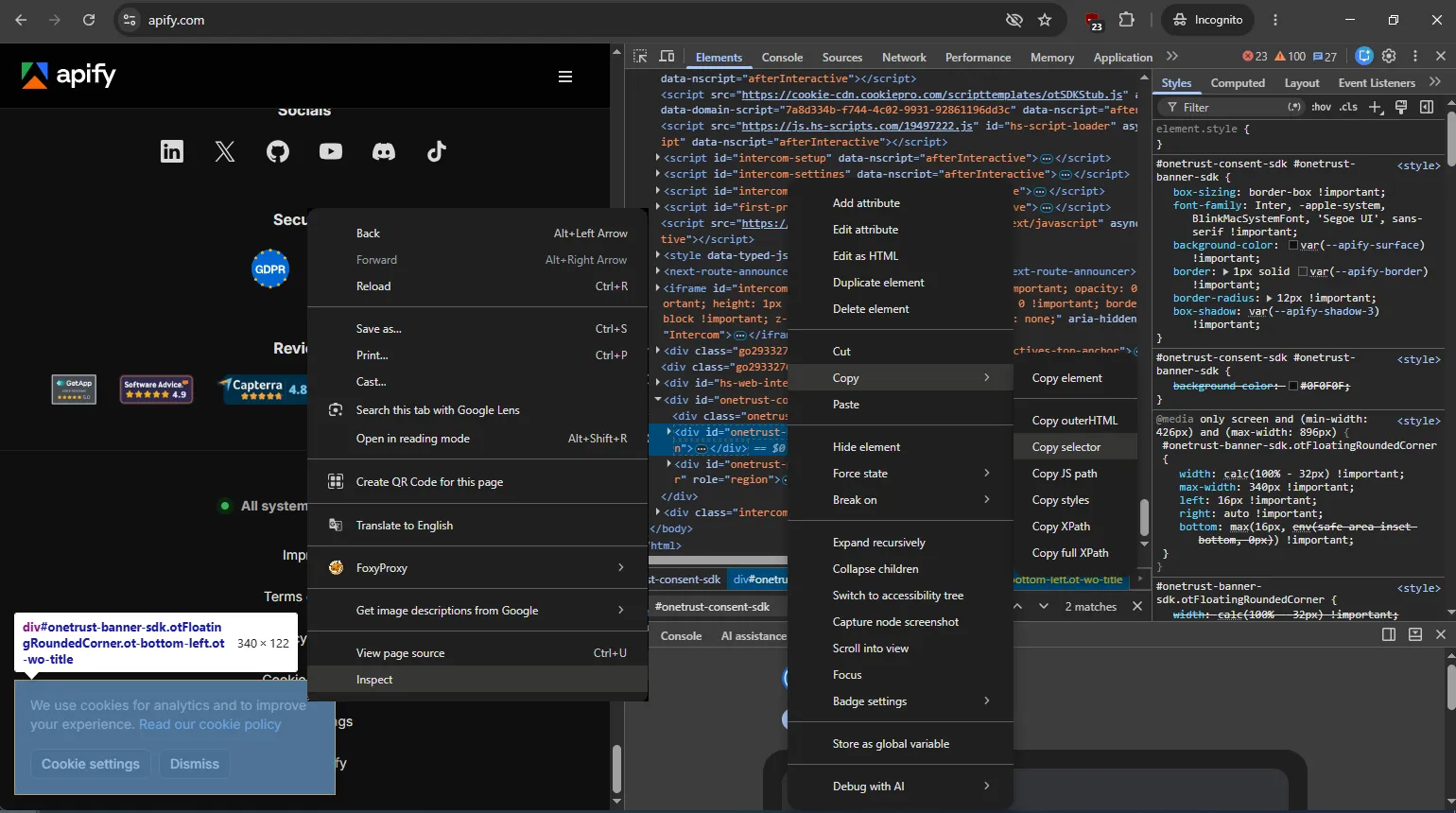
Right-click the banner you want gone and choose Inspect (bottom of the menu).
-
The developer tools open with that element highlighted. Click upwards through the boxes until the highlight covers the whole banner, not just its text — you can see the size readout,
340 × 122, confirming the right box is selected. -
Read the
idorclassoff that line and type it with the right prefix:In the HTML You type Because <div id="onetrust-consent-sdk">#onetrust-consent-sdkan id takes a #<div class="cookie-bar">.cookie-bara class takes a .Prefer the id when the element has one — it is shorter and changes less often.
The screenshot is Chrome, but this works the same in Edge, Firefox and Safari: you are reading an attribute out of the page's own HTML, not using a browser feature.
Chrome and Edge also offer Copy → Copy selector (Firefox: Copy → CSS Selector), visible on the right of the screenshot. It works, but it usually produces a long path like
#onetrust-consent-sdk > div:nth-child(2) > divthat breaks the next time the site changes its layout — the plain id above keeps working.
Hide the wrapper, not the text inside it, or you will be left with an empty bar.
Most consent banners come from a handful of platforms, so these cover a lot of the web:
| Platform | Selector |
|---|---|
| OneTrust (used by apify.com and many large sites) | #onetrust-consent-sdk |
| Cookiebot | #CybotCookiebotDialog |
| Osano | .osano-cm-window |
| Quantcast / TCF | .qc-cmp2-container |
| Usercentrics | #usercentrics-root |
| CookieYes | .cky-consent-container |
| Generic catch-all | [id*="cookie"], [class*="cookie-banner"] |
Hiding is applied as a style rule as soon as the page opens, so a banner that appears after the page has loaded is caught too — many consent scripts take several seconds to inject theirs.
If a selector matches nothing, the result row's notes says so rather than leaving you guessing.
🎛️ All settings
Page loading
| Setting | Default | What it does |
|---|---|---|
waitUntil | load | When the page counts as ready. load suits most sites and is much the fastest complete option. Move to a Network Idle mode only for pages that keep drawing after everything has loaded — it can add many seconds per page. |
timeouT | 30 s | How long to wait for a page before giving up on that attempt. |
maxRetries | 2 | Extra attempts when a page fails to load. 0 means a single attempt. |
delayBeforeScreenshot | 1000 ms | Extra pause after the page is ready, for animations and fonts. |
waitForSelector | — | CSS selector to wait for. If it never appears the page is captured anyway and the row says so. |
Scrolling & clean-up
| Setting | Default | What it does |
|---|---|---|
scrollToBottom | false | Scroll through the page before capturing so lazy content loads. |
maxScrollSeconds | 15 s | The longest scrolling may take. Scrolling also stops as soon as the page stops growing. |
delayAfterScrolling | 500 ms | Pause after scrolling, so content loaded on the way down can render. |
hideSelectors | — | CSS selectors to hide — cookie banners, chat bubbles, sticky headers. Applied as a style rule the moment the page opens, so it also catches banners that appear seconds later. Selectors matching nothing are reported in notes. |
Video & GIF
| Setting | Default | What it does |
|---|---|---|
recordingMode | scroll | scroll pans down the page; static holds the window still. |
recordSeconds | 5 s | How long the finished clip plays. GIF max 10, MP4 max 30. |
fps | 10 | Playback frame rate. GIF max 15, MP4 max 30. |
Image, PDF, device and network
| Setting | Default | What it does |
|---|---|---|
jpegQuality | 85 | JPEG only. PNG is always lossless. |
printBackground | true | PDF: keep background colours and images. |
formaT | A4 | PDF paper size. Ignored when any margin below is above 0. |
landscape | false | PDF orientation. |
toP / righT / bottoM / lefT | 0 mm | PDF margins in millimetres. |
device | — | One of 131 phone/tablet presets. Replaces the window size. |
window_Width / window_Height | 1920 × 1080 | Browser window when no device preset is chosen. |
userAgent | — | Send a specific browser identity. |
cookies | [] | Cookies applied before the page loads. |
proxyConfig | Apify datacenter | Route the capture through a proxy. |
enableSSL | true | Turn off only for a self-signed or expired certificate you trust. |
📊 What you get back
One row per address, plus the file itself in the run's storage.
Files are grouped by what they are. Open the run's Storage tab and you get three named collections rather than one flat list:
| Collection | Holds | Key prefix |
|---|---|---|
| Screenshots | PNG and JPEG images | screenshot- |
| Videos & GIFs | MP4 and GIF recordings | video- |
| PDF documents | PDF renderings | document- |
A GIF is filed with video, not with the images — it is a recording of the page, made by the same frame capture and described by the same length and frame-rate settings as an MP4. Its file type happens to be image/gif, which is why the video collection accepts that type too.
| Field | What it tells you |
|---|---|
status | success when a file was produced, failed when the page returned nothing |
screenshot_url / screenshot_image | Direct download link for the file |
content_Type, fileName, fileSizeBytes | What the file is and how big |
linkUrl / finalUrl | What you asked for, and where the page ended up after redirects |
pageTitle, httpStatus | The page's own title, and the status code it answered with |
frames, durationSeconds | Recordings only — how many frames and how long the clip plays |
captureMs | How long this page took, from opening it to saving the file |
error | On a failed page, one sentence saying what happened |
notes | Where the actor tells you it did something you did not ask for |
screenshot_image, content_Type, linkUrl and screenshot_url keep the exact names and meanings they had in version 1 — existing integrations need no change.
notes is worth reading. It is how the actor reports a clipped tall page, a scroll that stopped at the limit, a recording shortened to stay inside the frame limit, or hideSelectors that matched nothing.
💰 Pricing
You pay per capture, not per month, and the Actor's platform usage is included in the price — there is no separate compute bill for your runs.
What moves your bill:
- How many pages you capture. A still or a PDF is one capture, whatever the page weighs and however long it takes to load. A slow site costs you no more than a fast one.
- Recordings, in proportion to
recordSeconds × fps. A 5-second GIF at 10 fps is 50 frames; a 10-second MP4 at 30 fps is 300. This is by far the largest line on a recording's bill. - Sites that refuse datacentre addresses, which add up to three extra attempts. Almost no page needs any — see Sites that refuse datacentre addresses.
Addresses that produce no file are never charged, and neither is a page the site refused from every address — you pay only for the attempts in that case.
Pricing
| Event | FREE | BRONZE | SILVER | GOLD |
|---|---|---|---|---|
| Page capture (per saved file) | $0.007 | $0.006 | $0.0055 | $0.005 |
| Extra attempt (only when a site refuses us) | $0.005 | $0.0045 | $0.004 | $0.0035 |
| Video frame (per frame of an MP4 or GIF) | $0.00035 | $0.0003 | $0.00025 | $0.00025 |
No start fee, and no charge for browser time — a screenshot costs the same whether the page is quick or slow.
What a run actually costs — measured on this actor:
| Run | Frames | Total on BRONZE |
|---|---|---|
| One screenshot or PDF | — | $0.006 |
| Ten screenshots in one run | — | $0.060 |
| A 5-second GIF at 10 fps | 50 | ~$0.021 |
| A 10-second MP4 at 15 fps | 150 | ~$0.051 |
| A 10-second MP4 at 30 fps | 300 | ~$0.096 |
Still images and PDFs never pay the frame charge.
When a site refuses us
A few sites — Facebook's Ad Library is the well-known one — serve an empty page to a datacentre address. Waiting longer never fixes that, so the capture is retried from a different address, up to three extra times. Each extra attempt is charged, because each one is a real page load.
Almost every page needs none of them, so almost every capture costs the page capture fee and nothing more. On the sites that do fight back, expect one or two extra attempts: a BRONZE capture of a page like the Ad Library usually lands between $0.011 and $0.015 rather than $0.006.
Extra attempts are charged whether or not one of them gets through, because the work happens either way. The page capture fee is the opposite — if every address is refused you are not charged for it, so a run that ends with a blank image pays only for the attempts. Either way the result row says exactly what happened.
🛟 Limits, and why they exist
A browser can be asked to do something that never finishes. These limits mean it does not.
| Limit | Value | What happens when it is reached |
|---|---|---|
| Scrolling | your maxScrollSeconds, at most 60 s | Scrolling stops, the page is captured as it stands, and a note says so |
| Full-page image height | 16 000 px | The image is clipped to the top 16 000 px — the tallest a browser can render in one pass |
| Recording frames | 300 per page | The clip is shortened, keeping your frame rate, and a note says so |
| Recording time | 2.5 minutes per page | Recording stops and whatever was captured is encoded into a valid clip |
| Whole page | 4 minutes | The page is abandoned and reported; the run carries on with the next address |
| Output file | 100 MB | The page is reported with a suggestion to record less or use a smaller window |
🔄 If a run is interrupted
Progress is saved after every page. If the run is migrated, restarted or aborted, it resumes from the next uncaptured address instead of starting over — so an interruption never re-captures a page you already received.
🚫 When something goes wrong
| Situation | What you see | What to do |
|---|---|---|
| An address is not a web address | The run is refused when you submit it, naming the position of the bad line | Fix or remove that line |
| A page will not load | status: "failed" and an error sentence for that address only | Raise timeout, or check the address in a browser |
| The site answers with an error code | A capture of the error page, and a note giving the status code | Expected — the page really did answer that way |
| The site serves an empty page to a datacentre address | The capture is automatically retried from up to three other addresses; a note says how many were refused | Nothing, if one got through. If all of them were refused, see Sites that refuse datacentre addresses below |
| A page is taller than 16 000 px | A clipped image, and a note with the page's real height | Capture the window instead of the whole page, or a narrower window |
| A recording came out short | Fewer frames than asked, and a note saying why | Lower fps or recordSeconds, or record a lighter page |
| Nothing was captured at all | A single row with status: "no_input" | Check the addresses in the input |
Sites that refuse datacentre addresses
A few sites — Facebook's Ad Library is the well-known one — serve an empty page to any datacentre address. Measured on that page: a plain datacentre address gets through about four times in five once the capture retries on fresh addresses, and a residential address gets through every time.
If a site refuses you repeatedly, put a proxy of your own into Custom proxy
URLs in the proxy setting. Your own proxy is used ahead of everything else, and
the result row shows proxyType: "user" so you can confirm it was used. A
residential proxy is what works on these sites.
Selecting Apify's own RESIDENTIAL group works too, and its bandwidth is billed to your account as normal platform usage — expect roughly 12 MB per capture on a page like the Ad Library, which is far more than a datacentre capture costs.
❓ Frequently asked questions
Can it capture pages behind a login?
Yes, with the cookies setting. Export the cookies from a signed-in browser session and paste them in.
Why is my full-page screenshot cut off at the bottom?
The page is taller than 16 000 pixels. That is a browser limit, not a setting — a browser cannot rasterise an arbitrarily tall page in one image. The row's notes gives the page's real height.
My GIF looks shorter than I asked for.
Check frames and notes on the row. A clip is shortened when recordSeconds × fps would pass 300 frames, or when the page was too slow to record the full series in time.
Why is the video not the page's real motion?
Frames are captured one at a time, so a recording is a time-lapse rather than a real-time screen capture. In scroll mode that is exactly what you want — a smooth pass down the page. In static mode, fast animations look sped up.
Can I capture an infinite-scroll feed completely?
No, and neither can anything else — the feed has no end. Set maxScrollSeconds to how much of it you want; that is the amount you get.
How many pages can I capture per run? As many addresses as you like. Batching is more efficient than separate runs.
What happens if one address fails?
Only that address. It appears with status: "failed" and a sentence saying why, and the run continues.
I upgraded from version 1 — do I need to change anything?
No. Every setting from version 1 still works, and the four output fields integrations read keep their exact names. The retired video settings (frameCounT, frame, timefullPagE, infiniteScroll) are converted automatically and the run log says what they became. See the changelog for the full list.
Can I use my own proxy? Yes — set your own proxy URLs in the proxy setting. Apify's datacenter proxy is used by default.
⚖️ Legal & compliance
This actor captures pages as they are served to a browser — the same content any visitor can see, plus anything your own cookies give you access to.
Please use it responsibly:
- Only capture pages you are authorised to access, and only use cookies from accounts you own.
- Respect each site's Terms of Service and applicable data-protection law (GDPR, CCPA and equivalents).
- Screenshots of pages containing personal data are personal data — store and share them accordingly.
- Do not use captures to impersonate a site, a person or an organisation.
🤝 Support
- 📧 Email: flowextractapi@outlook.com
- 🐙 GitHub: FlowExtractAPI
- 🐦 Twitter: @FlowExtractAPI
- 🔧 Apify: FlowExtract API
Built by FlowExtract API — reliable data extraction actors for the Apify platform.


