

TikTok Hashtag, Sound & Place Scraper | Posts & Stats
Pricing
from $1.96 / 1,000 posts
TikTok Hashtag, Sound & Place Scraper | Posts & Stats
Get TikTok posts from hashtag, sound (music) and place (location) feeds: caption, publish date, views, likes, shares, saves, author handle, sound title, tagged place and rank in the feed. Mix many hashtags, sounds and places in one run. No login.
Pricing
from $1.96 / 1,000 posts
Rating
0.0
(0)
Developer

Flowo
Maintained by CommunityActor stats
0
Bookmarked
2
Total users
1
Monthly active users
7 days ago
Last modified
Categories
Features
Share
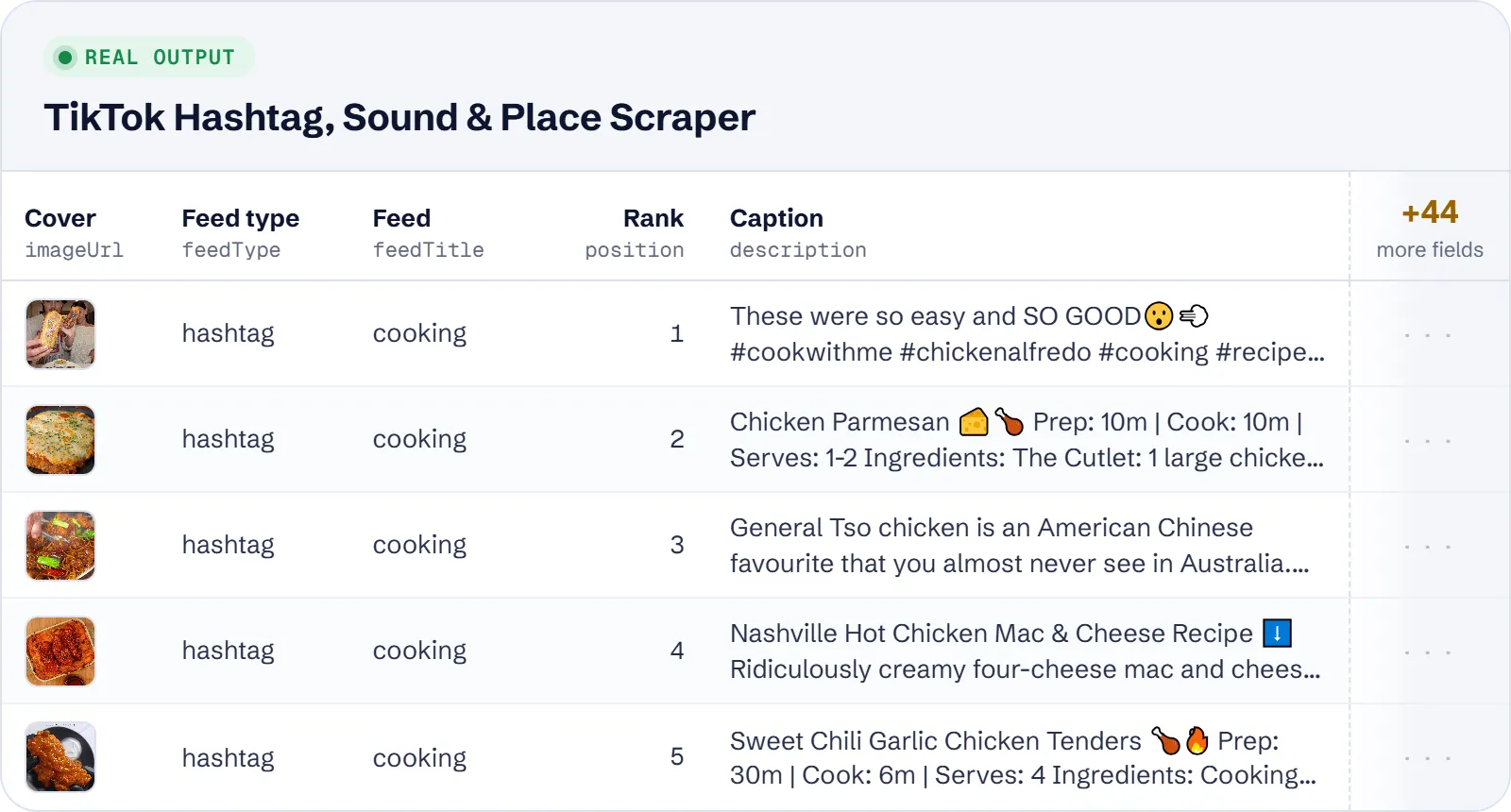
Get the public posts of TikTok hashtag, sound (music) and place (location) feeds as flat rows: caption, publish date, views, likes, comments, shares and saves, the author's handle, the sound title and the tagged place. Every row also tells you which feed it came from, the input you gave and the post's rank in the feed, plus the feed's total video count (and total views for hashtags). One run can mix any number of hashtags, sounds and places, with no login.
What does TikTok Hashtag, Sound & Place Scraper do?
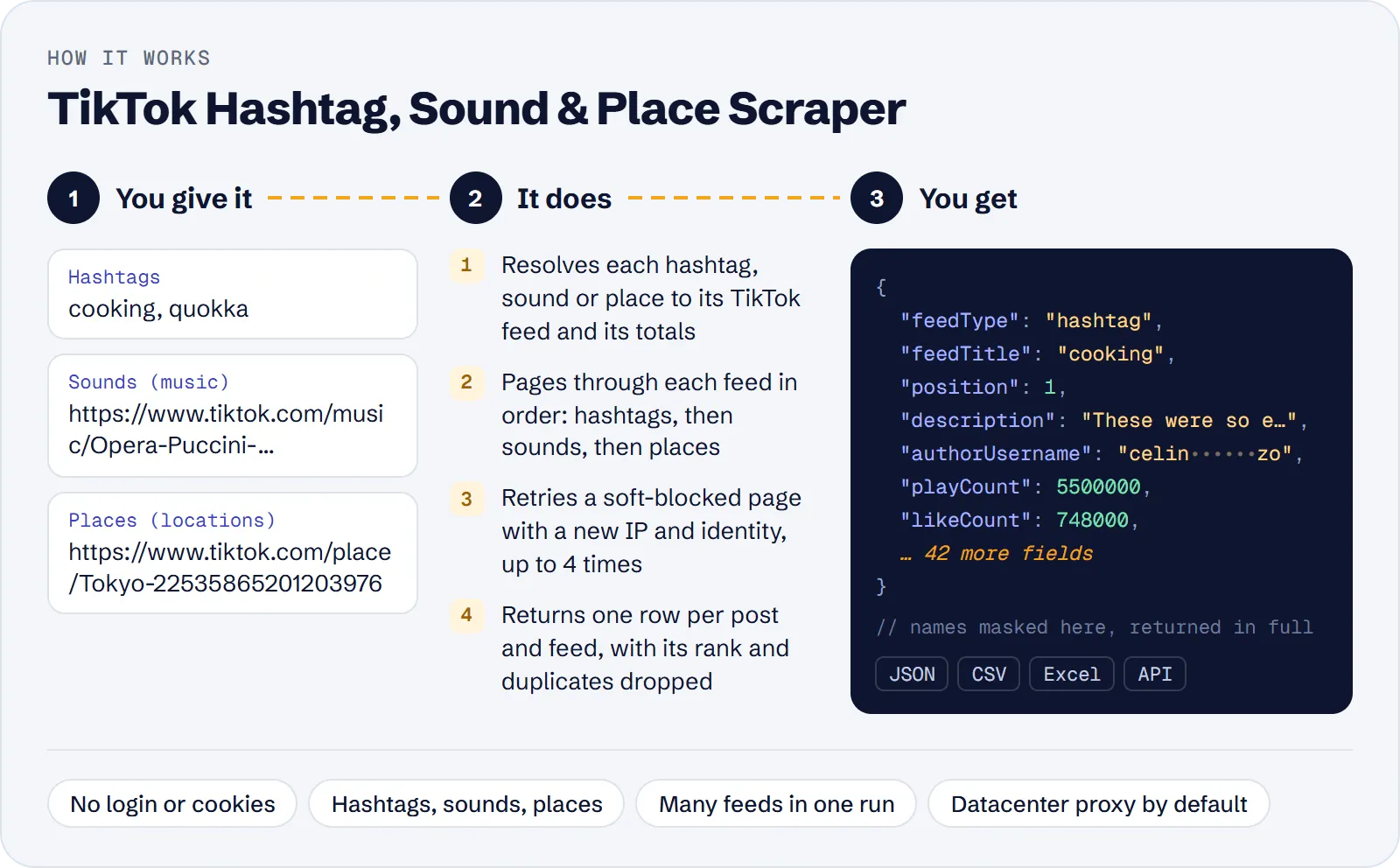
You give it TikTok hashtags (cooking, #quokka or a /tag/ URL), sound URLs or ids and place URLs or ids. It returns one row per post in each feed, in the order TikTok serves them. It is built for marketers tracking a campaign hashtag or a trending sound, music labels measuring how a track spreads, tourism and local-business analysts watching a place, and researchers or AI agents that need "posts for #X, sound Y or place Z" in one call.
How to scrape TikTok hashtag, sound and place feeds
- Open the actor in Apify Console.
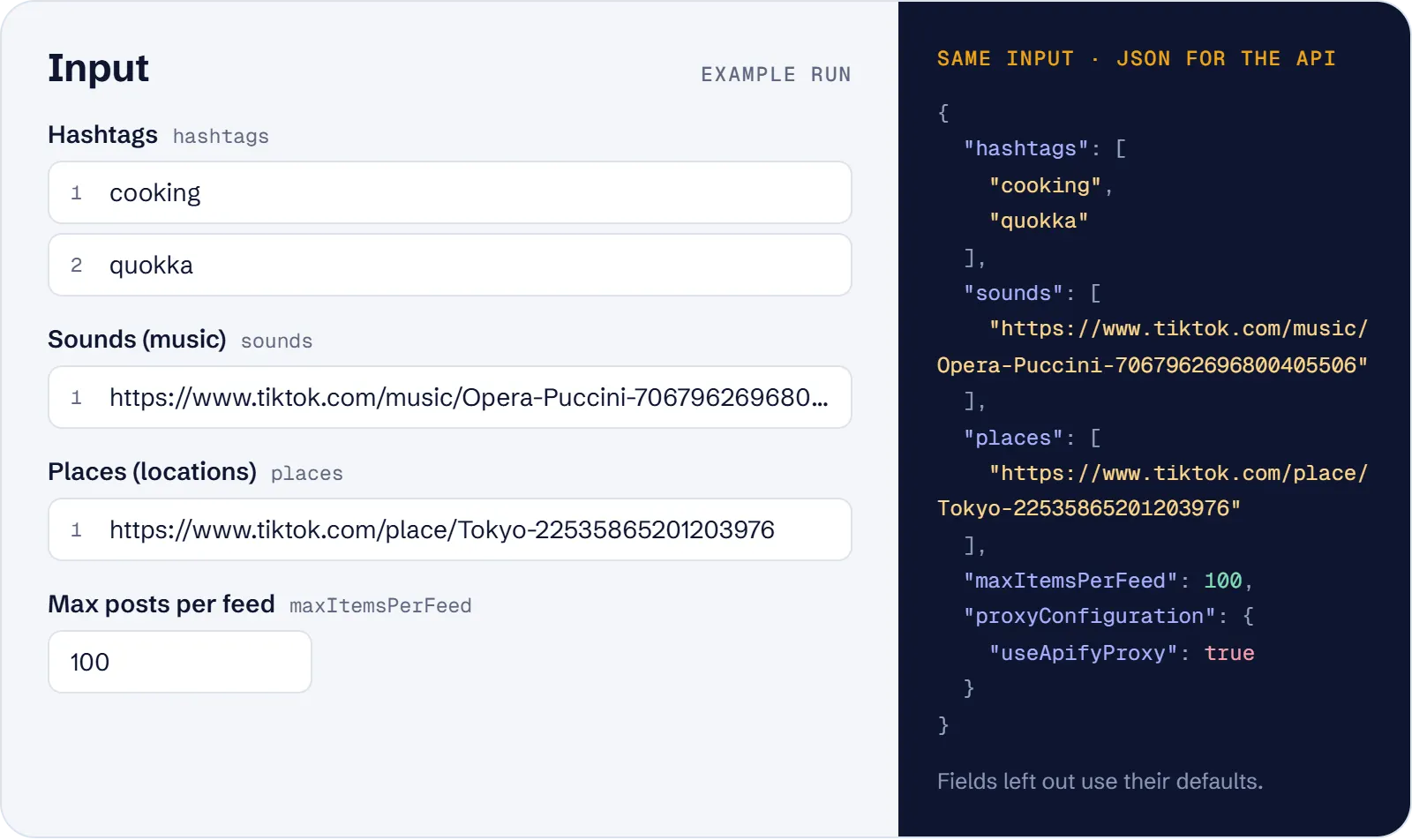
- Add hashtags to Hashtags, sound URLs or ids to Sounds (music) and place URLs or ids to Places (locations). Fill any one of them or all three.
- Set Max posts per feed (default 100) and, if you want a hard cap for the whole run, Max posts in total.
- Keep the default Apify datacenter proxy.
- Click Start. Download the posts as JSON, CSV or Excel, or read them via the API.
How much does it cost to scrape TikTok feeds?
Price per event by Apify plan:
| Event | Free | Bronze | Silver | Gold and above |
|---|---|---|---|---|
| Post | $2.30 per 1,000 | $2.185 per 1,000 | $2.07 per 1,000 | $1.955 per 1,000 |
| Actor start | $0.00005 | $0.00005 | $0.00005 | $0.00005 |
A test run with the API example input below returned 400 rows in 81 s.
You pay per post saved to the dataset (the post event, $0.0023 per post, $2.30 per 1,000 posts on the Free plan) plus a small actor start event ($0.00005). Feeds that are not found, invalid inputs and duplicate posts within a feed are not charged.
| Scenario | Posts (events) | Cost on Free plan |
|---|---|---|
| One hashtag, 100 posts | 100 | about $0.23 |
| Default input: 2 hashtags, 1 sound, 1 place, 100 posts each | 400 | about $0.92 |
| 5 sounds, 200 posts each | 1,000 | about $2.30 |
| 10 places, 1,000 posts each | 10,000 | about $23.00 |
Input
| Field | What it takes |
|---|---|
hashtags | Hashtag feeds, one per line: a name (cooking), #name or a tag URL (https://www.tiktok.com/tag/cooking). Case and spaces do not matter, TikTok resolves them ("two words" → #twowords). |
sounds | Sound feeds: a sound URL (https://www.tiktok.com/music/Takke-6870193640413612033) or its numeric id. Sound names cannot be searched. |
places | Place feeds: a place URL (https://www.tiktok.com/place/Tokyo-22535865201203976) or its numeric id. Place names such as "Paris" cannot be resolved. |
maxItemsPerFeed | Posts per feed, 1–2000, default 100. Hashtag feeds end earlier (about 120–240 posts). |
maxItems | Optional cap on posts for the whole run, across all feeds. |
proxyConfiguration | Proxy settings. Default: Apify datacenter proxy. |
At least one hashtag, sound or place is needed. A sound or place URL pasted into the wrong field is scraped as its own feed type with a warning. Video URLs, profile URLs, short links (vm.tiktok.com) and non-TikTok links are skipped with a warning.
What data can you extract from TikTok feeds?
| Group | Fields |
|---|---|
| Feed context | feedType (hashtag, sound or place), feedId, feedTitle, feedVideoCount, feedViewCount (hashtags only), query, position |
| Post | id, url, description, publishedAt, language, country (sound feeds only), hashtags, mentions, isPhotoPost, isAd |
| Video | durationSec, videoWidth, videoHeight, imageUrl (cover), videoUrl |
| Counts | playCount, likeCount, commentCount, shareCount, collectCount (saves), repostCount |
| Author | authorUsername, authorNickname, authorId, authorUrl, authorBio, authorAvatarUrl, authorVerified, authorFollowers, authorFollowing, authorLikes, authorVideoCount |
| Sound | musicId, musicTitle, musicAuthor, musicOriginal, musicUrl |
| Place | poiId, poiName, poiAddress, poiCategory |
| Run | scrapedAt |
A real row from the cooking hashtag feed (media URLs shortened):
Use cases
- Campaign hashtag monitoring: run your brand hashtags daily and compare views, likes, shares and saves per post, the authors' follower counts, and the hashtag's total videos and views over time.
- Sound spread for music labels: list the videos that use a track, with exact counts and the country each post was created in.
- Tourism and local business: collect posts tagged at a city, venue or landmark with the place name, address, category and publish date.
- Trend research and AI agents: one call returns hashtag, sound and place rows together, told apart by
feedTypeandqueryand ranked byposition.
Limitations
- Hashtag depth: TikTok shows logged-out visitors only about 120–240 posts per hashtag, so a higher
maxItemsPerFeedhas no effect there. The log says when a hashtag feed ended below your limit. Place feeds gave 300+ posts in tests; small sounds can end early. - No sort or date filter: the order is TikTok's own relevance mix, not newest first, and one feed can span many years.
- Names are not searched: sounds and places need a URL or numeric id.
- Sound rows have no author follower data:
authorFollowers,authorFollowing,authorLikes,authorVideoCountandauthorAvatarUrlare null there.countryis filled only on sound rows. - Rounded views: on hashtag and place feeds TikTok rounds
playCountfor logged-out viewers (e.g. 4400000); sound feeds give exact counts. - Fields that can be null: every field except
feedType,feedId,query,position,id,urlandscrapedAt. Typical cases:feedTitleandfeedVideoCountwhen TikTok withholds feed details,feedViewCounton sound and place rows,descriptionandauthorBiowhen empty, thepoi…fields on posts with no tagged place,musicUrlon some posts. languagecan beun(undetermined).imageUrl,videoUrlandauthorAvatarUrlare signed by TikTok and expire; video playback needs TikTok cookies. Media is not downloaded.- The same post found in two feeds gives two rows, each with its own feed context.
Tips and troubleshooting
- 0 rows? Check the log: a hashtag, sound or place that does not exist is reported as "not found" and is free. A place or sound given by name is skipped; copy the URL from its TikTok page.
- Fewer hashtag posts than asked? That is TikTok's logged-out cap (about 120–240 posts). Add related hashtags to get more posts.
- Use
maxItemsto cap the cost of a run. Feeds run in order hashtags → sounds → places, so later feeds may get no rows once the cap is reached. - Keep the datacenter proxy. Without a proxy a blocked feed cannot be retried from a new IP. A residential proxy works for hashtags and sounds, but TikTok then hides place details (
feedTitleandfeedVideoCountstay empty on place rows). - Only new posts: schedule the run and compare post
ids with the previous dataset; there is no date filter at the source.
API, MCP and integrations
Run the actor from your code with the same JSON input as in Console. Your API token is in Console → Settings → API & Integrations.
Python (pip install apify-client):
Node.js (npm install apify-client):
HTTP — one request runs the actor and returns the results (runs up to 5 minutes; longer ones: run asynchronously):
AI agents (MCP). Add the actor as a tool of the Apify MCP server. Claude Code:
Claude Desktop, Cursor or VS Code: {"mcpServers": {"apify": {"url": "https://mcp.apify.com?tools=genial_candlestand/tiktok-hashtag-sound-place-scraper"}}}. Then ask, for example:
- "Get 200 TikTok posts for #cooking with views, likes and author follower counts"
- "List videos using the TikTok sound 7067962696800405506 and count them by country"
- "Get 300 TikTok posts tagged at https://www.tiktok.com/place/Tokyo-22535865201203976"
Integrations. Run it on a schedule with Apify Schedules and send the results to Google Sheets, Slack, Zapier, Make, n8n or your webhook — see Apify integrations.
FAQ
Do I need a TikTok account or cookies?
No. The actor reads public feeds without login.
Can I search a sound or place by name?
No. Open the sound or place on TikTok and copy its URL (or the numeric id at its end).
Why do hashtag feeds stop at about 200 posts?
TikTok ends hashtag feeds for logged-out visitors after about 120–240 posts. Sound and place feeds go deeper (maxItemsPerFeed up to 2000).
How is it different from other TikTok feed scrapers?
It takes hashtags, sounds and places in one input, with no per-feed or per-location fee. Rows are flat (author, sound and place as plain columns) and carry the feed context — feedVideoCount, feedViewCount, query and position — plus country on sound rows. The price is $2.30 per 1,000 posts, against $3.00 for the leading dedicated hashtag scraper and $5.00 for the leading dedicated sound scraper.
Is it legal to scrape TikTok?
The actor collects only data that TikTok shows publicly to any visitor and no personal data beyond that. You are responsible for how you use it, including data-protection rules such as GDPR for author data, and TikTok's terms. Consult a lawyer if unsure.
Also useful
- TikTok Video Details Scraper — get full details and transcripts for the TikTok posts you found in a feed
- Instagram Profile Scraper — check the same creators on Instagram: exact followers, bio and links
- YouTube Search Scraper — track the same topic or song on YouTube: videos, Shorts and views
- Google Trends Scraper — compare a hashtag's TikTok buzz with search interest over time and by region
- Pinterest Search Scraper — find pins for the same keyword: images, outbound links and reactions


