

Paver Patio Calculator (Pavers, Base, Sand & Cost)
Pricing
Pay per event
Paver Patio Calculator (Pavers, Base, Sand & Cost)
Paver patios, walkways, pool decks and driveways: pavers with pattern waste, base gravel, bedding and polymeric sand, edging, digging and a materials cost, for any rectangle, L shape or circle.
Pricing
Pay per event
Rating
0.0
(0)
Developer

Jumble Mog
Maintained by CommunityActor stats
0
Bookmarked
2
Total users
1
Monthly active users
12 hours ago
Last modified
Categories
Features
Share
Work out everything a paver patio, walkway or driveway takes from one line of text. Ask 12 x 16 ft patio with 6x9 pavers, running bond and you get back:
- Pavers: how many, the square feet with the pattern's cuts (5% for running bond up to 15% for 45° herringbone, more for circles), their weight and pallets.
- Base gravel in cubic yards and tons to order, deep enough for the use (patio, walkway, pool deck or driveway), the soil (clay) and frost, reaching past the edges.
- Bedding sand, polymeric joint sand (by the joint volume of that paver), edge restraint with spikes, fabric on clay, and the dig depth and soil to haul away.
- Permeable pavers with an open-graded #57 base and #8 chips.
- Drainage fall and a materials cost in total and per square foot.
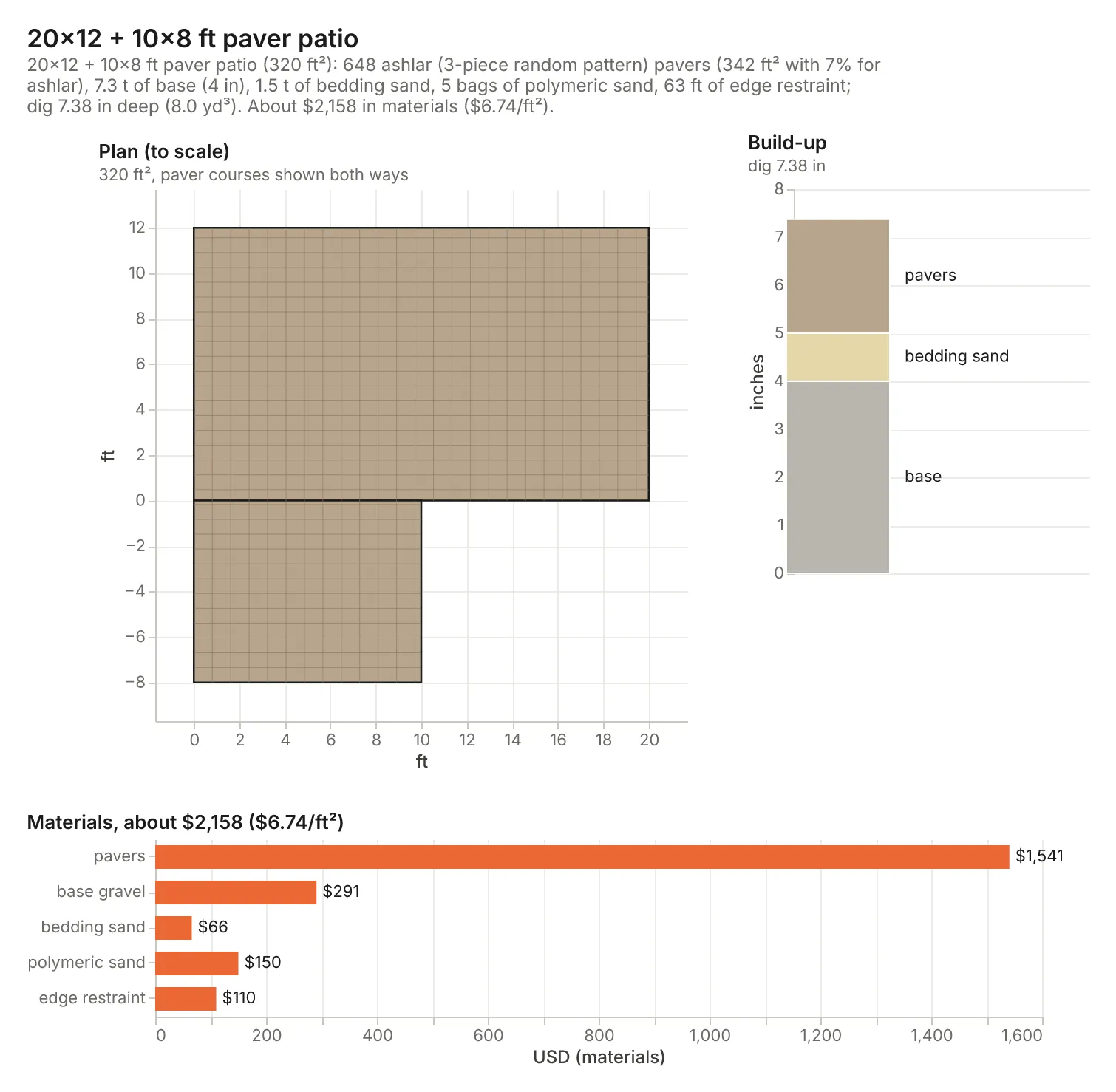
- Charts (a to-scale plan with the paver courses, the build-up and the cost by item) and a Markdown report.
It's made for:
- Homeowners and DIYers planning a patio, path or fire pit area.
- Landscapers and hardscape contractors putting together material orders and quotes.
- AI agents, home improvement and landscaping apps that need a paver estimate they can show their work for.
How to use it
- Write Requests, one per paved area. The form has examples.
- Optionally set the default paver and pattern.
- Click Start. Each request is a row in the results, with its summary, chart and report.
What you can write
| You write | It means |
|---|---|
12 x 16 ft, 16' x 20', 5 x 6 m, walkway 30 ft long 4 ft wide | A rectangle |
20x12 plus 10x8 | An L or T shape |
14 ft circle, circular patio 12 ft across, radius 6 ft | A circle |
300 sq ft | An area (edge length taken as a square's unless you give a perimeter) |
4x8, 6x9, 12x12, 24x24 slabs, ashlar, 7 x 10 inch pavers, 80 mm | The paver |
running bond, herringbone, 45 degree herringbone, basketweave, stack bond | The pattern |
patio, walkway, pool deck, driveway | The use |
clay, cold winters, permeable, against the house | Ground, climate and edges |
$4.25/sq ft, 10% waste | Prices and waste |
The same as an object: {"length": 24, "width": 14, "paver": "6x9", "pattern": "herringbone 90", "soil": "clay", "prices": {"pavers": 3.9}}.
Examples
12 x 16 ft patio with 6x9 pavers, running bond→ 520 pavers, 4.6 t base, 0.9 t sand, 3 bags of polymeric sand, 59 ft of edging; about $1,172.14 ft circle fire pit patio, 4x8 pavers, herringbone→ 761 pavers with 15% for the herringbone and the curve.paver driveway 20 x 40 ft in clay, cold winters, 4x8 pavers 80 mm, 45 degree herringbone→ a 14 in base (67 t), dig 18 in.walkway 30 ft long 4 ft wide, 12x12 pavers, $4.25/sq ft→ 124 pavers; about $875.L-shaped patio 20x12 plus 10x8 against the house, ashlar pattern→ 320 ft², edging on 60 ft of open edge.300 sq ft permeable paver patio→ a 6 in #57 base and #8 chips, no polymeric sand.
How-to examples
These are examples from Examples above, written as complete inputs; the result lines are from their runs.
How to calculate pavers, base and sand for a patio
Result: 520 pavers, 4.6 t base, 0.9 t sand, 3 bags of polymeric sand, 59 ft of edging; about $1,172.
How to estimate a circular fire pit patio
Result: 761 pavers with 15% for the herringbone and the curve.
How to size the base for a paver driveway
Result: A 14 in base (67 t), dig 18 in.
How to let an AI agent estimate a paver patio
Add this Actor to the Apify MCP server with https://mcp.apify.com/?tools=jumblemog/paver-patio-calculator. The agent writes the area and paver ("12 x 16 ft patio with 6x9 pavers") and passes on the paver count, base and sand tonnage and cost instead of guessing them.
FAQ
What does it give me? Pavers with pattern waste, base stone, bedding sand, polymeric sand, edging and a materials cost.
Which shapes does it take? Rectangles, L and T shapes, circles, or an area and perimeter you give.
Does it handle driveways and permeable pavers? Yes. Driveways and clay or cold sites get a deeper base, and permeable patios get open-graded stone with no polymeric sand.
Are the prices real? They're rough US retail for materials only. Give your own paver and stone prices for a real total.
How many can I run at once? Up to 200 paved areas per run, each as a line of text or an object. A request that can't be computed isn't billed.
Does it work with Zapier, Make or n8n? Yes. Call the Actor with its Apify app or an HTTP request and pass the results on.
Input
| Field | What it is |
|---|---|
requests | Paved areas as lines of text or objects (up to 200 per run) |
paver | The paver when a request doesn't say (6×9 in by default) |
pattern | The laying pattern when a request doesn't say (running bond by default) |
charts | Draw a chart for each request (default on) |
Output
One dataset item per request, also saved together in the run's OUTPUT record:
Every item has warnings, notes (every assumption and default), a Markdown report and links to the chart and report. A request that can't be computed has "status": "failed" and the reason in error, and isn't billed.
How it works
- Pavers = area × (1 + pattern waste) ÷ the face one paver covers with a 1/8 in joint, e.g. 6.125 × 9.125 in for a 6×9.
- Base: 4 in of compacted 3/4 in minus gravel for patios and walkways (6 in on clay), 8 in for driveways (12 in on clay), 2 in more where it freezes; it reaches 6 in past the edges (12 in for driveways). Ordered 20% extra for compaction at 1.4 tons a cubic yard.
- Bedding: 1 in of concrete sand, screeded. Polymeric sand = joint length per ft² (12/width + 12/length) × 1/8 in × paver thickness × 100 lb/ft³, plus 10%, in 50 lb bags.
- Edges: plastic or aluminum edge restraint on every open edge with a 10 in spike each foot; none along the house.
- Permeable: an open-graded #57 base 6 in or more (12 in for driveways) over fabric, 2 in of #8 chips, #8 chips in the joints.
- Drainage: a 2% fall (1/4 in a foot) away from the house across the short side.
- Driveways: 80 mm pavers in herringbone; large slabs are flagged.
Pricing
You pay one low price per paved area, at the price shown on this page. The charts and report are included. Requests that can't be computed are never charged. If you set a maximum cost per run, the Actor stops before a request that wouldn't fit.
Speed
A request takes milliseconds. A run through the API answers in about 10 seconds, including the cloud container starting.
Tips and limits
- Prices vary a lot: give your paver price per square foot and your stone prices for a real total; the defaults are rough US retail, materials only (installed pavers typically run $15-30 per ft²).
- Pallets are counted at about 3,000 lb each; your supplier's pallet size and delivery fee decide the order.
- Circles and curves need more cuts; add waste for tight curves and borders (soldier courses).
- Limits: 200 requests per run; rectangles, L and T shapes, circles or a given area and perimeter.
For AI agents and developers
This Actor works with the Apify MCP server, so AI agents can call it as a tool. Pass requests as plain text and read summary, materials, layers, cost and warnings. A direct API call that waits for the answer:
run-sync instead returns the run's OUTPUT: the status, the counts and every result as JSON.
In Python, with the apify-client package:
Credits
- Method: common Interlocking Concrete Pavement Institute (ICPI) style installation rules for base depth, bedding sand, edge restraint and slope; paver coverage and joint volume from the paver's size.
- Charts: Vega-Lite and vl-convert (BSD-3-Clause), with the Inter font (SIL Open Font License).


