

Linkedin Post Creation Date Scraper
Pricing
from $0.67 / 1,000 results
Linkedin Post Creation Date Scraper
Linkedin Post Creation Date Scraper returns the exact creation date and time (UTC, to the millisecond) of any LinkedIn post from its URL. Output: url, activity ID, date, ISO date and timestamp. No login, no proxy. Export JSON, CSV or Excel, or use the API.
Pricing
from $0.67 / 1,000 results
Rating
0.0
(0)
Developer

Social Data API
Maintained by CommunityActor stats
0
Bookmarked
2
Total users
1
Monthly active users
10 days ago
Last modified
Categories
Features
Share
LinkedIn Post Creation Date Scraper — Exact Post Date and Time in UTC
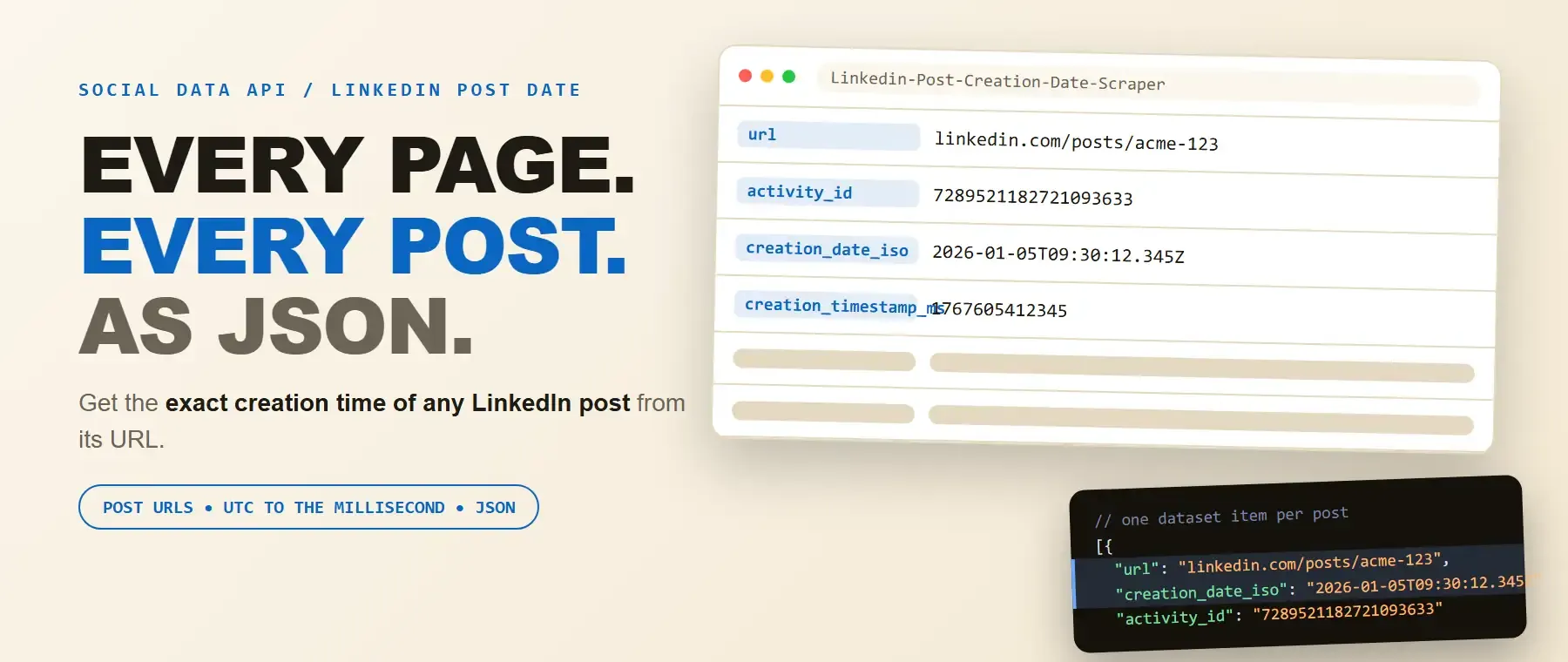
LinkedIn Post Creation Date Scraper returns the exact LinkedIn post publish date for any post link you paste: the date and time in UTC to the millisecond, an ISO 8601 date and a Unix timestamp, plus the post ID. Every response is structured JSON — ready to pass directly to an LLM, index into a vector store, or feed a social listening pipeline. No LinkedIn account or cookies needed. Check one link first, then run hundreds at once to date a whole content archive.
What data can I extract with LinkedIn Post Creation Date Scraper?
Using this LinkedIn Post Creation Date API, you will be able to extract the following LinkedIn post data:
| 🔗 Post link | 🆔 Post ID | 📅 Creation date (UTC) | 🕒 ISO 8601 date |
|---|---|---|---|
| ⏱️ Unix timestamp (milliseconds) | ⚠️ Error reason (when no date) |
How to use LinkedIn Post Creation Date Scraper
Social media managers, researchers and recruiters use it to get the real LinkedIn post timestamp for every link in one run, without opening each post.
Copy to your AI assistant:
LinkedIn Post Creation Date Scraper MCP Server: use these Actors from ChatGPT, Claude or Cursor
Point your AI assistant at this Actor and it can date LinkedIn posts on its own: paste links in a chat and get the publish time back. No glue code, no scraping logic in your prompts.
Step by step
- Create a free Apify account.
- Open LinkedIn Post Creation Date Scraper in the Apify Store.
- Paste the LinkedIn post URLs, one per line.
- Click Start (or send your API request).
- Download or stream your results in JSON, CSV or Excel.
How to scale LinkedIn Post Creation Date Scraper to bulk
The post URLs field takes a list, so one run can date many posts: a recorded run turned 124 links into 124 rows in about 2 seconds. For bulk LinkedIn post dates from a spreadsheet, paste the whole column, or send the list through the API and loop over your files. Duplicate links are processed once, and links without a post ID come back as free error rows, so your row count always matches your unique links.
✨ Features
LinkedIn Post Creation Date Scraper fetches clean, structured post dates from LinkedIn links ⚡. It's ideal for checking the age of posts before you engage, building content calendars from past posts, auditing when competitors publish, and adding a publish time to post lists you already collected.
It extracts, per post:
- Creation date – the date and time the post was published, in UTC, to the millisecond
- ISO date – the same moment in ISO 8601 format with the UTC offset
- Timestamp – the publish time as a Unix timestamp in milliseconds, ready for sorting
- Post ID – the 19-digit LinkedIn post ID found in your link
- Post link – the link exactly as you entered it
- Error – why no date came back, for links that are not post links
⚡ It works as a LinkedIn post date checker and LinkedIn post date extractor in one: no LinkedIn account, no cookies and no proxy, so runs finish in seconds.
Use cases 💡
- Social media manager — find the LinkedIn post time in UTC before resharing older content.
- Competitor analyst — sort a rival's post links by creation date to map their posting rhythm.
- Recruiter — check how old a job post is before reaching out.
- Researcher — find LinkedIn post date and LinkedIn post age for every post in a study sample.
- AI agent builder — give an agent post dates as context for time-aware answers.
Building an AI agent? Connect LinkedIn Post Creation Date Scraper over MCP and let it call the actor on its own.
Why choose this actor?
- Hundreds of posts in seconds. A recorded run dated 120 post links and flagged 4 non-post links in about 2 seconds, one row per link.
- Millisecond precision. A recorded post came back as published on 2024-07-16 at 06:09:31.913 UTC, with the matching ISO date and the timestamp 1721110171913.
- Five link formats, one field. Post links, feed links, urn:li:activity, ugcPost and share URNs, and bare post IDs all work in the same list.
⬇️ Input
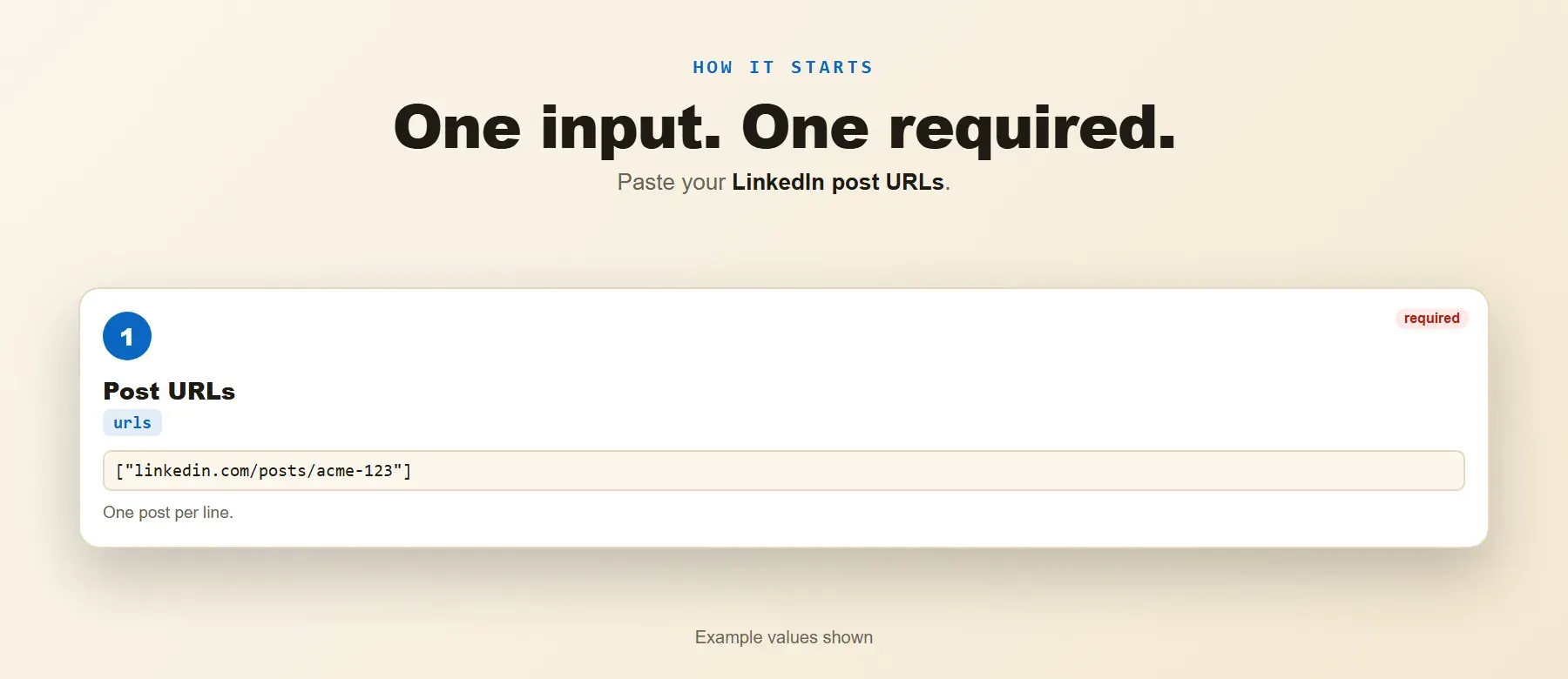
The actor accepts a list of LinkedIn post links, URNs or post IDs. The post URLs field is required.
| Parameter | Required | Type | Description | Example value |
|---|---|---|---|---|
urls | Yes | array | LinkedIn post links, one per line: /posts/...-activity- | ["https://www.linkedin.com/feed/update/urn:li:activity:7218859278495813634/"] |
Accepted formats:
https://www.linkedin.com/posts/<author>_<title>-activity-<id>-<code>https://www.linkedin.com/feed/update/urn:li:activity:<id>/(alsourn:li:ugcPost:<id>andurn:li:share:<id>, plain or%3A-encoded)urn:li:activity:<id><id>(the bare 19-digit post ID)
Free plan limits
Users on the Apify free plan can fetch up to 20 post dates per run (all URLs together) and 200 post dates per month. When the limit is reached, the run finishes successfully with a status message explaining the limit. Upgrade to any paid Apify plan to remove these limits.
Example input
⬆️ Output
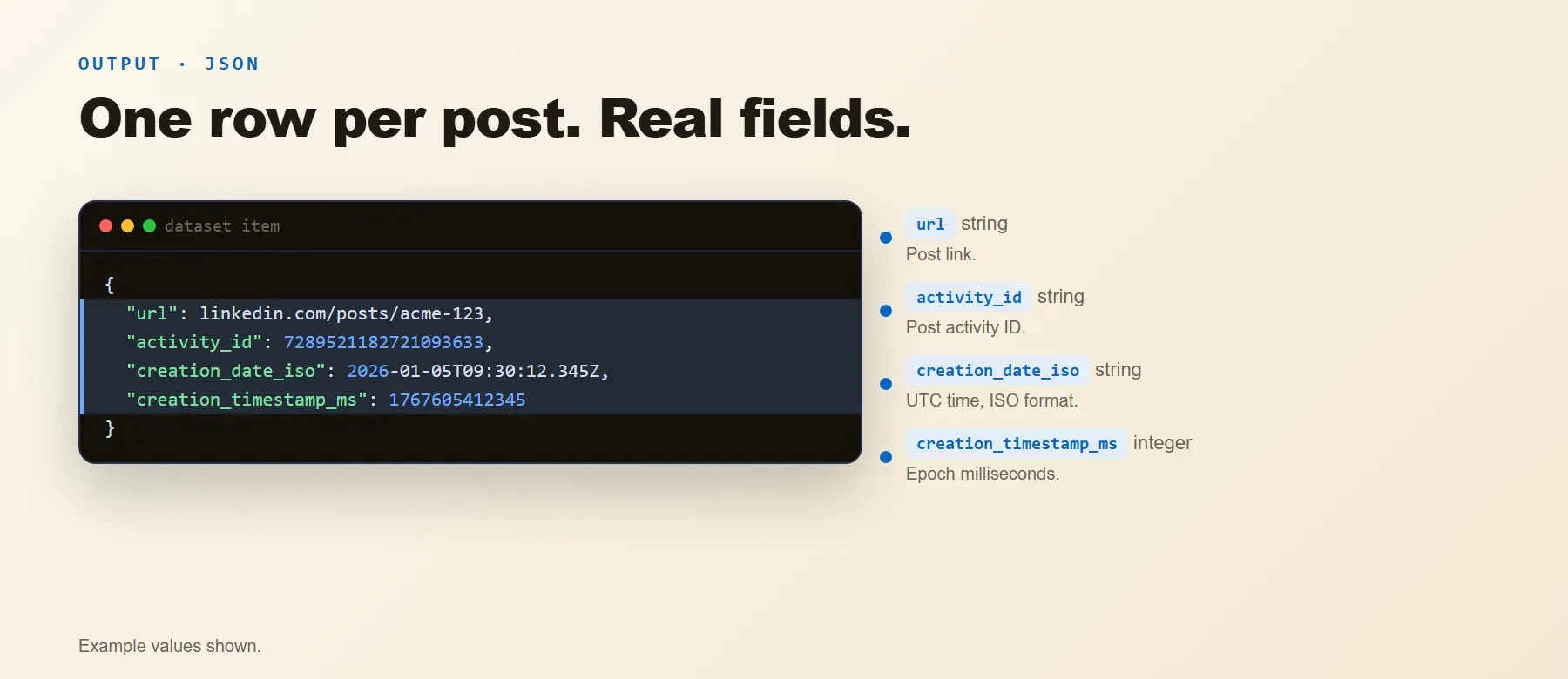
Every link becomes one typed, normalized JSON item with the same schema on every run, exportable as JSON (default), CSV or Excel. Links without a post ID come back as free rows with the error reason filled and the date fields empty.
Example output
Real rows from a recorded run of the example input:
How does it work?
You give the actor LinkedIn post links and it returns each post's publish date and time in UTC. It works from the links you provide: it does not log in, does not use cookies, does not open LinkedIn pages and needs no proxy, so there is no account to risk and nothing to block. Each link is checked on its own; a link that is not a post link (a profile, a company page or an article) gets a row that says why no date came back, and it is never charged. The output schema is normalized and stays the same on every run, whatever LinkedIn changes in its page design. Because nothing is downloaded, a post that was deleted or made private still gets its original publish date, as long as you still have its link.
How do you integrate LinkedIn Post Creation Date Scraper into your stack?
It works with what you already use: the REST API from any language, MCP for AI agents, and no-code tools.
Using LinkedIn Post Creation Date Scraper with the Apify API
Works in Go, Ruby, Node.js, cURL — any language that can make an HTTP request.
MCP integration for AI agents
Add the actor to your AI assistant with one command. The server starts with this Actor preloaded, so you can ask for the publish date of any post link in plain words.
This registers LinkedIn Post Creation Date Scraper as a tool your agent can call directly. It works in Claude Code, Cursor and Windsurf.
No-code tools (n8n, Make, LangChain)
- n8n — use the Apify node with "Run an Actor" and pick
socialdataapi/linkedin-post-creation-date, or the HTTP Request node pointed at the run-sync endpoint above with your token. - Make — use the Apify app's "Run an Actor" module, then "Get Dataset Items" to pass the dates to the next step.
- LangChain — install
langchain-apifyand loadApifyActorsTool("socialdataapi/linkedin-post-creation-date")as an agent tool.
Frequently asked questions
What fields does LinkedIn Post Creation Date Scraper return?
It returns the post link, the post ID, the creation date in UTC, the ISO 8601 date and the Unix timestamp in milliseconds, plus an error reason when no date can be read. See the data fields section.
Does LinkedIn Post Creation Date Scraper require a LinkedIn account or login?
No. It needs no LinkedIn account, no cookies and no login; it only uses the links you paste.
How fast does LinkedIn Post Creation Date Scraper run?
A recorded run dated 124 links in about 2 seconds, and a 3-link run took about 1 second.
What happens if a post is private or doesn't exist?
A deleted or private post still gets its date, because the actor does not check that the post still exists. A link without a post ID (for example a profile or article link) returns a row with the error field set and empty date fields; filter rows where the error is empty to keep only dated posts.
Can I scrape multiple LinkedIn post dates at once?
Yes. Put every link in the post URLs list; each unique link gives one row in the same run.
Does LinkedIn Post Creation Date Scraper work with Claude, ChatGPT, and other AI agent tools?
Yes — LinkedIn Post Creation Date Scraper is available as an MCP tool. Register it in Claude Code, Cursor or Windsurf with claude mcp add --transport http apify "https://mcp.apify.com?tools=socialdataapi/linkedin-post-creation-date"; any agent that can call an HTTP endpoint can use the REST API directly.
Does LinkedIn Post Creation Date Scraper return data in a format LLMs can use directly?
Yes. Every row is typed, normalized JSON with consistent field names. No HTML parsing, no selectors: pass it straight to an LLM, index it into a vector store or feed it to an agent tool.
What happens when LinkedIn changes its layout or updates its anti-bot system?
Nothing changes for you: the actor does not read LinkedIn pages, so page redesigns and anti-bot updates do not affect it, and your calls keep returning the same JSON schema.
Can I use LinkedIn Post Creation Date Scraper without managing proxies or browser infrastructure?
Yes. It needs no proxy and no browser at all. You send one request with your links and get structured JSON back.
Which LinkedIn post fields work best for AI training data and RAG indexing?
For RAG, attach the ISO date and the post link to the post text you already store, so answers can say when something was posted. For training data, use the Unix timestamp and the post ID; both are typed primitives that need no normalization.
Related scrapers
| Scraper | What it extracts |
|---|---|
| LinkedIn Post Scraper | LinkedIn posts with text, reactions and author details |
| LinkedIn Profile Post Scraper | Posts published by a LinkedIn profile |
| LinkedIn Post Comments Scraper | Comments on LinkedIn posts |
| Post Comments and Engagements Scraper for LinkedIn | Comments and engagement on LinkedIn posts |
| LinkedIn Profile Scraper | Public LinkedIn profile details |
Your feedback
Found a bug or missing a field? Let us know through the Issues tab on the actor's Apify Store page. Every report is read, and fixes ship as new versions of the actor.


