

LinkedIn Post Comments Scraper - Cheapest
Pricing
from $1.00 / 1,000 results
LinkedIn Post Comments Scraper - Cheapest
LinkedIn Post Comments Scraper extracts LinkedIn post comments: text, exact UTC time, reactions, author name, headline and profile URL. The first ~10 comments per post need no login; add your li_at cookie for every comment, nested replies and sorting. Export JSON, CSV or Excel.
Pricing
from $1.00 / 1,000 results
Rating
0.0
(0)
Developer

Social Data API
Maintained by CommunityActor stats
0
Bookmarked
2
Total users
0
Monthly active users
12 days ago
Last modified
Categories
Features
Share
LinkedIn Post Comments Scraper — Text, Authors, Time and Reactions
LinkedIn Post Comments Scraper extracts the comments on LinkedIn posts and returns each one with its text, exact UTC time, reaction count, author name, profile link and the post's real comment total. Every response is structured JSON — ready to pass directly to an LLM, index into a vector store, or feed a social listening pipeline. No LinkedIn account or cookies needed for the first comments; add your li_at cookie to load every comment, nested replies and sort order. Paste one post, then scale to a whole campaign.
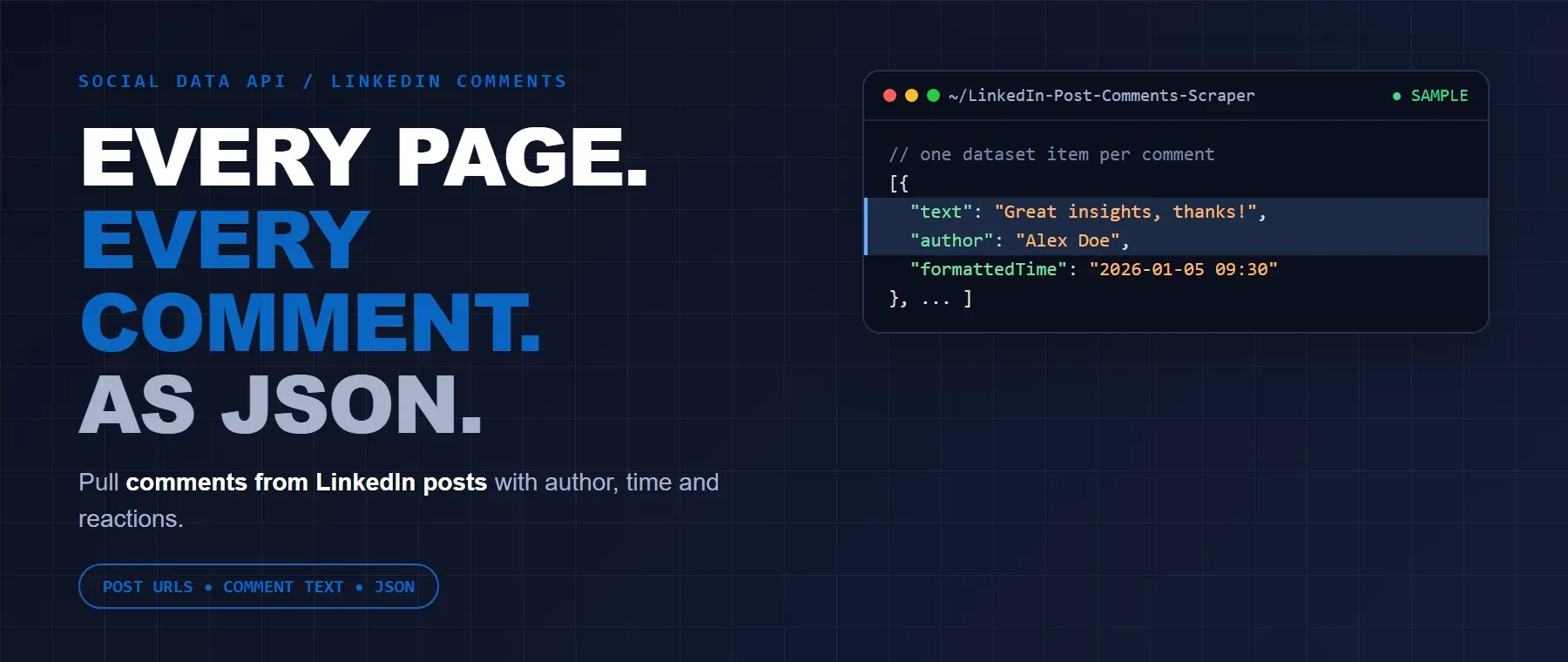
What data can I extract with LinkedIn Post Comments Scraper?
Using this LinkedIn Post Comments API, you will be able to extract the following LinkedIn comment data:
| 💬 Comment text | 🕒 Exact time (UTC and epoch ms) | 👍 Reaction count (by type with a cookie) | 👤 Author name, first and last name |
|---|---|---|---|
| 🔗 Author profile URL and public ID | 🖼️ Author picture (if available) | 💼 Author headline (with a cookie) | 🤝 Connection degree (with a cookie) |
| ↩️ Nested replies (with a cookie) | 🔢 Reply count | 📌 Pinned and edited flags (with a cookie) | ✍️ Written by the post author (with a cookie) |
| 🏷️ Mentions of people, companies and hashtags (with a cookie) | 🔗 Direct comment link | 🆔 Comment and post identifiers | 📊 Post's real comment total |
| ⚙️ Engine used (logged-out or logged-in) | 📅 Scraped at |
How to use LinkedIn Post Comments Scraper
B2B marketers and sales teams use it to turn the people who comment on a post into a list of warm leads with names, profile links and what they said.
Copy to your AI assistant:
LinkedIn Post Comments Scraper MCP Server: use these Actors from ChatGPT, Claude or Cursor
Point your AI assistant at Scrapier and it can read LinkedIn post comments on its own. No glue code, no scraping logic in your prompts.
Step by step
- Create a free Apify account.
- Open LinkedIn Post Comments Scraper in the Apify Store.
- Paste the LinkedIn post URL (or its activity ID); add your li_at cookie if you want every comment.
- Click Start (or send your API request).
- Download or stream your results in JSON, CSV or Excel.
How to get your LinkedIn li_at cookie
- Log in to linkedin.com in Chrome, Edge or Firefox.
- Open DevTools (F12) and go to Application > Cookies > https://www.linkedin.com.
- Find the cookie named
li_atand copy its value. - Paste it into the LinkedIn cookie (li_at) field. The field is stored as a secret; treat the value like a password.
How to scale LinkedIn Post Comments Scraper to bulk
Put every post into the posts list: URLs, activity URNs and bare activity IDs can be mixed. Posts are read one after another with a short pause, which keeps LinkedIn from rate-limiting the run, and each post stops at your per-post limit. To scrape LinkedIn comments for a whole campaign, save the input as a task and schedule it daily, or call the API from your own job and export LinkedIn comments to CSV or Excel when each run finishes.
✨ Features
LinkedIn Post Comments Scraper fetches clean, structured comments from LinkedIn posts. It's ideal for warm-lead lists, engagement tracking, audience research and community management, and it works as a LinkedIn comments scraper, LinkedIn commenters scraper and LinkedIn comment extractor in one.
It extracts, per comment:
- Comment text – the full text of what was written.
- Exact time – the UTC date and time of the comment, to the millisecond.
- Author name and profile link – who wrote it, ready for outreach.
- Reaction count – how many people reacted, by type with a cookie.
- Replies – nested under each comment when you add a cookie (a LinkedIn comment replies scraper in the same run).
- Post comment total – the post's real comment count, so you know the coverage.
⚡ Posts that cannot be read are saved as free rows with the reason, so a failed post never costs anything.
Use cases 💡
- B2B marketer — export LinkedIn comments on competitor posts to find warm leads.
- Sales rep — open the profile links of everyone who commented on an industry post.
- Community manager — track new comments on company posts with the date filter.
- Researcher — use it as a LinkedIn engagement scraper for reaction counts per comment.
- AI agent builder — feed comment text into a RAG index for audience sentiment answers.
Building an AI agent? Connect LinkedIn Post Comments Scraper over MCP and let it call the actor on its own.
Why choose this actor?
- Comments in seconds, no login. A recorded logged-out test run read 2 posts and saved 18 comments in about 3.4 seconds, with an invalid entry reported as a free error row.
- Coverage you can see. A recorded comment came back with its exact time (2025-01-27 06:21:46 UTC), 155 reactions and the post's real total of 211 comments.
- 10 inputs, two engines. Sort order, start page, date window, replies, author detail and exact reaction types, logged-out by default or logged-in with your cookie.
⬇️ Input
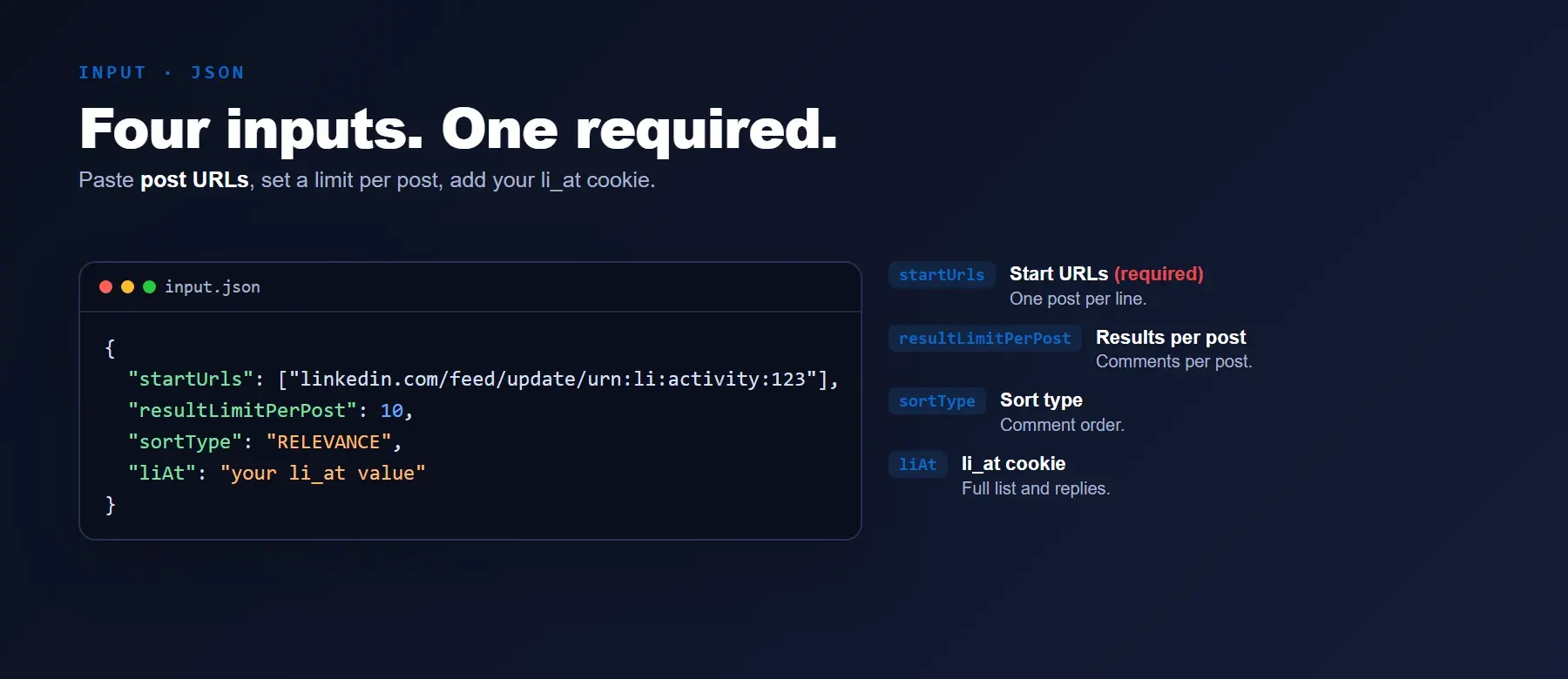
The Actor accepts one or more LinkedIn posts as URLs, activity URNs or numeric activity IDs; the li_at cookie (liAt) is required.
| Parameter | Required | Type | Description | Example value |
|---|---|---|---|---|
startUrls | No | array | Post URLs, activity or ugcPost URNs, or numeric activity IDs. Defaults to a sample post. | ["https://www.linkedin.com/feed/update/urn:li:activity:7289521182721093633/"] |
resultLimitPerPost | No | integer | Top-level comments per post, 1 to 500. Default 10. | 100 |
sortType | No | string | RELEVANCE or RECENT. Default RELEVANCE. Cookie only. | "RECENT" |
startPage | No | integer | Skip the first (startPage - 1) x 10 top-level comments. Default 1. | 1 |
postedLimit | No | string | any, 24h, week, month, 3months, 6months or year. Default any. | "month" |
scrapeReplies | No | boolean | Keep replies nested under each comment. Default false. Cookie only. | true |
profileScraperMode | No | string | full (headline, connection degree, picture) or short (name, profile URL, IDs). Default full. | "full" |
detailedReactions | No | boolean | Exact counts per reaction type. Default false (total reported under LIKE). Cookie only. | false |
liAt | No | string (secret) | Your LinkedIn li_at cookie for every comment, replies and sort order. | "AQEDAR...your_li_at" |
proxyConfiguration | No | object | Optional proxy. Default: no proxy, with automatic Apify proxies when LinkedIn blocks or rate-limits. | {"useApifyProxy": false} |
Free plan limits
Users on the Apify free plan can fetch up to 20 comments per run (all posts together) and 200 comments per month. When the limit is reached, the run finishes successfully with a status message explaining the limit. Upgrade to any paid Apify plan to remove these limits.
Example input
⬆️ Output
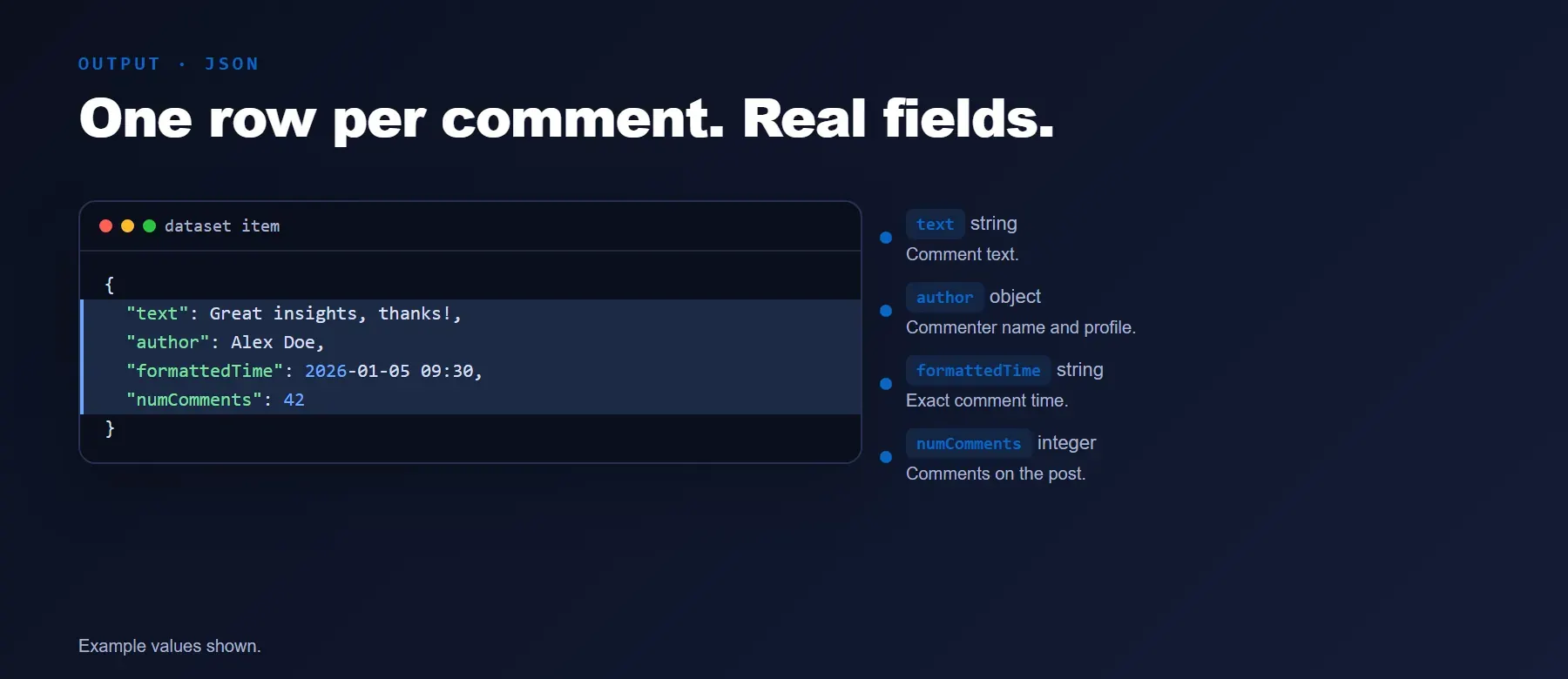
Every comment is one typed JSON item with the same fields on every run, with its replies nested inside; export it as JSON (default), CSV or Excel for LinkedIn comments to CSV workflows. A post that cannot be read becomes one free error row with the error reason and a short message.
Example output
A real comment from a logged-out test run, followed by the real free error row for an invalid entry (logged-out rows have an empty headline and connection degree, no mentions and no replies):
How does it work?
Scrapier's LinkedIn post comments scraper reads each post the way a visitor does. Without a cookie it sends plain HTTP requests for the public post page and reads the comments LinkedIn shows there, about the first 9-10 per post. With your li_at cookie it opens the post in a real browser, picks the sort order, scrolls and expands the thread until every comment and reply is loaded. Posts are read one at a time with a short pause; when LinkedIn blocks or rate-limits a request, the Actor retries with fresh Apify datacenter and then residential proxies, up to four attempts. Each comment is written to the dataset as soon as its post is done. The output fields stay the same on every run, so your downstream code keeps working when LinkedIn changes its pages.
How do you integrate LinkedIn Post Comments Scraper into your stack?
It works with what you already use: the REST API from any language, MCP for AI agents, and no-code tools.
Using LinkedIn Post Comments Scraper with the Apify API
Works in Go, Ruby, Node.js, cURL — any language that can make an HTTP request.
MCP integration for AI agents
Add the Actor to your AI agent with one command:
This registers LinkedIn Post Comments Scraper as a tool your agent can call directly. It works in Claude Code, Cursor and Windsurf, so an agent can pull the comments on a post, group the commenters by what they said and draft follow-ups.
No-code tools (n8n, Make, LangChain)
- n8n — add the Apify node with "Run an Actor" and pick
socialdataapi/linkedin-post-comments-scraper, or use the HTTP Request node pointed at the run-sync endpoint with your token. - Make — use the Apify app's "Run an Actor" module, then "Get Dataset Items" to send the comments to your sheet or CRM.
- LangChain — install
langchain-apifyand load the Actor withApifyActorsTool("socialdataapi/linkedin-post-comments-scraper").
Is it legal to scrape LinkedIn data?
Collecting comments that LinkedIn shows publicly on a post is generally legal, but how you store and use them matters. LinkedIn Post Comments Scraper returns, without a cookie, only what any visitor sees without logging in; with your cookie, what your own account can see on the post. Under GDPR and similar laws, scraping public data is generally permissible, but storing and using it must comply with local data-protection law, and you should respect LinkedIn's terms. Consult legal counsel if your use case involves bulk storage of personal data.
Frequently asked questions
What fields does LinkedIn Post Comments Scraper return?
It returns the comment text, exact comment time, reaction count, author name and author profile link of every comment, plus reply count, the post's comment total and, with a cookie, replies and headlines. See the data fields section for the full list.
Does LinkedIn Post Comments Scraper require a LinkedIn account or login?
Yes. The li_at cookie is required: it loads every comment, nested replies, sort order and exact reaction types. If LinkedIn rejects it, the comments LinkedIn shows any visitor (about the first 9-10 per post) are still saved. It is stored as a secret and never written to the logs.
How fast does LinkedIn Post Comments Scraper run?
A recorded logged-out test run read 2 posts and saved 18 comments in about 3.4 seconds. Data is read live from LinkedIn on every run, not from a cache; posts are read one at a time, and logged-in runs take longer because the whole thread is loaded.
What happens if a LinkedIn post is private or doesn't exist?
The post is saved as a free error row with isError true, an error reason (such as login_wall, no_comment_container, no_comments, http_999 or invalid_input) and a short message. In your code, skip rows where isError is true, or collect them to retry later.
Can I scrape multiple LinkedIn posts at once?
Yes. Add any number of post URLs or activity IDs to the posts list; they are read one after another and each one stops at your per-post limit.
Does LinkedIn Post Comments Scraper work with Claude, ChatGPT, and other AI agent tools?
Yes — LinkedIn Post Comments Scraper is available as an MCP tool. Register it in Claude Code, Cursor or Windsurf with:
Any agent that can call an HTTP endpoint can use the REST API directly.
Does LinkedIn Post Comments Scraper return data in a format LLMs can use directly?
Yes. Every row is typed, normalized JSON with consistent field names. No HTML parsing, no selectors. Pass it straight to an LLM, index it into a vector store, or feed it to an agent tool — no transformation step.
What happens when LinkedIn changes its layout or updates its anti-bot system?
Scrapier maintains the Actor. When LinkedIn changes, Scrapier updates the Actor — your calls keep returning the same JSON schema with no changes on your end.
Can I use LinkedIn Post Comments Scraper without managing proxies or browser infrastructure?
Yes. Retries and the switch to Apify proxies when LinkedIn blocks or rate-limits a request run on the Actor's side, and the logged-in browser runs inside the Actor. You send one request and get structured JSON back, with no proxy accounts, no headless browser setup and no maintenance.
Which LinkedIn comment fields work best for AI training data and RAG indexing?
For RAG, use the comment text with the author name, author headline and comment time. For training data, use the reaction count, reply count, the written-by-post-author flag and the exact time. All fields are typed values — strings, integers, booleans — with no normalization needed.
Related scrapers
| Scraper | What it extracts |
|---|---|
| LinkedIn Post Scraper | LinkedIn posts |
| LinkedIn Profile Post Scraper | Posts from LinkedIn profiles |
| LinkedIn Profile Scraper | LinkedIn profile details |
| LinkedIn Company Employees Scraper | Employees of LinkedIn companies |
| Facebook Comments Scraper | Comments on Facebook posts |
| YouTube Comments Scraper | Comments on YouTube videos |
Your feedback
Found a bug or missing a field? Let us know in the Issues tab of this Actor. The Scrapier team reads every report and ships fixes.


