

Youtube Subtitles Scraper
Pricing
from $0.67 / 1,000 results
Youtube Subtitles Scraper
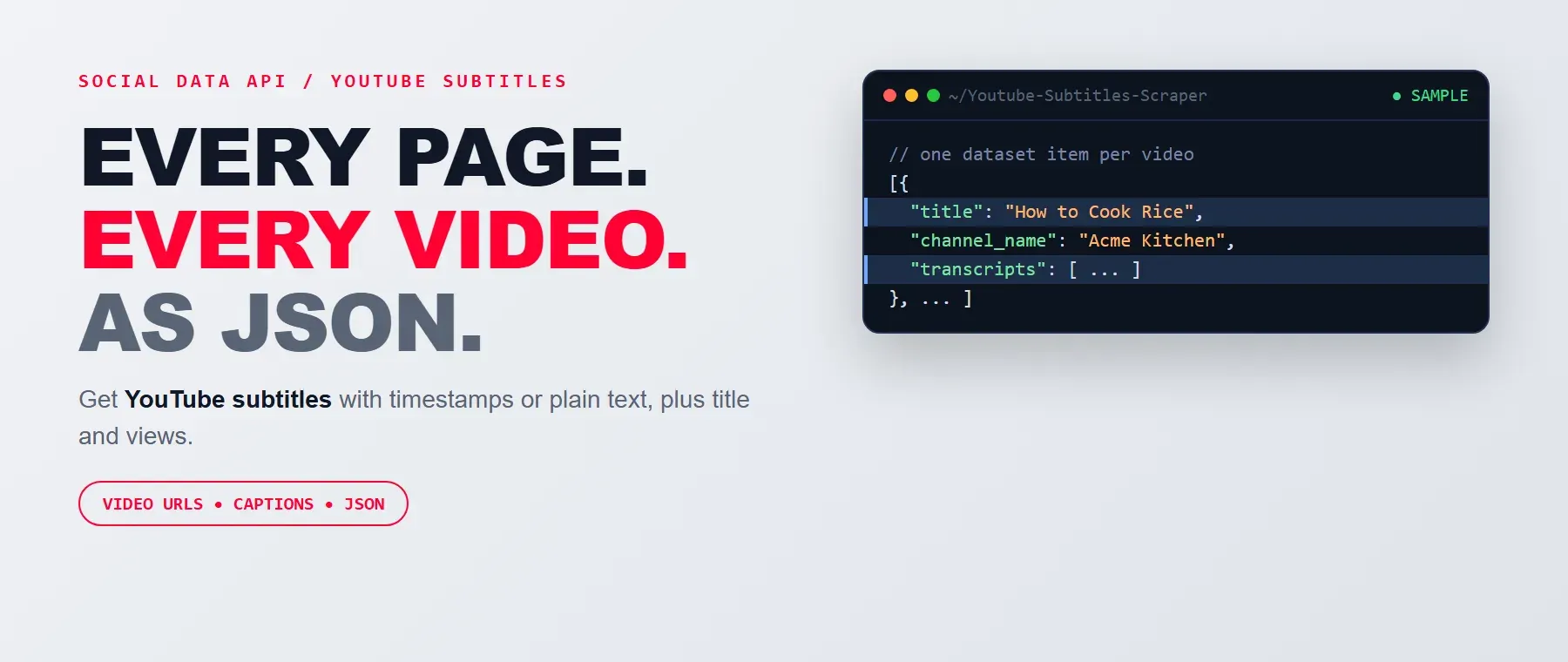
Youtube Subtitles Scraper gets the subtitles (manual and auto-generated captions) of YouTube videos with timestamps or as plain text, plus title, channel, length and views. Export JSON, CSV or Excel, or use the API.
Pricing
from $0.67 / 1,000 results
Rating
0.0
(0)
Developer

Social Data API
Maintained by CommunityActor stats
0
Bookmarked
2
Total users
1
Monthly active users
9 days ago
Last modified
Categories
Features
Share
Youtube Subtitles Scraper — Captions with Timestamps, Title and Views
Youtube Subtitles Scraper returns the subtitles of YouTube videos you list: manual and auto-generated caption tracks in any language, as timestamped lines or one plain-text block, together with the video title, channel, publish date, length, view count, description and tags. Every response is structured JSON — ready to pass directly to an LLM, index into a vector store, or feed a content summarization pipeline. No YouTube account or cookies needed. Start with one video, then extract YouTube subtitles for a whole playlist of links in one run.
What data can I extract with Youtube Subtitles Scraper?
Using this YouTube Subtitles API, you will be able to extract the following YouTube video caption data:
| 📝 Caption tracks | 🌍 Track language and code | 🤖 Auto-generated flag | ⏱️ Line start and end (ms) |
|---|---|---|---|
| 🕐 Line start time (m:ss) | 💬 Caption text | 📄 Plain-text version | 🎬 Video title |
| 🔗 Video URL and ID | 📺 Channel name, ID and link | 📅 Publish date | ⌛ Video length |
| 👀 View count | 🗒️ Description | 🏷️ Tags | ⚠️ Error reason (no captions) |
| 📥 Input value | 🕒 Scraped-at time |
How to use Youtube Subtitles Scraper
Researchers, content teams and AI developers use it to download YouTube subtitles in bulk and get one clean row per video, with every caption track inside, from one run.
Copy to your AI assistant:
Youtube Subtitles Scraper MCP Server: use these Actors from ChatGPT, Claude or Cursor
Point your AI assistant at this Actor and it can read YouTube on its own: manual and auto-generated captions of any public video, with timestamps, plus the title, channel and view count. No glue code, no scraping logic in your prompts.
Step by step
- Create a free Apify account.
- Open Youtube Subtitles Scraper in the Apify Store.
- Paste the YouTube video URLs (or bare video ids), one per line, and pick the caption tracks you want.
- Click Start (or send your API request).
- Download or stream your results in JSON, CSV or Excel.
How to scale Youtube Subtitles Scraper to bulk
Paste as many video links as you need; each one gives one row. Raise videos in parallel (up to 10) to process more videos at the same time, and the rows appear in the dataset as each video finishes. For bulk YouTube subtitles on a schedule, save the input as a task and schedule it, or call the run endpoint from your own code in a loop.
✨ Features
Youtube Subtitles Scraper fetches clean, structured captions from YouTube videos ⚡ at low cost 💸. It's ideal for video summaries, translation, search across spoken content and training-data collection. Use it as a YouTube captions extractor for one video, or to turn YouTube subtitles to text for a long list of links.
It extracts, per video:
- Caption tracks – every selected track with its language, language code and auto-generated flag
- YouTube captions with timestamps – each line with start and end in milliseconds and a readable m:ss start time
- Plain-text mode – the whole track as one string, ready for an LLM prompt
- Multilingual YouTube captions – all non-English tracks, or one extra language by its code
- Video details – title, channel, publish date, length, view count, description and tags
⚡ Videos without captions never cost you: they come back as free rows with a clear error reason.
Use cases 💡
- Researcher — search what speakers said across hundreds of talks using caption text.
- Content marketer — turn video captions into blog posts, quotes and social copy.
- Translator — pull YouTube auto-generated captions and manual tracks side by side.
- Educator — build study notes from lecture captions with timestamps for each point.
- AI engineer — chunk caption lines by start time into a RAG pipeline for video Q&A.
Building an AI agent? Connect Youtube Subtitles Scraper over MCP and let it call the actor on its own.
Why choose this actor?
- Four inputs in under six seconds. A recorded run read three videos and one invalid input, returning three rows with captions and one free error row, in 5.6 seconds.
- The full caption track, timed. A recorded row for "Never Gonna Give You Up" came back with the English manual and English auto-generated tracks, every line timed to the millisecond, plus 1,837,037,943 views and a 3:33 length.
- Any language, two formats. Manual captions, auto-generated captions, every other language or one extra language code, as timestamped lines or plain text, with up to 10 videos in parallel.
⬇️ Input
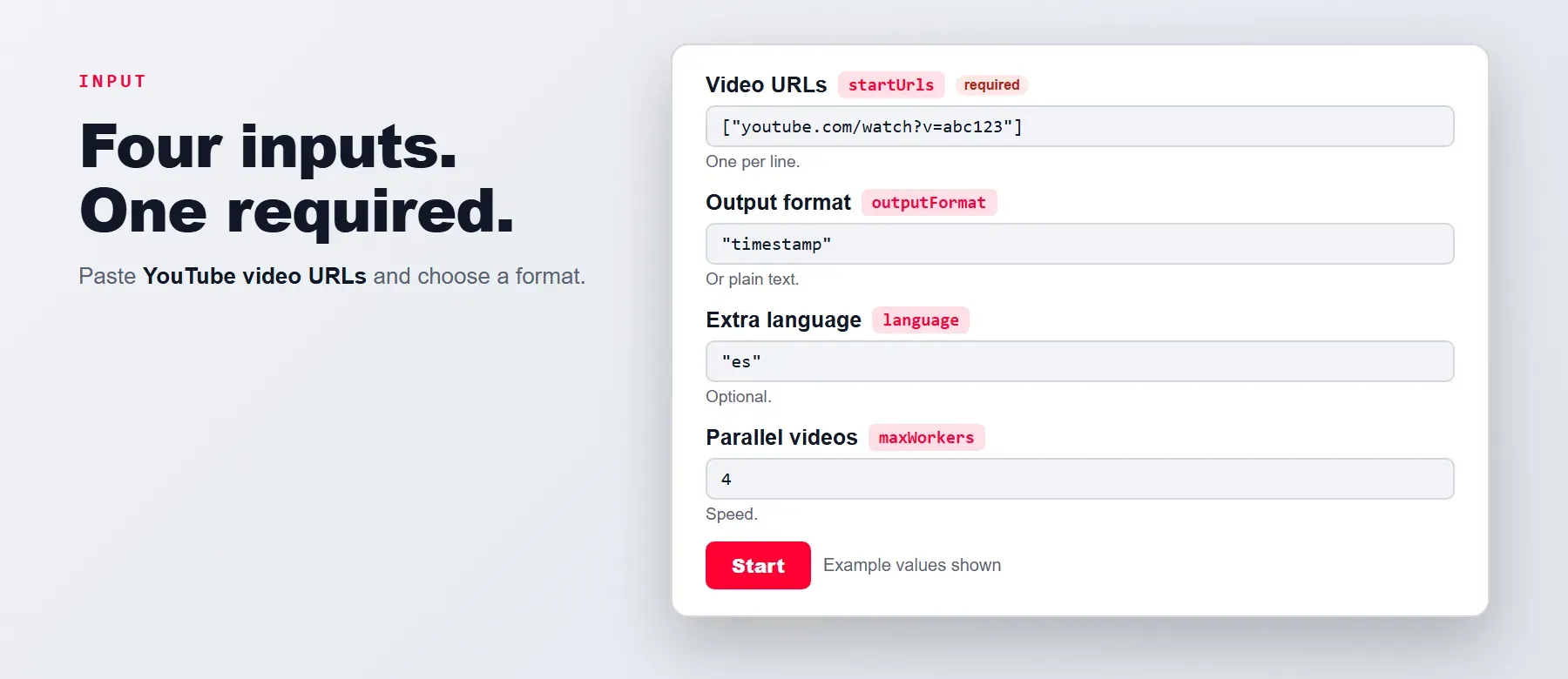
The actor takes a list of YouTube video links or video ids and the caption tracks you want. The video list is the only required field.
| Parameter | Required | Type | Description | Example value |
|---|---|---|---|---|
startUrls | Yes | array of strings | Video links (watch, youtu.be, shorts, embed or live) or bare 11-character video ids. One row per video. Channel and playlist links are not supported. | ["https://www.youtube.com/watch?v=dQw4w9WgXcQ"] |
includeEnglishAG | No | boolean | Also return YouTube's automatic (speech-recognition) English track. Default false. English manual captions are always included. | true |
includeNonEnglish | No | boolean | Also return every caption track in other languages. Default false. | false |
language | No | string | Also return the track of this language (for example es, de, ja) without turning on every other language. | "es" |
outputFormat | No | string | timestamp (default): a list of lines with start and end in ms, start time and text. text: the whole track as one string. | "timestamp" |
maxWorkers | No | integer | How many videos are processed at the same time, 1 to 10. Default 4. | 4 |
proxyConfiguration | No | object | Optional. The actor starts without a proxy and switches to Apify proxies by itself when YouTube refuses a connection. | {"useApifyProxy": false} |
If a video has none of the selected tracks, the best available track is returned instead of an empty row.
Accepted video formats:
https://www.youtube.com/watch?v=dQw4w9WgXcQhttps://youtu.be/dQw4w9WgXcQhttps://www.youtube.com/shorts/<id>,https://www.youtube.com/embed/<id>,https://www.youtube.com/live/<id>dQw4w9WgXcQ
Free plan limits
Users on the Apify free plan can fetch up to 20 videos per run (all video URLs together) and 200 videos per month. When the limit is reached, the run finishes successfully with a status message explaining the limit. Upgrade to any paid Apify plan to remove these limits.
Example input
⬆️ Output
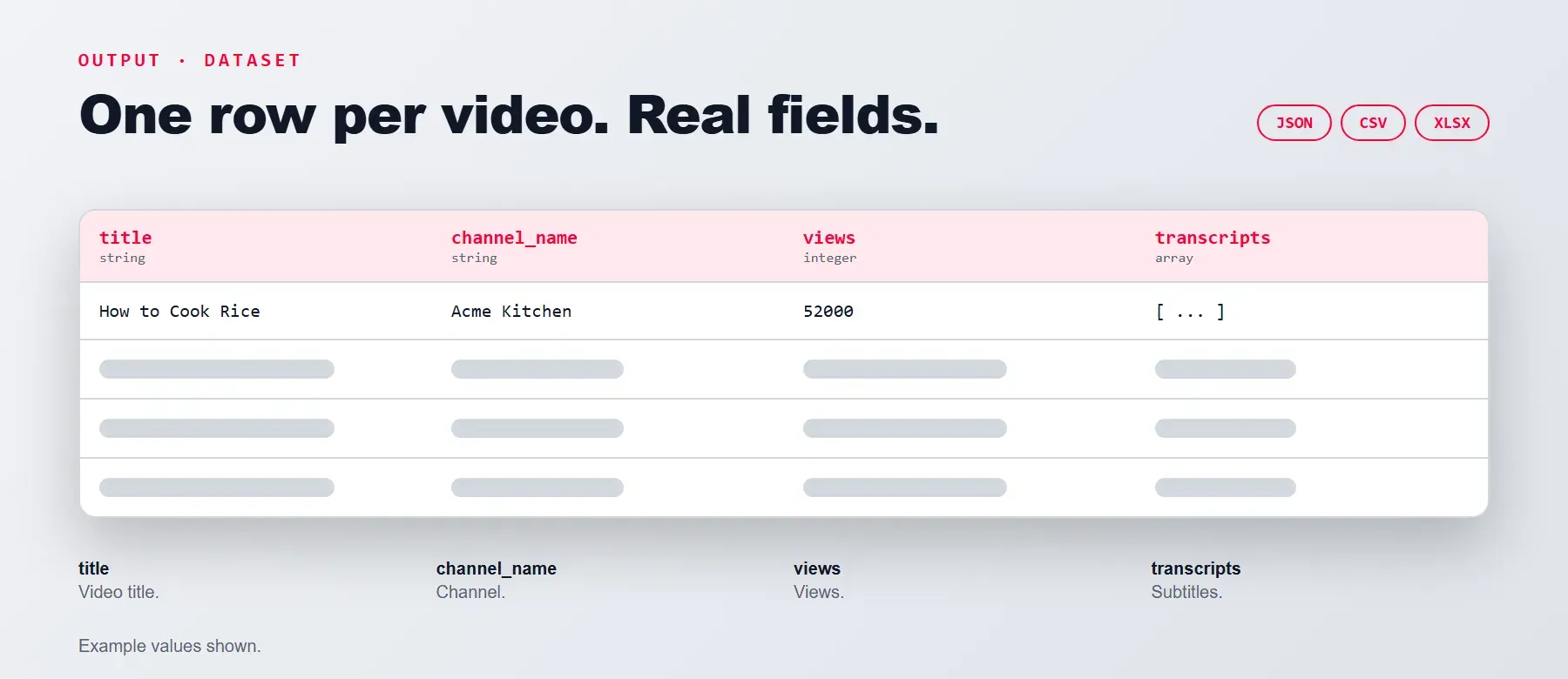
Every input gives one typed, normalized JSON item with the same 15 fields on every run; caption tracks sit in a list inside the row. A video without captions, or an input that is not a video, gives a free row with the error field set and an empty track list. Export as JSON (default), CSV or Excel.
Example output
How does it work?
Youtube Subtitles Scraper reads the same public caption tracks and video details that YouTube shows to any logged-out visitor, with plain HTTP requests and no browser. For each video it lists the caption tracks, keeps the ones you selected (or the best available one), and reads each track's lines with their timing.
The run starts without a proxy. If YouTube refuses a connection, the actor retries the video through Apify datacenter proxy and then residential proxy, each video on its own session. One track that fails never drops the others. It returns only publicly visible data, needs no YouTube account, and keeps the same schema even when YouTube changes its site.
How do you integrate Youtube Subtitles Scraper into your stack?
It works with what you already use: the REST API from any language, MCP for AI agents, and no-code tools.
Using Youtube Subtitles Scraper with the Apify API
Works in Go, Ruby, Node.js, cURL — any language that can make an HTTP request.
MCP integration for AI agents
Add the actor to your AI client with one command:
This registers Youtube Subtitles Scraper as a tool your agent can call directly. Give it a video link and it starts the run, waits and reads the caption tracks back. It works in Claude Code, Cursor and Windsurf, and in any other client that speaks MCP over HTTP.
No-code tools (n8n, Make, LangChain)
n8n: add the Apify node and choose "Run an Actor" with socialdataapi/youtube-video-subtitles-scraper, or use the HTTP Request node pointed at the run-sync endpoint with your token. Each video comes back as one item for the next node.
Make: use the Apify app's "Run an Actor" module, then "Get Dataset Items" to send each video's captions to a Google Doc, Notion or an AI module.
LangChain: install langchain-apify and load ApifyActorsTool("socialdataapi/youtube-video-subtitles-scraper") so your agent can fetch video captions as a tool.
Is it legal to scrape YouTube data?
Scraping publicly available YouTube data is generally legal, as long as you collect only what any visitor can see and use it responsibly. Youtube Subtitles Scraper returns only public captions and video details — what any user sees without logging in. Captions can contain names and statements of real people, which count as personal data under the GDPR: collecting public data is generally permissible, but storing and using it must comply with the data-protection law that applies to you, and reusing the text must respect the creator's copyright. Consult legal counsel if your use case involves bulk storage of personal data.
Frequently asked questions
What fields does Youtube Subtitles Scraper return?
It returns the caption tracks (language, auto-generated flag and timed lines), video title, channel, view count and publish date of each video, plus length, description and tags. See the data fields section for all 15 fields.
Does Youtube Subtitles Scraper require a YouTube account or login?
No. Only public caption and video data is extracted, the same data YouTube shows to logged-out visitors. No credentials are needed.
How fast does Youtube Subtitles Scraper run?
A recorded run read four inputs (three videos with captions and one invalid input) in 5.6 seconds with four videos in parallel. Data is fetched live on every run, not cached.
What happens if a video has no captions or doesn't exist?
You get one free row for it with an empty track list and a short error reason, such as "This video has no captions.", "This video is unavailable or was removed." or "Not a YouTube video URL or id.". Age-restricted and private videos are reported the same way. In code, keep rows where the error field is null.
Can I scrape multiple YouTube videos at once?
Yes. Put many video links in the list; each gives one row, and up to 10 videos are processed at the same time with videos in parallel.
Does Youtube Subtitles Scraper work with Claude, ChatGPT, and other AI agent tools?
Yes — Youtube Subtitles Scraper is available as an MCP tool. Register it in Claude Code, Cursor or Windsurf with:
Any agent that can call an HTTP endpoint can use the REST API directly.
Does Youtube Subtitles Scraper return data in a format LLMs can use directly?
Yes. Every video is typed, normalized JSON with consistent field names, and the plain-text format gives each track as one string. No HTML parsing, no selectors. Pass it straight to an LLM, index it into a vector store, or feed it to an agent tool — no transformation step.
What happens when YouTube changes its layout or updates its anti-bot system?
The actor is maintained. When YouTube changes, the actor is updated, and your calls keep returning the same JSON schema with no changes on your end.
Can I use Youtube Subtitles Scraper without managing proxies or browser infrastructure?
Yes. The actor starts without a proxy and switches to Apify proxies by itself when YouTube refuses a connection. You send one request and get structured JSON back. No proxy accounts, no headless browser setup, no maintenance.
Which YouTube caption fields work best for AI training data and RAG indexing?
For RAG, use the text fields: the caption lines, title, description and tags, chunked by start time. For training data, use the numeric and boolean fields: line start and end in milliseconds, view count and the auto-generated flag. All fields are typed primitives — strings, integers, booleans — so no normalization is needed.
Related scrapers
| Scraper | What it extracts |
|---|---|
| YouTube Transcript Scraper | Spoken text of YouTube videos. |
| YouTube Video Details Scraper | Full details of single YouTube videos. |
| YouTube Comments Scraper | Comments on YouTube videos. |
| YouTube Most Replayed Scraper | The most replayed moments of YouTube videos. |
| YouTube Shorts Scraper | YouTube Shorts and their stats. |
| TikTok Video Scraper | Details of single TikTok videos from their URLs. |
Your feedback
Found a bug or missing a field? Let us know on this Actor's Issues tab in Apify Console. Every report is read, and fixes ship as new versions of the actor.


