

Google Search Results Scraper (SERP) - No Login, Per Page
Pricing
from $7.77 / 1,000 results pages
Google Search Results Scraper (SERP) - No Login, Per Page
Scrape Google search results for your keywords: organic positions, titles, URLs, snippets, dates, sitelinks and related searches. Pick country and language, up to 10 pages per query. One row per result. No login.
Pricing
from $7.77 / 1,000 results pages
Rating
0.0
(0)
Developer

Cliqto Media
Maintained by CommunityActor stats
0
Bookmarked
2
Total users
0
Monthly active users
an hour ago
Last modified
Categories
Features
Share
Add search queries, pick a Google country and language, and get the public Google search results (SERP) as one row per result: organic results and related searches, each with its position. No Google login, no API key; you pay per loaded results page, about $0.015 for the first page of one query.
Use it for rank tracking, SEO research and competitor checks. The smallest run is the prefilled query apify web scraping with one page; it finishes in under a minute.
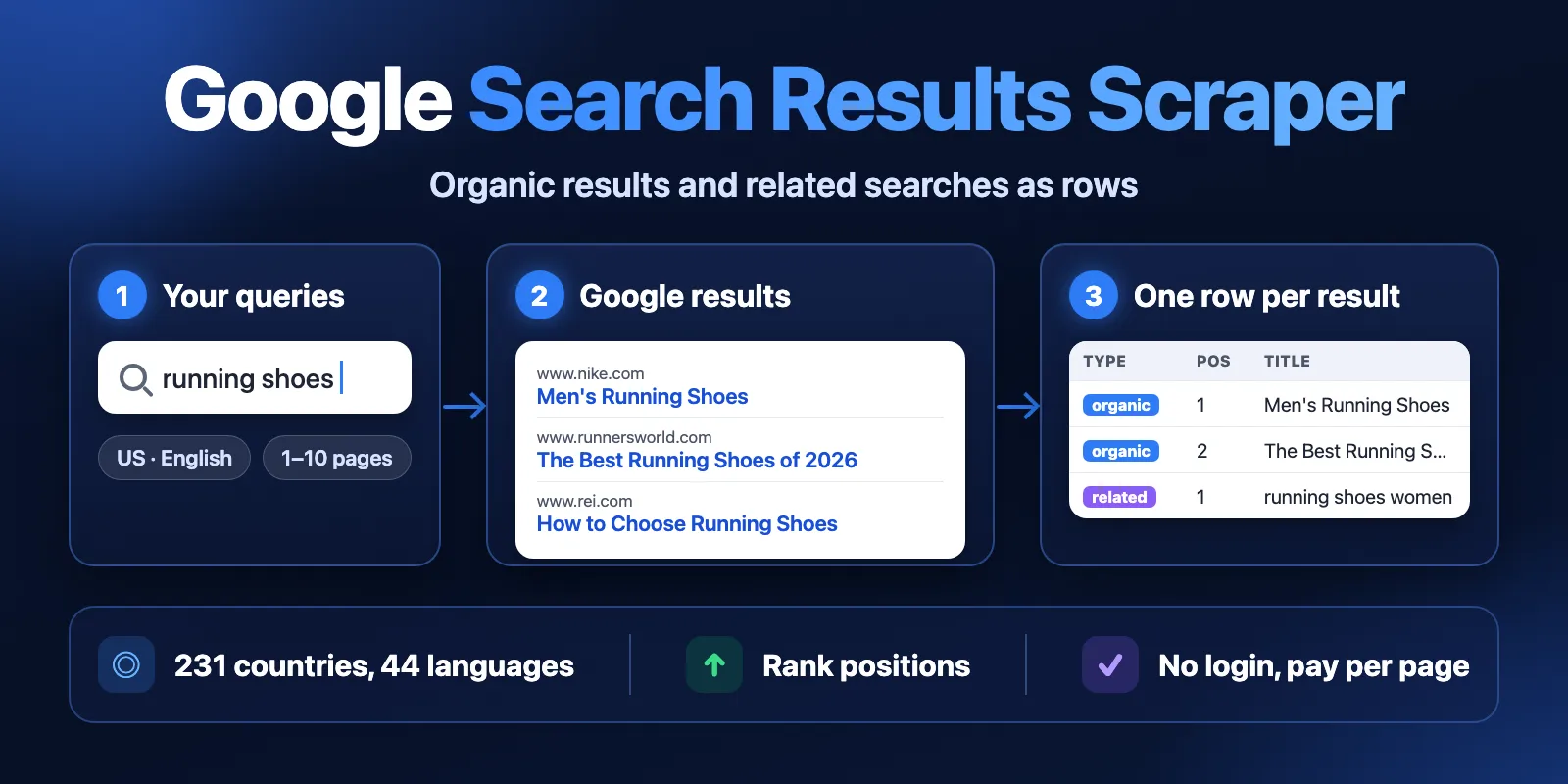
Table of contents
- What it does
- How it works
- Quick start
- Use cases
- Input
- Output
- Pricing
- Limits
- API, export and integrations
- Troubleshooting
- FAQ
- Related Actors
- Support
What it does
The Actor opens the public Google results page for each query, in the country (gl) and language (hl) you choose, and reads up to 10 result pages per query. It saves:
- organic results: position, title, URL, displayed URL, snippet, date and sitelinks (when Google shows them);
- related searches: the "People also search for" list, once per query.
Optional filters work like Google's own search tools: Time range (past hour, day, week, month or year) and Results language (only pages in one language).
Text ads appear rarely (in recent test runs 2–3 ad rows per 1,000 rows); includeAds keeps or drops them. The pages show no shopping prices, so the field price stays in every row for compatibility (always null). Sitelinks (the short links under some results) are saved in the sitelinks list of that result and are not separate rows; the list is empty when Google shows none.
Every row has the query, page number and status, so you can filter and sort in the Dataset, in a spreadsheet or by API.
Good fit
- Track where a site ranks for a list of keywords in one country.
- Collect top 10–100 URLs for a topic for SEO or content research.
- See which shops and brands rank for product queries.
- Find related searches to grow a keyword list.
Not a fit / limits
- The Actor reads Google's HTML results page. Ads are rare. It does not return shopping prices, People Also Ask, AI Overviews, featured snippets, maps or image packs.
- Results are not personalised and not tied to a city. A Google Ads account, Search Console data or search volume are not included.
- Google often answers automated traffic with a CAPTCHA. The Actor never solves CAPTCHAs: a refused page is loaded again through Apify Proxy
GOOGLE_SERP, a proxy made for Google results pages (see How it works).
How it works
- For each query and page, the Actor first asks Google for the simple results page through Apify datacenter proxy (or your proxy). This light route is fast.
- When Google refuses that page twice (CAPTCHA), the Actor loads it through Apify Proxy
GOOGLE_SERP, a proxy made for Google results pages. It takes 10–20 seconds per page. How many pages go this way depends on Google and changes from hour to hour: in recent test runs it was from 2 of 10 pages to every page. - After 3 such pages in a row, the whole run stays on
GOOGLE_SERPand tries the light route again every 25 pages. - If
GOOGLE_SERPfails 3 times in a row too, the run sends no more requests through it: each query it stops gets a freeerrorrow, and later pages go over the light route if Google lets them (when you chose theGOOGLE_SERPgroup, the run stops paid requests). - It saves one row per organic result and related search, plus a run report
RUN_SUMMARYin the key-value store.RUN_SUMMARY.httpshows how many pages went each way (cheapPages,serpProxyPages). The price per page is the same on both routes.
Quick start
-
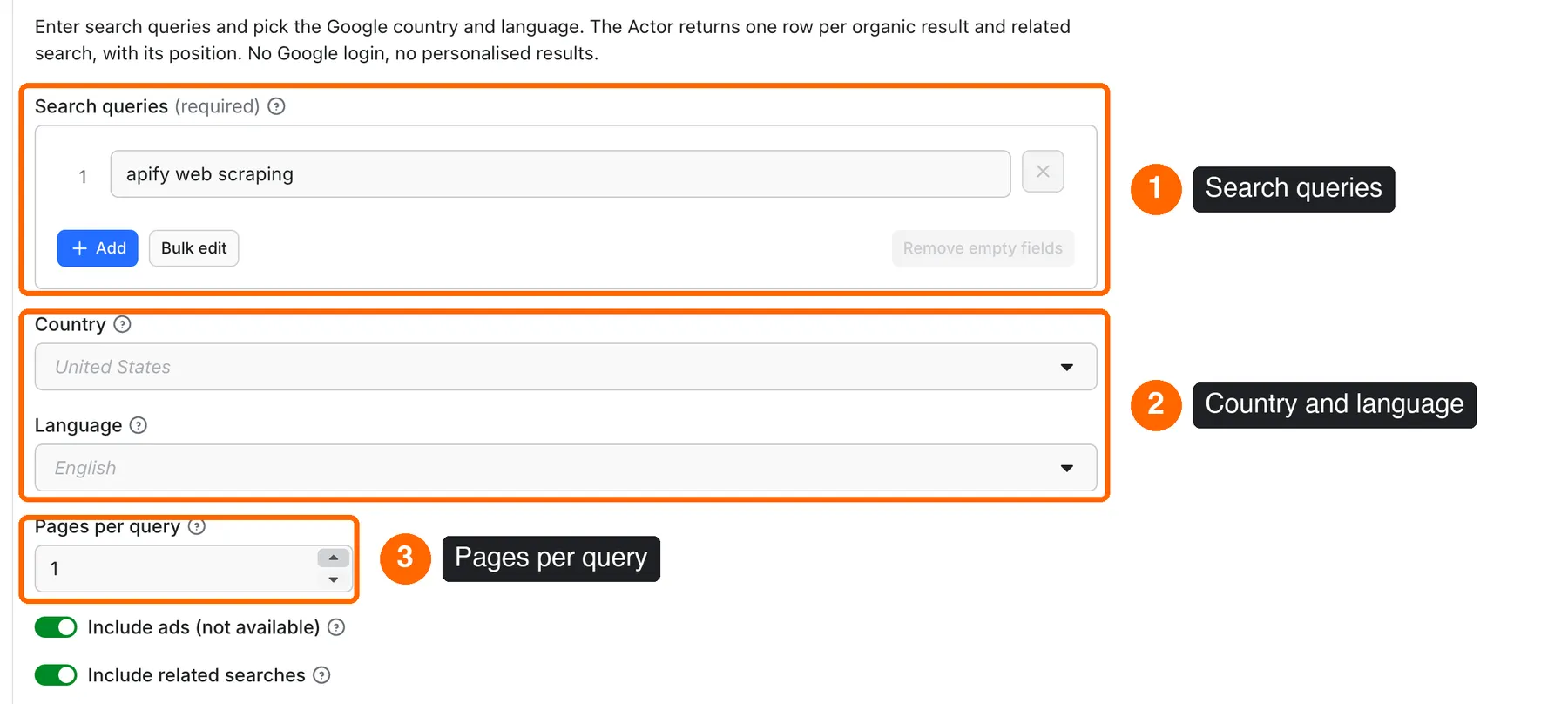
Open the Input tab. In Search queries (
queries), keep the prefilledapify web scrapingor add your own queries, one per line (box 1). -
Keep Country
usand Languageen(defaults), or choose others (box 2). -
Keep Pages per query (
maxPagesPerQuery) at1(prefill), or set up to10(box 3). -
Click Start, then open the Output tab (Dataset) and check the columns
type,position,titleandurl(box 4).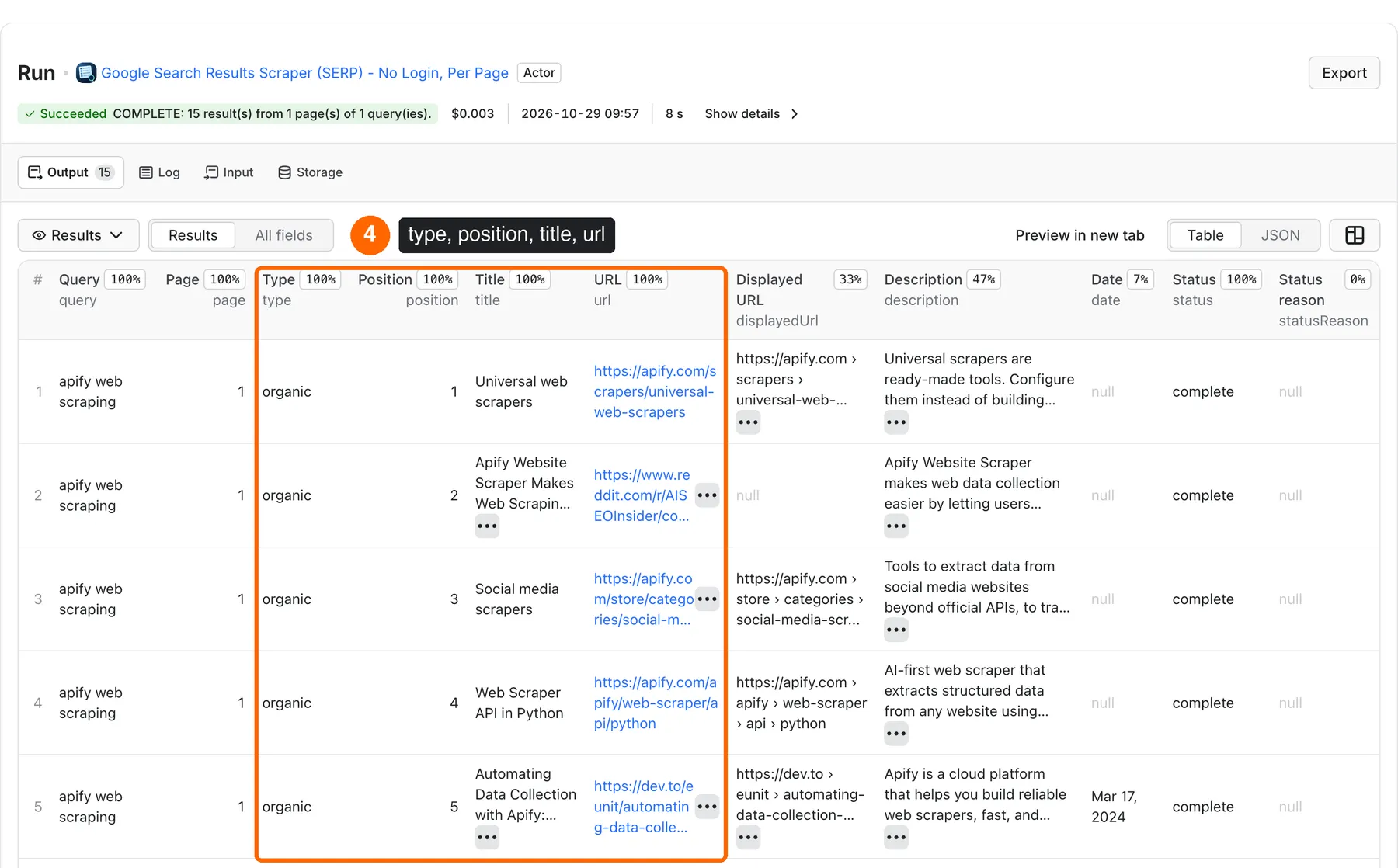
Expected result: usually 7–10 organic rows and about 8 related searches for each query page.
Use cases
| Buyer job | Input path | Output entity | Key fields | Next integration |
|---|---|---|---|---|
| Rank tracking | queries, countryCode, maxPagesPerQuery | organic row | query, position, url, page | Schedule + Google Sheets or API |
| SEO content research | queries, languageCode | organic row | title, description, displayedUrl, date | Export CSV / JSON |
| Shop and brand check | queries, countryCode | organic row | title, url, displayedUrl, description | Export to spreadsheet |
| Keyword ideas | queries, includeRelated | related row | title, url | Feed back into queries |
Input
Input fields
| Field | Plain name | Type | Required | Default / prefill | Allowed values | Effect | Example |
|---|---|---|---|---|---|---|---|
queries | Search queries | array of text | yes | prefill ["apify web scraping"] | 1–500 queries, up to 256 characters each | One Google search per query. Operators like site: and "exact phrase" work. Duplicates and extra spaces are removed. | ["best running shoes", "site:apify.com scraper"] |
countryCode | Country | text | no | default us | Google country codes, e.g. us, gb, de, fr, jp | Country for ranking (gl) | "de" |
languageCode | Language | text | no | default en | Google language codes, e.g. en, de, fr, pt-BR | Interface language (hl) | "de" |
maxPagesPerQuery | Pages per query | integer | no | default 1, prefill 1 | 1–10 | How many result pages per query (usually 7–10 organic results each). Each loaded page is charged. About 500 pages fit in one run; split bigger jobs into several runs. | 3 |
includeAds | Include ads | true/false | no | default true | true, false | Saves text ads as ad rows when Google shows them; this is rare. | false |
includeRelated | Include related searches | true/false | no | default true | true, false | Adds related search rows once per query | false |
timeRange | Time range | text | no | default any | any, hour, day, week, month, year | Only results Google dates within this period, like Google's Tools → Any time menu (tbs=qdr:) | "week" |
searchLanguage | Results language | text | no | empty (any language) | Google results-language codes, e.g. en, de, pt, zh-CN | Only pages written in this language (lr). languageCode changes only Google's interface | "de" |
proxyConfiguration | Proxy | object | no | Apify datacenter proxy | Apify proxy groups or your own URLs | Where requests come from on the light route. A page refused twice there is loaded through Apify Proxy GOOGLE_SERP instead. Choose the GOOGLE_SERP group to send every page there | {"useApifyProxy": true} |
deliveryConnector | Send run summary to | MCP connector | no | empty (no delivery) | a Notion or Slack connector from your Apify account | After the rows are saved, posts a short summary of the run (counts, first rows, links to the Dataset and the run) | pick it in the form |
deliveryTarget | Notion page or Slack channel | text | no | empty | Notion page link or ID, Slack channel ID | Where the summary goes. Required for Notion: the summary is added at the top of that page | "C0123456789" |
An empty queries list stops the run with a clear input error and no page charge.
Row limit. The platform Max items setting (or maxItems in API input) caps the result rows the run saves. The run stops when the limit is reached, ends with status COMPLETE and RUN_SUMMARY.limitReached: "MAX_ITEMS", and charges only the pages it loaded. maxResults, limit and resultsLimit work the same way, and query, searchTerms or keywords are read as queries, so inputs written for other Google Search Actors run as they are. Unknown fields are ignored and listed in RUN_SUMMARY.ignoredInputFields.
Interacting settings
| When | Input A | Input B | Effective behavior | Cost effect |
|---|---|---|---|---|
| Google has fewer pages | maxPagesPerQuery | the query | The Actor stops at the last page Google has | Only loaded pages are charged |
| Ads on or off | includeAds | any query | Off drops the rare ad rows | Fewer rows, same charge |
Own proxy or RESIDENTIAL | proxyConfiguration | countryCode | Your proxy is the light route; refused pages still go through GOOGLE_SERP | Same price per page; own proxy URLs are paid by you |
GOOGLE_SERP group | proxyConfiguration | any query | Every page goes straight through GOOGLE_SERP, 10–20 s per page | Same price per page |
Input examples
Track 3 keywords in Germany, 2 pages each
Expected behavior: 6 result pages, organic rows only.
Expected output: query, page, position, title, url.
Cost note: 6 pages + 1 start = $0.071 on the Free plan.
Output
One Dataset row per result. A query without results gets one not_found row; a query that could not be scraped gets one error row.
Output fields
| Field | Meaning | Type | Can be empty? | Example / enum |
|---|---|---|---|---|
query | Your search query | text | no | "apify web scraping" |
page | Google result page (1 = first) | number | null on status rows | 1 |
type | Row type (ad rows are rare) | text | null on status rows | organic, related, ad |
position | Place among rows of the same type for this query; organic positions continue across pages; a URL that Google repeats on a later page is saved once | number | null on status rows | 1 |
title | Result title or related search text | text | yes | "Apify" |
url | Result URL; for related, a Google search URL | text | yes, when Google hid the link | "https://apify.com/" |
displayedUrl | Site as Google shows it (domain and breadcrumb) | text | yes | "www.apify.com › store" |
description | Snippet text | text | yes | |
date | Date shown before the snippet, as Google prints it | text | yes | "Oct 9, 2026" |
sitelinks | Links shown under a result, as {title, url}; an empty list when Google shows none. They are not separate rows and do not change position | array | no | [{"title": "Python Introduction", "url": "https://www.tutorialspoint.com/python/index.htm#introduction"}] |
price | Always null: the Google pages show no prices | text | always null | |
countryCode, languageCode | Country and language used | text | no | "us", "en" |
searchUrl | Google page that was read | text | no | |
status | complete, not_found or error | text | no | complete |
statusReason, errorCode | Reason for not_found/error rows or a note on a result | text | yes | SOURCE_BLOCKED |
fetchedAt | When the page was read (ISO 8601) | text | no |
null means Google did not show this value. It is not zero and not an error.
Output entities and surfaces
| Situation | Where | Shape | What to do |
|---|---|---|---|
| Normal result | Dataset | one row per result, status: complete | Use type, position, url |
| No results for a query | Dataset | one not_found row | Check the query spelling or operators |
| Some queries failed | Dataset + RUN_SUMMARY | error rows, run status PARTIAL | Run the failed queries again |
| Query stopped after some pages | Dataset + RUN_SUMMARY | rows of the loaded pages, then one error row; query status partial | Run this query again later |
| Run stopped by time or charge limit | RUN_SUMMARY | status CAPPED, rows so far are kept | Raise the limit or split the queries |
RUN_SUMMARY in the Key-value store has the run status (COMPLETE, PARTIAL, NO_RESULTS, CAPPED, ERROR), the stop reason, totals (pages, charged pages, rows, organic, ads, related, errors) and, per query, its status (results, partial, not_found, error, not_processed), pages and organic, ad and related counts.
The Apify run itself shows SUCCEEDED for COMPLETE, PARTIAL, NO_RESULTS and CAPPED. It shows FAILED when no query could be loaded or Google kept refusing; rows already saved stay in the Dataset.
Output example
Trimmed first row of a run for coffee machine (us/en, 1 page):
A page usually returns 7–10 organic rows and about 8 related searches.
Moving from a one-row-per-page format
Some SERP tools save one row per page with nested lists. Here each result is its own row:
| One-row-per-page field | This Actor |
|---|---|
searchQuery.term | query |
searchQuery.page | page |
organicResults[].title / url / displayedUrl / description / date | rows with type: "organic", same field names |
organicResults[].siteLinks | sitelinks (when Google shows them) |
paidResults[], paidProducts[] | rare ad rows (text ads only); no product ads |
relatedQueries[] | rows with type: "related" |
Pricing
Pricing unit
You pay per loaded Google results page (serp-page) plus a small start fee per run. Organic results and related searches on that page are included. Platform usage (proxy, compute) is included in the price.
| Event | Free | Bronze | Silver | Gold+ |
|---|---|---|---|---|
Run start (apify-actor-start) | $0.004 | $0.004 | $0.004 | $0.004 |
Results page (serp-page) | $0.0111 | $0.00999 | $0.00888 | $0.00777 |
- A query with no results costs one page: Google was asked and answered.
errorrows (Google refused the page) are free.- The start fee is charged per GB of run memory (at least one). This Actor always runs with 256 MB, so the start fee is $0.004.
- Why this price: Google often blocks light requests, and then the page goes through Apify's
GOOGLE_SERPproxy, which costs about $0.0025 per page before the Store fee. The price stays the same even when every page needs it. - If you set a maximum charge for the run, the Actor stops before it, keeps the rows and ends with status CAPPED. Queries it did not reach get a free
errorrow withCHARGE_LIMIT, so you can see what is missing.
Cost examples (Free plan)
| Scenario | Input scope | Pages | Charge |
|---|---|---|---|
| Prefill | 1 query, 1 page | 1 | $0.015 |
| Small keyword list | 10 queries, 1 page | 10 | $0.115 |
| Top 100 for 10 keywords | 10 queries, 10 pages | 100 | $1.114 |
| Large batch (one run) | 125 queries, 4 pages | 500 | $5.554 |
| Query without results | 1 query | 1 | $0.015 |
Limits
- Up to 500 queries and 10 pages per query in one input, but about 500 pages fit in one run: up to 3 pages go through
GOOGLE_SERPat a time, 10–20 seconds each. After 3,600 seconds the run stops with status CAPPED and keeps all rows; split bigger lists across runs. - A page on the light route takes about a second; the prefill finishes in under a minute either way.
- Google decides how many pages a query has; some queries end before page 10.
- Max items (or
maxItems) stops the run early with status COMPLETE; pages already loaded are charged, nothing else.
API, export and integrations
- API: start the Actor with the same JSON input and read the Dataset items. See the API tab for ready code.
- Export: download the Dataset as JSON, CSV, Excel or HTML from the Output tab.
- Scheduling: create a Schedule with your keyword list to track rankings every day or week.
Send a summary to Notion or Slack
Pick a Notion or Slack connector in Send run summary to and, for Notion, a page in Notion page or Slack channel. After the rows are saved, the Actor posts the result count, the first rows and links to the Dataset and the run. In Notion each run adds its summary at the top of the same page. Delivery never changes the run status or the charge; its result is in RUN_SUMMARY.delivery. Without a connector nothing is sent.
Use with AI agents (MCP)
- MCP server with only this Actor:
https://mcp.apify.com?tools=cliqtomedia/google-search-scraper - Smallest input:
- Key output fields:
type(organic or related),position,title,url,description. - One query page takes 10–20 seconds and costs about $0.015 with the start fee. Keep
maxPagesPerQuerylow for quick answers.
Troubleshooting
Some queries have error rows with SOURCE_BLOCKED
Symptom: the run is PARTIAL, some queries have one error row.
Likely reason: Google refused the page on the light route and through GOOGLE_SERP too, or GOOGLE_SERP was not reachable.
Check: statusReason and RUN_SUMMARY.
Action: run only the failed queries again later. Error rows are not charged.
Fewer pages than maxPagesPerQuery
Symptom: a query has 3 pages, you asked for 10. Likely reason: Google has no next page for this query. Action: nothing to fix; only loaded pages are charged.
No ad rows
Symptom: includeAds is on, but there are no ad rows.
Likely reason: the results pages the Actor gets from Google rarely carry ads.
Action: use the organic rows; ad rows appear only when Google shows ads on that page. Empty sitelinks on a result means Google showed no sitelinks for it.
Results look different from my browser
Likely reason: your browser shows personalised results for your location and account. The Actor gets anonymous results for the chosen country.
FAQ
Why does url show only the site's home page for some results?
On some pages Google hides the real link behind an encrypted redirect. The Actor opens the redirect to get the real URL. If Google does not reveal it, url is the site's home page, displayedUrl still shows the path, and statusReason says so. Video and forum cards show no address, only a source such as "YouTube · channel": then url is that site's home page (YouTube, Reddit, Medium and other big sites) or empty, and statusReason names the source. Results Google groups under one site with no address of their own get that site's home page.
Do I need a Google account or API key?
No. The Actor reads public results pages without login or cookies of any account.
How many results do I get per page?
Usually 7–10 organic results and 6–10 related searches, depending on the query. A URL that Google repeats on a later page of the same query is saved once.
Is the order the same as on google.com?
position follows the order on the Google results page for the chosen country and language. It can differ a little from your personalised page.
What does null mean?
Google did not show that value, for example no date. It is not zero and not an error.
Related Actors
- Google Autocomplete Scraper: Keyword Suggestions — get keyword ideas to use as
queries. - Google News Scraper - Real Article URLs, No Login — news articles for the same keywords, with real article URLs.
- RAG Web Search: Google Results as Clean Markdown — Google results with the page text as clean Markdown for AI tools.
- DuckDuckGo & Bing Search Scraper - No Login, Real URLs — compare rankings on other search engines.
- Website Metadata & Open Graph Scraper: Meta Tags & Canonical — read titles and descriptions of the result URLs.
- Keyword Search Volume & CPC: Google + Bing via DataForSEO — search volume and CPC for the keywords you track.
- Domain WHOIS (RDAP) & DNS Lookup, No Login — who owns the domains that rank.
- Website Screenshot & PDF Generator: Full Page & Mobile — screenshots of the ranking pages.
Support
For bugs, questions or feature requests, open the Issues tab of this Actor. Add the run ID, your input (queries can be shortened) and the statusReason text. Never send tokens, cookies or passwords.
⭐ Found it useful? Rate this Actor. Something wrong? Report a problem — we fix reported problems.
The run's final status message ends with the same two links.


