

Septic Tank & Drain Field Size Calculator
Pricing
Pay per event
Septic Tank & Drain Field Size Calculator
Septic tank and drain field size for a house, from plain text: the design flow from the bedrooms, the tank, the absorption area from the perc rate or soil laid out as trenches, chambers or a bed, a water table check and how often to pump.
Pricing
Pay per event
Rating
0.0
(0)
Developer

Jumble Mog
Maintained by CommunityActor stats
0
Bookmarked
2
Total users
1
Monthly active users
9 hours ago
Last modified
Categories
Features
Share
Size a home septic system from one line of text. Ask septic system for a 3 bedroom house, perc rate 30 min/in and you get back:
- The design flow from the bedrooms (150 gallons a day each, or your state's figure).
- The septic tank: the International Private Sewage Disposal Code minimum, two days of flow, half again with a garbage disposal, rounded up to a standard tank.
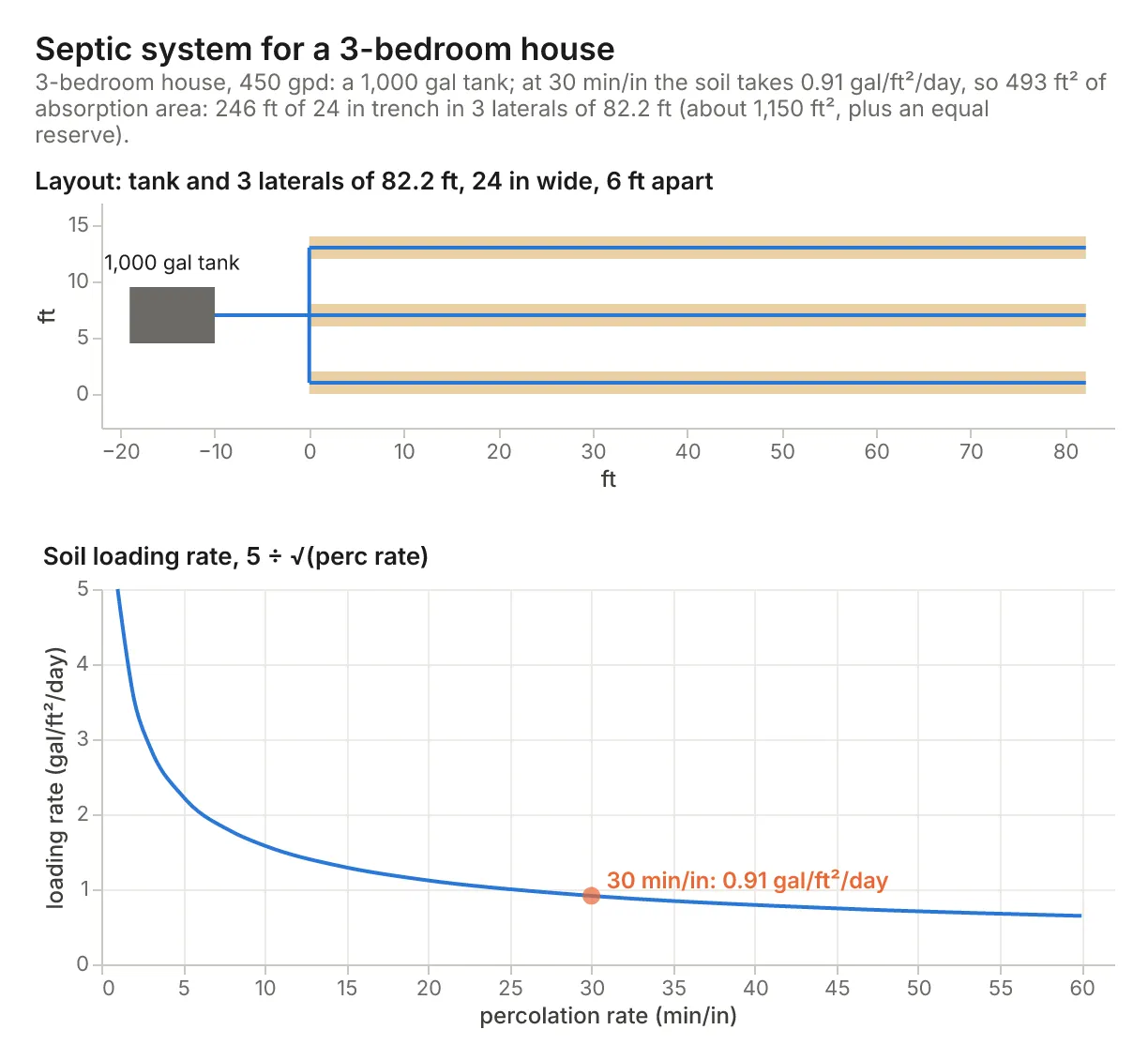
- The drain field: the absorption area from the percolation rate or the soil texture, laid out as gravel trenches, chambers or a bed, with the laterals, their length, the footprint, gravel, pipe and an equal reserve area.
- Checks: soil too fast or too slow for a conventional field, too little separation to the water table or rock, a tank that's too small.
- Pumping: how often the tank needs pumping for the people in the house, and typical setbacks from wells, water and the house.
- Charts (the field layout and the loading-rate curve, or pumping years by household) and a Markdown report.
It's made for:
- Homeowners and buyers planning a build, a repair or a pumping schedule.
- Septic installers, designers, home inspectors and real estate agents.
- AI agents, quoting tools and property apps that need septic numbers they can show their work for.
How to use it
- Write Requests, one per entry. The form has examples.
- Optionally set the gallons a day per bedroom and the field type.
- Click Start. Each request is a row in the results, with its summary, chart and report.
What you can write
| You write | It means |
|---|---|
3 bedroom house, 4 br, 5 people, family of four, 600 gpd | The house and its flow |
120 gpd per bedroom | Your state's flow a bedroom (150 by default) |
perc rate 30 min/in, perc 15 mpi, sandy loam, clay loam | The soil |
trenches (default), chambers, infiltrator, septic bed | The field type |
25% chamber reduction, 18 in trenches, laterals no longer than 80 ft | Field details |
water table at 36 inches, rock at 4 ft | The limiting layer, for the separation check |
garbage disposal | A bigger tank and more frequent pumping |
how often to pump a 1,000 gallon tank with 4 people | Pumping only |
The same as an object: {"bedrooms": 4, "perc": 20, "system": "trench", "trenchWidth": 3, "maxLateral": 80}.
Examples
septic system for a 3 bedroom house, perc rate 30 min/in→ 450 gpd, a 1,000 gal tank, 493 ft² of absorption area: 246 ft of 24 in trench in 3 laterals of 82.2 ft.4 bedroom house on clay loam, garbage disposal, chambers→ a 2,000 gal tank and 890 ft²: 75 chambers in 3 lines of 98.9 ft.septic bed for 2 bedrooms on sand→ a 750 gal tank and a 13.4 × 13.4 ft bed.5 bedroom house, perc 15 mpi, water table at 36 inches, 4 people→ a 1,500 gal tank and 581 ft², with a warning: only 12 in of separation under a 24 in trench.how often to pump a 1,000 gallon septic tank with 4 people→ about every 2 years (a third full in 2.8).3 bedroom house on clay→ too slow for a conventional field: plan a mound, drip or aerobic system.
How-to examples
These are examples from Examples above, written as complete inputs; the result lines are from their runs.
How to size a septic tank and drain field
Result: 450 gpd, a 1,000 gal tank, 493 ft² of absorption area: 246 ft of 24 in trench in 3 laterals of 82.2 ft.
How to size a drain field with chambers
Result: A 2,000 gal tank and 890 ft²: 75 chambers in 3 lines of 98.9 ft.
How to work out how often to pump a septic tank
Result: About every 2 years (a third full in 2.8).
How to let an AI agent size a septic system
Add this Actor to the Apify MCP server with https://mcp.apify.com/?tools=jumblemog/septic-system-calculator. The agent writes the house and soil ("3 bedroom house, perc rate 30 min/in") and passes on the tank size, absorption area and trench layout instead of guessing them.
FAQ
What does it size? Daily flow, the tank, and the absorption area as trenches, chambers or a bed, from bedrooms and a perc rate or soil type.
How much flow per bedroom? 150 gallons a day unless you set perBedroom.
What if my soil is too slow or the water table is high? It flags it and points to a mound, drip or aerobic system, which it doesn't design.
Can I build from these numbers? No. Your health department's rules and a perc test on the lot decide; use these to plan and compare.
How many can I run at once? Up to 200 houses or tanks per run, each as a line of text or an object. A request that can't be computed isn't billed.
Does it work with Zapier, Make or n8n? Yes. Call the Actor with its Apify app or an HTTP request and pass the results on.
Input
| Field | What it is |
|---|---|
requests | Houses or tanks as lines of text or objects (up to 200 per run) |
perBedroom | Gallons a day per bedroom when a request doesn't say (150 by default) |
system | Trenches, chambers or a bed when a request doesn't say (trenches by default) |
charts | Draw a chart for each request (default on) |
Output
One dataset item per request, also saved together in the run's OUTPUT record:
A pumping request has only pumping (with recommendedYears and a byPeople table). Every item has warnings, notes (every assumption and default), a Markdown report and links to the chart and report. A request that can't be computed has "status": "failed" and the reason in error, and isn't billed.
How it works
- Flow: 150 gallons a day per bedroom, the usual code figure; codes size by bedrooms, not people.
- Tank: the IPSDC table (750 gal up to 2 bedrooms, 1,000 for 3, 1,200 for 4, 1,425 for 5, then 225 more a bedroom) or two days of flow if larger, times 1.5 with a garbage disposal, rounded up to a standard size; two compartments.
- Loading rate: the US Public Health Service relation q = 5 ÷ √t gal/ft²/day for a percolation rate of t min/in. Conventional fields need 1 to 60 min/in. Soil textures map to typical perc rates when no test is given.
- Field: trench bottom area = flow ÷ q; a bed needs 1.5 times as much. Trenches 2 ft wide (chambers 3 ft) and 6 ft apart (7 for chambers), laterals up to 100 ft, 24 in deep with 12 in of gravel under the pipe; chambers at 4 ft each, with any reduction your state allows. A reserve area the size of the field.
- Separation: the trench bottom should stay 24-48 in above the water table or rock.
- Pumping: when sludge and scum fill a third of the tank, at about 30 gallons a person a year (30% sooner with a disposal); EPA advises an inspection every 1-3 years.
Pricing
You pay one low price per request, at the price shown on this page, whether it's a design or a pumping question. The charts and report are included. Requests that can't be computed are never charged. If you set a maximum cost per run, the Actor stops before a request that wouldn't fit.
Speed
A request takes milliseconds. A run through the API answers in about 10 seconds, including the cloud container starting.
Tips and limits
- The permit decides: your county or state health department sets the flow, loading rates, field sizes and setbacks, and a perc test or soil evaluation on the lot is what counts. Use these numbers to plan and compare.
- Don't drive or build over the field, and keep roof water away from it.
- Slow soil, high water or shallow rock mean an engineered system (mound, drip or aerobic treatment); this tool flags them but doesn't design them.
- Limits: 200 requests per run; conventional gravity systems for single houses.
For AI agents and developers
This Actor works with the Apify MCP server, so AI agents can call it as a tool. Pass requests as plain text and read summary, tank, field, pumping and warnings. A direct API call that waits for the answer:
run-sync instead returns the run's OUTPUT: the status, the counts and every result as JSON.
In Python, with the apify-client package:
Credits
- Rules: the International Private Sewage Disposal Code tank table (ICC), the US Public Health Service Manual of Septic-Tank Practice loading relation, typical state code trench, bed and setback rules, and EPA septic maintenance guidance.
- Charts: Vega-Lite and vl-convert (BSD-3-Clause), with the Inter font (SIL Open Font License).
