

OpenAPI Catalog & Breaking Change Detector: JSON & YAML
Pricing
from $0.07 / 1,000 endpoint or change rows
OpenAPI Catalog & Breaking Change Detector: JSON & YAML
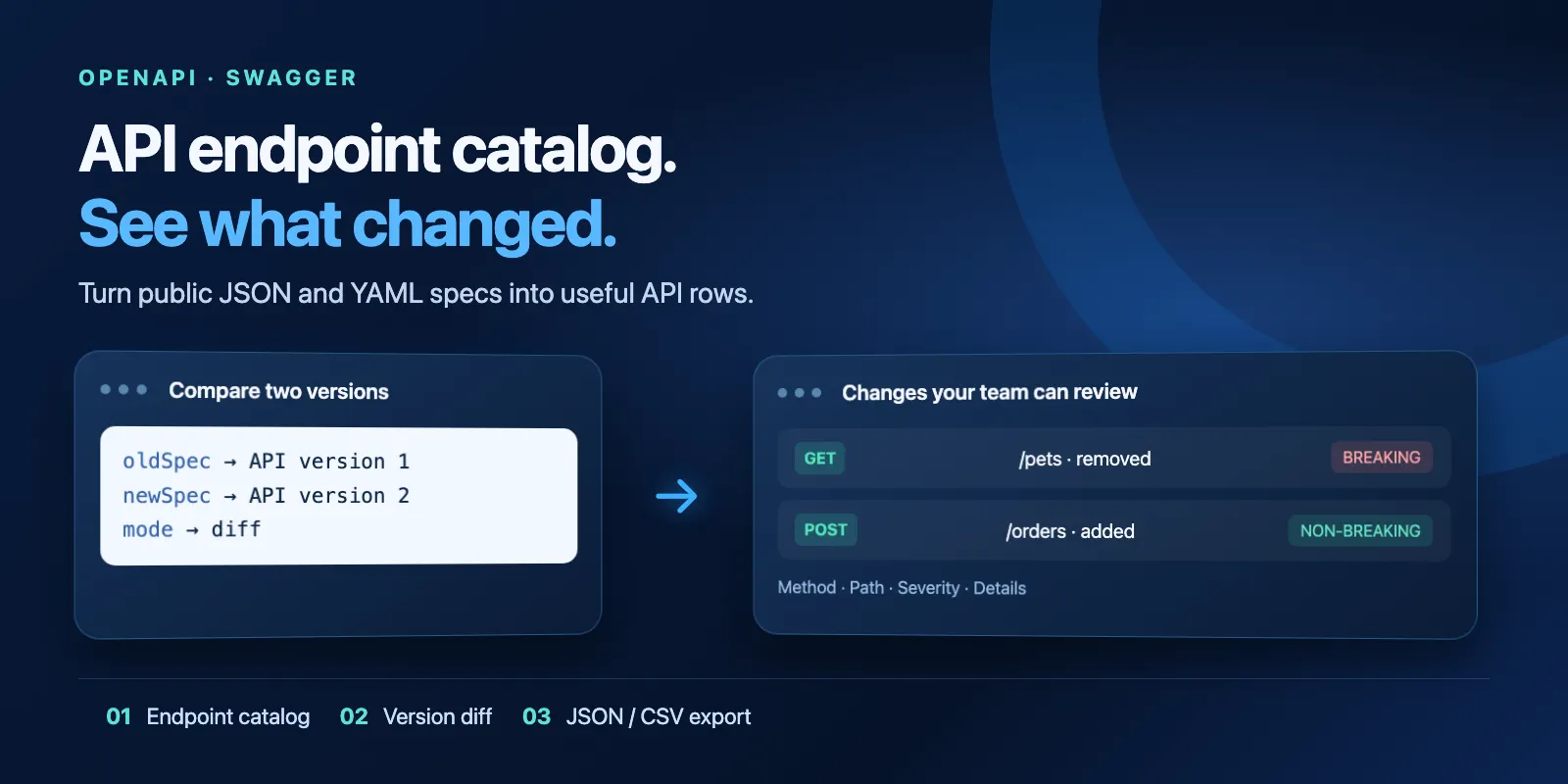
Export endpoint catalogs from OpenAPI 2/3 JSON and YAML, or compare two specs for possible breaking changes. Public URLs and APIs.guru IDs. No keys needed.
Pricing
from $0.07 / 1,000 endpoint or change rows
Rating
0.0
(0)
Developer

Cliqto Media
Maintained by CommunityActor stats
0
Bookmarked
2
Total users
1
Monthly active users
7 days ago
Last modified
Categories
Features
Share
OpenAPI Catalog & Breaking Change Detector
Turn public OpenAPI specs into an endpoint catalog, or compare two versions for possible breaking changes. Use public HTTPS JSON/YAML documents or APIs.guru IDs. No API key is needed to read the demo specs. A small run with 8 rows costs $0.0508 on the FREE tier.
Contents
- What it does
- Data you get
- Quick start
- Inputs
- Input examples
- Output example
- Output fields
- Price
- Use cases
- Repeated checks
- API, exports and integrations
- Use with AI agents (MCP)
- Limits and partial results
- Troubleshooting
- FAQ
- Support
What it does
Catalog: one row per method and path. It reads OpenAPI 2.0, 3.0 and 3.1, as JSON or YAML. It combines path and operation parameters. It shows effective security requirements, including alternatives and scopes.
Diff: compare oldSpec with newSpec. Find removed or added operations, parameters, request media types, responses, schema types, formats, enums, required properties and selected constraints. Changes to security requirements are flagged for review. Composed schemas are checked conservatively, including local references. Request enum narrowing and response enum widening are breaking findings.
The detector is a structural heuristic. It does not prove that clients are safe. It does not test API calls, generate clients, or run the listed endpoints. It never downloads external $ref targets.
Data you get
In catalog mode, use the Endpoint catalog table. In diff mode, use Version changes. JSON exports contain the full row fields. CSV tables show the fields selected in each view. The run also writes RUN_SUMMARY and OUTPUT with status, counters and errors.
APIs.guru provides a public directory. Its CC0 directory policy does not give one licence to every API document. Each row shows the licence stated in the spec, or null. Check the provider's terms before reuse.
Quick start
- Keep
modeascatalog. - Keep the two small public spec URLs in the form.
- Start the Actor with the default 300-second timeout. If you set a maximum charge, keep it above $0.05.
- Open Endpoint catalog. The demo currently returns 8 operations from APIs.guru and NASA APOD.
- Export JSON or CSV. You can then replace the URLs with your public specs.
The form, example input and runtime defaults use the same two public documents. Calling with {} uses these documented defaults. No day-of-week window is used.
Inputs
| Field | Type | Default | Limits and effect |
|---|---|---|---|
mode | string | catalog | catalog or diff. Choose the task. |
specs | string array | two demo URLs below | Catalog only. 1–20 public HTTPS URLs or APIs.guru IDs. Exact duplicate entries are checked once. |
oldSpec | string | absent | Required in diff mode. Old public URL or ID with @version. |
newSpec | string | absent | Required in diff mode. New public URL or ID with @version. |
maxRows | integer | 1000 | 1–1000 rows. Caps saved results. A truncated result reports partial and ROW_LIMIT. This does not reduce all document parsing. |
breakingOnly | boolean | false | Diff only. Export breaking findings only. It does not reduce source downloads. A filter with no matches succeeds with zero rows. |
Each spec entry is at most 2048 characters. URLs must use HTTPS on port 443. Credentials, query strings and URL fragments are rejected. No authenticated or signed URLs. Private, loopback and reserved IPs are blocked, including DNS and redirect targets. A failed spec stops the run.
An APIs.guru ID is a key from its directory, for example apis.guru or nasa.gov:apod. adyen.com:CheckoutService@37 selects a version. Without @version, the preferred directory version is used. A colon in an ID is part of the name. The directory is fetched once per run when an ID is used; URLs avoid that download.
Input examples
Small catalog:
Compare two public versions:
Read a YAML spec:
Output example
An endpoint row from the public NASA APOD spec:
Timestamps reflect the fetch. The URL is the source spec, not an API call. The Actor reads the APOD document without using the APOD API key.
Output fields
| Field | Type / null | Meaning |
|---|---|---|
kind | string | endpoint or change. |
api, version | string | Title and version from info. |
openapiVersion | string; absent in diff | Swagger/OpenAPI version. |
oldVersion | string; absent in catalog | Old API version in diff. |
method, path | string | Uppercase method and operation path, e.g. GET, /apod. |
operationId, summary | string or null; catalog | Declared ID and short summary; null if absent. |
tags | string array; catalog | Operation tags, or []. |
authSchemes | object array; catalog | Effective scheme name and type; no keys or token values. |
securityAlternatives | nested array; catalog | Outer entries are OR alternatives; schemes inside one entry are required together. Each has name and scopes. Empty array means no auth requirement. |
deprecated | boolean; catalog | True only for declared deprecated: true. |
requestContentTypes, responseContentTypes | string arrays; catalog | Request and response media types, or [] if undeclared. |
parameters | object array; catalog | Effective name, in, required, type. type may be null. Path parameters are always required. No examples or defaults. |
responseCodes | string array; catalog | Declared status keys, including default. |
changeType | string; diff | Rule, such as endpoint_removed, parameter_required, type_changed or response_added. |
severity | string; diff | breaking or non-breaking. Conservative flags need review. |
details | string; diff | Brief explanation, without schema values. |
provider | string | OpenAPI document. |
sourceUrl, oldSourceUrl | string | Final public URL; old source exists only in diff. |
sourceUpdatedAt | string or null | Directory update time or HTTP Last-Modified; null if unknown. |
fetchedAt | string | ISO 8601 UTC fetch time. |
licence, licenceUrl | string or null | Stated document licence and link; null if absent. This is not a legal check. |
Metadata text is limited to 500 characters; tag/scope lists to 100 values. Credential-looking text is replaced by [REDACTED]. Raw documents, examples, default values, contacts and server URLs are not exported. Do not put secrets in your input or public specs; input remains subject to Apify storage rules.
RUN_SUMMARY and OUTPUT contain provider, catalogueLicence, status, reason, mode, specsRequested, specsProcessed, rowsSaved, breakingChanges, requests, bytesRead, errors, fetchedAt, limits and partial. OUTPUT also has datasetId and summaryKey. errors contains a stable code and the failing spec input (null when the comparison step failed), not source bodies. breakingChanges is the total before breakingOnly and row filtering. Catalog reports zero for this counter.
Price
A run has an automatic $0.05 start event, including an empty or invalid run. There is no second manual start fee. Each saved endpoint or change has one result-row event. Platform usage is included in the event price.
| Account tier | Per row | Per 1000 rows |
|---|---|---|
| FREE | $0.000100 | $0.100 |
| BRONZE | $0.000090 | $0.090 |
| SILVER | $0.000080 | $0.080 |
| GOLD / PLATINUM / DIAMOND | $0.000070 | $0.070 |
| Saved rows | FREE total, including start |
|---|---|
| 0 | $0.0500 |
| 8 (demo) | $0.0508 |
| 10 | $0.0510 |
| 100 | $0.0600 |
| 1000 | $0.1500 |
Only saved rows count. An unchanged diff or an empty breaking filter pays the start event only. A failed source may leave paid rows from earlier documents. If your charge cap is reached, the Actor saves the summary, reports partial/CHARGE_LIMIT, and succeeds. Use a cap above $0.05 to allow results. Memory is fixed at 256 MB; the start event does not multiply above one GB.
Use cases
- List the operations used by your integration team.
- Review a vendor's API version change before changing clients.
- Build an API inventory with methods, tags, auth types and licences.
- Feed possible breaks into a manual release review.
Repeated checks
This Actor has no saved baseline and creates no schedule or webhook. To check again, provide the old and new spec versions each time. An unchanged document pair gives zero findings. Keep exported results in your own workflow if you need history.
API, exports and integrations
Run through Apify's API, using the JSON input above. Export the Dataset to JSON or CSV, or read the RUN_SUMMARY output link. Catalog and changes are separate Dataset views; choose the view for your mode. An irrelevant view may have blank mode-specific columns.
Use with AI agents (MCP)
Use Apify MCP. Ask it to run {"mode":"catalog","specs":["apis.guru"],"maxRows":20}. Read method, path, operationId, authSchemes and sourceUrl. A seven-row catalog costs $0.0507 on FREE. Small URL runs take seconds; IDs require a directory download. The Actor uses limited permissions and batch runs.
Limits and partial results
- At most 20 catalog inputs, 10000 operations per document, 10000 findings per comparison and 1000 saved rows. Catalog output is capped at 64 KB per row and 10 MB per document; schema comparison at 300000 steps. Large output is a cap, not a promise that every provider has that many operations.
- 5 MB per JSON spec, 1 MB per YAML spec; 12 MB for the APIs.guru index; 30 MB total downloaded bytes per run. Three redirect hops. At most 64 requests including retries.
- Network and body timeout: 15 seconds per request, up to three tries for transient connection errors or 429/5xx responses. A long Retry-After stops the run. Total source work is capped at 180 seconds, even if the platform timeout is longer. A shorter platform timeout shortens work.
- Only internal JSON-pointer
$refreferences are supported. External, file and unresolved references fail explicitly. Circular reference chains fail; recursive schemas are compared within depth and visited-pair limits. - OpenAPI 3.2 is not supported. This is not a full spec or JSON Schema validator. Webhooks, callbacks, server changes, response headers, descriptions and full JSON Schema keyword semantics are outside the diff rules. Dynamic references and complex schema equivalence are not evaluated. Absence of findings does not prove compatibility.
- Changed security requirements and selected schema constraints are conservatively marked breaking. Removing a parameter or response property is also conservative. Read each finding before taking action.
ROW_LIMITorCHARGE_LIMIT:SUCCEEDED, withstatus: partial. The saved rows are usable.- Source, parse, deadline or cancellation failure:
FAILED; summary ispartialwhen earlier rows remain, otherwiseerror.NOT_FOUNDis a source error, not an unchanged API.
No data calls are made to the API described by a spec. Requests fetch the documents and, when needed, the public directory only. This product is not endorsed by APIs.guru, NASA or API providers.
Troubleshooting
| Code / symptom | What to do |
|---|---|
UNSAFE_URL, PRIVATE_ADDRESS | Use a public HTTPS document without credentials, query strings or a private host. |
NOT_FOUND | Check the URL or APIs.guru ID/version. Old versions may no longer exist. |
INVALID_DOCUMENT, INVALID_SPEC | Check JSON/YAML syntax, required info fields and paths. |
EXTERNAL_REF_UNSUPPORTED, INVALID_REF | Bundle your document with local references before running. |
CYCLIC_REF, STRUCTURE_LIMIT, SCHEMA_DEPTH_LIMIT | Simplify deeply nested or cyclic reference chains. |
BYTE_LIMIT, YAML_BYTE_LIMIT, OUTPUT_LIMIT, COMPARISON_LIMIT, OPERATION_LIMIT, CHANGE_LIMIT | Split the job into smaller documents/pairs. |
HTTP_TIMEOUT, DNS_TIMEOUT, SOURCE_UNAVAILABLE | Check source availability. Run again later with a small input. |
ROW_LIMIT | Increase maxRows within the cap or split the catalog. |
CHARGE_LIMIT | Increase your maximum charge if you want more results. |
| Zero diff rows | This can mean no covered changes, or no breaking findings after filtering. Check summary errors and review unsupported rules. |
FAQ
Can I use an API that needs a key? Its public spec can describe key-based auth. The Actor needs no key to read a public document. Authenticated spec downloads are not supported.
Does it call each endpoint? No. It reads the spec only.
Does an added field always break clients? No. Request and response direction matters. The output is a heuristic with conservative rules.
Can I use Swagger 2 or YAML? Yes. The catalog and core diff handle Swagger 2.0, OpenAPI 3.0/3.1, JSON and YAML.
Can I monitor an API automatically? Re-run with an explicit pair of versions in your own workflow. There is no built-in baseline, notification or schedule.
What licence applies? Check licence, the linked terms and the original provider. Unknown licence is null, not a claim that reuse is free.
Support
Open an Issue on this Actor's Apify page. Share the run ID and stable error code. Do not post credentials or confidential documents. We usually reply within two business days.


