

Trending Keywords Scraper — Google Trends Rising Queries
Pricing
from $1.50 / 1,000 breakout keywords
Trending Keywords Scraper — Google Trends Rising Queries
Google Trends breakout keywords: breakout and rising queries with the real growth % behind Google’s Breakout label, by seed keyword, country and category. On request: the 12-month curve (up to 5 per seed) and top queries with current interest. From $1.50 per 1,000 breakout keywords, no start fee.
Pricing
from $1.50 / 1,000 breakout keywords
Rating
0.0
(0)
Developer

Steadyfetch Team
Maintained by CommunityActor stats
0
Bookmarked
2
Total users
1
Monthly active users
4 days ago
Last modified
Share
Trending keywords from Google Trends rising queries — from $1.50 per 1,000 breakout keywords,
with the growth number Google's own UI hides. Seed keywords in, rising and Breakout queries out.
When a query grows more than about +5,000%, Google Trends stops showing a percentage and
prints the word Breakout. The number is still in the payload, and this actor ships it:
nike mind 001+57,450%, not as a label. A seed with no rising data comes back as an honest row
you are not charged for.
See a real run before you spend anything: sample dataset — one run, 11 charged rising queries, one seed with nothing rising left uncharged, the summary row last. Unedited.
Using an AI agent? Pin this actor in Apify's MCP server with one link: https://mcp.apify.com?tools=steadyfetch/breakout-keywords-scraper
- Actor id:
steadyfetch/breakout-keywords-scraper - Input:
{ "searchTerms": ["ai agents"] }— the one field to set. - Cap the bill: set
maxTotalChargeUsdon the run (a run option, not Actor input), e.g.0.50— the run stops when it reaches it.
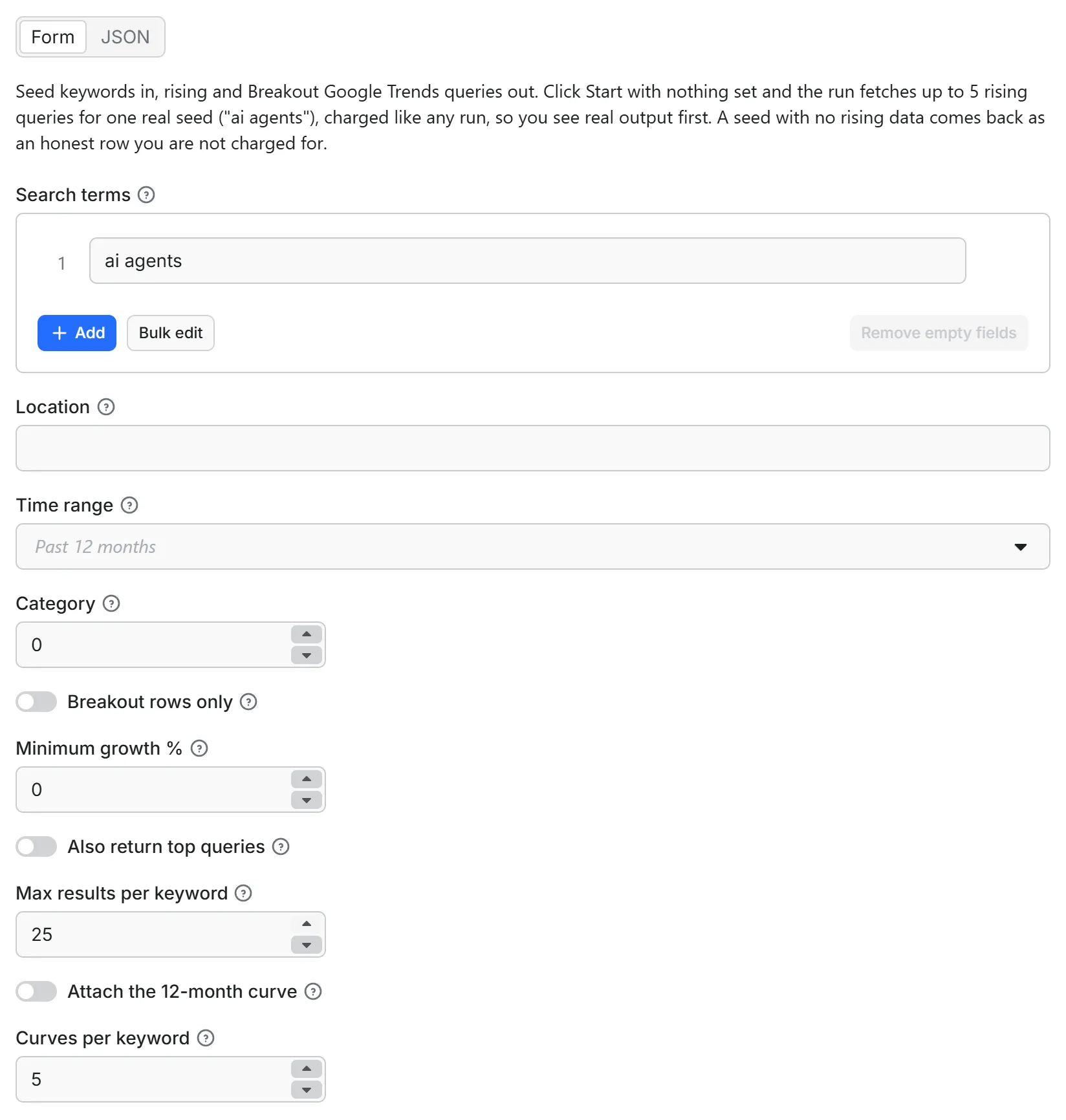
Just want to see it work? Click Start without typing keywords and the run fetches up to 5 rising queries for one real seed (ai agents), charged like any run at your plan's per-row price. Set a region, a time range or any other setting and leave the keywords empty, and that same sample runs under your settings — one uncharged note row names them, and a row limit above the sample's own 5 is a ceiling, not a request. Put your own seeds in searchTerms for your own run.
Unofficial. This actor is not affiliated with, endorsed by, or sponsored by Google. "Google" and "Google Trends" are trademarks of Google LLC, used here only to describe what this tool reads.
From $1.50/1,000 breakout keywords — all-inclusive pay per event, nothing charged for starting a run, charged only on delivery.
Worth a schedule? Rising data is computed by Google against the time range you pick and it
moves daily, so the same seed can return a different rising set tomorrow. Every row carries
fetchedAt, so you always know when a figure was true.
You only pay for keyword rows that are delivered. Every row carries status and charged, so the
invoice reconciles against the dataset itself. Only rows with charged: true were billed.
Output
This is the dataset table of a real run — rising queries for the seed ai agents — exactly as it
appears in the Apify console:
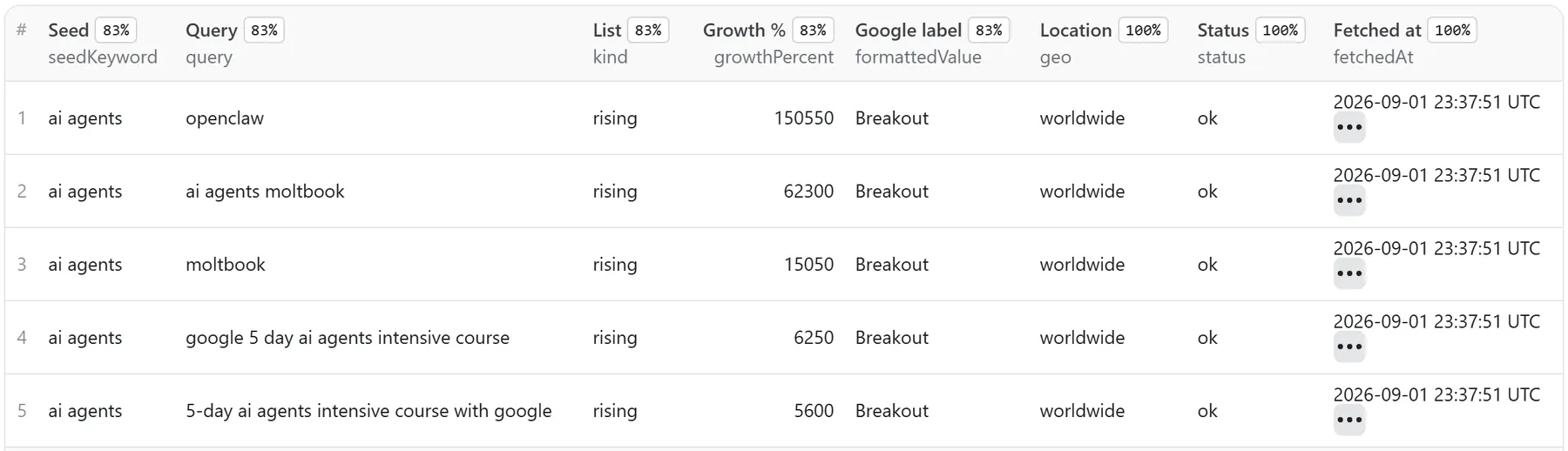
Real output, unedited:
And the row you are not charged for, when a seed has too little search volume for Google to compute a rising list at all:
Browse the full live example dataset →
— one real run of the current code, unedited: 13 rows — 11 charged adidas rising queries with
their growth numbers, one seed that returned nothing and was not charged, and the run's own summary
row last.
isBreakout is Google's own label and nothing else — we never derive it from the number. A query at
+1,500% is a big riser and is still not a Breakout, because Google did not call it one.
| Field | What it is |
|---|---|
seedKeyword | the seed you passed |
query | the rising (or top) query Google returned for it |
kind | rising or top |
rank | position in that list, 1 = strongest |
isBreakout | true only when Google's own label is Breakout |
growthPercent | the growth number — present on every rising row, Breakout rows included |
value / formattedValue | Google's raw pair, exactly as returned |
trendsUrl | the Google Trends page for that query |
timeline | the 12-month curve, when you ask for it |
status / message / charged | the honesty contract, see below |
The dataset schema and Output tab carry the same fields, so status and charged filter cleanly in
the console, the API and any spreadsheet export.
The last row of every run is an uncharged summary row — _summary: true, status: "run_summary",
charged: false — carrying delivered, noticeRows, seedsRequested, seedsDone, seedsLeft,
stoppedBy and chargedEvents. Its chargedEvents["breakout-keyword"] equals the number of rows
above it marked charged: true, so the invoice reconciles from the dataset alone. Export with
clean=true for a spreadsheet-ready CSV, and reconcile from the per-row charged flags immediately,
or from the run's charge counter once it settles (about 12 seconds after the run ends).
Agent / API paste-block
Calling from an agent or MCP client: omit an option you do not want rather than sending null —
the platform rejects an explicit null before the run is even created.
What each seed costs
One event, breakout-keyword, charged once per delivered keyword row — from $1.50/1,000 breakout
keywords on the volume tier, $0.0060 each on the Apify free plan. No start fee, no minimum, no
subscription. Google caps each list at 25 rows per keyword, so a seed that returns a full rising set
is 25 rows; the median across 90 measured keyword × country combinations was 23.
Rows that were not charged, and never will be:
status | What happened |
|---|---|
no_rising_data | Google returned no rising queries for this seed (usually too little search volume) |
no_match | rising queries existed but your filters removed all of them |
upstream_unavailable | Google did not answer for this seed on this run — the row says what was tried, and whether the run waited for the block to clear before giving up |
sample_note | you set settings but no keywords, so the sample ran under them — this row names them, never charged |
run_summary | the last row of every run: the totals above, never charged |
Maximum cost per run is the ceiling. The run stops cleanly against it and tells you how many seeds
were left, rather than being killed mid-way.
Which seeds actually return data
Measured over 90 keyword × country combinations before this actor was built:
| Seed type | Returned a rising set |
|---|---|
commercial head terms (weight loss, crypto) | 10 / 10 |
brands (nike, adidas) | 10 / 10 |
head terms (insurance, mortgage) | 10 / 10 |
news spikes (us open) | 10 / 10 |
mid-tail commercial (skincare, electric vehicles) | 15 / 15 |
seasonal (halloween costumes) | 8 / 10 |
thin niche phrases (mechanical keyboard switches) | 4 / 10 |
whole sentences (best project management software for small teams) | 0 / 10 |
Anything a keyword researcher would realistically type comes back full. Sentences and very thin niches come back empty — and an empty seed is never charged. Use the head term instead.
Country matters: the same seed returns different rising queries in the US, GB, IN and DE. So does
category — ai agents under Computers & Electronics returns a different top rising query than
under all categories.
Chaining: from a breakout keyword to the ads already running on it
The natural next question after "what is breaking out?" is "who is already advertising on it, and what do their ads say?" Look the breakout query up in an ad library, then hand the advertiser domain or the ad links to the matching actor below and get the words those ads actually use.
There is a ready-made n8n workflow template for this actor — see Free templates below.
Freshness and failures
Rising data is computed by Google against the time range you pick, and it moves daily — the same
seed can return a different rising set tomorrow. Rows carry fetchedAt so you always know when a
figure was true.
This actor may fail when the platform changes things — failed items are never charged.
FAQ
How do I find breakout keywords on Google Trends?
Pass your seed keywords in searchTerms. Each seed returns Google's rising related queries, and the
ones Google labels Breakout carry isBreakout: true plus the real growth percentage.
What does "Breakout" mean in Google Trends?
Google prints Breakout instead of a percentage when a query's growth is above roughly +5,000%.
It is a display cut-off, not a separate metric — this actor gives you the underlying number.
Can I get rising keywords for a specific country?
Yes, set geo to a country code (US, GB, DE) or a sub-region (US-CA). Leave it empty for
worldwide.
Can I filter to only the fastest-growing queries?
Set breakoutOnly: true for Google-labelled Breakouts, or minGrowthPercent for a numeric floor.
Filtered-out rows are never charged.
What happens if I set a filter but no keywords?
The sample runs under your settings: your region, time range, category and filters are kept, everything
you did not set takes the sample's own value, and a row limit above the sample's own 5 is treated as a
ceiling. One uncharged sample_note row names the settings that were kept. Only an input field name this
actor does not recognise, or a searchTerms list you filled with blanks, gets a guidance row instead.
Why did my keyword return no rising data?
Google needs enough search volume to compute a rising list. Whole sentences and very thin niche
phrases usually return nothing at all — you get an uncharged no_rising_data row instead of an
empty run.
Does it return related topics as well as queries?
No — this actor is built around rising and Breakout queries only. Related topics are a
different surface, and its sibling
Google Trends Scraper — Google Trends Data, Interest Over Time delivers
them: add relatedTopics to that actor's surfaces for the top and rising topic entities with
their knowledge-graph ids.
Can I use this through an MCP server? Yes. It is a standard Apify actor, so any MCP client that can call Apify actors can call it.
Why does a run cost more than the keyword rows?
Apify bills platform usage (compute and proxy) for what a run actually consumes, separately from
these events. Maximum cost per run is the ceiling that covers both.
Steadyfetch trends & keyword suite
One actor per surface, one job each, the same contract everywhere: all-inclusive pay per event, nothing charged for starting a run, charged only on delivery — so a workflow built for one of them ports to the next. Keyword volume is the one exception: a run that buys fresh volume data adds one fresh-lookup fee of $0.19; runs answered from the 30-day cache pay none.
| What you want | Actor |
|---|---|
| Interest over time, related queries, regions, compare | Google Trends Scraper — Google Trends Data, Interest Over Time |
| What is trending right now, by country | Google Trends Trending Now Scraper — Live Trending Searches |
| Rising and Breakout queries, with the real growth number | this actor |
| Autocomplete suggestions across 5 engines | Google Autocomplete Scraper — Google Suggest, 5 Keyword Engines |
| Monthly search volume and CPC for a keyword list | Keyword Search Volume Scraper — Google Ads Keyword Planner, CPC |
| What is trending on social platforms | TikTok Trends Scraper — X, Pinterest, YouTube & Google Trends |
The rest of the steadyfetch shelf — same contract everywhere: all-inclusive pay per event, nothing charged for starting a run, charged only on delivery (three actors add a small delivery-conditional fee: keyword volume's fresh lookup, profile posts' profile lookup, Google Jobs' search fee — each README states it).
| Family | Actors |
|---|---|
| Ad creative intelligence | Facebook · Google Ads video · TikTok · LinkedIn · Google Ads text & OCR |
| Trends & keywords | Google Trends · Trends Now · Breakout keywords · Autocomplete keywords · Keyword volume & CPC · Social trends |
| YouTube transcripts | YouTube videos · YouTube channels |
| Reel transcripts · Profile posts | |
| Jobs | Indeed · Career sites by domain · Glassdoor · Multi-board · Google Jobs |
| Amazon | Products · Search · Bestsellers · Sellers |
| Any media file | Speech to Text · any link or file |
Free templates
Free n8n workflow templates for this actor are listed on our profile website (link on our Apify profile).
Feedback & support
Found an issue? Open it on the Issues tab — we usually reply within a couple of hours, always within a day.
If it earned its keep, a rating helps other buyers find it, and saving the actor keeps it one click away.


